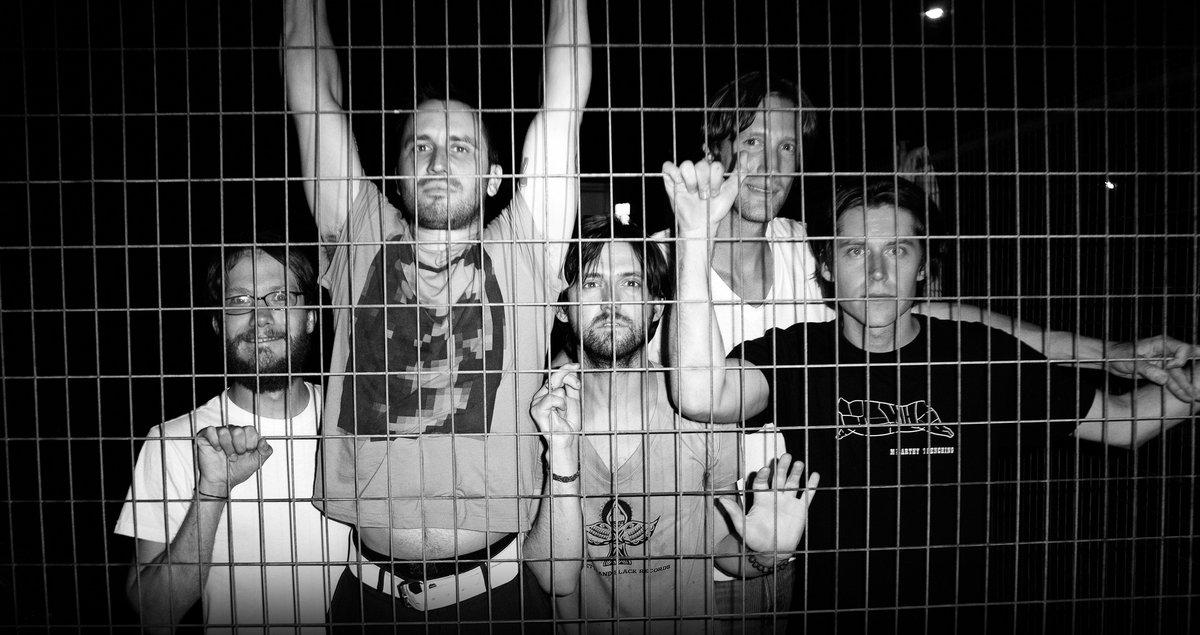
Desaparecidos is a 5-piece rock band fronted by Bright Eyes singer/songwriter Conor Oberst (vocals, guitar) and featuring Denver Dalley (guitar), Landon Hedges (bass, vocals), Ian McElroy (keyboards), and Matt Baum (drums). Matt and Ian are familiar to many of you from the various incarnations of Bright Eyes‘ touring band of which they played in.
Conor Oberst may be better known for his confessional song writing and storytelling, but Desaparecidos is nothing of the sort. Indeed, similar vocal melodies and song structure are present, but the guitars are loud and distorted, the bass is pounding, and the drums and keyboards round out this hi-energy, pop-rock band without the lyrical focus of personal relationships. Oberst screams out observational commentary about urban development, the sacrifice of human value for the dollar bill, and the new American Dream.
2022 finds us releasing the 20th Anniversary Edition of Desaparecidos’ “Read Music/Speak Spanish” into a world in which the dread and disenfranchisement detailed throughout the album feel as pertinent today as they did then. The characters and settings may have changed, but the startling narrative has not.
In late 2001, Conor Oberst, Denver Dalley, Landon Hedges, Ian McElroy, and Matt Baum spent a week at Presto! Recording Studio in Lincoln, NE recording a punk album. That debut album, released in the post-9/11 fog of early 2002, screamed out observational commentary on urban development, the sacrifice of human value for the dollar bill, and the new American Dream in a way that felt distinctly out of sync with the hyper-patriotic atmosphere of peak G.W. Bush-era America.
The band toured, got a bit of attention, and then went their separate ways for a long spell. In the ensuing years, Read Music/Speak Spanish gained cult status and became one of the most beloved and meaningful documents of the era, capturing the alienation that those who had seen through the fog of war for $$$$ experienced at the time.
20 years on, those feelings are just as, if not more, relevant than they were in that moment. America has mutated into a new confused version of itself, in many ways unimaginable two decades ago. Yet, the fear and disgust voiced on Read Music/Speak Spanish now sound more prophetic than paranoid, making the album’s message as necessary as ever.
Setting out to capture the rawness of the band, the record was recorded over one week at Presto! Recording Studio in Lincoln with producer Mike Mogis. Bright Eyes fans will love it, but it’ll also appeal to anyone who’s ever dug At The Drive In, The Pixies, Weezer, Dinosaur Jr., etc.
This album was originally released February 11th, 2002
Bright Eyes have announced a new box set, collecting six of their records from the 2000s. It’s aptly titled The Studio Albums 2000-2011, and it’s out on vinyl and CD on September 16th via Saddle Creek. The Studio Albums includes 2000’s Fevers and Mirrors, 2002’s Lifted, or, The Story Is in the Soil, Keep Your Ear to the Ground, 2005’s I’m Wide Awake, It’s Morning and Digital Ash in a Digital Urn, 2007’s Cassadaga, and their most recent LP The People’s Key (2011). All of the albums have been remastered by engineer Bob Ludwig (at Gateway Mastering).
Formed in 1995, Bright Eyes have released nine studio albums (with another one on its way later this month) and each of their records explore different sonic territories—folk, emo, country, pop, indie rock. It’s a tough and almost unfair challenge to rank their albums, much less their songs, but it’s a task worth exploring.
Still, with every album, the distinguishing factors remain: frontman Conor Oberst’s shaky, despondent vocals, and his existential, often story-like lyricism. At the heart of every song is some kind of revelation, whether it’s about love, lust, pain, or existence. In Cassadaga, this happens in a magical setting with cowboy vibes and no laws; whereas Digital Ash in a Digital Urn exists within a morbid electro-pop atmosphere, like a realm of cyberspace.
Down in the Weeds, Where the World Once Was arrives August. 21st via Dead Oceans. The record travels through water and fire, life and death, sickness and health. It’s hard to place what territory Bright Eyes have not touched; and if there’s any space left over, they will be sure to explore it at some point.
The vinyl edition of the box set includes 10 coloured LPs, 12 8×10 photo prints by Butch Hogan, and an essay by Nathaniel Krenkel (who founded Team Love Records with Conor Oberst). Each record is “housed in a foil stamped linen-wrapped box.” In addition, each disc in the 6xCD edition is “housed in a foil stamped linen coated board slip case.” See the vinyl box set below.
The new remastered records will be available individually in November via Saddle Creek. Fevers and Mirrors and Lifted are out November 4th. I’m Wide Awake, Digital Ash, and Cassadaga are out November 11th.
Bright Eyes – The Studio Albums 2000 – 2011 Bright Eyes is largely the brainchild of Nebraskan song writer Conor Oberst and his long time collaborator/producer/multi instrument playing friend Mike Mogis. Cataloguing all of the bands studio works, this box set features some of, in our opinion, the most underrated albums of their time. This long awaited box set catalogues Conor Oberst’s song writing at its peak, beautifully put together on stunning coloured LPs with some lovely extras. It really hits the old cliché of being ‘a must for any fan’ which we hear far too much in press releases from labels trying to promote box sets like this, but it really is worth it!
“Lover I Don’t Have to Love” Reckoning with toxic impulses, addiction, love, and pain, this track is the most intense Bright Eyes song. It moves slowly, and Oberst’s vocals are close to whispers, but his words are raw and sharp: “I want a lover I don’t have to love / I want a girl who’s too sad to give a fuck.” There’s a powerful tension between darkness and love, and this storyline is specific but universal. Towards the end, Oberst proclaims: “But life’s no story book / Love’s an excuse to get hurt,” and it’s just one of his many despondent observations that make Bright Eyes so evocative and special.
“You Will. You? Will. You? Will. You? Will.” This beautiful acoustic track follows two lovers who consider each other to be “the re-occuring kind.” Oberst compares their love to a storybook, and reflects on the beginning: “We were just kids when I first kissed you / In the attic of my parents’ house / And I wish we were there now.” It’s a messy type of love, but Oberst paints it as romantic and meant-to-be, playing with ideas of destiny and fate. His voice is confident and enthused by the end, and the instruments are booming like an excited orchestra at a wedding.
‘Fevers and Mirrors’ and ‘Lifted…’ are two great examples of how to make beautifully crafted songs with darker subject matter like failed suicide attempts, and drug abuse. Both, are to some extent, reminiscent of the writing style of Leonard Cohen, and Nick Cave, these songs aren’t afraid to lay out Oberst’s misery, or unafraid to be called depressing by some, because if songs are as good as these early works, they can’t be depressing at all!. Bright Eyes, but make it rock ‘n’ roll.
This Fevers and Mirrors track best demonstrates the vague Victorian aura this album plays with. It samples the unsettling melody and some lyrics from the 1964 Fiddler on the Roof song of the same name, and Oberst’s haunting voice adds to the darkness. He sings of the cyclical nature of life, describing it as a trap we can’t escape without death.
The heartbreak ballad is best listened to during a breakup. Oberst wallows in self-pity to the fullest extent, showing it off like he’s proud. His voice trembles in the typical Oberst fashion, but at times it sounds as if he’s about to burst into sobs. He even breaks out in a yell, lamenting the betrayal of the one he loved the most: “You said you hate my suffering / And you understood / And you’d take care of me / You’d always be there / Well where are you now?” Even though he’s clearly being dramatic, it’s impossible to not sympathize with him and want to cry yourself.
The Calendar Hung Itself…This obsessive love song is an iconic emo anthem. Every line reads like a Tumblr poem about a toxic relationship between young lovers: “Does he lay awake listening to your breath / Worried that you smoke too many cigarettes?” Oberst is full-on playing a character, and he’s tangled up in something he knows will end up hurting him. It’s the second track on Fevers and Mirrors, and it sets up the scene for the self-pity and panic attacks to come.
The guitars on the song from 2011’s The People’s Key are almost generic, Charming harmonies and a keyboard are layered throughout the song, and an extravagant culmination of the two closes it out. Still, the best part is the beginning, with Oberst singing, “I loved a triple spiral / My maiden-mother-crone,” with a fun rhythm buoying the song along.
The band’s real mainstream breakthrough came with the 2005 release of two albums on the same day, ‘Digital Ash InA Digital Urn’ a slightly more experimental album with touches of Obersts early oddities, and what is seen by many as the bands high point ‘I’m Wide Awake, It’s Morning’. An album that fits in with some of the best modern Americana, with a real love of country and is almost a more career driven album, itching to fulfil the critics who referred to Oberst as a modern day Dylan.
Cassadaga carries on prefectly from where ‘I’m Wide Awake…’ with country inspired tracks at the start of the album, such as the single ‘Four Winds’, but flows through bits of everything the band had done before. The track ‘No One Would Riot For Less’ feels like an end of the world, anti war piece that wouldn’t be out of place at the end of the ‘1984’ film, that no one else could’ve written. Recounting a story about emotional affairs, religion and redemption, this extravagant song sounds at first as if it’s from Neutral Milk Hotel’s In The Aeroplane Over the Sea. Oberst is taking on the perspective of a wife whose husband cheated on her with a mistress, and she’s a vivid, complicated character: “Her bed beneath a crucifix / On guests performing miracles / With the Son of God just hanging like a common criminal.” But nothing in the song compares to Oberst passionately singing the unforgettable line: “Oh, I’ve made love, yeah, I’ve been fucked, so what?”
The heartwarming ballad “First Day of My Life” is Bright Eyes’ biggest hit, though it’s a bit misleading. Oberst is rarely this optimistic, but it explains why he’s so crushed when a relationship ends. His love is deep and committed, and his voice is tender as he recalls the blossoming of it all, quoting what his lover said to him: “This is the first day of my life / I’m glad I didn’t die before I met you.” It’s the tamest, most content part of I’m Wide Awake, It’s Morning—free of any sense of darkness, war or ache.
“When The President Talks To God” This political, country-folk song caught the audience of The Tonight Show with Jay Leno off guard. Bright Eyes were promoting the double release of “I’m Wide Awake, It’s Morning” and Digital Ash in a Digital Urn, and instead of performing songs from either of those albums, they used their platform to protest the presidency of George W. Bush. The song is confrontational enough to give you chills: “When the President talks to God, / Are the conversations brief or long? / Does he ask to to rape our women’s rights?” It gave context as to why Oberst is often cast as one of the most depressed voices of our generation—he’s haunted by the state of the world as much as he is by his own life.
“Middleman” is this evocative western track is an eccentric travelling song. Cassadaga itself resides in a weird world—one representing the town in Volusia County, Fla., known for its psychics, mediums and overall spiritual energy. “Middleman” creates this mystical aura best with careful strumming, poignant violin and what sounds like a bongo drum. Oberst is a mysterious narrator offering vague warnings: “Because I never know when it’s time to go / It’s too crowded now inside / The dead can hide beneath the ground / And the birds can always fly.”
“Land Locked Blues” This song is lyrically perfect down to every line, which is impressive for a nearly six-minute journey. Oberst harmonizes with Emmylou Harris again, and they reckon with a love that must end, wars that won’t stop and the urge to be free. These themes intertwine and interact with each other, most noticeably in this powerful image: “We made love on the living room floor / With the noise in the background from a televised war / And in the deafening pleasure I thought I heard someone say / If we walk away, they’ll walk away.”
“We Are Nowhere And It’s Now” Opening with the lines “If you hate the taste of wine / Why do you drink it ’til you’re blind?,” this song is full of personal, depressing accusations. In the same verse, Oberst asks: “Why are you scared to dream of God / When it’s salvation that you want?” Everything is colossal, though the guitar is tame, and Oberst and legendary country singer Emmylou Harris sing slowly and carefully.
The band’s final album, ‘The Peoples Key’, feels in some ways like a fitting end to the collection in this box, for the most part its a band that is still at its high point, but in moments like the stunning ‘The Ladder Song’ you feel like you’re right back with a ‘Fevers and Mirrors’ Conor. The beauty of all of these albums is how well Mogis can blend the ever changing collection of collaborating musicians that make up Bright Eyes with the bewitching vocals and lyrics from Oberst.
Conor Oberst with First Aid Kit and Taylor Goldsmith of Dawes performs a Bright Eyes song “Lau” recorded at the Haldern Festival in August for Cardinal Sessions,
CONOR OBERST set is available to stream through http://www.npr.org from this last weekends Newport Folk Festival, Oberst backed by the alt,country,rock band DAWES. with some tracks taken from the recently released album “Upside Down Mountain” and some from his back catalouge its an awesome set of songs




 The Fat Angel Sings