Posts Tagged ‘Bill Berry’

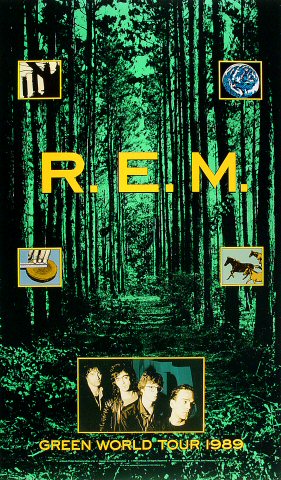
R.E.M. Poster

On January 26th, 1989, R.E.M. kicked off the Green World Tour at MZA Stadium in Tokyo, Japan. Unsurprisingly, the set list skewed heavily toward the band’s latest album, 1988’s Green: The Athens, Georgia, band opened the show with “Pop Song 89,” and performed eight of the album’s 11 tracks overall omitting only “The Wrong Child,” “Hairshirt” and “Orange Crush.”
The rest of the setlist leaned heavily on 1986’s Lifes Rich Pageant (“I Believe,” “Begin The Begin,” “Cuyahoga,” “Just a Touch”) and 1987’s Document (“Finest Worksong,” “Exhuming McCarthy,” “Welcome To The Occupation,” “Disturbance At The Heron House”), with a scattering of older tunes—notably, 1984’s “Pretty Persuasion”—thrown in for good measure.

As the Green tour progressed and traveled to New Zealand, Australia, the U.S., U.K. and Europe throughout 1989, the shows followed a similar template, with tunes from 1982’s Chronic Town EP (“Wolves, Lower,” “1,000,000”) being particularly welcome chestnuts. There were other surprises scattered throughout, of course. Vocalist Michael Stipe occasionally prefaced “World Leader Pretend” with some lines from Gang of Four‘s “We Live As We Dream Alone,” while prior to “I Believe,” he recited lyrics from Syd Straw’s “Future 40’s (String Of Pearls)” or the band’s own rarity “Tired Of Singing Trouble.”
In fact, covers were a staple of the tour: Hugo Largo’s “Harpers,” Velvet Underground’s “After Hours,” George Gershwin’s “Summertime,” Television’s “See No Evil” and Syd Barrett’s “Dark Globe” rotated in and out of the setlist. So did the Golden Palominos’ “Boy (Go),” on which Stipe contributed lead vocals. Perhaps the most well-known re-do, however—likely because it ended up on the band’s 1989 fan club holiday singlewas a rip-roaring take on Mission of Burma’s “Academy Fight Song.”

Image result for R.e.m the green world tourR.E.M. Green World Tour ORG 1989 Concert Program STIPE

The Green tour marked many firsts for the band. For example, the trek featured auxiliary musician Peter Holsapple (late of the dB’s) adding guitar and keyboards, marking the first time R.E.M. expanded beyond a four-piece onstage. Although the band played a mix of U.S. auditoriums, college venues and arenas on 1987’s Work Tour, it stuck to the latter for Green tour, and played larger spaces overseas as well. This was partly due to popularity—Green was the band’s first major label album, recorded for Warner Bros.—and partly out of necessity.
The tour featured the group’s first forays into major video productions on stage, and these took the form of song-appropriate clips (e.g., trees and nature for “Fall On Me”), emphasis projections (words such as “HELLO” and “GOVERNMENT” flashing during “Pop Song 89″) and deliberately detached “participation” banter moments. According to the R.E.M. Timeline, at a March 1, 1989, show in Louisville, Stipe read these three rules aloud: “No. 1: Don’t stand on your seat as you may fall. No. 2 Don’t hurtle missiles or throw things. No 3. Don’t rush the stage as Peter doesn’t like that.”

https://www.youtube.com/watch?v=hlxnkQ5d8vw

Their first show of several in the year 1989 The Green Tour (Audio Only with photo accompaniment) At this point Green had just hit Gold (over 500,000 copies sold) two months after release, and it would go on to sell over 5 million copies as of 2015. Audio isnt great Quality 5/10 (the audio comes in through the right channel only during Get Up)

Not a spectactular show, and certainly lacking the spectacle of some of their later performances on the Green tour, but it’s still a decent concert. Also, only (mostly) complete R.E.M. show in Japan .

REM live Pop Song 89 Tourfilm 1989

Stage-wise, Stipe did some of the shimmies he exhibited during the videos for “Pop Song 89″ and “Stand” during those songs, and sported a white suit, which drew comparisons to the boxier, large suit David Byrne sported during Talking Heads‘ Stop Making Sense. The attire was camera-ready: In 1990, R.E.M. released the Green tour-focused concert film “Tourfilm” which was filmed over five shows near the end of the tour—and the black-and-white footage of the performances was striking.


On November 13th, 1989—the day after the Green tour officially concluded  R.E.M. performed all of Green and 1983’s Murmur albums back to back, during a benefit show at the Fox Theatre in Atlanta. It would be the last time to catch R.E.M. for a while: The Green tour was the group’s last major, extended batch of concerts until 1995’s Monster tour. R.E.M. had spent much of the ’80s on the road, and the band needed an extended break. “We were physically, mentally, spiritually, emotionally spent,” Stipe told the Los Angeles Times in 1994. “I thought I would never tour again. The idea to stop touring wasn’t any strategy. It was survival.”

R.E.M. playing live at The Omni in Atlanta, GA on April 1st, 1989.

https://www.youtube.com/watch?v=uJPxKYKhkrs

REM_Reckoning.jpg

As R.E.M. looked to record the follow-up to ‘Murmur,’ the bar set for their second album, ‘Reckoning,’ was already exceedingly high.On this day in 1984, R.E.M. released their second album, ‘Reckoning,’ featuring the singles “So. Central Rain (I’m Sorry)” and “(Don’t Go Back To) Rockville” . Produced by Don Dixon and Mitch Easter

For R.E.M., 1983 had been a momentous year. Though the Athens, Georgia, quartet had already achieved healthy sales for their independently released debut single, “Radio Free Europe,” and their IRS debut, 1982’s “Chronic Town” mini-LP, their full-length debut, “Murmur”, had exceeded expectations, selling over 200,000 copies

Instead of labelling the sides of the record as “side one” and “side two”, the sides were designated as “L” and “R”.
For the cover of Reckoning, Michael Stipe drew a picture of a two-headed snake, which he then gave to artist Howard Finster to fill in as a painting.

Reckoning is the second studio album by the American band R.E.M., released in 1984 by I.R.S. Records.  The album was recorded at Reflection Sound Studio in Charlotte, North Carolina over 16 days in December 1983 and January 1984.

R.E.M. rejoined their tried and tested production team at the studios, early in December 1983. Retrospective anecdotes from those involved have since claimed that the sessions lasted for anything from 10 days to three weeks (with the band taking a break for the Christmas period) straddling December 1983 and January ’84, yet what can be relayed with certainty is that all concerned wanted to record quickly and capture a record more representative of R.E.M.’s effervescent live sound. Dixon and Easter intended to capture the sound of R.E.M.’s live performances, and used binaural recording on several tracks. Singer Michael Stipe dealt with darker subject matter in his lyrics, and water imagery is a recurring theme on the record. Released to critical acclaim,

Separated by two weeks of canceled studio time that allowed the band to play a show in Greensboro, North Carolina, go out to see a movie, and shoot a video in the studio. While the studio diary listed 16 days for recording, the album sleeve later claimed the album was recorded in 14 days, while in interviews Buck at times commented that the album was recorded in 11 days. The producers both disputed that the sessions were that short; Dixon insisted that they were at the studio for at least 25 days (during which he worked eighteen-hour days), while Easter said “When I read ‘eleven days’ I thought, what the fuck! It was twenty days, which was still short, but it’s not eleven.”

Few singers can stuff as much complexity into a simple, one-word chorus as Michael Stipe. “I’m sorry” is a bit of a rote sentiment for a pop-rock ballad, but Stipe sells it here, yelping like a wounded dog in the space between verses. He famously refused to lip-sync for the song’s music video, which goes to show how seriously he took the lyrics and the elusive story behind them. Impressive as the vocal performance may be, it’s the other members of R.E.M. who make “So. Central Rain” such a crucial entry in the band’s discography. Peter Buck kicks things off with a riff that may as well double as the manifesto for jangle rock, and the rhythm section shines in a thundering post-chorus that borrows from the playbooks of Television and Joy Division while asserting R.E.M. as a forced to be reckoned with in their own right.

“Reckoning” also yielded two stone-cold classic singles courtesy of “(Don’t Go Back To) Rockville” and “So. Central Rain (I’m Sorry).” Though it had been played live as far back as October 1980, the former was given an extensive studio makeover and eventually emerged as a country-roots anthem featuring honky-tonk piano and emotive vocal interplay between Stipe and Mills. Also Southern gothic-flavored, the glorious, melancholic sweep of “So. Central Rain…” was again accentuated by piano and a lush Stipe vocal, and it arguably remains “Reckoning’s” artistic pinnacle.

This time around, as Don Dixon put it, the group “wanted to rock out a bit more,” and Easter and Dixon were keen to accentuate the fiery, jangly spirit inherent in Buck’s guitar and Berry’s crisp, punchy drumming. To help realize this, Dixon utilized the “binaural” recording technique wherein two microphones were raised off the ground, roughly at the height of the average person’s ears, thus creating a recording that replicates how people actually hear sound. This method ensured that “Reckoning” sounded notably snappier than “Murmur”, not least on the album’s energetic rockers such as “Harborcoat,” the bright’n’breezy “Second Guessing” and the atypically anthemic “Pretty Persuasion,”

During the recordings there was pressure from I.R.S. Records to try to make the album more commercial. The label sent messages to Dixon and Easter, which the producers told the band that they would ignore. While the producers respected I.R.S. president Jay Boberg, they expressed dismay at the comments he made when he visited during the last day of sessions. Dixon called Boberg “record company clueless”, while Easter said “I got along with Jay Boberg OK […] but now and again he would express an opinion that would make me think, ‘holy shit’, because it would strike me as really teenage.” Buck said he was grateful that Dixon and Easter acted as a buffer between the band and its label. He said that “it got to the point where as much as I respected the guys at I.R.S., we basically tried to record the records so they wouldn’t know we were recording them!”, and explained that part of the reason why R.E.M. recorded the album so quickly was that the group wanted to finish before representatives from I.R.S. showed up to listen to it.

Musicotherapia: R.E.M. - Reckoning (1984)

https://www.youtube.com/watch?v=E1lioyEbVCs

The recording sessions were difficult for singer Michael Stipe, who, among the band, was particularly worn out by the group’s 1983 tour schedule. Getting usable vocal tracks from Stipe was difficult; Dixon recalled that he and Stipe would show up around noon each day before the rest of the band, but that “he was kind of shut down, and it was difficult to get him to open up”. While recording the song “7 Chinese Brothers”, Stipe sang so quietly that Dixon could not hear him on the tape. Frustrated, the producer climbed a ladder to a spot above the recording booth Stipe was in and found a gospel record titled The Joy of Knowing Jesus by the Revelaires, which he then handed to the singer in an attempt to inspire him. Stipe began reciting the liner notes from the album audibly, which enabled Dixon to move on to recording the vocal track to “7 Chinese Brothers” properly  (the initial recitation take was later released in 1987 as “Voice of Harold” on the later compilation Dead Letter Office.

For R.E.M., the frenetic touring of 1983 continued unabated after the release of “Reckoning”. The band’s second tour of duty in small-scale UK and European clubs was already underway when “Reckoning” was released, and, during the summer and early autumn of ’84, their Little America tour of the US saw them stepping up to larger auditoriums such as LA’s Hollywood Palladium and San Francisco’s Warfield Theatre, in California, and to New York’s Beacon Theatre on the East Coast.

Stipe and company continued to chalk up further successes before 1984 wound down, with their awards for Best Group and Best Album (for “Reckoning”) at New York’s CMJ New Music Awards ceremony in October gratefully accepted in their absence by Mitch Easter and I.R.S. personnel while the band were performing their highly anticipated debut tour of Japan. A further round of European shows – with R.E.M. again conquering cavernous indoor halls such as London’s Lyceum and Dublin’s SFX Theatre – then steeled the group for the British studio sessions which would result in their groundbreaking third album, 1985’s “Fables Of The Reconstruction”.

R.E.M.-Chronic-Town

On this day (August. 10th) in 1982: Athens, Georgia alternative rock band R.E.M. released the ‘Chronic Town’ EP, the first result of their signing with IRS Records the previous May; the tracks had been recorded with producer Mitch Easter back in October, 1981 when the group was considering setting up their own label; the disc provided the first extended illustration of R.E.M.’s signature musical style – jangling guitars, chords played in arpeggio, murmured vocals & obscure lyrics – & introduced such early, lo-fi classics as “Gardening At Night” & “Carnival of Sorts (Box Cars)”.

I.R.S. released Chronic Town in August 1982 as its first American release. Reaction to the EP varied; one I.R.S. radio promoter said that many of his contacts at universities radio didn’t know what to make of the record, but added, “The Georgia stations and some of the more together college stations across the country jumped on it.” The band filmed its first video for “Wolves, Lower” to promote the record. The EP sold 20,000 copies in its first year.

“Chronic Town” is five songs that spring to life full of immediacy and action and healthy impatience. Songs that won’t be denied.” NME praised the songs’ auras of mystery, and concluded, “R.E.M. ring true, and it’s great to hear something as unforced and cunning as this.

The debut 5 track EP from R.E.M. titled ‘Chronic Town’ was the beginning of a long love affair for many of us with the boys from Athens, GA. The original vinyl EP R.E.M. labeled the A side (tracks 1–3) as the “Chronic Town” side and the B side (tracks 4 and 5) as the “Poster Torn” side.


All songs written by Bill Berry, Peter Buck, Mike Mills and Michael Stipe.

Side one – “Chronic Town”
  1. “Wolves, Lower” – 4:10
  2. Gardening at Night – 3:29
  3. “Carnival of Sorts (Box Cars)” – 3:54
Side two – “Poster Torn”
  1. “1,000,000” – 3:06
  2. “Stumble” – 5:40

remoutoftime

On this day in 1991, R.E.M. released its seventh album, ‘Out of Time,’ featuring the singles “Losing My Religion,” “Shiny Happy People,” “Near Wild Heaven” and “Radio Song”

“Out of Time” was the seventh studio album by the American alternative rock band R.E.M., released on Warner Bros. Records in 1991. R.E.M.’s status grew from that of a cult band to a massive international act. The record topped the album sales charts in both the U.S. and the UK, spending 109 weeks on American album charts and enjoying two separate spells at the summit, and 183 weeks on the British charts, and spending a single week at the top. The album has sold over four and a half million copies in the US and over 18 million copies worldwide. The album won three Grammy Awards in 1992: one as Best Alternative Music Album, and two for the first single, Losing My Religion.”

https://www.youtube.com/watch?v=if-UzXIQ5vw

Recorded between September to October 1990 at,Bearsville Studios, Woodstock,New York, United States; John Keane Studios, Athens, Georgia, United States (recording); Soundscape Studios, Atlanta, Georgia, United States (strings);Prince’s Paisley Park Studios,Chanhassen, Minnesota, United States (mixing), produced by Scott Litt and R.E.M.

https://www.youtube.com/watch?v=iCQ0vDAbF7s

“Out of Time” combines elements of pop, folk and classical music  as heard on their previous album “Green, with a new concentration on country elements that would continue on 1992’s “Automatic for the People“.

Preceded by the release ofLosing My Religion“, which became R.E.M.’s biggest U.S. hit, Out of Time gave them their first U.S. and UK #1 album. The band did not tour to support the release. In Germany, it is the band’s best-selling album, selling more than 1,250,000 copies, it was also the first R.E.M. album to have an alternative expanded release on compact disc, including expanded liner notes and postcards. Check out this different demo for the song ” Near Wild Heaven

The third single from 1991’s Out Of Time chronicles a relationship at loose ends: “Whenever we hold each other, we hold each other/ There’s a feeling that’s gone/ Something has gone wrong.” Despite the gloomy outlook, “Near Wild Heaven” sounds surprisingly upbeat. (Consider it the musical equivalent of winter’s chilly sunshine.) Chiming guitars, daybreak piano and lead vocals from Mike Mills provide graceful levity, while the chorus boasts Beach Boys-caliber harmonies dotted with longing falsetto and gorgeous counter-melodies. “Near Wild Heaven” both exemplifies Out Of Time’s plush instrumental palette and illuminates R.E.M.’s inventive perspective.

The supporting tour for Green had exhausted R.E.M., and they spent nearly a year recuperating before reconvening for the recording session for Out of Time. Where previous R.E.M. records captured a stripped-down, live sound, Out of Time was lush with sonic detail, featuring string sections, keyboards, mandolins, and cameos from everyone from rapper KRS-One to the B-52’sKate Pierson. The scope of R.E.M.‘s ambitions is impressive, and the record sounds impeccable, its sunny array of pop and folk songs as refreshing as Michael Stipe‘s decision to abandon explicitly political lyrics for the personal. Several R.E.M. classics — including Mike Mills Byrds-y Near Wild Heaven,” the haunting “Country Feedback,” and the masterpiece “Losing My Religion” — are present, but the album is more notable for its production than its songwriting.

In the hands of many bands, “Half a World Away” — a song about the persistent ache of distance, in both the romantic and traveling sense — would sound far too busy. R.E.M.’s lush arrangements, however, have the perfect balance of texture and velocity. “Half a World Away” is dominated by harpsichord and mandolin, which are braided together to create an ornate melodic foundation, and Michael Stipe’s conspiratorial vocal tone. Swaying organ provides oceanic swells underneath. And, near the end of the song, proud strings jump into the fray to underscore the music’s sweet melancholy.

R.E.M – ” Walk Unafraid “

Posted: December 20, 2014 in MUSIC
Tags: , , ,

with First Aid Kit covering this REM song thought we should look at the originators and this quite powerful song. taken from their eleventh album release “Up” by the American alternative rock band R.E.M. It was the band’s first album without original drummer Bill Berry, who left the group amicably in October 1997 to pursue his own interests. In his place, R.E.M. used session drummers and drum machines.

remadventures

The 10th album from REM titled “Adventures In Hi-Fi released this day in 1996 featuring the singles “E-Bow the letter” with added backing vocals from Patti Smith, “Bittersweet Me”, “How The West Was Won” and “Where it Got Us” and “Electrolite” all the singles released had multiple added live songs or worthy outtakes and some great covers.The album was recorded after coming off the road in support of the previous album “Monster” with a lot of the recording process with tracks being recorded live on the road resulting in several songs being about travel and motion. It was also drummer Bill Berry’s last album with the band and the last of the Scott Litt produced, considered to be among their better latter day albums it also featured one of their best songs “Leave”.

rem reckoning

R.E.M’s “Reckoning” was the second album from the alternative rock band released this day in 1984, 30 years ago on IRS Records label, The five albums REM issued on IRS were among the best music ever of the 80’s. Produced by Mitch Easter and Don Dixon and recorded over a sixteen day period the pair who had also produced their debut “Murmur” stepped in after some 22 songs had been recorded with Elliot Mazer who had worked with Neil Young but Peter Buck wanted a more live and crisper sound.
The Intro into “Pretty Persuasion” even now is still magical, With its jangly, arpeggiated chords and driving rhythm section, “Pretty Persuasion” doesn’t seem out of place on 1984’s Reckoning, even though R.E.M. allegedly penned the song years earlier. There’s a clear power-pop influence here, and Peter Buck’s sparkly intro riff sets the tone for a darker, more ominous version of The Records’ “Starry Eyes” (released a year before R.E.M. formed, in 1979). Michael Stipe almost sounds like a punk singer as he rails against the “hurry and buy” impulse of consumerism, his anger intermingling with the jangly melody to create something odd and inexplicably captivating.

Other stand out tracks “Harbourcoat”, “South Central Rain (I’m Sorry)” are still as fresh as ever.
Micheal Stipe was exhausted after the 1983 tour and the sessions were difficult for him ,his vocal evolved after some of the mumbling on “Murmer” although Mitch Easter had to coerce Stipe to sing the songs in a more pronounced manner. The songs have a darker edge lyrically with Water a recurring theme. Peter Buck had wanted the album to be a double with some of the songs that had been played in the live set since 1980.

https://www.youtube.com/watch?v=ZD2R7G3z6WU

rem murmur

Released this day in 1983, Murmur was a seminal album, the debut from this alternative rock band from Athens,Georgia. featured the singles “Radio Free Europe” and “Talk About The Passion” produced by Don Dixon and Mitch Easter for IRS records It received Critical acclaim. Once in awhile an album comes along that changes perception and times. REM re-introduced the straight four piece guitar fronted band, Peter Bucks jangly chiming guitar sound and Micheal Mills melodic bass lines along with the indistinct obscure Vocals from Micheal Stipe. Rolling Stone Magazine voted MURMUR as the best album of 1983