Albumism_ToriAmos_BoysForPele_MainImage_16x9.jpg

Happy 25th Anniversary to Tori Amos’ third studio album “Boys for Pele”, originally released in the UK January 22nd, 1996 and in the US January 23rd, 1996. I was lucky enough to see Tori Amos at Birmingham Town Hall

After seeing her performance it compelled me to relinquish my previously held aversion and embrace Amos’ music? Well, as I spent more time with her first three albums, I had a few epiphanies about their creator, revelations that would have been unthinkable for me a few years prior. First, Amos’ virtuoso piano playing is incredible and rivalled by only a select few. Second, she is one of the most iconoclastic, inventive and fearless songwriters I’ve ever heard, with lyrics that demand my (and your) rapt attention. And third, her songs are ripe with her own brave confessions and more broadly universal insights about the complexities of women’s psyches, hearts and souls. The latter proving valuable information for a young male listener like myself, who, at the time, was still trying to figure out what makes young women tick. In other words, I recognized that I could learn a helluva lot from Tori Amos.

When I first heard “Caught a Lite Sneeze” in the early days of 1996, I was all ears. And I loved what I heard. A few weeks after my discovery, Upon listening to the album a few times that day, I promptly returned to the store the following day and added Little Earthquakes and Under the Pink to my CD collection. And a new Tori Amos convert was born.

Of the albums that comprised Amos’ early career trilogy, the unorthodoxly crafted Boys for Pele still resonates the loudest for me. Recorded in a church in rural County Wicklow, Ireland, with additional sessions in a New Orleans studio, Boys for Pele is the first of her albums produced primarily by Amos herself. Though her signature stripped-down piano arrangements are still present, her third LP is noticeably more experimental, with multi-layered instrumentation, including several harpsichord-blessed compositions. “The thing I wanted from this album was freedom,” Amos confided to Irish music magazine Hot Press shortly after the album’s release. “I wanted to do things musically that I hadn’t done before.” Her ambition paid off, as the 18-track Boys for Pele proved a more sonically expansive song suite than its precursors, offering testament to Amos’ musical vision and versatility.

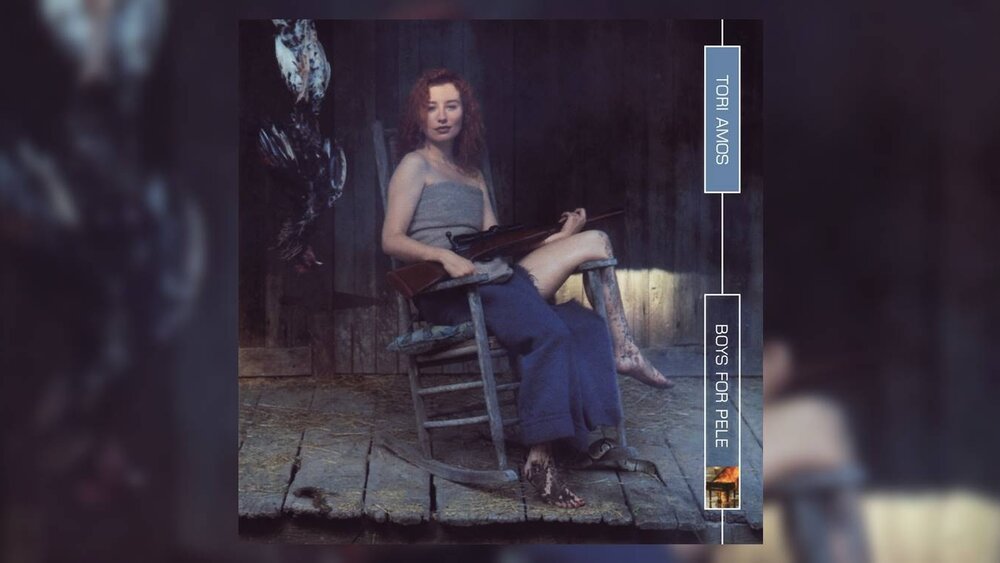
Even before pressing play on the disc for the first time, the most cursory of glances at the arresting album artwork signaled that Boys for Pele was a considerably more volatile record than her previous two efforts. The portrait of strength and sensuality, an emboldened Amos casts her piercing gaze toward the listener from a wooden rocking chair, naked and muddied leg draped over one of the chair’s arms, rifle resting across her lap, with a snake coiled by her foot and a dead rooster hanging behind her. A far cry from the innocuous Little Earthquakes cover, which shows Amos knelt inside a box with a miniature blue piano at her feet.

While some have interpreted the striking visual as a nod to “Me and a Gun”—her poignant account of her first-hand experience with rape that features on Little Earthquakes—the imagery more broadly signifies her state of mind throughout the recording process. Recorded in the wake of the dissolution of her romance with producer Eric Rosse, who co-produced her first two albums, the introspective Boys for Pele finds Amos looking deep within herself, casting her emotional demons aside, and ultimately reclaiming ownership of her identity. “This is about finding my fire,” she said to the Baltimore Sun. “This is about standing on my own.” She later explained that “As I wrote the songs for Boys for Pele, I started valuing myself through my own eyes, instead of valuing me through the eyes of others, like the press or a lover or whatever.” So while the album’s creation was an emotionally demanding one for Amos, it ultimately proved a therapeutic exercise for her.

The album’s title was inspired by her trip to Hawaii, during which she learned about the legend of Pele, the Goddess of Fire and Volcanoes. According to Hawaiian mythology, the powerful Pele was prone to raging fits of fury, and known to exact her vengeance by sacrificially tossing young boys into her volcanic flames. Though the theme of Amos—and women, in general— finding and seizing her inner fire pervades the album, the only direct reference to Pele appears in “Muhammad My Friend,” by way of the line “You’ve never seen fire until you’ve seen Pele blow.”

More broadly, and expanding upon the thematic foundations of Little Earthquakes and Under the Pink, Boys for Pele is predicated upon Amos’ deconstruction of patriarchal hegemony and masculinity, specifically within relationships and religion, and her assertion of female will in the face of interpersonal and institutionalized repression. At the risk of understatement, it’s an intense and empowering record. A complex collection of songs that demands the listener’s undivided attention and patience to decipher Amos’ metaphor-heavy lyrics and less intuitive, leftfield symbolism. But it’s also one of Amos’ most rewarding efforts across her prolific discography.

Ubiquitous throughout the 70-minute affair are the ghosts of Amos’ dissolved relationship, which naturally segue into her exploration of the broader conflict between the feminine and the masculine. Surfacing just two tracks in and arguably the album’s heaviest song, “Blood Roses” explores the darker side of love and the exploitation of women in its various physical, psychological and emotional forms. On the percussive, harpsichord-drenched first single “Caught a Lite Sneeze,” Amos reflects that she “didn’t know our love was so small,” an obvious reference to the demise of her doomed relationship.

“Hey Jupiter” and “Doughnut Song” are both tender piano ballads, the former detailing the heartache of a love lost, the latter acknowledging the emptiness of a relationship and the fact that her lover has moved on. Appearing toward the end of the record, “In the Springtime of His Voodoo” and “Putting the Damage On” find Amos struggling to reconcile her profound feelings of loss and lingering affection for her former paramour.

The spiritual counterpart to “God” from Under the Pink, “Muhammad My Friend” challenges organized religion’s marginalization of women by turning the traditional male-dominated conception of God on its head, as Amos declares “It’s time to tell the world / We both know it was a girl / Back in Bethlehem.” A fictional tale of a woman caught between two worlds, “Little Amsterdam” takes on the American South’s centuries-old legacy of patriarchal domination perpetuated by racist whites.

A handful of standout songs diverge a bit from the album’s dominant themes, but they’re no less provocative. Falsely interpreted by some as an endorsement of the satanic or a veiled ode to Amos’ minister father, the lilting, lullaby-like “Father Lucifer” is actually about liberating one’s suppressed desires and embracing whatever your preferred vices may be, however taboo.

“Now, when I say Lucifer, I’m talking about the feelings that we hide from ourselves,” Amos explained during a 1996 radio interview . “Not something that’s twisted and evil, like during the Inquisition when they used Christianity to torture people. That’s Satanism. I had to go in this record when I was trying to find parts of myself that I had not let scream and dance and have a tear. I went to go visit Lucifer to get my talisman, which means my little magic key that took me to the places that I hadn’t let myself go. That’s really about having a little tango, a little dance, with Lucifer. The idea that Dark is not a scary thing if you go in there understanding there is a purity in Darkness.”

Though much of the world is more familiar with the propulsive, dancefloor-filling Armand Van Helden remix of “Professional Widow,” its original incarnation featured here is noteworthy for its much-debated allusions to none other than Courtney Love. According to widespread rumours the validity of which have yet to be proven, mind you Love played a not-so-insignificant part in the fracturing of Amos’ friendship with Trent Reznor. Believe what you will.

When Amos initially brought the finished album, admittedly devoid of any obvious radio-friendly hits beyond “Caught a Lite Sneeze,” to the executives at Atlantic Records, they were skeptical of its commercial potential. From their perspective, Boys for Pele represented a curveball of a record, relative to the more conventional and marketable Little Earthquakes and Under the Pink. But the album was certified platinum for surpassing one million in sales by August of 1996, an achievement that, as Amos chatted at a show in Boulder, CO later that year, “record companies, radio had fuck-all to do with.”

Sales figures and eggs on record execs’ faces aside, Boys for Pele is unequivocally the work of a brave, vital artist who has taken thrilling risks throughout her storied, nearly 30-plus-year solo recording career, in the spirit of preserving her creative freedom and adventurous approach to songcraft. Amos’ recorded repertoire is vast, comprised of 15 studio albums, a plethora of B-sides (some of which are among her strongest compositions), and a slew of official and bootlegged live recordings. And Boys for Pele is arguably the most powerful musical statement she has ever made.
front

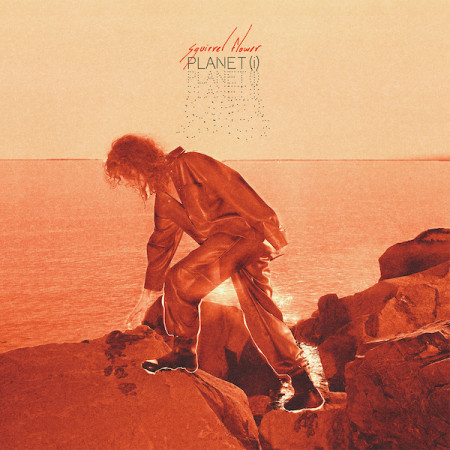
Squirrel Flower, the moniker of Ella Williams, has announced her new album “Planet (i)”, due for release on 25th June! We couldn’t be happier to have new music from Ella so soon after the brilliant “I Was Born Swimming” was released last January. And what an album this is…

For now, we’re sharing the explosive single Hurt A Fly and its video directed by Ryan Schnackenberg. Ella has spoken a bit about the track’s meaning: 

“‘Hurt A Fly’ is me embodying a persona of gaslighting, narcissistic soft-boy type shit. The classic ‘sorry I acted violently, I’m not mad that you got upset at me, wanna hang out next week?’. I wanted to see what it was like to be a character trying to skirt around accountability. It’s an angry and unhinged song, and for the video I wanted to be inside a bubble writhing around and trying to get out. A stranger filmed me practicing choreography at a public park, submitted it to a meme page making fun of ‘influencers,’ and the video got 1,000,000 views, which in my mind is perfect thematically.” 

Planet (i) is the follow-up to 2020’s I Was Born Swimming, for which MOJO described her as “one of 2020’s most engaging new artists” and she was made a ‘One To Watch’ by The Observer. 

Planet (i) is a world entirely of Williams’ making. The title came first to her as a joke: it’s her made-up name for the new planet people will inevitably settle and destroy after leaving Earth, as well as the universe imagined within her music. The record is a love letter to disaster in every form imaginable – these songs fully embrace a planet in ruin. Buoyed by her steadfast vision and propelled by her burning comet of a voice, Planet (i) is at once a refuge, an act of self-healing, and a musical reflection of Squirrel Flower’s inner and outer worlds.

Williams wrote most of the songs on Planet (i) before the COVID-19 pandemic, but disaster looms large in its DNA. Susceptible to head injuries having played a lot of sports in her youth, Williams received three concussions from 2019-2020. Amidst the chaos of touring internationally during her own healing process, she began weaving threads between her physical and personal sense of ruin and her lifelong fear of the elements: of being swept up by storms, floods, and the deep ocean. “To overcome my fear of disasters”, Williams says, “I had to embody them, to stare them down”. This journey of decay and healing is the lifeblood of Planet (i).

Once quarantine set in, Williams began to produce demos in her room, amassing a collection of more than 30 recordings. Feeling a sense of artistic synchronicity over international phone calls with producer Ali Chant (PJ Harvey, Perfume Genius), and with newfound covid antibodies, Williams flew to Bristol, UK in the fall of 2020 to record Planet (i) at Chant’s studio, The Playpen. “We had this shared creative language”, she recalls, “and the recording process was, like my demo process, very sculptural. Instead of recording live with a full band, we built this record layer by layer, experimenting, taking risks”. While Williams

and Chant played most of the instruments on the record, Bristol drummer Matt Brown and Portishead’s Adrian Utley also joined their sessions. When Chant suggested the idea of backup vocals, Williams, whose voice had until now stood alone in her songs, enthusiastically enlisted friends and family to join her remotely with their voices and instruments; Tenci’s Jess Shoman, Tomberlin, Katy J. Pearson, Jemima Coulter, Brooke Bentham, and her brothers Nate and Jameson Williams, as well as her father Jesse.

The songs on Planet (i) are Squirrel Flower’s instruments for connection: with the people in her life, her collaborators, audiences, and ancestors; a lineage of artists whose spirits continue to inform her art. At the heart of this record is an insistence on connection and healing in the face of catastrophe.

On Planet (i), Squirrel Flower reveals a bright and uncompromising vision, confident in her powers of self-healing and growth. No matter what the disaster ahead of or within her looks like, and no matter how she shape-shifts to meet it, Squirrel Flower will always be a world of her own, a space-rock flying down the road in flames and flat tires. 

May be an image of text

David Singer’s Fillmore posters that I really like that the American Flag is incorporated in. Here we have BG number with the Byrds, Fleetwood Mac and John Hammond and 211 with Chicago, Guess Who and Seals and Croft. 

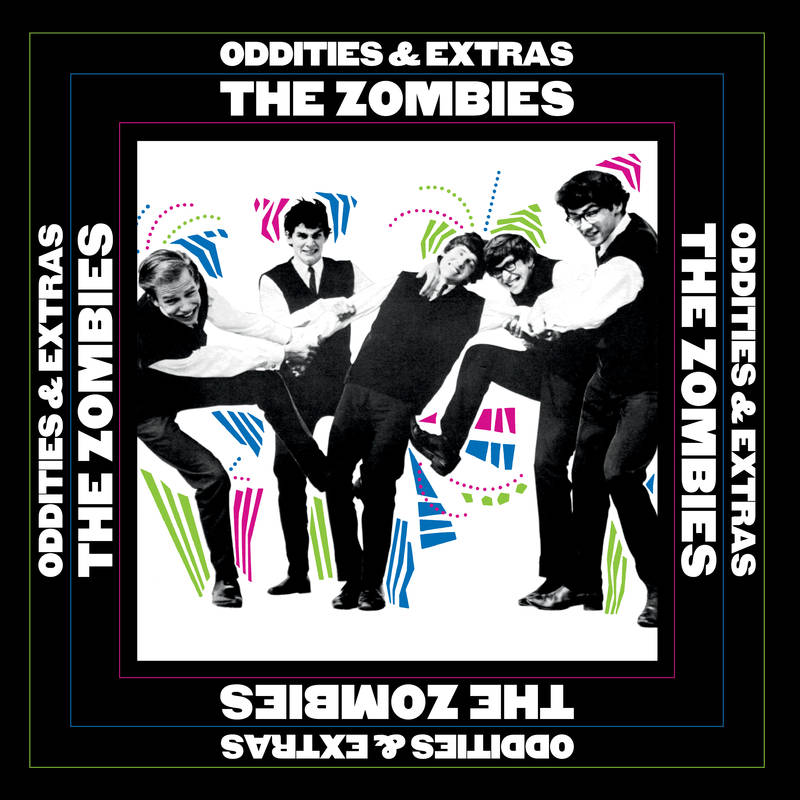
The Zombies have a bit of a confusing discography, with different configurations of their albums being released in the U.K. and U.S.  There have been efforts to clean things up over the years, but there are still differences.  A case in point: the release in 2019 of two different vinyl box sets examining the group’s studio work, one on Demon Records for the U.K and one from Varese Vintage for the U.S.A.

Now for Record Store Day, Craft Recordings is releasing the fifth LP from the Varese set (which was newly curated at the time).  The 13-track set gathers material not featured on the U.S. versions of The Zombies’ albums including rarities, U.K.-only album tracks and outtakes.  Collectively, this material makes a compelling listen on its own.  Some of the songs include a cover of Little Anthony and The Imperials’ “Goin’ Out of My Head,” the early B-side “I Can’t Make Up My Mind,” as well as three songs (“Remember You,” “Just Out of Reach” and “Nothing’s Changed”) from the soundtrack to Otto Preminger’s 1965 film Bunny Lake Is Missing, in which the band appeared. 

A bespoke collection of rare singles and UK-only album tracks from the Rock and Roll Hall of Fame inductees. Far from being cast-offs and also-rans, the selections are every bit as essential as the tracks included on the Zombies’ primary releases.  

Side One: 1. Kind Of Girl, 2. She’s Coming Home, 3. I Must Move, 4. I Want You Back Again, 5. I Can’t Make Up My Mind, 6. I Remember When I Loved Her, 7. I’m Going Home; Side Two: 1. Remember You, 2. Just Out Of Reach, 3. Nothing’s Changed, 4. Goin’ Out Of My Head, 5. She Does Everything For Me, 6. A Love That Never Was

Pressed on 180g black vinyl, the LP includes notes from Andrew Sandoval, who also co-produced the set.  It is limited to 3,000 copies.

There are a lot of label anniversaries this year that come with fun surprises. Two days ago we got a collaboration between Hypnotic Brass Ensemble and Perfume Genius for a cover of Richard Youngs’ “A Fullness Of Light In Your Soul” for the 25-year anniversary of Jagjaguwar Recordings. Today, the company’s sister label Secretly Canadian offers a gift as well: new songs for their series SC25 Singles, which includes a lovely rendition of Kacey Musgraves’ “Lonely Weekend” by NNAMDÏ. His vocals are fragile and vulnerable; at less than three and a half minutes, it’s a satisfying flash of twangy indie rock.

Folks that toured with me in the past few years know it’s no secret that I’m a huge fan of Kacey Musgraves’ music. I got the dang tweet receipts and everything. Every song on Golden Hour is a bop and ‘Lonely Weekend’ is one that always pumps me up because of its immediacy. The song just starts with the vocals and you’re in it for the ride from the get go. Kacey introduced me to an album by the prodigy, bluegrass savant Chris Thile that really blew me away. Since I was gifted a really old ukulele and a funky lil busted ass banjo early last year, I decided it would be fun to incorporate some elements of that into this cover despite never having played banjo before. Lol. It’s kind of a slight homage to that with my own spin on it and a thank you to her for introducing me to one of my new favourite records.

“Lonely Weekend” released through Secretly Canadian on: 11th June 2021: NNAMDÏ

Over the last couple of years, Smoothboi Ezra has made a name for themselves crafting spare-sounding love songs; light on musical backing, and loaded with feeling. 2018’s debut track ‘Thinking of You’ paired strummed ukulele with barely-there percussion, and artfully deployed tweaks of high pass filter; it gave the song a transient quality, like a blaring car radio fading away towards the horizon. ‘A Shitty Gay Song About You’ was similarly pared-back, underpinned by twinkling chimes.

After fleshing out their sound further on their 2019 EP ‘Is It’ the County Wicklow singer released their single ‘My Own Person’ – a distinct levelling up with a live feel. Bolstered by extra instrumentation, Ezra explored their gender identity with both warmth and specificity (the musician is non-binary, and uses they/them pronouns). “I wanna blend into the background, I wanna be nobody and never make a sound,” they sang, “but I wanna start feeling like I can be myself”.

Now, six months later, Smoothboi Ezra’s new EP ‘Stuck’ knits together these two musical threads – sparse, emotive stories, and the heft of a beefier backing band. Backed by uneasy guitars, the title-track concerns a fraught relationship where both halves feel equally stuck. Ezra’s narrator is rooted by fear: “I can feel the growing resentment, but I’m too afraid to end it,” they admit. And their partner’s trapped in the worst year of their life, unable to see anything beyond it: “[It] started when you met me,” Ezra sings, “you say I shouldn’t take it personally.” Gradually, lone guitar builds into a propulsive heartbreak epic.

On ‘Without You’ languid guitar lines and scuffing snares mingle together, drawing on ‘90s alternative rock; it puts Ezra in similar territory to maybe Snail Mail and Soccer Mommy. Lyrically, the song explores the uncertain grey area of love-turned-friendship, and the slightly petty everyday struggles of outwardly thriving when your heart is secretly breaking. Specifically, the ill-advised post-breakup haircut. “I finally cut a fringe,” they say dryly, “you always said I wouldn’t so I did, but I pushed it back, I’m waiting for it to grow out again”.

The EP’s more minimal tracks, ‘You’ and ‘Palm of Your Hand’, spring up from similar ground – though they’re songs written for somebody else, there’s a gulf between Ezra’s narrator and subject. On the latter, they watch from the corner of a chaotic house party as somebody else gets as fucked up as possible – all the while, kept there by a deep care that isn’t necessarily returned. And ‘You’, Ezra has explained, is about a different kind of separation: “My autism makes it hard for me to remember how I feel about people when they’re not right in front of me,” they wrote in a statement. “I have very little emotional object permanence which makes it hard to feel loved by people but also makes it hard for me to let the people I love know and feel my love for them.”

As a whole, ‘Stuck’ is about the feeling of being a step away from something, and yet feeling rooted to the spot. And in stark contrast, it’s also Smoothboi Ezra’s freest sounding release. They might feel stuck in the ground, but musically ‘Stuck’ is continually breaking loose and building bigger than anything the musician’s done before – it’s a quiet, but convincing reinvention.

Released June 10th, 2021

PRONOUN – ” OMG I Made It “

Posted: June 14, 2021 in MUSIC

“OMG I Made It”, the latest project from Pronoun — the nom de plume of emo-pop auteur Alyse Vellturo — hits like a much-needed catch-up with an old friend you hadn’t seen since all of this happened, five sparkling songs encapsulating the life of the Brooklyn-based indie label manager by day, bedroom artist by night who’s toured with your favourite formative emo bands. hits like a much-needed catch-up with an old friend you hadn’t seen since all of this happened, five sparkling songs encapsulating the life of the Brooklyn-based indie label manager by day, bedroom artist by night who’s toured with your favourite formative emo bands.

The new EP from the awesome Pronoun, following on from the excellent and charming 2019 debut full length ‘i’ll show you stronger’. 

Offering up another dose of infectious and spellbinding mixes of bedroom pop, electro-rock and an immediate influence of 90’s emo. Fans of Jimmy Eat World’s ‘Clarity’, Now Now, Day Wave, The Japanese House and Wild Pink should check this out.

One of the the first releases on (your ‘soon-to-be-new-favourite’) label, Wax Bodega.

Out on June 11th, 2021 via Wax Bodega.

released June 11, 2021

May be an image of text

Image  —  Posted: June 14, 2021 in MUSIC

2ND GRADE – ” Superglue “

Posted: June 13, 2021 in MUSIC

It was hard to get in touch with Pete Gill in the summer of 2018. He didn’t have a phone, car, or apartment. He had a job renting swan boats on the Delaware River in Philadelphia, where he was the oldest employee by ten years. He had a 3rd Generation iPod Touch, which he used to tell his friends whether he could hang out over Facebook Messenger on public wifi, and to listen to the Beach Boys every single day. And he had a bicycle.

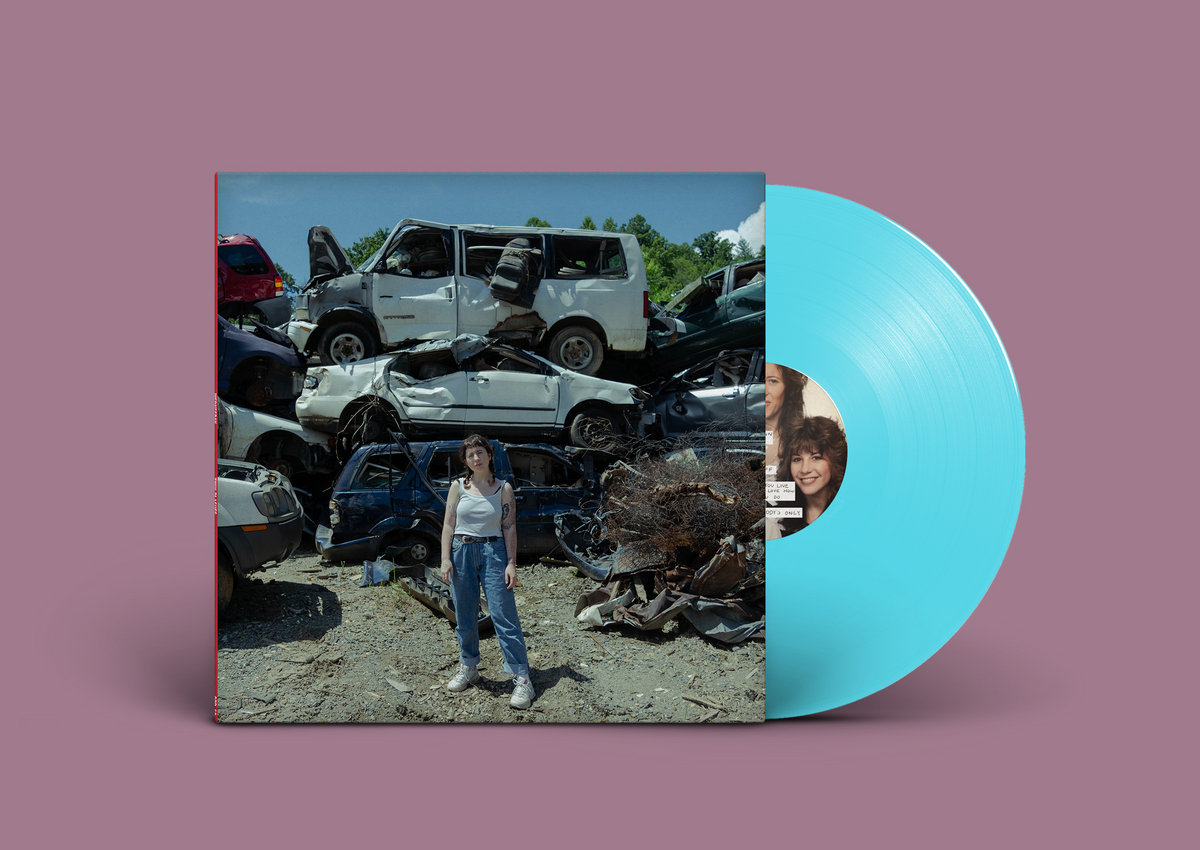
Gill isn’t getting sunburned at the Harbor Park anymore. He’s got a band, and he wants everyone to hear it. He still writes songs at a Robert Pollard-pace, but he doesn’t have to play his own drums. In 2020, 2nd Grade released the 24-track LP Hit to Hit on Double Double Whammy with a band of Philly all-stars including members of Remember Sports, Friendship, and 22 degree halo. Now, the five-piece band has re-recorded eight songs from Wish You Were Here Tour. Along with remastered versions of the original fourteen and one outtake, they will make up Wish You Were Here Tour Revisited, a document of the band’s past, present, and future.

2nd Grade’s past is Pete Gill on a friend’s futon, layering guitars with a zoom recorder on his day off. Wish You Were Here Tour came before the band members, studio, and more serious genre experimentation of Hit to Hit, and is Gill at his most vulnerable. Lo-fi guitar riffs and snarky jokes are broken up by sincerity and tenderness. Despite Gill’s pan-instrumental virtuosity, Wish You Were Here Tour is still defined by personal idiosyncrasy.

The future is a nonstop rush of guitar, harmony, and gratification. 2nd Grade’s new albums are like bags of Jolly Ranchers; seemingly bottomless containers of sweet sensory overload, with every possible flavour – overwhelming confusion, new love, spite, fear, and nostalgic longing. There’s more distortion, more production, and even more guitar. Gill sings louder than he used to, whether it’s due to confidence or the move from thin-walled apartments to the recording studio. Both versions of the Wish You Were Here Tour songs develop the 2nd Grade ethos: childhood wonder, experimentation, guitar hooks, and having as much fun as possible before you die.

From the remastered “Wish You Were Here Tour Revisited” available everywhere June 25th on Double Double Whammy Records.

WEDNESDAY – ” Cody’s Only “

Posted: June 13, 2021 in MUSIC
Tags:

I love “Twin Plagues” first for its songs, plainly. If you, listening to Wednesday for the first time around or even the second time around, stumble onto this album, I promise you the songs will be what grab you first, beyond any of my foolish high-level emotional theorizing or projections. Every band that loves the pursuit of their craft the way this band does is one to follow, because getting to sit on the side lines and watch them level up is a real generosity.

Twin Plagues is overflowing with hooks, but what most delighted me about the band from the start has taken a leap: they have managed, somehow, to get even better at structuring their noise from one movement of a song to the next. The idea of the “song” itself is flexible in their hands, so much so that each song holds two, or three songs within. This, again, generosity. “Cody’s Only” is a ballad until it begins to threaten a storm of volume, and then, in its final act, it becomes something else altogether. “One More Last One” is a shoegaze-y trip that swells and swells until it overflows, but it doesn’t stop. It keeps offering and offering and offering. I say “noise,” and never in a dismissive sense. Everything has a place, and so much of its place is to serve the true heart of this album, and the true heart of Wednesday’s music, which is allowing cracks through which tenderness can enter and exit as needed. Tenderness that, it seems to me, is always wrestling underneath whatever else might be happening on a song’s surface.

The Band:

vocals and guitar Karly Hartzman
lead guitar Jake Lenderman
Bass Margo Schultz
Drums Alan Miller
Lap Steel Xandy Chelmis