Jeff Tweedy performing live in the KEXP studio. This lineup just keeps getting better every time I see them perform, and the songs from TO seem to keep evolving in the live setting. KEXP always has such a top notch sound mix. Worth watching!!!! In my opinion the songs from “Twilight Override” really have to be seen live. Really great performances.
Recorded April 2nd, 2026.
Songs: One Tiny Flower 00:41 New Orleans 06:39 Out In The Dark 10:30 Lou Reed Was My Babysitter 14:35 Jeff Tweedy – Guitar, Vocals Spencer Tweedy – Drums, Vocals Sammy Tweedy – Synthesizer, Vocals Macie Stewart – Guitar, Strings, Vocals Sima Cunningham – Bass, Vocals Liam Cunningham – Guitar, Vocals
From the heart of the Australian psych scene… country pop rainbow rockers Babe Rainbow return with their 7th studio album “Acid And Honey” recorded on a houseboat in Amsterdam and zen master Mullarky’s Malibu ranch… Exciting dance beat production backs wailing Babe Rainbow vocals on solid skanking hip-hop hard rocking finger funky sounds. Pressed in ‘Acid & Honey’, 180gm Black & Gold pinwheel vinyl, and housed in a euro-style card sleeve, with a gold foiled embossed sticker. Limited to only 250 copies with our signature, numbered obi strip.
From the heart of the Australian psych scene… rainbow rockers Babe Rainbow return with their 7th studio album “Acid and Honey” recorded on an op shop acoustic on a houseboat in Amsterdam and finished at zen master Mullarky’s Malibu ranch. Exciting country-pop beat production backs wailing Babe rainbow vocals on solid skanking hip-hop hard rocking finger funky sounds. The first single “Polymucalsaccharide’ is just something Perry Farrell says and it means “drool, like you’re dribbling cos the truth is once you hit the road you don’t remember the good shows, they’re just like every other show”
British sibling duo Penelope Isles have announced a new album, “3” on Bella Union, and shared its lead single, “Thinking Seat,” via a music video. The fittingly titled “3” is the Brighton-based band’s third album and is due out September 25th . Check out “Thinking Seat” below, followed by the album’s tracklist and cover art.
The new album follows 2021’s “Which Way to Happyand” 2019’s “Until the Tide Creeps In“. Not only has it been five years since Penelope Isles’ last album, it’s also been three years since their last live show. In that time, the duo have been busy with solo projects—Jack with Cubzoa and Lily with My Precious Bunny (who released “A Moment in My Eyes” in May; Jack has also toured with CMAT on guitar.
“Penny Isles is such a big part of our personalities,” says Jack in a press release. “So it was about time we got back to it.”
The album features Joe Taylor on drums and was recorded live in the studio, at Black Bay Studio on the Isle of Lewis off Scotland’s northwest coast. Prior to that, the album was written on a monthlong surf trip to Lagos, Portugal.
In a world increasingly shaped by disposable content, Chat Pile answer with something defiantly real and organic, a mentality that permeates “Who Loves The Sun“, their third full-length record. Since the band’s formation just over six years ago, the Oklahoma City-based quartet Chat Pile has grown from a scrappy passion project into one of the defining heavy acts to emerge from the 2020s underground. Ray B. (vocals), L. Manhole (guitar), Stin (bass), and Cap’n Ron (drums) create a crushing, crass, and cathartic take on noise rock that captures a raw, undeniably human essence in an age marked by technological overreach and the cold state of society. Nothing about “Who Loves The Sun” feels synthetic.
Whereas their debut album “God’s Country” depicted a particularly American flavour of dread, and the follow up “Cool World” showed a cruel planet defined by global systemic violence, “Who Loves The Sun” peels the skin back on how collective indifference defines this new century. Spanning imagery of coastlines devouring cities, dead-end jobs, and submission to data-driven inauthenticity, the album dissects the apathy-bloated state of 21st-century existence as a slow-motion apocalypse.
As with much of Chat Pile’s work, Oklahoma City itself looms over the album like a character, its sprawling isolation, economic contradictions, and underlying sense of decay embedded in the fabric of the record. The perfect allegory for the thematic essence of Who Loves The Sun is the photo embossed on the record’s cover, where Devon Tower, a glassy, largely vacant monolith, looms high above the Oklahoma City skyline while a burnt-out home or storefront envelops the foreground.
The album remains lyrically and sonically confrontational, but Chat Pile approached the songwriting with hooks in mind, drawing on melodic tones of pre-2000s indie rock, alt-rock, and new wave. From the blood-soaked vocal passages of “Christabel ’26” to the eerie trip-hop pulse of “Same Rules,” “Who Loves The Sun” is deeply human despite its allusions to a dying, divided .
“This Mirror Weighs a Ton”, Interpol’s first album in four years and debut for Partisan Records, finds the band turning inward while continuing to move forward. Across the record, reflection, distortion and perception become a lens through which familiar shapes are refracted into something slightly alien, as if seen through a different kind of light.
Alongside the announcement of their new album ‘This Mirror Weighs a Ton’, and accompanying singles “This Mirror Weighs a Ton” and “See Out Loud”
Within it. Nothing feels imposed. Instead, the additions deepen the band’s language of restraint, atmosphere and tension. At its centre remains the creative relationship between Paul Banks, Daniel Kessler and Sam Fogarino, a partnership now approaching three decades and defined by intuitive alignment and momentum that continues to generate new possibilities. The result is an album that feels expansive, uncanny and alive with forward motion, not a reinvention but an evolution that allows Interpol to continue transforming without losing their identity.
“This Mirror Weighs A Ton” / “See Out Loud” is a study in duality, with Interpol moving fluidly between familiarity and departure. The title track unfolds from a skeletal progression into something vast and textural, built from warped bass, a wordless female voice and a sense of motion that feels tidal, bending the band’s familiar language into somewhere more expansive and unfamiliar. By contrast, “See Out Loud” carries the DNA of Interpol’s earliest work, sharp, propulsive and direct, while complicating it through layered vocals, shifting perspectives and a rare lead vocal turn from Kessler. Both tracks reflect the interplay between structure and spontaneity that defines “This Mirror Weighs aTon, expanding Interpol’s world through fresh textures while keeping the instinctive chemistry between Banks, Kessler and Fogarino at the center. The double single is accompanied by two visualizers directed by Nick Steinhardt.
Interpol last week they shared its third single, “Iron City.” “This Mirror Weighs a Ton”is Interpol’s first for Partisan after previously being on Matador for much of their career.
Interpol’s core members are Daniel Kessler, Paul Banks, and Sam Fogarino. “This Mirror Weighs a Ton” is the band’s eighth album, and the follow up to 2022’s “The Other Side of Make-Believe”, 2019’s “A Fine Mess” EP, and 2018’s “Marauder” full-length.
Andrew Wyatt (ROSALÍA, Charli xcx) produced the album, recording it in his studio in Manhattan’s Lower East Side. David Fridmann (Sleater-Kinney, MGMT) mixed the album. The album cover features an artwork by Addie Wagenknecht, which is currently held in the Whitney Museum of American Art’s permanent collection. “This Mirror Weighs a Ton” is the first Interpol song since “PDA,” from their 2002 debut album “Turn On the Bright Lights”, to feature vocals from Kessler.
Of working with Interpol, Wyatt says in a press release: “I wondered what it would be like to keep the parts perfectly legible, because everyone in that band writes such great parts. And to add some different spatial dimensions to it.” Wyatt says. “It was something almost a little bit more like chamber music—the musical ideas bear scrutiny without needing the sonic treatment of it to carry all the weight. It was also nice to add a trick or two I picked up over a couple decades of making pop records.”
“This Mirror Weighs a Ton” by Interpol, from the album “This Mirror Weighs a Ton“, out August 28th, 2026 on Partisan Records:
In an age of algorithms, Westside Cowboy are pure-spirited proof of the magic that can only come from human connection. Just three years on from forming in Manchester, starting a band for the fun of it without so much as a plan to even play a gig, the quartet – Jimmy Bradbury (vocals, guitar), Reuben Haycocks (vocals, guitar), Aoife Anson O’Connell (vocals, bass) and Paddy Murphy (drums) – have crafted perhaps the year’s most exciting debut by simply figuring out what feels good, and following it into the horizon.
Having won the Glastonbury Emerging Talent Competition in 2025, the hotly tipped four-piece band from Manchester perform their new single ‘Kick Stones (The Boys)’ from their upcoming debut album ‘It Goes On’.
“It Goes On” is the debut album from Manchester-based four piece Westside Cowboy, produced by Loren Humphrey. It may well be one of the best records of 2026. Instant golden songs for a new generation.
In an age of algorithms, Westside Cowboy are pure-spirited proof of the magic that can only come from human connection. Just three years on from forming in Manchester, starting a band for the fun of it without so much as a plan to even play a gig, the quartet have crafted perhaps the year’s most exciting debut by simply figuring out what feels good, and following it into the horizon. There’s an urgency of feeling to “It Goes On” that could only ever really happen with a young group’s debut record
Manchester, England four-piece Westside Cowboy are releasing their debut album, “It Goes On,” on August 21 via Island Records. Now they have shared its second single, “Pin Up Boys,”
The band collectively had this to say about the song in a press release: “‘Pin Up Boys’ was written a year and a half ago using an acoustic guitar, a drum machine sample pad and some screwdrivers as drumsticks. It is by far the longest serving song on the album and the one that we have played the most live, which was a blessing and a curse when we came to record. After realising this song was set in its ways, we thought the recording should be a somewhat faithful version of the live performance. We hope you get something out of it.”
Jack Shep directed the song’s video and had this to say about it: “Westside Cowboy’s performance style is so energetic and distinct. They clearly have a mountainous future ahead of them, and it was awesome to work with young people at the precipice of starting something really special together. In the video we wanted to capture the band’s dynamism, through a spotlight. We follow this fixed, malevolent spotlight chasing our hero (played by the band’s mate, Will) as he tries to escape its gaze. As he runs, he manages to escape, splitting into a new spotlight with a new version of the band. The whole thing begins to buckle and shatter.”
Westside Cowboy is Reuben Haycocks (guitar, vocals), James (Jimmy) Bradbury (guitar, vocals), Aoife Anson O’Connell (bass guitar, vocals), and Paddy Murphy (drums, vocals). They’ve been gathering momentum and attention due to earlier singles, such as “Can’t See,” which made our Songs of the Week list last November. They have also supported Geese and Black Country, New Road on tour.
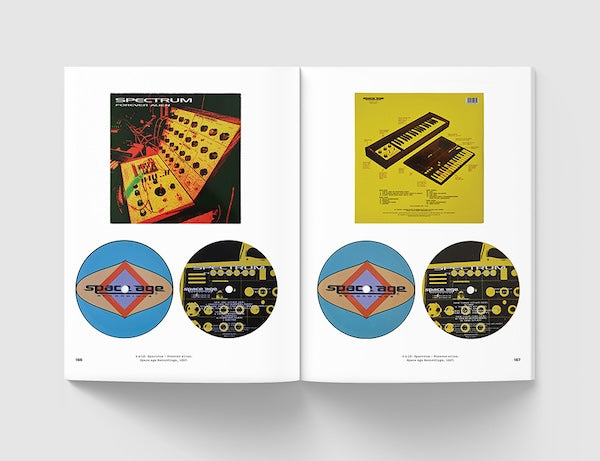
Pete Kember’s influence on independent music stretches far beyond the cult legacy of Spacemen 3. Through his many aliases (Sonic Boom, Spectrum and E.A.R.) he has spent decades exploring the outer reaches of psychedelia, drone, experimental electronics and pop, building one of the most distinctive and enduring discographies of the last forty years.
Compiled by Danny Passarella, Sonic Boom / Spectrum / E.A.R. Vinyl Archive 1989–2026 is the definitive visual guide to Kember’s solo vinyl output. Spanning more than 330 pages, the book meticulously documents every release from his 1989 first post-Spacemen 3 single Angel through his latest collaborations and the forthcoming A ? Of When album with Panda Bear. Packed with tons of photos of records, detailed release information and exclusive interviews covering each of Kember’s artistic aliases, it offers an unparalleled look into one of modern music’s most fascinating catalogues.
Making this edition even more special is an exclusive flexi-disc featuring an unreleased instrumental version of the Spectrum classic “How You Satisfy Me”, available only with the book and marking the 100th and final release on the Feral Child label.
The first pressing also includes an A3 poster and hype sticker, making this one an essential collectors’ piece.
Blending punk, country, and psychedelic looseness, Arizona’s Meat Puppets were ahead of their time in fusing genres that shouldn’t have fit together. Their cult classic ‘Plateau’ perfectly exemplifies this eccentric, desert-baked sound.
I’ll get flak for recommending this record above Meat Puppets II, the one Kurt Cobain covered in his famous MTV Unplugged concert. The Meat Puppets were the third great SST band, and all three grew by leaps and bounds in the mid-’80s. With Meat Puppets II (1984), the Arizona post-punkers reveal a dizzying range of artistry, from slam-dance hardcore to virtuosic instrumentals to jam-band psychedelia. With Up on the Sun, the band finds its groove, reeling off a stream of melodic, light-psychedelic guitar-boogie classics. Warm guitar riffs anchor most of the songs, and the Kirkwood brothers adorn them with their unique brand of hypnotic, vaguely off-key harmonies: this is college radio’s answer to Disraeli Gears.
Arizona’s Meat Puppets were ahead of their time in fusing genres that shouldn’t have fit together. Their cult classic ‘Plateau’ perfectly exemplifies this eccentric, desert-baked sound.
Nirvana’s legendary MTV Unplugged performance briefly introduced the track to a wider audience, but the Curt and Cris Kirkwood-led band remains criminally underrated. They helped pave the way for alternative rock by fearlessly breaking down barriers.
New York’s The Bobby Lees have built their reputation the long way round, through relentless touring and a catalogue that feels more scraped together than carefully assembled, which is precisely the appeal. A fourth album, and a first for a bigger label, might suggest a smoothing-out of those rough edges. It doesn’t really happen. ‘Napoleon’ opens with guitars pushed high in the mix, drums snapping into a tight, almost claustrophobic pattern while Sam Quartin delivers lines in short bursts that feel half-spoken, half-spat. Their take on ’50ft Queenie’ keeps the lurching rhythm intact but roughens the tone, bass slightly distorted, everything sitting just a fraction off-centre. ‘New Self’ loosens the tempo, letting the rhythm section breathe a bit more. It’s direct, certainly, but it lands.
Highly recommended. That band you saw backing Jon Spencer recently – that was the Bobby Lees!
For The Bobby Lees, their fourth album and Epitaph debut marks a thrilling new chapter for the band while doubling down on what’s always made them so magnetic. The Bobby Lees don’t need much in the way of introduction.
Uncle Acid & The Deadbeats return with ‘Don’t Let It Control You’, issued via Killer Candy Records. Built from fuzzed-out guitars, pounding piano and warped harmonies, the track barrels forward with a raw, unhinged energy, wrapped in the band’s trademark horror-tinged lyricism.
On the flip, ‘Don’t Let It Control You Part II’ reimagines the track as a slower, more disoriented counterpart. Acoustic elements, woozy keys and drifting feedback pull it into a late-night haze, offering a stark contrast to the A-side’s urgency while expanding the band’s shadowy soundworld.
Combining Fuzzrite guitars with driving Stooges piano, out of tune harmonies, Shadow Morton backing vocals and pulp horror lyrics, Uncle Acid continue to evolve in their own terrifying world.
Cult group Uncle Acid and the deadbeats are back in the ditch with their new single “Don’t Let It Control You”, on Killer Candy Records. Released May 29th,