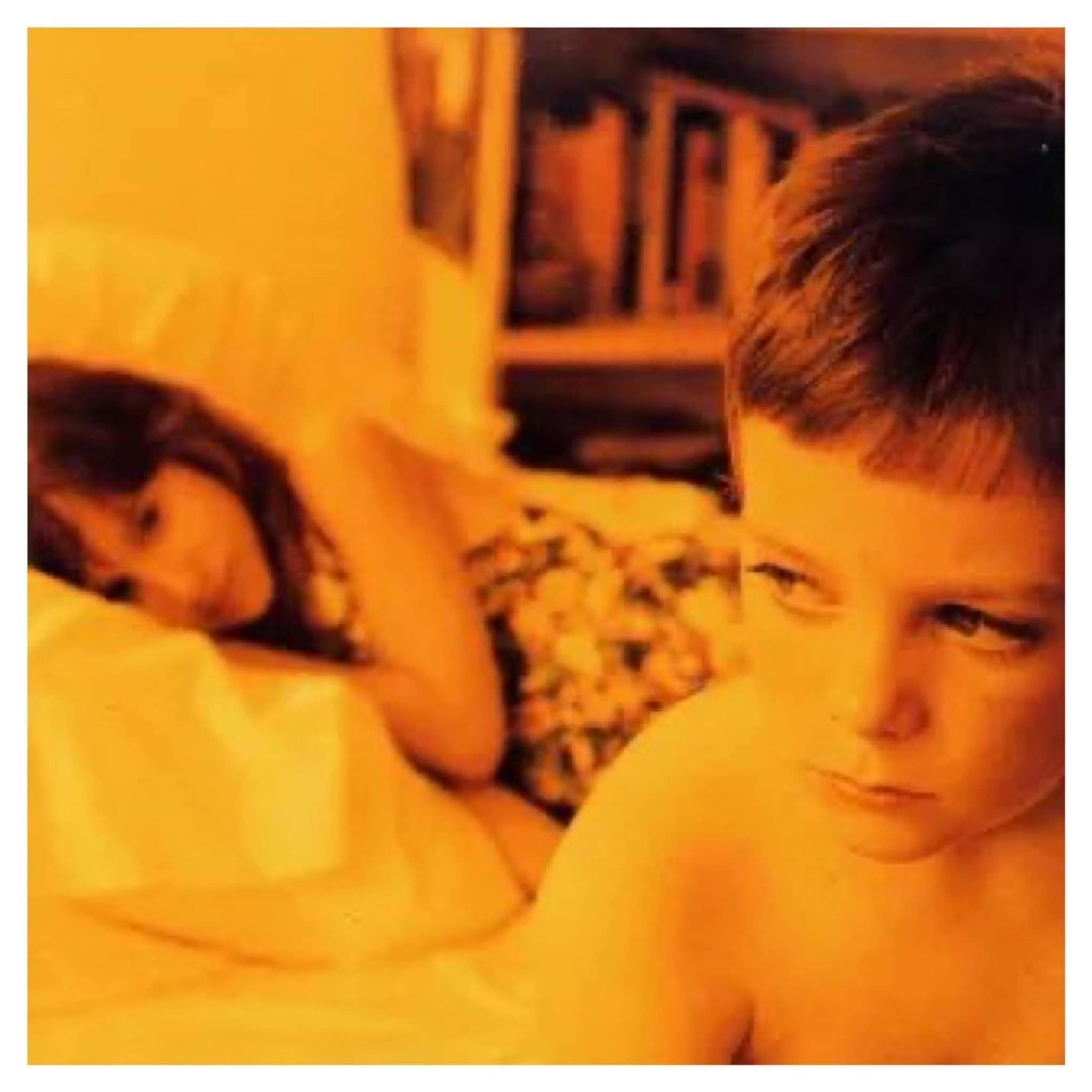
We recorded this song at a hotel in Omaha. Mari and I were on tour with a day off. We invited Anna to come play around with us. Anna and I palled around a few years ago, connecting over our mutual love of Lucinda, so it just seemed right. She rode up with her keyboard strapped to her bike. Mari had her pedal steel for our set on that run of shows. I played my big bass vi and gave us an easy beat to feel along it. We all sang. I love this recording, for all y’all who got a rock n roll heart.
Mia June, a 19-year-old singer/songwriter from Australia. I know we hear so often that someone is a wunderkind, a prodigy, etc., etc., and part of what I love about Mia June is that she’s wise about her years, not beyond them. Like, take her E.P. title: “Don’t Forget Your Bags”. It’s funny because what she means by “bags” is “baggage,” you know, as in: emotional stuff. But as people age out of teenagehood and into the “real world” of adult loneliness, tedium, aimlessness, alienation, pointlessness, boredom, etc., they kinda, like, forget who they were when they still believed they might amount to something. It’s like Johnny Cade said, with his dying breath, “Stay gold, Ponyboy.” But Mia June is Ponyboy, herself, and she’s smart enough to know the threats of that “real world” are, in fact, real, and hefty, and coming for her. Heck, by the time Biggie was 21 he had already proclaimed he was ready to die. It’s a hard world out there.
Mia says ‘Don’t Forget Your Bags’ is an ode to my adolescence, the people I have met during it that have formed the person I am, things I have experienced, good and bad, yearning, confusion, anxiety, love, anger and growing. I don’t want to forget anything in this journey from childhood to adulthood. I hope this EP will serve as a reminder of all of this, and to never ever forget my bags.
YES, one of Rock’s most innovative progressive bands enjoyed a long run with several line-ups. To date, they remain stationary even if shy of most of the original line-up (excepting Steve Howe, who maintains the last vestige of YES with as much agile care as possible). The band has 23 studio albums, many of those well loved.
The Yes Album, Yes’ classic third studio release from 1971, that showcases their great musicianship, harmonies and unique songwriting, is getting a Super Deluxe Edition, with a newly remastered version along with rarities, two previously unreleased concerts, and fresh mixes by Steven Wilson, including an immersive Dolby Atmos Mix. The expanded box set contains 4-CDs, a Blu-ray disc, and an LP, arriving on November 24th, 2023, via Rhino Records.
The Yes Album is the third studio album by English progressive rock band Yes, released on 19th February 1971 by Atlantic Records. It was the band’s first album to feature guitarist Steve Howe, who replaced Peter Banks in 1970, as well as their last to feature keyboardist Tony Kaye until 1983’s 90125.
The band spent mid-1970 writing and rehearsing new material at a farmhouse at Romansleigh, Devon, and the new songs were recorded at Advision Studios in London in the autumn. The album was the first by the band to feature all-original material. While the album retained close harmony singing, Kaye’s Hammond organ, and Chris Squire’s melodic bass, as heard on earlier releases, the new material also covered further styles including jazz piano, funk, and acoustic music. All of the band members contributed ideas, and tracks were extended in length to allow music to develop. Howe contributed a variety of guitar styles, including a Portuguese guitar, and recorded the solo acoustic guitar-piece “Clap”, live at the Lyceum Theatre, London.
The Super Deluxe Edition includes Wilson’s newly remastered version of the original album on the CD. The LP is a new AAA cut by Bernie Grundman from the original master tapes. One of the two previously unreleased concerts from 1971 was recorded just a few weeks before “The Yes Album” was released, while the second was recorded six months later during the band’s U.S. tour. These performances include live versions of songs from the album, such as “Starship Trooper,” “Yours Is No Disgrace” and “Perpetual Change,” as well as songs from 1970’s “Time and a Word“.
Guitarist Steve Howe made his debut with the progressive rock band on the album. In the October announcement, he said, “The Yes Album” represents to me the invention of 70’s Yes. This was aided by leaving outside material off the record and heavily investing in the influences we brought together, particularly the arrangement skills and utilizing the available best technology. Our adventurism shows in the originality of the music and lyrics, as none of us had done anything quite like this before.”
The album was a critical success and a major commercial breakthrough for Yes, who had been at risk of being dropped by Atlantic due to the commercial failures of their first two albums.
Anderson also reflects on the original. “It’s wonderful to know that 50 years later our music is still appreciated. It was a ‘make or break’ time for the band on many levels. The harmony within the band was really special at that time, and it came through in the music.”
The reissue of “The Yes Album will feature a collection of rarities, the Steven Wilson remixes from the Panegyric reissue, the original album, as well as a mono mix of the original album (a promo release), previously unreleased live track cuts, and a Dolby Atmos mix of the album by Steven Wilson contained on the Blu-ray. Other things promised include a previously unreleased and unnamed instrumental, as well as an alternate take of “Starship Trooper”.
On November 24th, YES will reissue “The Yes Album” in a 4CD/LP/BD Box that celebrates the album’s 50th Anniversary. (Let’s hope that this kind of reissue continues on through)
Also, on October 6th, a new singles compilation to be called “Yessingles” will be released with 12 singles from the band over their popular span of time. It is being issued on DD and vinyl LP, but may be issued on CD in time.
A brand-new compilation featuring the band’s A-side singles for the first time on vinyl. Includes: “Roundabout”, “Owner of a Lonely Heart”, “Starship Trooper” “Life Seeker” and more!
Since its inception in the late 1960s, Yes has consistently pushed the boundaries of rock music, carving a path into new and uncharted sonic landscapes. Rhino is introducing a new collection that is the first to feature rare single versions of the band’s biggest hits on vinyl.
The collection boasts new artwork created exclusively for the album and features 12 songs that have resonated with generations of devoted fans. “Yessingles” moves chronologically through the Rock and Roll Hall of Famer’s career, starting in 1971 with the group’s first Top 40 hit, “Your Move,” and ending in 1984 with its smash, “Leave It.” In between, Yessingles touches on the band’s different eras, ranging from intricate prog-rock tapestries like “Starship Trooper” and “America” to the unforgettable soundscape of its chart-topping sensation, “Owner Of A Lonely Heart.”
With a discography spanning over five decades, Yes’ influence on rock remains immeasurable, and “Yessingles” reaffirms the band’s status as the most enduring, ambitious, and virtuosic progressive band in history.
The title will be pressed on 140g-weight black vinyl LP, and a special edition Splatter colour LP that will be made available through record stores. This set is being produced by Rhino Entertainment.
The newly remastered 3CD edition of the classic 1971 Family album “Fearless”. Featuring 24 bonus tracks,
Family’s Roger Chapman, discusses the new Cherry Red Records special 3-CD release of the British progressive rock band’s 1971 album “Fearless”remastered plus bonus tracks and BBC recordings. He also shares stories about the subsequent album “Bandstand”, both with the late John Wetton, before his time with King Crimson, Roxy Music, Uriah Heep, and most notably Asia. Chapman mentions a John Wetton tribute event and shares a pair of songs from his latest solo album “Life in the Pond”, and his guest vocalist appearance with the duo The Sinclairs: Rat Scabies of The Damned and Billy Shinbone of Flipron.
Featuring vocalist Roger Chapman, guitarist John ‘Charlie’ Whitney, drummer Rob Townsend, bassist and vocalist John Wetton and multi-instrumentalist John ‘Poli’ Palmer on vibes, keyboards and flute, ‘Fearless’ was released in October 1971 and was the first album to feature new member John Wetton following the departure of John Weider following the band’s second US tour in 1971 and the UK Top Ten hit single ‘In My Own Time’.
The album was one of Family’s finest and reached the UK Top 20 upon its release; featuring such strong material as ‘Spanish Tide’, Burning Bridges’ and ‘Between Blue And Me’. The first time I heard Family on AM rock radio station playing “Larf and Sing” from “Fearless”. The vocal arrangement on Poli Palmer’s composition is so unique, and the remastered version captures that very well in stereo, along with Poli’s flute.
Poli did a demo of it as his home and brought it to the Olympic recording studio in London and we performed it there. John Wetton and Roger did the barbershop vocal stylings, then Poli put the lead vocal on afterwards. That vocal arrangement was a great idea, and it is such a good song.
Poli was one of the instigators in that musical league with the synthesizer, which he would bring on the stage along with his vibes. As people changed in the band, we took their influences to propel the band to somewhere else. Everyone was an equal partner in the band, very democratic, making it very creative as we toured the U.K., France, Germany, Italy, and the U.S. we toured two or three times. We did well in New York and Los Angeles, but once we got out into in the middle of the country, our recognition was hit or miss.
Charlie Whitney and Roger wrote this song and so many songs for the band, since the first album, “Music in a Doll’s House” in 1968. We clicked together. His real name is John Whitney, but we had so many Johns in the band that we decided to call them by different names. John Whitney became Charlie, John Wetton became Ken, and John Palmer became Poli.
The chorus on “Spanish Tide,” that Roger and Charlie co-wrote sounds like a predecessor of what John Wetton would bring to Asia’s debut album a decade later, a bit faster on “Only Time Will Tell.”
Before the“Fearless” album was the summer hit single of 1971 “In My Own Time,” with a marching beat, and is one of the bonus tracks on this new 3-CD collection.
The second disc of the new set begins with 1971 BBC sessions in the studio and the recording is so professional in sound. It opens wonderfully with “Procession/No Mule’s Fool.” it was a very nice version. It includes John Weider, yet another John who played bass for the group before John Wetton joined. On this song he played violin. John Wieder had been in Eric Burdon and The Animals before joining Family.
The BBC concert on the third disc features . “Drowned in Wine” is so powerfully dramatic. Chapman says that was also powerful on stage and a big favourite with fans because it is explosive. Fortunately, my voice hardly gave out. If I got a little hoarse, people really wouldn’t know if I was hoarse or not. With my range, I could rock it out or sing a breathy love song ballad.
This new three-disc edition of this classic album has been newly remastered from the master tapes and also includes 24 bonus tracks drawn from the ‘In My Own Time’ single, BBC Sessions and “In Concert” performances, plus an illustrated booklet with new essay and reproduction poster.
“What should I tell her? She’s going to ask…” These words, are murmured by frontman Greg Dulli over a slithering, tendril guitar line like a snare tightening around its prey, open “Gentlemen”, the bands third album by the Afghan Whigs. Part-confessional, part-boast, part-catharsis, the album is as bleak and unforgiving an examination of love, lust, addiction and oblivion as the 1990s ever delivered.
What, then, does Dulli tell “her”, and also us? Only everything. Only every little black morsel of his heart, soul and groin. Only every little trick his brain knows to sell his ass to you, and how it feels the next morning, when he finds himself lying next to the latest victim of his narcotic charm, the harsh light of day leaving no scrap of cover for his shame and remorse. Context isn’t everything, but sometimes it’s important. In 1993, the year of “Gentlemen’s” birth, the grunge wave was peaking. Two years earlier, Nirvana’s “Nevermind” had crashed into the mainstream,
We initially finished recording “Gentlemen” in May of 1993 but after I went back to Memphis that June to remix “What Jail Is Like” and “Debonair”, the release was pushed back a month to October. We all loved the record and were excited to go out and play it live. We toured it for a year straight and life was never the same. From the clattering introduction as John and I drove across the Roebling suspension bridge to the sun shining through the trees at the end of Brother Woodrow, we delivered on the promise of “Congregation” with the best record we knew how to make.
Afghan Whigs were different. Though previously signed to grunge’s signature imprint, Sub Pop, they hailed from Cincinnati. Dulli might occasionally have sprouted a hideous, ‘stache-less chin-beard as the era dictated, but he and his Whigs dressed sharp: shirts with collars, shoes you couldn’t wear on a basketball court, and the general ambience they might have stepped out of the frame of a Tarantino movie. And while their guitars often stirred much angst, like an infernal tornado of turbulence, their frame of reference was crucially adrift from their labelmates.
The Whigs: with their final Sub Pop release, 1992 covers EP “Uptown Avondale”, essayed tunes by Al Green and Percy Sledge, along with an acrid version of Freda Payne’s Band Of Gold, and a take on The Supremes’ ‘Come See About Me’. This EP wasn’t a one-off; included among the bonuses on the deluxe reissue of “Gentlemen” is a former B-Side, a live medley of The Supremes’ ‘My World Is Empty Without You’ and ‘I Hear A Symphony’ that correctly identifies the songbook of Motown bards Holland/Dozier/Holland as some of the heaviest, darkest, most emotional tuneage in music.
“Gentlemen’s” lyric sheet also set the Whigs far apart from others of their era. Dulli’s tales were blunter, darker, more adult. “Gentlemen” is an album about sex, and sometimes love; about the tangle, the aftermath, the gratification and then the recrimination. Romance, at least in any corny sense, is absent.
“Love” in the world of “Gentlemen” is a twisted and complex and contradictory thing, and sometimes Dulli’s purposefully evading it, in search of baser and more immediate pleasures. “Be Sweet” could be a signature song, of sorts. It’s the calling card of some kind of pick-up artist, back before celebrity creep.
Afghan Whigs would follow “Gentlemen” three years later with a more ambitious but less satisfying opus, “Black Love”, and 1998’s “1965”, their most accessible album yet, which nevertheless prefigured their split. Recently they reformed, delivering a comeback album, last year’s “Do To The Beast“, which in no way dishonoured that which had come before. In the interim, Dulli formed a new outfit, The Twilight Singers, though their subject matter, and their soulful, dark music, was strongly familiar.
The love that folks had and still have for it will never cease to make me smile. Happy 30th anniversary, old friend. I’ll never forget any of it. –Greg Dulli
Bleach Lab proudly call themselves perfectionists. The South London band formed in 2017 as a duo of bassist Josh Longman and guitarist Frank Wates, they then recruited vocalist Jenna Kyle before reaching their final form at the start of 2021 with the recruitment of drummer Kieran Weston. After releasing three EPs, they are now gearing up for their debut album “Lost In A Rush Of Emptiness”, where the band felt free to experiment, always keeping true to their alternative nature. The songs on it are packed with widescreen, dreamy soundscapes that pushed their aesthetics forwards and continued the experimentation that exists at the heart of the project.
With wave after wave of shiver-inducing shoegaze, glistening indie rock, and dream pop wash over the ears as Bleach Lab’s debut album drenches its audience not just in breath taking sound, but in visceral emotion. Released September 22nd, 2023 via Nettwerk Music Group, “Lost in a Rush of Emptiness” is the apotheosis of everything the London quartet have built over the last four years: As enchanting as it is achingly intimate, their first full-length is an immersive collection of inner reckonings and soul-stirring reflections on what it means to be alive. They plunder the depths of their own hearts and souls, ultimately delivering an experience that is at once wondrous and wistful, thought-provoking and deeply evocative.
It feels like everything that’s come before – the grief and trauma of “A Calm Sense of Surrounding” the heartache and vulnerability of “Nothing Feels Real” the haunting beauty and seductive, raw reverie of “If You Only Feel It Once” – has been leading up to this moment.
“This album is the result of years of work,” vocalist Jenna Kyle says. “Years experimenting, finding our sound, and finding out what our music meant to us.
On this record, more than any other, you’re listening to our most personal stories, emotions, feelings, and each track means so much to us. All we hope is that you find a way to connect with these songs as much as we have.”
Bleach Lab – “Lost In A Rush Of Emptiness” released through Nettwerk Records
Jefferson Airplane’s Grace Slick becomes the very first person in history to say “fuck” on American television on August 19th, 1969—the day after Woodstock—on The Dick Cavett Show. Technically the whole band pretty much sings “fuck” if you want to split hairs. Someone had to do it first, I’m glad it was the Airplane.
“We Can Be Together” was the lead-off number on the band’s politically radical “Volunteers” album and the B-side for the “Volunteers” single. Due to the group’s unique contract for the times—they had complete artistic control—RCA Records had to go along with whatever the Jefferson Airplane wanted, including “shit” and “motherfucker” appearing in their lyrics. For the single, the “motherfucker” was mixed low, but not actually bleeped.
The song’s music and lyrics are credited to Paul Kantner, who claimed to be inspired by the Black Panther Party’s use of the “Up against the wall, motherfucker” battle cry, itself a phrase 60s activists often heard coming from police and national guardsmen during that tumultuous era.
Kantner also cribbed some (nearly all) of the lyrics from something called “The Outlaw Page” that appeared apparently first as a leaflet and then in the East Village Other underground newspaper. “The Outlaw Page” was a polemic written by a guy called John Sundstrom, who was a member of an anarchist/Situationist-inspired Lower East Side-based “street gang with analysis” called the Up Against the Wall Motherfuckers [UAW/MF] whose name came from a poem titled “Black People!” by Amiri Baraka. The Motherfuckers, whose unprintable name made them virtually press-proof, were involved with storming the Pentagon, setting up crash pads in New York City for counter culture types and the occupation of Columbia University. Marxist philosopher Herbert Marcuse’s stepson, Tom Neumann was an early member.
“Volunteers” was released in late 1969, ( November 2nd ) the cover photo dates back to 1967; it features the band wearing disguises and was taken during the filming of a promotional film made for the “Martha” single.
In addition to the usual two channel stereo version, a specially remixed four channel quadraphonic version of the album appeared in 1973. This was released on LP using the Quadradisc system. It was also released in quad reel-to-reel and 8-track tape tape formats. The quad mixes are different from stereo; “Hey Fredrick” has a completely different lead vocal along with different guitar lines and coda, “Volunteers” is a totally different recording, Kaukonen’s guitar lines are different on “We Can BeTogether”, “Wooden Ships” lacks the opening sailboat sound effects and the backing vocals by Ace of Cups on “The Farm” are more prominent. A few tracks from the quad version were included in the three CD box set “Jefferson Airplane Loves You“, though on this release the four channel recordings are reduced to two channels due to the technical limitations of CD.
A band Combining two loves — music and baseball — The Baseball Project is a true indie supergroup. Featuring Mike Mills and Peter Buck, of R.E.M., Dream Syndicate frontman Steve Wynn, Scott McCaughey, leader of both The Minus 5 and and Young Fresh Fellows, and Linda Pittmon of The Filthy Friends, the band took the members’ baseball fandom and turned that into a passion project of songs about America’s Pastime.
With baseball’s more than century-long history, there is a lot of material for the group to write about, from a song about current phenomenon, Los Angeles Angels DH/pitcher Shoehi Ohtani, to legends like the Boston Red Sox Ted Williams.
One of the standout cuts on the band’s new album, “Grand Salami Time” (a term for a grand slam home run), is “Disco Demolition,” a song that looks back on one of baseball’s most infamous nights.
On July 12, 1979, the Chicago White Sox hosted “Disco Demolition Night,” a radio stunt gone horribly wrong. A local DJ hosted what was supposed to be a promotion, where fans got together and destroyed disco albums during the height of the disco backlash. But a riot ensued and the second game of the double header was canceled.
Thought of as a publicity stunt gone wrong at the time, the whole event has been rewritten in history as one that was actually racist and homophobic. Wynn writes about that in the song. But knowing the message of being open minded has to be delivered in a palatable way, the band found a brilliant way to do so, enlisting James Blagden, who did the animated video showcasing pitcher Dock Ellis’ very famous 1970s no-hitter, thrown while Ellis was on acid, to do an animated “Disco Demolition” clip, premiering here.
“Grand Salami Time” released on Omnivore Recordings June 30th, 2023.
“It’s been incredible making this,” he says. “Despite all the life stuff that’s happened, it has brought me immense happiness. I’ve always railed against it when people ask if making a record is cathartic but I’d have to admit that this one really was.”
Beautifully produced and rich in scope – ‘Iechyd Da’ is Bill Ryder-Jones’ most ambitious record to date. At times joyous and grand, at others intimate and heartbreaking, the past few years spent producing other artists have provided that gentle nudge to expand into new territory, from kids choirs and tender strings to dramatically re-contextualised disco samples.
“Iechyd Da” is Ryder-Jones’ first new record since Yawn in 2018. “I love this album,” says Ryder-Jones, “I haven’t been this proud of a record since “A Bad Wind Blows in My Heart.”
This exceptional album is released by Domino on January 12th. “Iechyd Da” is available to pre-order from the Domino store on exclusive coloured vinyl (with postcard), a Dinked-edition coloured vinyl (with exclusive Big Softies 7” & signed sleeve), Indies-exclusive coloured vinyl, standard vinyl, CD and digitally.
Bill Ryder-Jones has released a new track, “This Can’t Go On”, which is taken from his forthcoming album, Iechyd Da. on Domino Recordings
RC 550 will hit – skim across the surfaces of – the shelves like a shiny pebble from the past. The cover story might be something you’ll be invested in: a rundown of the greatest gigs at arguably rock’s greatest venue. Bowie’s 1980 Floor Show? Hendrix, Who, Hot Rods? How many did you attend? Elsewhere we interview Paul Young and Pete Townshend, Glenn Hughes and Cliff Bennett, Arthur Baker and Corinne Bailey Rae. We review the latest releases, reissues, books and singles, rate all the rarities you could want and de-murk the memorabilia.