
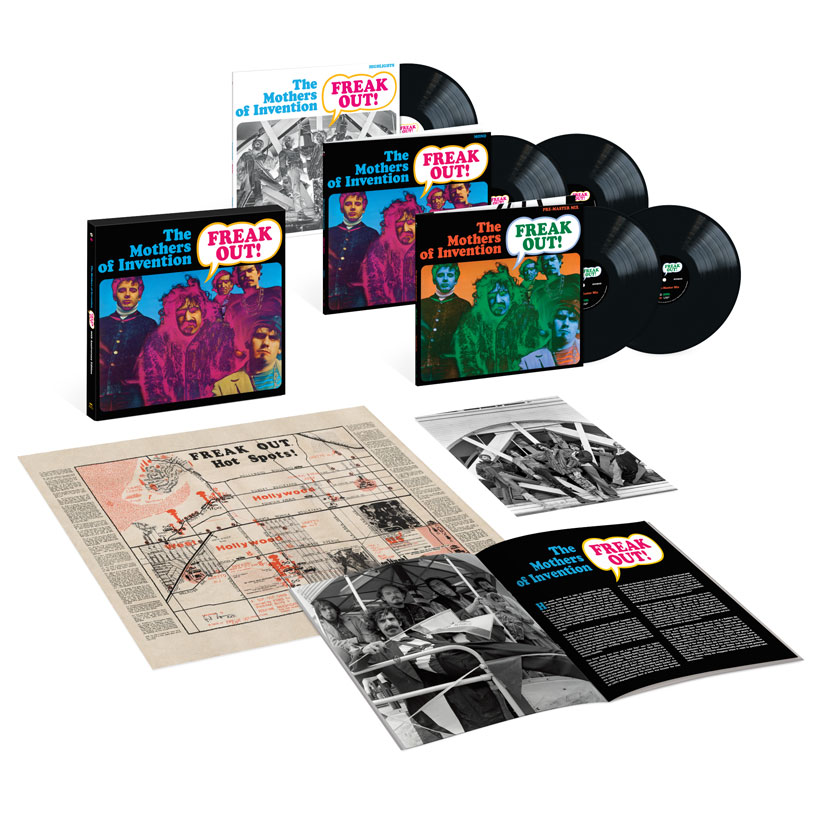
Frank Zappa’s 1966 debut album “Freak Out!” a pioneering double LP and one of rock’s first concept albums, blending experimental rock, satire, and avant-garde sound collages. Freak Out! was originally released on June 27th, 1966, by Verve Records and marked the debut of Frank Zappa and the Mothers of Invention . Produced by Tom Wilson, the album is often cited as one of rock music’s first concept albums, satirizing American pop culture and the emerging Los Angeles “freak” scene .
It was recorded over four days at TTG Studios in Hollywood in March 1966 . The album features Zappa on guitar and vocals, alongside Ray Collins, Roy Estrada, Jimmy Carl Black, and Elliot Ingber, with contributions from session musicians known as the “Mothers’ Auxiliary”
The album’s music spans rhythm and blues, doo-wop, blues-influenced rock, orchestral arrangements, and avant-garde sound collages The expanded box set will mark six decades since the release of the double album, which is widely cited among rock’s earliest concept records.
When Frank Zappa and The Mothers of Invention’s “Freak Out!” arrived in the summer of 1966, it represented a seismic shift in what a rock album could be. Virtually unprecedented as a debut release — Zappa and The Mothers rejected the prevailing conventions of the three-minute pop single, instead crafting an ambitious work that blended doo-wop, rhythm and blues, orchestral music, free jazz, tape manipulation, and biting social satire into a cohesive artistic statement. Set against the backdrop of a pivotal moment in American culture amid the rise of the counterculture, the Vietnam War, and a growing distrust of mainstream values the album skewered suburban conformity, celebrity culture, consumerism, and political complacency with a level of sophistication and irreverence that was virtually unprecedented in popular music.
Its experimental structure, culminating in the groundbreaking sound collage ‘The Return of the Son of Monster Magnet,‘ helped redefine the possibilities of the LP, demonstrating that a rock album could function as a unified artistic work rather than simply a collection of songs. In doing so, “Freak Out!” expanded the creative vocabulary of popular music and helped define the increasingly ambitious and experimental direction rock would take in the latter half of the 1960s.
The newly expanded 60th anniversary edition will be released on Zappa Records/UMe in a variety of formats, including a six-disc (5CD/1Blu-ray Audio) Super Deluxe Edition that features 105 tracks in total, many of which have never been released. Produced by Zappa Vaultmeister Joe Travers, this new, expanded collection titled “Freak Out!:” 60th Anniversary Edition contains Travers‘ 24-bit/192kHz digital transfers and John Polito’s 2026 mastering of the core album’s 15 tracks, along with the rediscovered 1966 pre-master mix, the retrieved and restored 1966 mono mix, Fillmore Auditorium tapes mainly culled from a trio of live 1966 dates, original Mothers 1966 rehearsals, original Mothers demos, mono vocal reference mixes, and a truly special three-track “Freak Out!” late-night jam session outtake collage.
Tracks like “Hungry Freaks, Daddy” critique the American school system, while “Who Are the Brain Police?” explores themes of societal control and conformity
The 12-minute closer, “The Return of the Son of Monster Magnet”, is an unfinished ballet in two tableaux, showcasing tape manipulation and experimental sound techniques
Zappa described “freaking out” as a process of casting off restrictive social norms to express creativity individually and collectively, “Freak Out!” was one of the first double albums by a rock act and influenced the development of concept albums and avant-rock
Although initially underappreciated in the U.S., it gained a cult following and was more successful in Europe Sixty years after its release, “Freak Out!” remains not only a landmark recording, but a bold artistic manifesto whose originality, irreverence, and uncompromising vision continue to challenge, provoke, and inspire new generations of musicians and listeners alike.

