
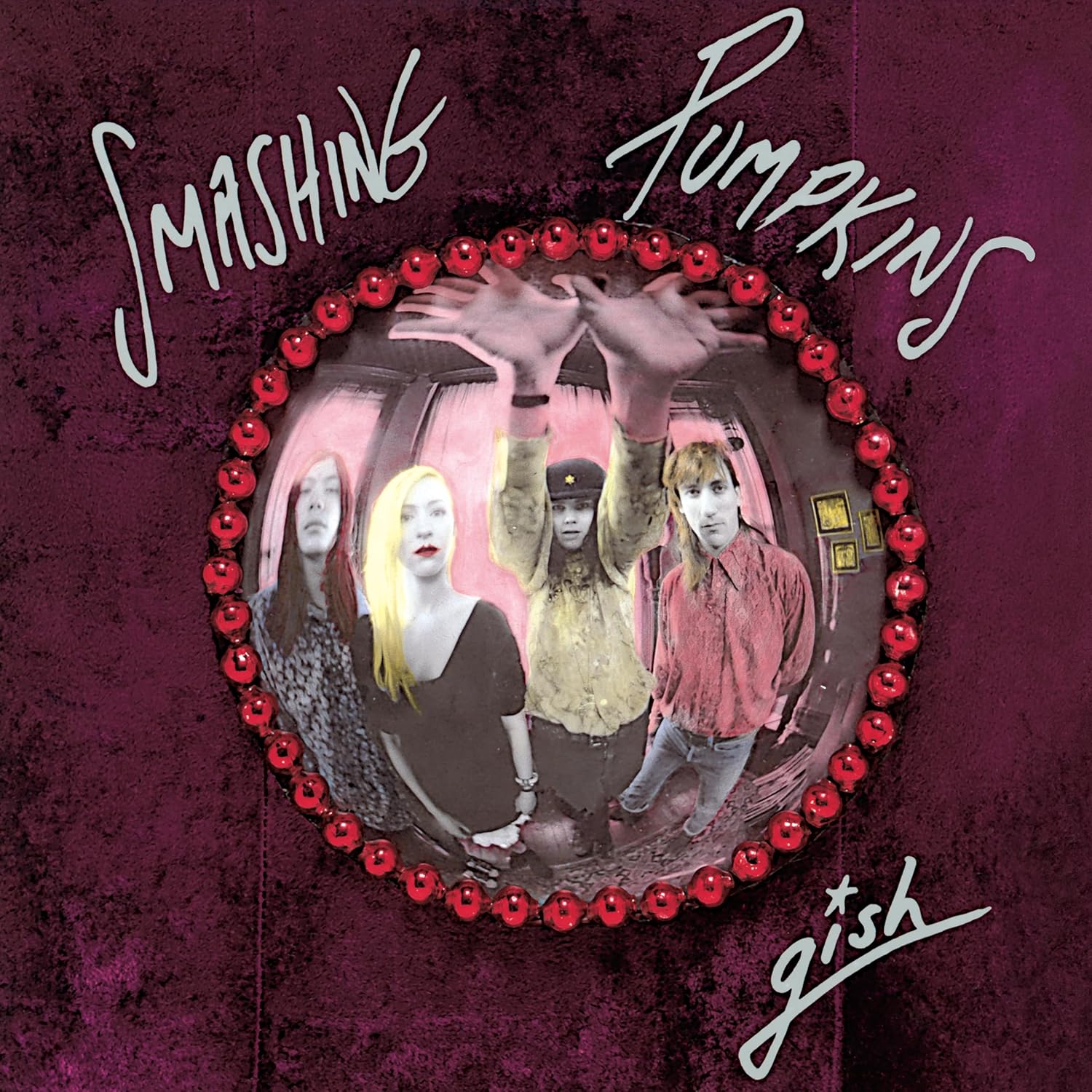
Courtney Love once told Billy Corgan that his debut album annoyed her. Not because it was bad – quite the opposite. It annoyed her because it was so accomplished that it sounded like a second album. It’s a perfect observation, and one that cuts to the heart of what makes “Gish” such a fascinating record thirty-five years on from its May 1991 release. This is an album that, on paper, shouldn’t work as well as it does. A debut by a band barely two years old, recorded in a modest Wisconsin studio for twenty thousand dollars, on an indie label, by a group of twenty-somethings from Chicago with no real precedent for the sound they were trying to make. And yet what they produced was startlingly assured: psychedelic, intricately layered, full of rolling moods. It didn’t sound like a first attempt at anything. It sounded like a statement.
Love’s observation came with a challenge, too. She apparently teased Corgan for his obscure, hippy-ish lyrics on “Gish” and pushed him to write more directly – a provocation that, by Corgan’s own account, fed directly into the sharper, more confessional songwriting of his actual second album, “Siamese Dream“. But that’s getting ahead of the story. “Gish” has spent thirty-five years being treated as a prologue to the main event. “Siamese Dream” and “Mellon Collie and the Infinite Sadness” get the reverence and the mythology. “Gish” gets a pat on the head and a “pretty good for a debut.”
Back in 1991 it felt like no-one quite knew what to make of Smashing Pumpkins. Keen to connect the Chicago quartet to the flowering of US alt rock, Melody Maker’s review of “Gish” talks about the band’s debut in terms of a hard rock experience, the contents within marked “highly greased, chromed-up black biker metal”, for example. Across the pond Rolling Stone concerned themselves with its “meticulously calculated chaos” and “swirling energy”. There’s truth in all of that, but neither quite nails it. Most of the press at the time tied themselves in knots trying to work out what Smashing Pumpkins actually were. Within a few years that would be easy. Nirvana’s “Nevermind” opened the idea of mainstream alternative rock like a flower and the Pumpkins slipped right in behind it with “Siamese Dream’s” sonic shimmer; wrapping bruiser riffs, punchy pop, elegant melancholia and space jams into something that felt very self-contained with a solid identity.
Two years earlier, though, when the idea that Gen X’s deconstructed, damaged freaks and ghouls could saturate the American mainstream seemed ludicrous, “Gish” was a trickier thing for the pigeonhole-fanciers of the music press to get their head around. The Pumpkins were from Chicago, and the fact they didn’t hail from the hipster coasts felt important: more grounded and less self-conscious than the painfully arty Sonic Youth or Jane’s Addiction. But they certainly weren’t Big Black. You couldn’t imagine them on their hometown’s hipper indie labels, Touch ‘N’ Go or Wax Trax. Their obvious love of Black Sabbath connected them to the sodden, sludgy sounds of the Pacific North West and they’d put out a single on Sub Pop, but they didn’t have the grotty, snotty urchin vibe of the punk rock underground that marked out Mudhoney, TAD and Nirvana. There was art-for-art’s sake whimsy that felt of a piece with the college radio scene, indebted to kitchen sink British indie and goth, but also a sincere and unembarrassed hard rock virtuosity that was completely at odds with that. Could you be a classic rock band and a gothy shoegaze act at the same time? Billy Corgan, passing time as a pizza delivery boy listening to a cassette that had Joy Division’s “Unknown Pleasures” on one side and Metallica’s “Ride The Lightning” on the other, who loved both The Beatles and the Banshees, who employed a cool-as-fuck arty goth couple on guitar and bass on the one hand, and a virtuoso jazz and polka drummer with a mullet on the other, who wore paisley shirts while shredding metal riffs and dropping acid, thought, “fucking yes”. This can all be the same band.
Hence “Gish”, a debut record that often does all of that in a single song. Take ‘Bury Me’, which sports the album’s meatiest riff and most typically hard-rock construction but tags a gorgeous, pinwheeling coda; a journey that makes no sense on paper but sounds as natural as breathing on disc. Take ‘Rhinocerous’ which meanders in a hazy dream right up until the point Corgan rips out a face-melting solo. Take ‘I Am One’, a slinky rock beast that would be interrupted on tour every night with an elongated “art rant” jam section before resolving into twin solos. “Gish” does all of this. It has hippie bliss-outs like ‘Suffer’ and delicious, mini goth-pop epics like ‘Snail’ and none of it feels weird, placed side-by-side. No wonder the hacks of the day struggled to find the right box.
We should acknowledge, at this juncture, that calling “Gish” the band’s debut is technically true but slightly misleading. It sounds like a second record for a reason. By the time they arrived at Butch Vig’s Smart Studios in Madison, Wisconsin, in December 1990, the Pumpkins had already written, recorded and discarded at least an album’s worth of material, a lot of it really strong. Songs like ‘Spiteface’, ‘East’, ‘Egg’ and ‘Jennifer Ever’ – “doomy little goth pop songs”, as Corgan would later say – were sold on demo tapes at shows, played to death in clubs and eventually abandoned as the sound evolved, honed and got closer and closer to what was in Billy Corgan’s head. The ‘I Am One’ single had appeared on the tiny and somewhat ironically named Limited Potential label, ‘Tristessa’, the recording of which paired the band with Vig for the first time, was part of Sub Pop’s legendary singles club. This was not a band fumbling towards an identity. They knew exactly who they were. “Gish” was less a debut than their formal introduction to the world at large. A statement of intent. “Here’s who we are. Imagine what we’re going to do next”.
The recording sessions, spread across roughly forty working days from December 1990 to March 1991, paired the band with Butch Vig, then a relatively unknown producer working out of his own Smart Studios. The budget was twenty thousand dollars, funded by Caroline Records – a subsidiary of Virgin, but one that operated with the autonomy of a genuine indie. The choice to release on Caroline rather than going straight to Virgin was a deliberate one on Corgan’s part. He didn’t want the pressure of a major label debut hanging over his first record. He wanted room to experiment, to figure out how to translate the sound in his head onto tape without the pressure of radio singles. He wanted permission for Smashing Pumpkins to be their weird, outsider selves. Permission a nervy major may not have allowed. It was a shrewd move, and one that shaped the album’s character. There’s a freedom to “Gish” that comes, at least in part, because unlike the records that came next, it wasn’t made with an expectation that it needed to conquer the world. It was weird, psychedelic and out-of-step with the college rock playbook, and happy to be so.
The Corgan-Vig relationship turned out to be one of those rare creative partnerships where both parties push each other to uncomfortable heights. Vig, accustomed to recording indie bands in three or four days, suddenly had someone willing to spend hours chasing a guitar tone, someone with a specific vision that he was prepared to go the distance to realise. Corgan, ambitious but studio-green, had a producer who matched his perfectionism without being intimidated by it. “I was over the moon,” Vig later recalled of the extended sessions. “I’d found a comrade-in-arms who wanted to push me, and who really wanted me to push him.” They’d go in for fourteen- or fifteen-hour days, constantly upping the ante, neither willing to settle. It was the beginning of a relationship that would define both men’s careers – Vig packed up from the “Gish” sessions and went almost directly to Los Angeles to record “Nevermind” with Nirvana (“a lot of people are gonna be after him when they hear that record.” as Corgan, who’d had a sneak peak, told Spiral Scratch that summer. Something of an understatement). Corgan has since claimed, with a mixture of pride and mischief, that Vig took his guitar tone to the Nirvana sessions with him. It’s certainly the case that the producer arrived in LA with a very clear idea of how to make guitars sound enormous, and it’s hard to imagine those forty-one days in Madison didn’t inform it.
It is, of course, well-established that Corgan played nearly all of the guitar and bass parts on “Gish” himself, playing James Iha’s guitar parts and D’arcy Wretzky’s bass lines using their own instruments. This is the detail that tends to dominate discussions of the album’s making, and it’s worth noting both what it tells us and what it doesn’t. It tells us that Corgan was, from the very start, a control freak of the first order (though he’d argue that this was partly expediency: he knew he could get everything done faster on his own) – a tendency that would intensify to near-pathological levels on “Siamese Dream” and remain a defining feature of his career. What it doesn’t tell us is that the album sounds like a solo project. It doesn’t. These songs came out of the rehearsal room, where Iha and Wretzky channelled Corgan’s visions into their own musical voicing. Those sessions were genuinely collaborative – Iha even gets a co-writing credit on ‘I Am One’. Corgan wasn’t just playing bass and guitar parts, he was playing Wretzky and Iha’s bass and guitar parts, replicating their style, polished to his own perfectionist standards.
His bandmates are on the record in spirit, even if they’re not literally present in the mix. They’re also both there in voice. James Iha’s backing vox are clearly present on ‘Bury Me’, while Wretzky gets a whole lead vocal on the wistful dreampop of closer ‘Daydream’. Smashing Pumpkins were, and indeed are, a force dominated by a single personality, that’s absolutely true. But “Gish” is the product of a band. Change one of the four and it’s a different album.
There’s also the not-insignificant matter of the one instrument Corgan couldn’t replicate: Jimmy Chamberlin’s drums.
Chamberlin’s playing on “Gish” is extraordinary. A jazz drummer by background, he brought a swing and dynamism to the Pumpkins’ that nobody else in alternative music was offering. His fills are enormous, his feel is impeccable, and the propulsive physicality of his playing anchors even the most sprawling, psychedelic passages. The drum sound itself is a thing of beauty – Vig recorded Chamberlin’s kit unprocessed and unsampled, and the live-room acoustics of Smart Studios, with its odd angles and absence of parallel walls, gave the recordings a natural resonance that sounds as gorgeous today as it did in 1991. Listen to the breakdown of ‘Siva’ on a good set of headphones and lose yourself in the tones and the dynamics as Chamberlin ripples across the toms and strokes and glances at his snare before beating the shit out of it to bring in the rest of the band and the song’s final movement. It’s world-class playing.
‘Siva’ is the best example here of what Smashing Pumpkins could do across a single song, and it’s pretty much the entire album in miniature: a psychedelic, riff-heavy pop monster that breaks open midway through into a whispery, dreamy passage of picked guitar and hushed vocals before crashing back with redoubled ferocity. Corgan called this approach “flow arranging,” and it’s the secret architecture of the entire album. Other bands could do quiet/loud/quiet/loud, Smashing Pumpkins had gears and levels all the way down. The tension between the extremes, the journey across them and the refusal to settle on one mode when you can have four or five is what makes “Gish” such a satisfying listening experience 35 years on, quite unlike anything else the US underground put out in 1991.
‘Rhinoceros’, though, might be the album’s masterpiece, or at least its most complete realisation of the Pumpkins’ aesthetic up to that point. Built on a bed of shimmering, layered guitars – reportedly an eventual seventeen tracks of feedback and overdubs – it starts gently and builds gradually, hushed and dreamlike right up until the point the other shoe drops and it explodes into something bigger, hungrier and more desperate sounding. It’s the soft and the heavy not competing but feeding each other: one of those songs that sounds simultaneously vast and intimate. If you wanted to play someone a single track that explained what the Smashing Pumpkins were about (something Courtney Love apparently does regularly), before the fame and the mythology and the butterfly wings, this is the one.
Elsewhere, ‘Bury Me’ rides a galloping, classic-rock riff through the most urgent Billy Corgan vocals on the record. ‘Crush’ is gorgeous and gauzy, a love song draped in delay and reverb that anticipates the dreamier moments of “Siamese Dream”. ‘Window Paine’ is an exercise in deconstruction, building from the bass and kick drum through tremolo guitars before erupting into a frenzied climax. ‘Tristessa’, re-recorded from the earlier Sub Pop single, is a grinding rocker and the most alt-rock thing here, while ‘Daydream’, the album’s closing track, sung by Wretzky in a fragile, beautiful vocal that channels the Cocteau Twins and My Bloody Valentine is a perfect comedown after the intensity of what preceded it. The strings that seep in beneath the acoustic guitar give the album a final, unexpected grace note and point forward to what Corgan would do in the coming years with ‘Disarm’.
The lyrics are, as Love noted, often oblique. Corgan himself has described “Gish” as “almost like an instrumental album – it just happens to have singing on it.” He’s not entirely wrong. The words are frequently subsumed by the music, and where they surface they tend towards a vaguely spiritual, quasi-mystical register – pain and transcendence, desire and dissolution. Corgan has called it “an album about spiritual ascension,” which is the sort of statement that sounds either profound or pretentious depending on your tolerance for such things. But the lyrics work because they’re not really asking to be parsed as poetry. They function more as another texture, another layer in the mix, and the emotional content comes through in Corgan’s delivery: that divisive, distinctive voice, more mannered then than it would become, which like that of Robert Smith or Morrissey or Ian Curtis is unmistakably his, sometimes a snarl, sometimes a coo, and unlike anyone else operating at the time. If the music didn’t carry a distinct enough identity, the voice put Smashing Pumpkins out of their own. No-one else sounded like this.
“Gish” sold slowly at first. It debuted at a barely-there number 195 on the Billboard 200 and spent precisely one week on the chart. But it topped the College Music Journal chart, which tracked airplay on the college radio stations that were the lifeblood of American indie music, and it became an underground phenomenon. Within a year it had sold a hundred thousand copies – extraordinary numbers for an indie release at the time. Corgan has claimed, not unreasonably, that for a period “Gish” was the best-selling independently released album in America. This is broadly true, with the caveat that Caroline Records’ relationship with Virgin made the definition of “independent” slightly elastic. It held that position until 1994, when the Offspring’s Smash – released on the genuinely independent Epitaph, obliterated all records by selling over eleven million copies worldwide. Still, for a debut album on a quasi-indie label, with no real radio hits and no MTV support to speak of, “Gish’s” commercial trajectory was remarkable. It was certified gold in 1994, buoyed by the success of “Siamese Dream“, and eventually went platinum in 1999. It still does extremely respectable numbers on streaming.
Not that all of those sales are, necessarily, the same album. Billy Corgan’s drive for sonic perfection has given the album a more varied mastering history than many of its peers. “Gish” has been through three distinct versions: the original 1991 Caroline pressing, mastered by Howie Weinberg from Digital Audio Tape; a 1994 remaster, also by Weinberg, when Virgin reissued it to capitalise on the “Siamese Dream” boom; and a full 2011 remaster by Bob Ludwig – one of the most respected mastering engineers in the business – for the deluxe 20th anniversary reissue. Each iteration polishes the album a little further, buffs the edges a little brighter. The “Gish” most people hear today is not quite the “Gish” that came out in 1991. It has been through Corgan’s quality-control process twice over, refined across three decades by the same perfectionist who would drive himself close to insanity on “Siamese Dream“. Whether you call that restoration or revisionism depends on your philosophy of remastering, but it’s worth noting for an audience of collectors that the 35th anniversary vinyl uses Ludwig’s 2011 retooling – the most sonically accomplished version of the album, but also the one most distant from the original tapes as Weinberg and Vig left them. It’s brighter and punchier, more recognisably the band of “Mellon Collie” and beyond, but loses some of the appealing haziness of the 90s masters.
“Gish” was proof of concept. It demonstrated that you could be heavy and pretty at the same time, that you could draw from metal and shoegaze and psychedelia without belonging to any of those camps, that a debut album on an indie label could sound as ambitious and fully realised as anything being released by a band three albums deep. It also established the blueprint the Pumpkins would spend the next decade expanding: the dynamic extremes, the layered guitars, the emotional rawness couched in sonic grandeur. Everything that “Siamese Dream” perfected and “Mellon Collie” took to its extreme was already here, in embryo, announced with quiet confidence. Though Corgan has been around the houses musically since 1991, his compass needle, if left to spin free, will eventually point back to the “Gish” plan. It’s there on “Siamese Dream” and it’s there, thirty years later, on 2024’s “Aghori Mori Mei”.
Does it hold up? Absolutely. Thirty-five years on, “Gish” sounds neither dated nor quaint. The production, which seemed impossibly lush for an indie debut in 1991, has aged beautifully – aided, admittedly, by Ludwig’s sympathetic remaster – and there’s a warmth and weight to it that digital-era recordings often struggle to match. The songs remain compelling, the performances are ferocious, and Chamberlin’s drumming is, if anything, more impressive now that you can appreciate just how far ahead of his peers he was. There are moments where the album sags slightly – the mid-section, around ‘Suffer’ and ‘Crush’, can feel a little airless if you’re not in the right mood – but these are minor complaints against an album that gets so much so spectacularly right.
It’s tempting to view “Gish” purely as a stepping stone, the album the Pumpkins had to make before they could make the albums that made them famous. But that sells it short. This is not a band finding their feet – they were already running. And it’s not a band finding their voice. They’d got there already. It’s a band using that voice fully for the first time, immediately, to say something that nobody else was saying. The fact that they’d go on to say it louder, and to more people, doesn’t diminish the power of this first utterance. Courtney Love was right. It does sound like a second album. Which, in the best possible way, makes it one of the great debut albums in alternative rock.


Since reading Melissa from Montreal’s autobiography recently I’ve been revisiting early Pumpkins trying to hear it the way she did. And Gish is phenomenal. I totally missed the boat on this record for 30 years.
It’s superb. And Courtney is right. It’s too good for a debut