

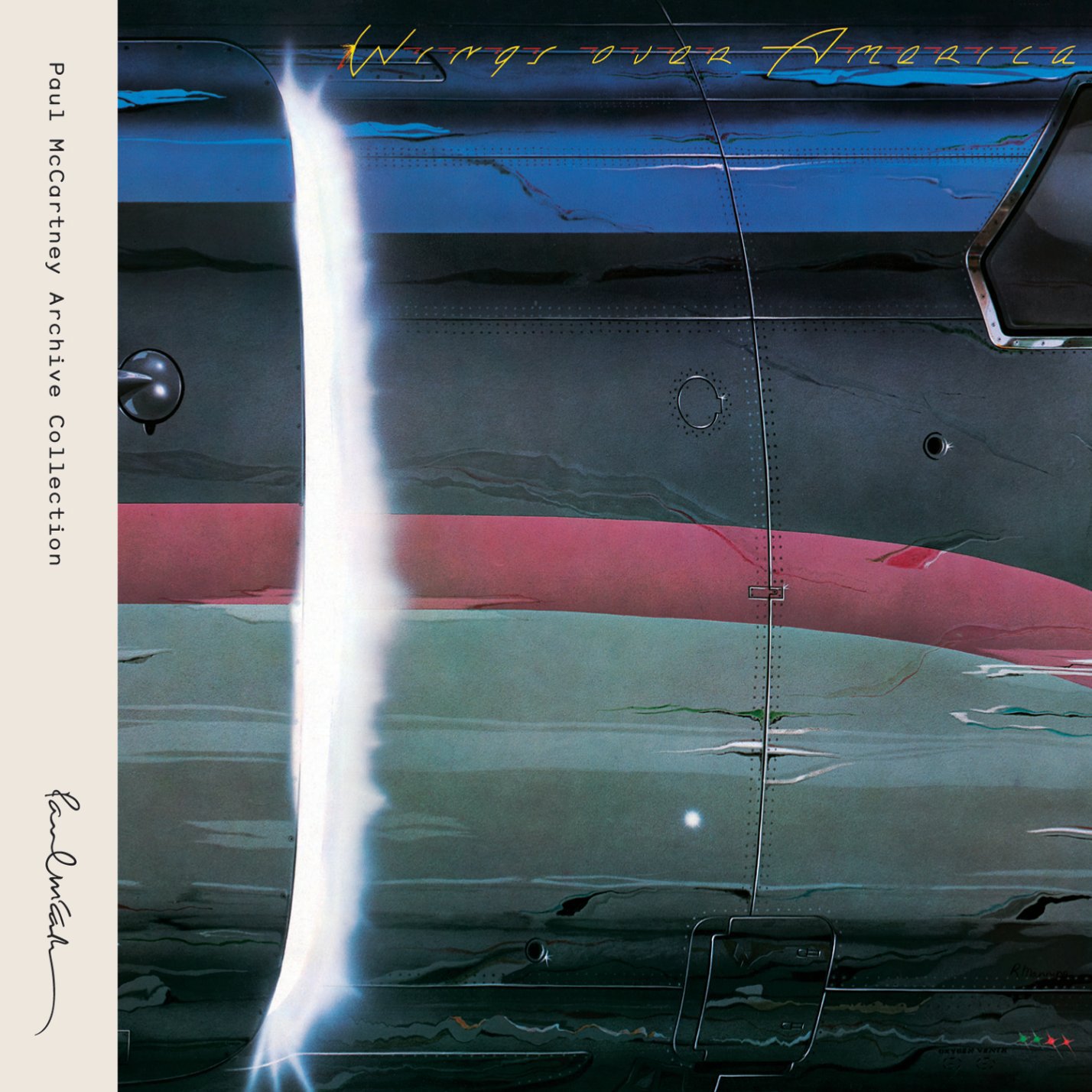
Paul McCartney backed by the most accomplished Wings line up took to the road to give epic performances across the world recorded in the summer of 1976, “Wings Over America” released on December. 10th 1976 feeling like a triumphant musical summation of the summer tour for Paul McCartney and his band Wings.
Originally, Wings over America was to be a two-record set of highlight performances but this was rethought due to the success of a bootleg called Wings from the Wings, which was released as a triple record set on red, white, and blue vinyl, and contained the entire 23r June 1976 concert recorded at The Forum in Los Angeles
In stark contrast to his modern-day globe-trotting ways, McCartney hadn’t up to this point toured the U.S.A in 10 years , and those concerts dated to his time in the Beatles. Only one of his former bandmates had even attempted such a thing. Highlights of this tour included not just the American concert debuts of a number of ’70s hits with Wings but also – and this was of particular interest at the time – Beatles favorites like “Blackbird,” “The Long and Winding Road” and “Lady Madonna” — all of which were recorded after the Beatles had stopped touring.
From the opening chords of Rock Show which sets the scene and creates plenty of anticipation, Of course, after so many successive McCartney tours since he retook the road in 1989, much of what made Wings Over America so exciting then seems like nostalgia today. It’s much easier, decades later, to separate the music from the moment. This multi-disc set can come off like the sum of its weakest parts.
The second half of Wings Over America was weaker than the first as McCartney and company delve into some of the most lightweight (but biggest selling, mind you) songs from their polyester-era oeuvre, including the smash “My Love” from 1973’s Red Rose Speedway, the 1975 Venus and Mars hit “Listen to What the Man Said,” and “Silly Love Songs” from their then just-released Wings at The Speed Of Sound.
Too often, it seems, Wings Over America threatens to run out of gas as it couples throwaways like “You Gave Me the Answer” and “Magneto and Titanium Man” or “Hi Hi Hi” and “Soily” with stronger material.
Apart from the songs, listen to McCartney’s bass playing on this record. On ‘Time To Hide’ for example. The rest of the band is also worthy of mention. Jimmy McCullough’s solo on ‘Maybe I’m Amazed’ is inspired as is his solo track ‘Medicine Jar’ from the ‘Venus And Mars’ album from 1975. So much better than the album version, not least due again to McCartney’s bass playing.
Later, the project’s reputation took a hit when it was revealed that no small amount of post-production fixes had been employed before release.
“While everybody’s parts were spot-on musically – maybe not the harmonies, maybe not every note was exactly right but the general feel was pretty good,” Wings stalwart Denny Laine said in Luca Perasi’s Paul McCartney: Recording Sessions (1969-2013). “ I had the feeling it could have been a better feeling, a fuller sound, so I double-tracked the guitars, just to fill it out [and] added little bits when you get an obvious mistake. We kept most of the solos, and most of the bass parts as it was.” Drummer Joe English put a finer point on which elements most needed to be retouched, overdubs were necessary because of “people singing out of tune – and I don’t mean Paul.”
So, maybe Wings Over America wasn’t the career exclamation point that it once seemed.
This fizzy rush of anticipation still surrounds the album’s initial trio of songs — “Venus and Mars/Rock Show” combined with incandescent take on “Jet,” even now the best opening Paul McCartney’s ever constructed. Then there’s this set’s definitive version of “Maybe I’m Amazed.” And a remarkable take on “Call Me Back Again,” from Venus and Mars with Jimmy McCulloch’s blistering guitar matched stride for stride by a tough trio of horn players led by saxophonist Thaddeus Richard.
Along the way, McCartney came to feel the Wings had finally come into their own, that fans were ready to accept them on their own terms. “I don’t know for sure, but I’ve got a feeling that they go away thinking, ‘Oh, well, it’s a band,’” “It lets them catch up. I think the press, the media is a bit behind the times, thinking about the Beatles a lot. And I think the kids go away from the show a lot hipper than even the review they’re going to read the next day.”
Wings Over America also stands as the pinnacle of Denny Laine’s often-overlooked career with Wings, from his featured vocals on “Spirits of Ancient Egypt” and “Picasso’s Last Words,” to a vital take of his Moody Blues hit “Go Now” But check out “Time to Hide,” a deep cut from Speed of Sound, where we find Laine brilliantly recapturing the raw emotion of his early R&B-sides with the Moodies.
Then, just as the mawkish distractions of “Let ‘Em In” threaten to sink the whole thing, Wings unleashes the feverish “Beware My Love” — another Speed of Sound track which, though tissue thin lyrically, begins a run of three muscular tracks that secure this album’s enduring legacy: The Venus and Mars cut “Letting Go,” which is shot through with this jagged sexuality, and then the ageless “Band on the Run.”
Two related releases followed the album: A TV documentary Wings Over The World and a film titled Rockshow purporting to contain a complete show from Seattle. it contains only five songs that were filmed at Seattle’s Kingdome the remainder of the film’s 30 songs come from the band’s New York and Los Angeles shows, these additional releases appeared three and four years, respectively, after the 1976 live album.
Musicians:
Wings
Paul McCartney – vocals,bass,guitar,piano
Linda McCartney – vocals,keyboards
Denny Laine – guitar,vocals
Jimmy McCulloch – guitar,vocals
Joe English – drums
Horn section
Tony Dorsey
Howie Casey
Steve Howard Jr.
Thaddeus Richard
thanks to Ultimate Classic Rock for some words.
 The Fat Angel Sings