Posts Tagged ‘Soulfire’

In 2017, Steven Van Zandt wanted to play the Cavern Club, the legendary Liverpool venue where the Beatles performed so many pre-fame shows. But he had a condition. When the Cavern Club reopened in the ’80s, the venue expanded to two main rooms. One tried to replicate, using original bricks, the hallowed ground where the Fab Four jammed so many times; the other had a more modern stage and has become one of the city’s top spots for local bands and touring acts. 

“When Paul McCartney played there [in 1999], he played the second, bigger room, and they assumed I wanted to do that also,” Van Zandt says. “I said, ‘No, no, I’ve got to play the room with the arches. I want to play that room that I grew up looking at.’ So we had to put the horns and girls in the hallway. Because we could barely fit the rhythm section on that stage. It’s only built for four or five people.”

Van Zandt made this Beatles fantasy come true during a stop on his European “Soulfire” tour. The singer, songwriter, guitarist and producer – and not to mention Bruce Springsteen’s right-hand man in the E Street Band – had plenty of free time when the Boss started his run on Broadway. So he hit the road with a reformed Disciples of Soul. When he booked a November date at Liverpool’s O2 Academy in 2017, he got the idea of doing a set at the Cavern earlier in the day.

“We were about to play Liverpool, and I remembered how the Beatles would play lunchtime sets,” he says. “That’s how Brian Epstein, their manager, actually saw them for the first time. From, like, 12am to 12:30am, local businesses would break for lunch and the secretaries or whomever would bring their lunches into the Cavern Club, and the Beatles would play for half an hour. I thought, just for fun, let’s do a Beatles tribute and do a lunchtime set. … I don’t think anybody has done that since the Beatles.”

Van Zandt remembers distinctly how his life was forever changed when he watched the Beatles play The Ed Sullivan Show in 1964. (He cites the Beatles and the Rolling Stones as the twin reasons he picked up a guitar and “made rock ‘n’ roll my religion.”) But just because he’s a long time devotee doesn’t mean putting together a baker’s dozen of tracks covering every era of his idols’ career was easy. The live performance, plus a duet with Paul McCartney on “I Saw Her Standing There” recorded at the Roundhouse in London, have been collected on Little Steven’s new “Macca to Mecca” CD/DVD package.

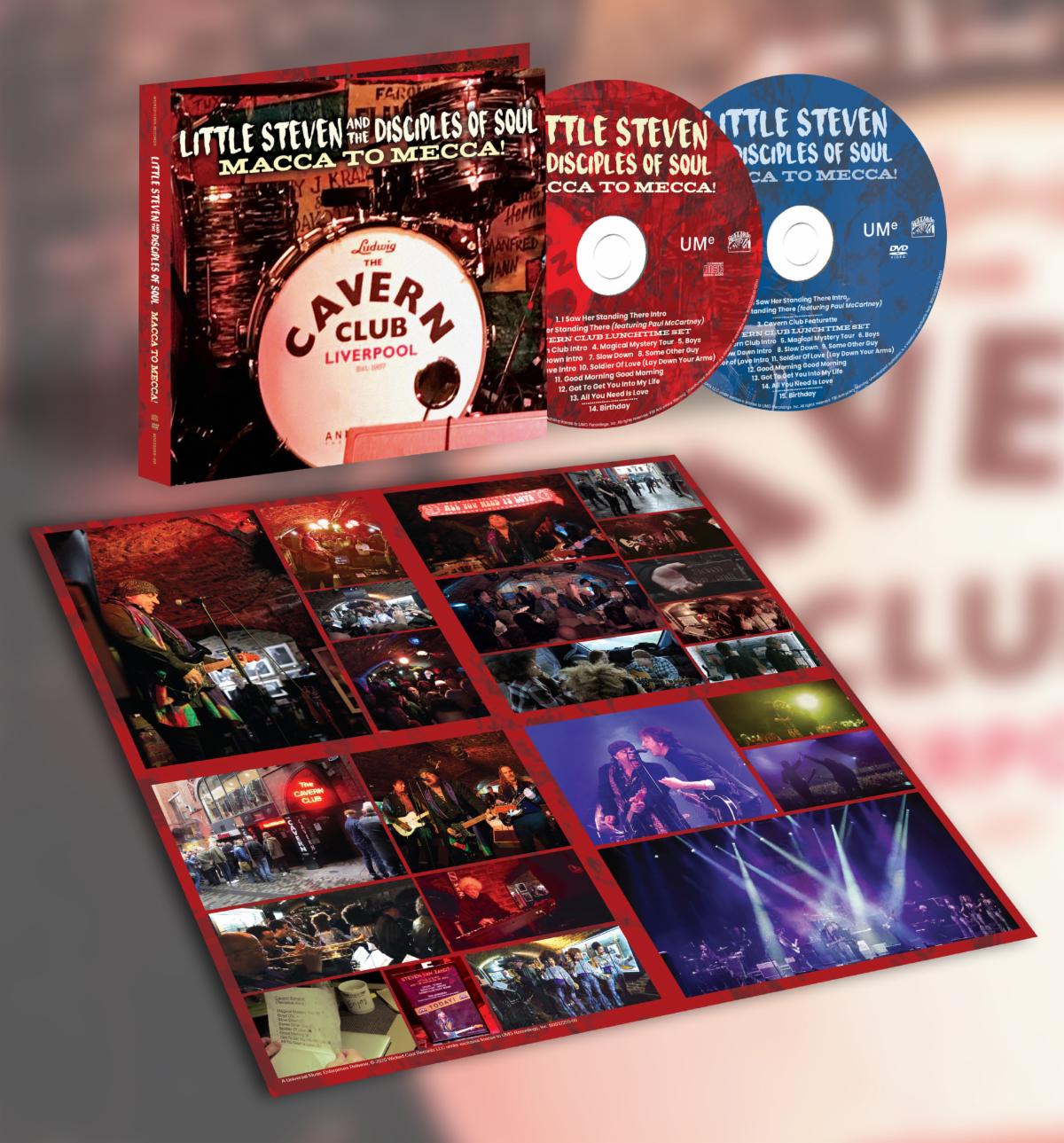
Macca To Mecca! Begins as a 12-song tribute to The Beatles that kicks off with a riveting performance of “I Saw Her Standing There” recorded at The Roundhouse in London . It is followed by an extraordinary surprise set at Liverpool’s legendary Cavern Club.  The intimate lunchtime gig is filled with rocking renditions of “Magical Mystery Tour,” “Good Morning, Good Morning,” “Got To Get You Into My Life,” and “All You Need Is Love,” alongside iconic songs famously performed by the nascent Fab Four, including “Boys” (originally by The Shirelles), “Slow Down” (by Larry Williams) and “Soldier Of Love” (first recorded by Arthur Alexander).

Little Steven Van Zandt has released Macca to Mecca, a live album honouring the music of The Beatles recorded in front of The Cavern Club, the Liverpool dive where the Fab Four famously got their start.

In the fall of 2017, when Little Steven landed in Liverpool on his sold-out European tour with his newly reformed band the Disciples of Soul in support of Soulfire, his first new album in nearly two decades, the Rock and Roll Hall of Fame musician, songwriter, and lifelong Beatles fan played a surprise, afternoon set outside of the legendary Cavern Club. “Playing in the same venue where The Beatles started their careers was a childhood dream of mine come true,” says Van Zandt in a statement. “This was a band that set me on course for a life of music. For my rock ‘n’ roll religion, The Cavern is the first sacred site (after the 4 clubs in Hamburg they played!). It was an honour – no, make that an epiphany – to perform there.”

The performance at the Cavern Club was professionally recorded and filmed, with the audio and video initially included exclusively as part of the Soulfire Live! box set. Macca To Mecca, available now via Wicked Cool Records/UMe.

“I wanted to do covers that they had done at the Cavern … songs from [rock ‘n’ roll pioneer] Larry Williams and [country soul legend] Arthur Alexander and some of those things,” he says. “Because I had the horns, I thought, ‘Let’s do Beatles songs with horns.’ … The horn parts in Magical Mystery Tour are quite sophisticated, and my horn section handled it quite well, but, man … some of the stuff was tricky. ‘All You Need Is Love’ has quite a bit going on. It was a bit of a challenge, but I think we met the challenge.”

For Van Zandt, the Cavern gig was the culmination of an obsession kicked into high gear when he started traveling across the Atlantic for Springsteen tours. “When I first got to England, I ran to Liverpool to see all the famous sites that I had wanted to see growing up,” Van Zandt explains. “But when I got to the Cavern, it was a parking lot. They had paved over it. Then they realized the error of their ways and rebuilt it with a lot of the same bricks … on pretty much the same site.”

Macca To Mecca includes the complete Cavern Club concert in both video and audio, exclusive interviews, behind-the-scenes footage and a special documentary that sees Van Zandt honoured with a brick in the club’s hallowed Wall of Fame before leading his band through swift rehearsals of Beatles songs mere minutes ahead of their performance.

Macca To Mecca, available now via Wicked Cool Records/UMe.

Steven Van Zandt – known widely in music circles as Little Steven and Bruce fans as Miami Steve, among other sobriquets – is something of a New Jersey renaissance man, yet he’s never been one to really seek the spotlight.

Whether it’s his long-standing role as Bruce Springsteen’s right-hand man in The E Street Band – it was Van Zandt himself who gifted him the nickname “The Boss” – or in his lauded TV role as Silvio Dante in The Sopranos, he’s usually happy playing sideman to bigger names, a role he carries off with a humble aplomb.

There are, of course, exceptions to every rule – he had the lead role in short-lived Norwegian-American gangster series Lilyhammer, and he hosts his own beloved Underground Garage radio show which is syndicated all over the world – but mainly Van Zandt is happy to eschew the limelight and leave the grandstanding to others.

Little Steven & The Disciples Of Soul covering The Southside Johnny and Asbury Jukes classic, “I Don’t Wanna Go Home”, performed by Little Steven & The Disciples of Soul at BluesFest 2016.

https://www.youtube.com/watch?v=kjprd4fFBI8

But with The Boss a couple of years ago deciding to make a lengthy one-man stand on Broadway and his acting commitments having temporarily dried up, Van Zandt found himself reviving the ‘80s outfit he’d formed during another hiatus from The E Street Band – this time when Springsteen was assembling his 1982 solo masterpiece Nebraska – namely Little Steven & The Disciples Of Soul.

His solo project had found him returning to the Jersey Shore sound that Van Zandt had helped formulate back in the ‘70s, first with his early group Southside Johnny & The Asbury Jukes and then on the early Springsteen records (which he largely arranged), and then over the course of a number of staggered albums taking that sound into new and routinely fascinating places.

Yet he’d barely even considered that body of work for 20 years when in mid-2016 he was randomly invited by a London promoter to appear at a UK blues festival, after which he pulled a new version of the band together and hasn’t looked back. Since then the band has two new albums to their name – Soulfire (2017) and Summer Of Sorcery (2019) – and has been touring ever since to global acclaim, something Van Zandt had never envisaged happening again.

“Yeah, it’s been quite an experience and I’m very, very happy I did it,” he chuckles. “It was fortunate, Bruce decided to spend some time on Broadway and I didn’t have a new TV show going, so just through those random circumstances I ended up revisiting my own work, and I found it to be really quite rewarding.

“I hadn’t realised the value of the stuff and how well it all held up and how it had kinda become its own genre through the years, that ‘50s rock-meets-soul thing which at this point is quite unique.

“So it’s just been fun to revisit your stuff and try and reconnect with an audience again and see how the stuff holds up. It’s been quite a year-and-a-half of exploration and discovery and it’s been a very, very satisfying response from the audience – the audiences have been going crazy!”

The Disciples Of Soul are a 15-piece powerhouse, but Van Zandt is like a pig in mud back putting their massive sound together.

“The arranging is the fun part,” he smiles. “I’ve been using five horns ever since we put together Southside Johnny & The Asbury Jukes really which was mid-‘70s, and then I carried that same sound into my first solo album in ’82. Then the rest of my solo albums are all very different from each other, so I just went back to it recently.

“Plus I recently produced an album for the great Darlene Love and she had these great background singers so I fell in love with background vocals, so that’s the one thing I’ve added to my sound now. I just thoroughly enjoy the horn parts and the string parts and the background vocal parts all being woven together and complementing each other, and making sure that they all work together and don’t step on each other and don’t cancel each other out and they all work dynamically: that’s the fun part for me.”

And being in the spotlight again? Little Steven is fine with it, but you can tell that he’s still taking on such prominence reluctantly.

“I’ve never really needed it, my inclination is to be behind the scenes,” he reflects. “I’m really a producer at heart – that’s how I describe myself. I really am a producer first, but I am a performer and I do enjoy being a sideman.

“Even as a frontman I got really quite good at it in the ’80s – you get used to it and you get good at it – and I’m almost halfway back to being a frontman, I’m not all the way there yet. I’m working my way back because it’s a big mountain to climb, man, it’s a whole different job and you actually have to work for a living as opposed to being ‘the guitar player’ where you can just muck around.”

https://www.youtube.com/watch?v=3t–YaBT1Vc

Van Zandt is famously well versed in many different types of music – as well as the Jersey Shore sound he helped found, he’s a noted rock’n’roll aficionado and curates satellite radio stations covering both garage-rock and outlaw country – and he puts these disparate passions in part down to the timing of his earliest musical forays.

“I think growing up when we did, it was an extraordinary period of time,” he marvels. “It was an absolute renaissance in the sense that the greatest music being made was also the most commercial, which we’ll never see again or not for hundreds of years, I think.

“More than that, we were, in a funny way, pretty much a monoculture back then and the trends would come and go year by year: in ’64 everyone’s into the British Invasion, in ’65 everybody is into folk-rock and that’s when The Byrds and Bob Dylan started, in ’66 it might have been country-rock so everybody gets into country music and then it was jazz-rock so everybody gets into jazz, and then in ’67 it’s psychedelic-rock so everyone gets into that – and I mean everybody! – and then in ’68 blues-rock came in and everybody got into blues, and then the final trend of the ‘60s in ’69 was southern-rock, which is more rootsy and Americana and The Band and Delaney & Bonnie and Taj Mahal and The Youngbloods and people like that.

“And believe it or not most musicians would follow from one trend to the other and you’d pick up some pieces of it – you’d take some of it for your own identity – and then some would stay in it: some would get to country-rock and they’d stay there, some would get to blues and they would stay there for the rest of their career. But a lot of us would go from one to the next, and you’d learn that genre and pick up what you want from it for your own identity and then you’d move on to the next one.

“So I think partially it was a result of growing up in that time, when things went from one trend to another and we were all going to school without knowing we were going to school. Parts of each genre stick with you and in the end you tend to just appreciate greatness whenever you hear it, it doesn’t matter what genre it is really. Even if it’s not a genre that you’re particularly fond of or use for your own identity, greatness is greatness and you recognise it and you appreciate it. I think that’s what’s stuck with me all these years.”

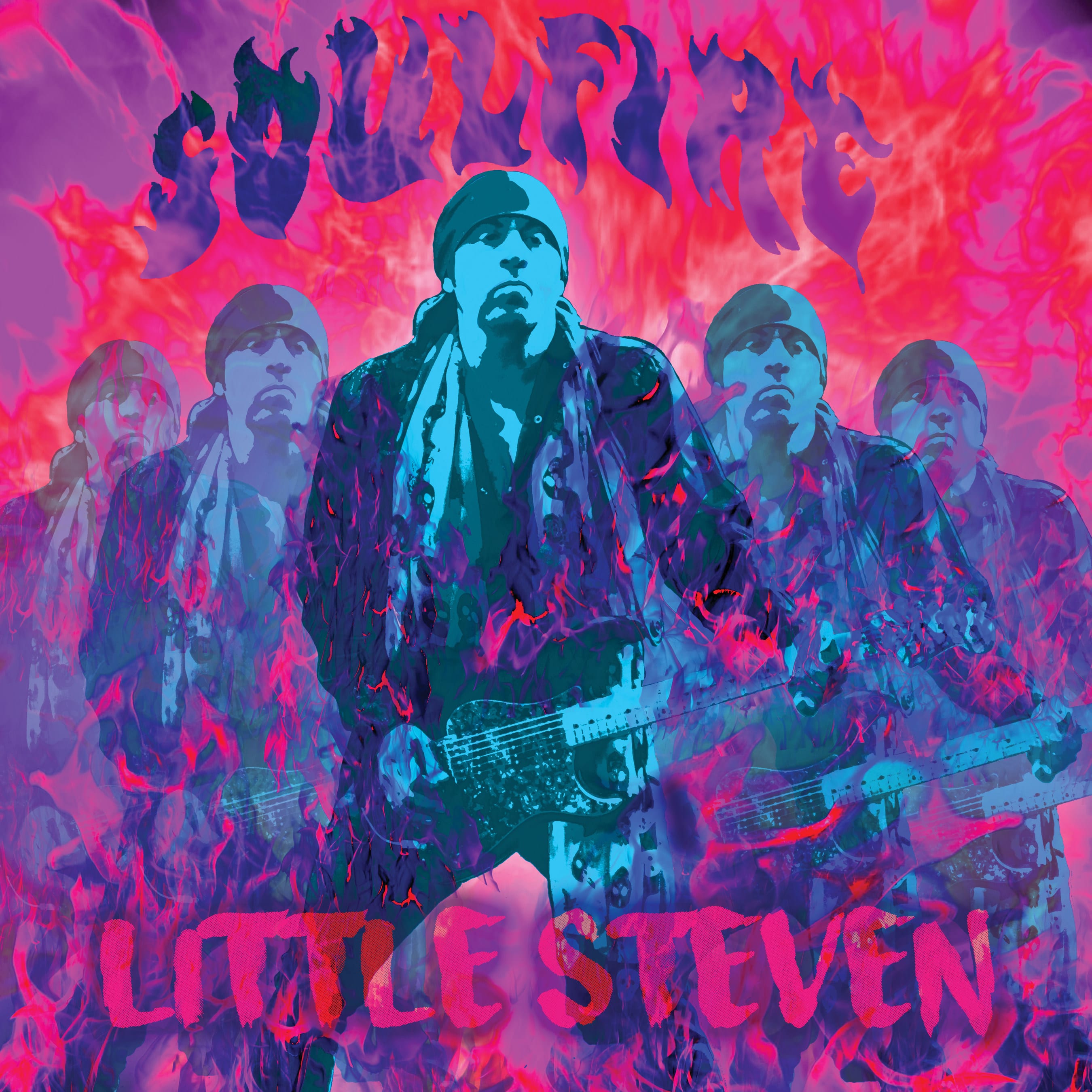
The E Street Band member and Underground Garage presenter returns with his first solo album in two decades, featuring the lead off single “St. Valentine’s Day” and a revival of Little Steven and Bruce Springsteen’s classic song for Southside Johnny, “Love on the Wrong Side of Town.”  Available now on CD, DD and LP.

Bruce Springsteen’s longtime right hand man/shotgun riding guitarist and occasional actor’s first solo stab in nearly two decades . If, as Steven Van Zandt says in the press notes accompanying the release “This record is me doing me,” .

It’s impossible not to hear the Southside Johnny blueprint of horn-bolstered classic R&B on Soulfire, both in the boisterous, brassy arrangements and Steve Van Zandt’s vocals that are often so similar to Johnny’s . Additionally, Steven recreates five songs he wrote for various Southside albums in arrangements that hew closely to the first versions. Other tunes have already appeared on albums from Gary U.S. Bonds and The Cocktail Slippers, a band on Van Zandt’s Wicked Cool record label.

None of this is a deal breaker though. Little Steven and his Disciple of Souls backing unit attack the material with the fever, fervor and, well, fire of Springsteen at his most soulful. These recordings crackle and explode out of the speakers with a wall of sound approach that brings a widescreen audio ferocity to the hour-long program that never lets up. The cinematic association is particularly relevant on a cover of James Brown’s “Down and Out in New York City” from Brown’s Black Caesar soundtrack where Steven sharply recreates the “blaxploitation” sound — right down to the wah-wah guitar, horns and strings — first popularized with Isaac Hayes’ music for Shaft.

Elsewhere, Steven revisits his doo-wop roots on “The City Weeps Tonight,” a tune he had planned for his 1982 debut but recently finished, and charges head-first into “I Saw the Light” (not the Todd Rundgren hit), that would have fit perfectly on any of the first three Asbury Jukes albums. He takes a rugged Chicago blues rock excursion on “The Blues is My Business,” initially performed by Etta James, and sets the album’s tone on the opening rugged funky/soulful title track with gospel backing female singers. While adding the now classic “I Don’t Want to Go Home” to the track listing brings Steven’s career full circle (it was the first song he wrote), 

Regardless, it’s hard to imagine a more joyous and revelatory contemporary blue-eyed soul recording. The appropriately titled Soulfire is a tough, tight and clearly inspired project as well as a most welcome return from the musical shadows for Steven Van Zandt.