Posts Tagged ‘Roger Daltrey’

tommy

Pete Townshend‘s masterpiece is as much a defining part of the late ’60s as Vietnam and Woodstock. Its story — about a deaf, dumb and blind boy  turns hippie idealism into a messianic fable of acceptance and rejection. But it’s the music, constructed as a rock opera complete with an overture and recurring musical themes, that holds together this double-record epic.

Perhaps it’s the original rock opera “Tommy”, released in 1969, composed by Pete Townshend and performed by The Who. This acclaimed work was presented over two LPs and it took the idea of thematically based albums to a much higher appreciation by both critics and the public. It was also the first story-based concept album of the rock era to enjoy commercial success. The Who went on to further explorations of the concept album format with their follow-up project “Lifehouse”, which was abandoned before completion, and with their 1973 rock opera, “Quadrophenia”.

After the witty, but flawed The Who Sell Out, The Who still hadn’t been really accepted as a serious album act. That was it, if they were going to conquer the world, they were going to have to use the big guns. It was time for the rock opera. While there had been concept albums before, none of them had been on this scale, Tommy was a double album meditation on loneliness, murder, child abuse, spritual guff, rejection and and a whole host of other weird stuff. On top of this it also had some fantastic tunes and was easily the best Who album to date.

Tommy as a little boy see’s his father murdered by his mother and her lover. He is told to never say he saw it or heard it. Tommy, being deaf, dumb, and blind learns to play pinball by sense of smell and touch soon master’s the game.
Tommy as an adult becomes famous for his pinball prowess and quickly gains a mass following. By the end of the Opera Tommy’s follower’s turn on him, as they get sick of all of the rules he give’s.

Townshend’s desire for this album to be taken seriously is underlined by the instrumental passages “Overture” and “Sparks”, though admittedly the ambitious “Underture” was far too long for its own good. Most of the characters in this cantata are given voice by Roger Daltrey, though each member of the band seems to get to voice at least one character. As many of the songs on Tommy are a part of the much bigger narrative, there’s actually not that many songs that work well as stand-alone tunes, with only the rocking “Pinball Wizard” and to a lesser extent “Sally Simpson” able to thrive outside of the confines of the parent album.

Tommy is an album you have to listen in totality. There’s no point in which you can happily let your mind wander, other than “Underture”, which probably explains why it is one of the most popular tracks on the album (i.e. it gives you chance to put the kettle on). Arguably the thing that makes Tommy work was the drive and ambition of Pete Townshend and the fact at this stage in their career, The Who were a particularly well-drilled band, capable of making a good job of almost anything thrown at them.

Of course since its release Tommy has inspired countless bands to attempt ill-conceived and frankly tedious concept albums, all trying to be hugely significant and open the doors of perception. Ultimately Tommy is a much more intelligent and creative album than its questionable legacy suggests.

On (May 23rd) in 1969: The Who released their classic album ‘Tommy’ (Track Records in the UK/Decca Records in the US), a full-blown ‘rock opera’ about a deaf, dumb & blind boy that launched the band to international superstardom; written almost entirely by Pete Townshend, his ability to construct a lengthy conceptual narrative brought new possibilities to rock music; despite the complexity involved, he & the band never lost sight of solid pop melodies, harmonies & forceful instrumentation, imbuing the material with a suitably powerful grace the album has sold over 20 million copies worldwide…

The Who – Rock Opera Tommy – Full Concert – 1989 – Live performance in Los Angeles at the Universal Amphitheater The Los Angeles version of this show featured Phil Collins as Uncle Ernie, Patti LaBelle as the Acid Queen, Steve Winwood as the Hawker, Elton John as the Pinball Wizard and Billy Idol as Cousin Kevin

The Band

Roger Daltry (Vocals) Peter Townsend (Vocals/ Guitar) John Entwistle (Vocals Bass) Phil Collins, Billy Idol, Elton John, Patti LaBelle, Steve Winwood Simon Phillips (drums) Steve Boltz Bolton (Guitar) John Rabbit Bundrick (Keyboards) Roddy Lorimor (trumpet) Jody Linscott (Percussion) Simon Clarke (Saxophone) Tim Sanders (Saxophone) Niel Sidwell (Trombone) Simon Gardner (Trumpet) Chyna (Vocals) Cleveland (Vocals) Billy Nichols (Vocals)

Image may contain: text

On 1st June a week before Roger Daltrey begins a tour where he’ll perform Tommy with an orchestra, the Who vocalist will release “As Long as I Have You”. This will be Daltrey’s first record  in four years since Going Back Home, his collaboration with Dr. Feelgood guitarist Wilko Johnson.

The album is a mixture of self-penned tracks such as ‘Certified Rose’ and the soulful ballad ‘Always Heading Home’ along with songs that have inspired Daltrey over the years including Nick Cave’s ‘Into My Arms’, ‘You Haven’t Done Nothing’ by Stevie Wonder, Stephen Stills’ ‘How Far’ and the title track originally recorded by Garnet Mimms in 1964; the year that Daltrey, Townshend, Entwistle and Moon changed their name from The High Numbers and became The Who.

It’s a return to his roots mixed with the wisdom that can only come with age. “This is a return to the very beginning, to the time before Pete [Townshend] started writing our songs to a time when we were a teenage band playing soul music to small crowds in church halls.

Daltrey said in a statement. “That’s what we were, a soul band,” he continued. “And now, I can sing soul with all the experience you need to sing it. Life puts the soul in. I’ve always sung from the heart but when you’re 19, you haven’t had the life experience with all its emotional trials and traumas that you have by the time you get to my age. You carry all the emotional bruises of life and when you sing these songs, those emotions are in your voice. You feel the pain of a lost love. You feel it and you sing it and that’s soul. For a long time, I’ve wanted to return to the simplicity of these songs, to show people my voice, a voice they won’t have heard before. It felt like the right time. It’s where I am, looking back to that time, looking across all those years but also being here, now, in the soulful moment”

Daltrey worked with a band that includes former Style Council keyboardist Mick Talbot and Sean Genockey on lead guitar. Townshend contributed guitar on seven tracks, and noted that the record “shows Roger at the height of his powers as a vocalist.” .

Image may contain: text

Image result for the who my generation record sleeve images

The Who have long held a reputation for being a ferocious live band, but a performance on The Smothers Brothers Comedy Hour back in the ’60s resulted in one of the most memorable performances of all time. See, drummer Keith Moon always had a penchant for the extreme, but it was during this performance that he decided the band needed to end their live show with a bang… literally.

Bribing a stage hand to fill his drum kit with explosives, Keith Moon was set to make his drum kit explode at the end of the song. However, unbeknownst to almost everyone, the stagehand filled the drum kit with more than ten times the amount of explosives required. The resulting detonation was enough to almost destroy the stage, and to give guitarist Pete Townshend permanent hearing loss in one ear.

Along with tracks like ‘You Really Got Me’ by The Kinks, ‘My Generation’ was instrumental in forging the foundation for garage and punk rock. The dirty production, garagey arrangement, and defiant lyrics make this slice of proto-punk one of modern music’s most enduring youth anthems.

My Generation” by the English rock band The Who, which became a hit and one of their most recognisable songs. The song was named the 11th greatest song and among 100 greatest songs of all time. 

The song has been said to have “encapsulated the angst of being a teenager,” and has been characterized as a “nod to the mod counterculture” Originally released as a single on 29th October 1965, reaching No. 2 in the UK, The Who’s highest charting single in their home country,  “My Generation” also appeared on The Who’s 1965 debut titled album, My Generation  and The Who Sings My Generation in the United States , and in greatly extended form on their live album Live at Leeds (1970). The Who re-recorded the song for the Ready Steady Who! EP in 1966, but it was not included on the EP, and this version was released only in 1995 on the remastered version of the A Quick One album. The main difference between this version and the original is that instead of the hail of feedback which ends the original, the band play a chaotic rendition of Edward Elgar’s “Land of Hope and Glory.” In the album’s liner notes the song is credited to both Townshend and Elgar.

But when guitarist and songwriter Pete Townsend was first penning the classic tune, it sounded more akin to later hit ‘Magic Bus’, consisting of shuffling acoustic guitar and a reverb-laden call-and-response section. Townshend reportedly wrote the song on a train and is said to have been inspired by the Queen Mother who is alleged to have had Townshend’s 1935 Packard hearse towed off a street in Belgravia because she was offended by the sight of it during her daily drive through the neighbourhood. Townshend has also credited Mose Allison’s “Young Man Blues” as the inspiration for the song, saying “Without Mose I wouldn’t have written ‘My Generation’.”  Townshend  said that “‘My Generation’ was very much about trying to find a place in society.

An aspect of The Who’s “My Generation” is Daltrey’s delivery: an angry and frustrated stutter. Various stories exist as to the reason for this distinct delivery. One is that the song began as a slow talking blues number without the stutter (in the 1970s it was sometimes performed as such, but with the stutter, as “My Generation Blues” , but after being inspired by John Lee Hooker’s “Stuttering Blues,” Townshend reworked the song into its present form. Another reason is that it was suggested to Daltrey that he stutter to sound like a British mod on speed. It is also proposed, albeit less frequently, that the stutter was introduced to give the group a framework for implying an expletive in the lyrics: “Why don’t you all fff… fade away!” However, producer Shel Talmy insisted it was simply “one of those happy accidents” that he thought they should keep. Roger Daltrey has also commented that he had not rehearsed the song prior to the recording, was nervous, and he was unable to hear his own voice through the monitors. The stutter came about as he tried to fit the lyrics to the music as best he could, and the band decided it worked well enough to keep. The BBC initially refused to play “My Generation” because it did not want to offend people who stutter, but it reversed its decision after the song became more popular.

The instrumentation of the song duly reflects the lyrics: fast and aggressive. Significantly, “My Generation” also featured one of the first bass solos in rock history. This was played by Entwistle on his Fender Jazz Bass, rather than the Danelectro bass he wanted to use; after buying three Danelectros with rare thin strings that kept breaking easily (and were not available separately), a frustrated Entwistle used his Fender strung with nylon tapewound strings and was forced to simplify the solo. The song’s coda features drumming from Keith Moon, as well, whereupon the song breaks down in spurts of guitar feedback from Townshend’s Rickenbacker, rather than fading out or ending cleanly on the tonic. There are two guitar parts. The basic instrumental track (as reflected on the instrumental version on the My Generation Deluxe edition) followed by Townshend’s overdubs including the furious feedback on the outro.

https://www.youtube.com/watch?v=F03a-EYvifU

The Who
  • Roger Daltrey – lead vocals
  • Pete Townshend – guitar, backing vocals
  • John Entwistle – bass, backing vocals
  • Keith Moon – drums

Image result for the who roger daltrey 1973 images

The final night of the North American tour, was when The Who took to the stage of the Capital Center in Largo, Maryland before another sold-out house. This show, like the preceding show in Philadelphia two nights prior, was recorded by the King Biscuit Flower Hour. These historical recordings have been the source of collector confusion and the subject of debate for nearly 35 years. While PA system issues are apparent and the band is struggling with problems both on and off the stage, here for the first time ever, are the nearly complete direct recordings from this final night of The North American tour, including all the Quadrophenia songs performed that evening. Much like the Philadelphia gig two nights prior, this performance kicks off with a double dose of primal Who, first with the opener “I Can’t Explain” followed by a ferocious “Summertime Blues” to warm things up. Next up is another enjoyably expanded version of John Entwhistle’s “My Wife,” before they cap off this initial segment with the signature song, “My Generation.” Both feature impressive instrumental exchanges between Townshend, Entwhistle and Moon, with the latter taken at a furious tempo and pummeling in its delivery.

The next hour is devoted exclusively to Quadrophenia or as Daltrey jokingly mentions in his introduction, “what’s left of it.” The band had been trimming it down since the tour began and the opening “I Am The Sea” tape sequences had been problematic. On this final night in America, they forego it completely and instead launch directly into “The Real Me” to kick it off, followed by “The Punk And The Godfather.” As the storyline progresses, the crowd continues to surge toward the stage, which doesn’t go unnoticed by the band. Several times during Quadrophenia both Daltrey and Townshend implore the audience to relax and move back as fans were being crushed against the stage. After addressing this, Townshend continues with his introduction to “I’m One.” Similar in structure to “Behind Blue Eyes,” this begins as a solo vehicle for Townshend’s voice and guitar alone, before the entire group kicks in to dramatic effect. The remainder of the Quadrophenia material features plenty of great ensemble playing, but the problems continue in front of the stage and one can sense the band is distracted. The performance of “5:15” is quite good and a marathon take of “Drowned” never loses its energy. “Bell Boy,” again features Keith Moon altering his lyrics to recall the hotel room destroyed in Montreal earlier that week. Despite the technical limitations of the equipment, which are more prominent during this latter part of the Quadrophenia presentation, the band concludes with a fine performance of “Dr. Jimmy” followed by a majestic “Love, Reign O’er Me” that has Daltrey’s raw vocals echoing throughout the mammoth hall. It’s a strong finale to a difficult performance. As the audience roars, Daltrey addresses them in regards to this being their last night in America. He mentions the ups and downs of this tour and makes a point to debunk then prominent press rumors that this would be The Who’s last tour. As if to hammer this message home, they launch into a powerful “Won’t Get Fooled Again.” As icing on the cake, they cap it all off with two classic tracks from Townshend’s earlier magnum opus, Tommy. First by way of a frenetic rendition of “Pinball Wizard,” followed by a wild finale of “See Me Feel Me” to end the night and the 1973 North American tour.

https://www.youtube.com/watch?v=mziRZXyS1rk

King Biscuit Introduction

Setlist:

I Can’t Explain Summertime Blues My Wife My Generation Quadrophenia Introduction The Real Me I’m One Sea And Sand Drowned Bell Boy Doctor Jimmy Won’t Get Fooled Again Pinball Wizard See Me Feel Me

Roger Daltrey – vocals, harmonica; John Entwistle – vocals, bass; Keith Moon – vocals, drums; Pete Townshend – vocals, guitar

Universal Music will issue The Who “Live at the Fillmore East 1968” in April, a set of unreleased recordings from the second of two nights played at Bill Graham’s legendary, but short-lived, venue in the Lower East Side of Manhattan. An oft-bootleg concert by the Who will soon gets its first official release. Live at the Fillmore East 1968, which documents the last show of a two-night stand at the New York venue.

The two-disc, three-LP set, whose track listing is below, focuses largely on material from their two previous records, The Who Sell Out and A Quick One. But there are also three Eddie Cochran covers — “Summertime Blues,” “C’mon Everybody” and “My Way” plus takes on Benny Spellman’s Allen Toussaint-penned “Fortune Teller” and Johnny Kidd and the Pirates’ “Shakin’ All Over,” and a lengthy version of “My Generation.”.
The Who’s manager Kit Lambert had recorded both the 5th and 6th of April shows of ’68 with a view to issuing as The Who’s fourth album after “The Who Sell Out”That never happened, but 50 years later sound engineer Bob Pridden (who was there in 1968) has restored and mixed songs from the 6 April show for this new archival release.

The Who headlined the Fillmore East with Free Spirits and Buddy Guy opening.

The second night of The Who’s first run ever playing at the Fillmore East is an unbelievably great document of the band in its early prime, still full of the punk attitude that they would initially define while beginning to venture off into more artistic and experimental territory. Every minute of this performance is fascinating and much of this material has never been released, This set captures the entire band fully engaged in their music. Although many songs were still short and concise during this stage of their career, the intensity level is undeniable. Opening the show with Eddie Cochran’s “Summertime Blues,” they immediately set a bar that most other bands could never even approach.

Their second song of this set is the Stones‘ cover of the Allen Toussaint penned “Fortune Teller” which they had just performed for the first time ever the previous night.

They continue with “I Can’t Explain,” one of the few songs American audiences were familiar with at the time, but with a new level of aggression that wasn’t apparent on that early single. Next up is their current single at the time, “Happy Jack,” a tune that found them exploring new directions and beginning to experiment with dynamic changes. Extremely rare live performances of “Relax” and “My Way” follow and continue to explore and expand on the boundaries within the band’s music. “Relax” surprisingly turns out to be one of the heavier numbers on this set and the band takes flight into some inspired jamming following the verses. Unfortunately, the jam fades out and is incomplete.

John Entwistle then steps up for his defining song, “Boris The Spider,” lending his dark sense of humor to the proceedings. At this point, the band launches into “My Generation” and this version is amazing. The improvisational section following the verses is a great early example of the band letting the music propel itself. Although at times it seems like they are on the verge of being out of control, they never are, and early signs of Townshend developing themes within a jam are also surfacing. The approach to their instruments and the sound they create as a unit is utterly unique and unlike any other band at that time. The reels were changed during this jam, so a small part of it is missing on this recording.

This surely must have left the audience breathless, so while they were recovering, the band embarks on their most experimental composition yet, “A Quick One While He’s Away,” which is incomplete and begins in the middle of the song. This adventurous suite of songs, loosely tied together, is a hint at Townshend’s future aspirations that would eventually be realized in his first full-blown rock opera, Tommy. This is a fascinating performance for its entire eight minutes.

They close their set this night with another propulsive jam on “Shakin’ All Over,” again letting the music propel the band through several pulverizing jams, including spontaneous flailing of riffs familiar from other songs. Again, the raw energy is astounding. This and the previous night’s performance must have gone a long way towards cementing their reputation in New York City. This should be required listening for anyone interested in that era of rock music and especially for anyone interested in The Who this is absolutely essential.

Pete Townshend – guitar, vocals; Roger Daltrey – vocals; John Entwistle – bass; Keith Moon – drums

The Who Live at Fillmore East 1968 will be released on 20th April 2018. Amazon UK have a remarkably cheap pre-order price for the 2CD edition. Who fans should also note that an expanded 2CD deluxe edition of Pete Townshend‘s solo album “Who Came First” will be issued a week earlier on 13th April.

The Who / Tommy Live at the Royal Albert Hall

The Who performed their rock opera Tommy live and in its entirety, for the first time back in April this year, at the Royal Albert Hall. That concert is being issued on DVD and blu-ray with the audio available on CD and vinyl packages.
The performance of the 1969 album was in aid of Teenage Cancer Trust, a charity Roger Daltrey and Pete Townshend have supported for a very long time. The band have performed Tommy in the past, but crucially they always dropped a handful of tracks. This time it was different and the whole album was performed – and enhanced by specially created animations. After the performance, the band (inevitably) treated the audience to a short set of Who classics!

The Who – Tommy Live At The Royal Albert Hall is release on all formats on 13th October 2017. The audio from this special occasion is being issued on two-CD and three-LP vinyl, while the entire concert is being issued on blu-ray and DVD. Interestingly, there are no audio/video ‘bundles’ or deluxe editions

On 1st April 2017, The Who took to the stage at London’s Royal Albert Hall to deliver a blistering performance of their legendary rock opera, Tommy. Written by Pete Townshend almost 50 years ago, the full length piece had, until then, never been performed live by the band. In a rare treat for fans, The Who decided to perform Tommy for the first time ever in its entirety for their participation in the annual Teenage Cancer Trust benefit shows. These shows are produced every year by Roger Daltrey at the iconic Royal Albert Hall to raise essential funds for the specialist treatment of young people with cancer.

Music video by The Who performing Tommy Live At The Royal Albert Hall.

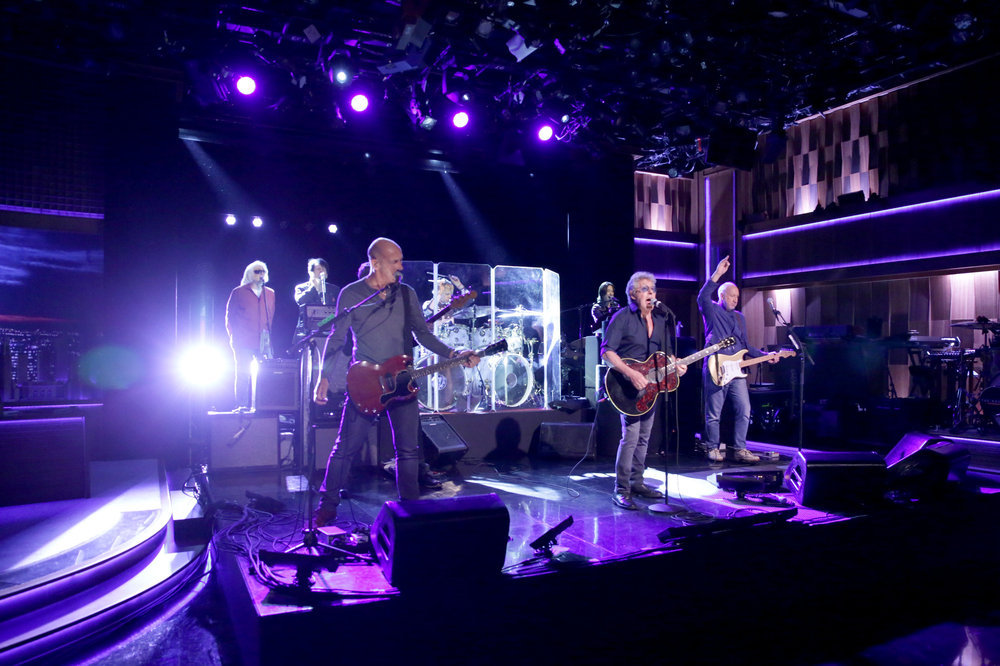
Even today, The Who are one of the most prolific rock bands in the history of rock n’ roll. From Roger Daltry’s dazzling vocals, to Pete Townshend’s iconic windmill guitar playing style, The Who have managed to remain relevant decades after their debut.  The Who delivered performed two classic tracks the rock outfit opened with “I Can See for Miles” from 1967’s The Who Sell Outtreading deftly through the track’s simmering verses and building to each bombastic chorus. Before the final refrain, guitarist Pete Townshend even pulled out his best trick, unleashing a nifty triple windmill.

Check out their amazing performance Music guest The Who performs “I Can See for Miles” for the Tonight Show audience.

https://www.youtube.com/watch?v=CKfYR0dG7s4

Recently, The Who made an appearance on The Tonight Show With Jimmy Fallonand proved they’ve still got it with an electrifying performance of their smash hit “I Can See For Miles.” The band sounds as tight as ever, with Daltrey’s voice sounding as great as it did in 1981, and Pete even busts out his signature windmill. Fallon’s “Tonight” crowd is mesmerized throughout the entire set, and although The Who don’t smash their instruments and destroy the stage like they used to, they still managed to bring a hell of a lot of energy!

The Who then jumped forward a few decades for a performance of “You Better You Bet” off 1981’s Face Dances. Amidst the steady guitars and twinkling synths of the pop rock tune, singer Roger Daltrey delivered mighty vocals.

Music guest The Who performs “You Better You Bet” in this exclusive Tonight Show performance extra.

https://www.youtube.com/watch?v=4JdPzrq_ayw

'The Who Sings My Generation'

The WHO – My Generation (1965) debut album

The Who…  The vinyl reappearances of My Generation (the U.K. edition), A Quick One  and the glorious The Who Sell Out simply catapulted me back to the age of 14 when these albums were the most important to ever come into my life.  To revisit them they way I first heard them was as thrilling now as it was then – except now, I’m 50 years old, Keith and John are long-deceased and Pete and Roger are celebrating their 50th anniversary as The Who.  Nonetheless, these three albums should be the cornerstone for teaching your children about rock & roll, about playing guitar, plus the first steps to songwriting and are for all time, essential listening:

My-Generation-SDE-3D-Packshot600 (1)

Super Deluxe Edition featuring unreleased songs, demos, mixes, remasters, new notes from Pete Townshend, an 80-page book, rare memorabilia and much more!

5-CD Super Deluxe box set, 3-LP Edition* and 2-LP Edition*

In the half century since its release The Who’s debut album “My Generation” has lost none of it’s raw visceral power and still stands as the ultimate musical declaration of teenage rebellion. The title track alone has been covered innumerable times by the likes of Oasis, Green Day, Patti Smith, Billy Joel, Alice Cooper and Iron Maiden amongst many more. Back in 1965 the band were considered to be so dangerous that the tailors tasked with turning a Union Jack into a pop art mod jacket for the cover feared that they would be jailed for desecration of the nation’s flag.

Brunswick Records first issued My Generation in the UK in December 1965, and later in the US, under the title The Who Sings My Generation, in April 1966. It was produced by Shel Talmy who shot to fame with his work with The Kinks, a group that the teenage Pete Townshend admired greatly.

During a break in touring in 2015 Pete Townshend discovered tapes in his audio archive featuring previously unheard demos for the album which also included three totally unreleased songs that the other members of The Who hadn’t ever even heard, ‘The Girls I Could Have Had’,  ‘As Children We Grew’and ‘My Own Love’.

The spectacular 79-track five disc super-deluxe edition features these unheard songs as well as unreleased demos, unreleased alternate mixes, new remasters and a stereo remix which was created using new overdubs from Roger Daltrey and Pete Townshend. For this mix Pete used exactly the same guitars and amps as the original album and Roger used the same type of microphone.

The super deluxe edition also features a stunning 80-page colour book with many rare and unseen period photos, candid and insightful new notes from Pete Townshend and period memorabilia.

Of the super deluxe box set Pete Townshend commented “Gathering these demos for this collection has been enjoyable; it’s wonderful for me to have these tapes made fifty-two years ago to listen to. I hope you enjoy them. They have a naiveté and innocence, a simplicity and directness, and an ingenuousness that reveals me as a young man struggling to keep up with the more mature and developed men around me. What an incredible group of strong, talented, young and engaging men they were!”

From the 5th January 1966 UK TV show, “A Whole Scene Going”.

https://www.youtube.com/watch?v=Pp3fyLUM1_8

The Who

47 years ago tonight, The Who performed at Leeds University in Leeds, UK on February. 14th, 1970. The recording of this landmark concert became known as the greatest live album in Rock history

Classic Rock photographer Ross Halfin is an avid record collector – especially when it comes to The Who. He owns multiple versions of the band’s classic Live At Leeds album, and here he tells us through ten different versions of them.

The Who’s “Live At Leeds” is among the greatest live rock album of all time, The original on vinyl is way better than the uncut, remastered version, which is too much. It goes on for too long. The original edit by Pete Townshend captures all the dynamics of The Who as a band. And the vinyl release sounds better.

In England, there were three variants of “Live At Leeds”. The first came out with a black-stamp cover, and the first 1,000 copies of it had the ‘Maximum R&B’ poster from The Who at the Marquee [in 1964] inside. There have been versions with blue stamps and red stamps as well.”

Image may contain: 1 person, on stage, playing a musical instrument and standing

There have been Taiwanese versions, Spanish versions, a Peruvian version with a picture of Townshend jumping on the cover… The critic Nik Cohn, who inspired Pinball Wizard and wrote the article that became Saturday Night Fever, reviewed “Live At Leeds” for the New York Times, and called it a “hard rock holocaust”. The hardest version to find, then, is the one that came out in Israel with Cohn’s quote translated into Hebrew on the cover. It had to be withdrawn.

Since its initial reception, Live at Leeds has been cited by several music critics as the best live rock recording of all time

A Quick One (Remastered)

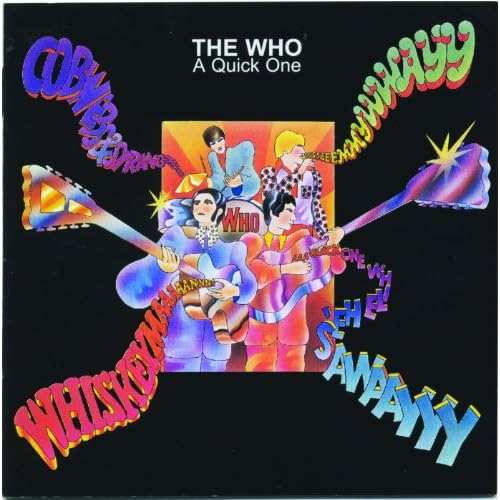
Not long after The Who’s debut album was released, Pete Townshend was already moving on. “My Generation”, which had arrived at the tail end of 1965, was mostly made up of R&B covers, garage-rock rave-ups and guitar-powered pop that pretty much sounded like every other above-average British rock LP of the period, but louder. Their second record, “A Quick One”, showed a glimpse of Pete Townshend’s ambition, wit and skewed sense of what rock music should sound like in the mid-’60s when it was released on December 9th, 1966.

So when the group assembled in IBC Studios and Pye Studios in London late in the year to lay down tracks for its second album, Townshend  with the other band members dutifully along for the ride by contributing their own material . A Quick One is the Who’s most delightfully unfocused album,  weaving through the band’s most democratic period. Bassist John Entwistle contributed two songs (including “Boris the Spider,” probably his most well known composition); drummer Keith Moon did (the instrumental “Cobwebs and Strange” encapsulates his boozy, woozy charm in two and a half minutes). Vocalist Roger Daltrey wrote one song, plus there’s a cover of the Martha & the Vandellas hit “Heat Wave.”

That left the remaining four tracks to Townshend, who, by comparison to most of his bandmates’ contributions, sounds rather conventional on three songs, although “So Sad About Us” is one of his most underrated. But it’s his final number, and the album’s closer and de facto title track, that dominates the LP and sets up the Who’s future and legacy. Clocking in at more than nine minutes, “A Quick One, While He’s Away” distills six separate songs into one cohesive track. It was Townshend’s first attempt at a rock opera, prefiguring future classic Who albums like Tommy and Quadrophenia. And it’s a masterpiece of tension and release, the story of a woman who has an affair after her boyfriend goes missing, told through various song movements that shift through moods and tempos.

Today, the album is viewed as the link between the band’s more traditional early years and the start of the ambitious period that followed with 1967’s The Who Sell Out .

Recorded at IBC Studios, Pye Studios and Regent Sound, London in the autumn of 1966. Pete’s first rock opera contains six separate songs, ‘Her Man’s Gone’, ‘Crying Town’, ‘We Have A Remedy’, ‘Ivor The Engine Driver’, ‘Soon Be Home’, and ‘You Are Forgiven’. Along the way the unnamed heroine pines for her absent lover, selects Ivor as a substitute, regrets her folly when her man returns, confesses her indiscretion and is ultimately forgiven. John:”We wanted to put ‘cellos on the track but Kit Lambert said we couldn’t afford it. That’s why we sing ‘cello, cello, cello, cello,’…where we thought they should be.”


janglepophubhome.wordpress.com/

Dedicated to all jangly indie/guitar/jangle-pop

Stray Bullet

Show a little faith there's magic in the night

blackwings666

Horror, Science Fiction, Comic Books and More

hotfox63

IN MEMORY EVERYTHING SEEMS TO HAPPEN TO MUSIC - Tennessee Williams

All Things Thriller

A Celebration of Thrillers, Noire and Black Comedy by Pamela Lowe Saldana

The UK Number Ones Blog

Join me as I listen to every single #1 single!

Mike and Paul's Music Blog

Two Guys In Search of Great Music

A Unique Title For Me

Hoping to make the world more beautiful

A Sound Day

hear ye, hear ye!

Christian's Music Musings

Celebrating music craftsmanship

ECLECTIC MUSIC LOVER

Favorite song lists, reviews, featured indie artists, and music commentary.

Every record tells a story

A Blog About Music, Vinyl, More Music and (Sometimes) Music...

Make Your Own Taste

Eclectic reviews of ambient, psychedelic, post-rock, folk and progressive rock ... etc.!

Martin Crookall - Author For Sale

A transparent attempt to promote a writing career

Music Aficionado

Quality articles about the golden age of music

J. ERIC SMITH

Slow molasses drip under a tipped-up crescent moon.

THE PRESS | Music Reviews

Click Header to Return Home

Born To Listen

to Rock, Country, Blues & Jazz

Blabber 'n' Smoke

A Glasgow view of Americana and related music and writings.

The Music Files

Rewind the Review

If My Records Could Talk

A stroll down memory lane through my music collection

The Fat Angel Sings

the best music of yesterday today and the tomorrow, every era every genre