

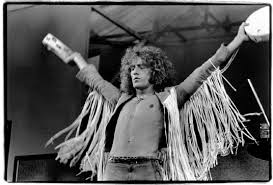
As a founding member of The Who, Roger Daltrey played a critical role in 1960s as well as 1970s music. While Pete Townsend wrote most of the band’s music and lyrics, it was Roger Daltrey’s powerful voice that brought the songs to fruition. Though, the Who’s early work was textually so different in contrast to their later work, they enjoyed hits as “I Can’t Explain” and “Anyway, Anyhow, Anywhere.” However, it was the song “My Generation” that connected with the emerging counter culture and put the band on the Rock and Roll map. Arguably, The Who recorded the first concept album, “Tommy”. And when casting began for the film based on the record in 1975, Daltrey got the nod to play the lead role for which he won a Golden Globe. With his long golden locks and stunning good looks, he looked the part as a rock god. On stage the band was explosive as Roger Daltrey would whip his mic 10 feet in the air and catch it with ease. Considered by many to be the band’s swan song, Who’s Next, featured such memorable tracks as “Won’t Get Fooled Again,” “Bargain,” “The Song is Over” and the seminal track “Baba O ‘Riley.”
Never one to rest on his laurels, he began his solo career in 1973 with the release of “Daltrey”. While the record was a hit in Europe, it failed to chart in the States. Since then, he has released seven solo projects and has appeared on recordings by Meat Loaf, Barry Gibb, Joe Strummer and Barbra Streisand. Roger Daltrey is a songwriter, singer, performer, actor and icon who has received countless awards including induction into the Rock and Roll Hall of Fame in 1990.
In May 1971 The Who were in London’s Olympic Studios recording ‘Join Together’ which came out a year later as a single in both the UK and America. Pete Townshend’s lyrics include the line, “It’s the singer not the song that makes the music move along.” And that is so, so true of the way that Roger Daltrey has propelled the Who from his position out front of the band. He is arguably the greatest rock singer that has fronted any band in that same half century .

‘My Generation’ with Roger’s unique stuttering vocal that is one of the greatest singles to be released in the 1960s. Not far behind it is ‘Pinball Wizard’ from Tommy, which has Daltrey in imperious form. Then the next single is ‘I Can See For Miles’, another great driving vocal. ‘Behind Blue Eyes’ comes from the Who’s fifth album, Who’s Next and it demonstrates the maturing of Roger’s voice; in fact it is one of his finest ever rock-god vocals. The same can be said of ‘Love Reign O’er Me’ from “Quadrophenia”. ‘Won’t Get Fooled Again’ is another that is from the god-like rock locker. Can’t you just see Roger marching as he sings this powerful vocal and the scream towards the end is one of the finest moments in all rock.
One of Roger’s great gifts is that he seemed able to reproduce his powerful recorded vocals on stage, making it seem effortless in the process. ‘Summertime Blues’ from “Live At Leeds” is just perfection.Thirteen years earlier his rendition of ‘See Me, Feel Me/Listening To You’ from a Canadian concert is among the best versions of these moments from Tommy that the band has released.
‘Baba O’Reilly’ was a stand out from “Who’s Next” and the version from a concert at Shepperton, London in May 1978 is another outstanding example of Roger’s brilliance. The other non Pete Townshend song where Roger excelled is Bo Diddley’s ‘I’m A Man’ which harks’ back to the band’s early blues influences and it has Roger giving it his all in what is the greatest ever cover of this classic.
According to The Flaming Lips’ Wayne Coyne “You don’t realize how great a singer Roger Daltrey is until you try to do it yourself.” He’s talking generally about Roger’s singing but it could especially be applied to ‘The Real Me’ from “Quadrophenia”. In a similar voice ‘Who Are You’ from the album of the same name bears out Coyne’s assertion. It’s also one of those songs that converted many a non-believer into believing that The Who are the greatest rock band in the world.
‘We’re Not Going To Take It’ became one of the highlights of the Woodstock Festival but the “Tommy” original version which spotlights both sides of Daltrey’s voice, from bombast to beauty.

‘Long Live Rock’ is another incredible vocal, with Pete singing the verses, and yes he does, but it is Roger that lifts this song to the giddy heights of a rock anthem. ‘Slip Kid’ comes from the 1976 album, “The Who By Numbers” and might not be the most obvious song to include but it features Roger Daltrey showing how controlled his vocals can be.
‘I Can’t Explain’ is 20 year old Roger and while it may lack some of the power of our other selections, just listen to it in context. Try hearing it alongside other 1965 pop singles and you hear the vocal brilliance when compared to the kind of dull stuff that was being churned out by most bands.
“Quadrophenia’s” ‘5.15’ is another of Roger’s rock-god vocals – this is turbocharged! The same can be said of ‘Join Together’, but the absolute pinnacle of this number is just after the final verse. Roger hits a high note, while singing, “well everybody come on” that seems inhuman, it send him off into another place.
the later tracks is ‘Music Must Change’, a hidden gem of a track from “Who Are You”. Roger sings the verses in his lower register, saving his falsetto for later in the song before the final 30 seconds when vocally he just explodes.

Possibly there’s only one song that could end a list of the greatest of Roger Daltrey classics and it is ‘The Song Is Over’ from “Who’s Next”. It’s majestic, at times gentle, at others unbelievably tough and it has everything that makes Roger Daltrey brilliant. His voice is every bit as powerful as Pete’s guitar sound and his gift is to be whatever Pete has written for him to sing. He becomes Townshend’s characters and as Roger says, “That’s why I shut my eyes when I sing — I’m in another space, and the characters are living in me.”
 The Fat Angel Sings