Unlike ‘Quadrophenia’ and ‘Tommy,‘ The Who’s other celebrated concept albums, ‘The Who Sell Out’ doesn’t tell a story. Instead, the album weaves together songs (like ‘I Can See for Miles’) with fake commercials (like for deodorant) so that the whole thing plays like 40 minutes of a pirate radio station. It’s pop-art filtered through the era’s psychedelic shadings.by The Who followed with its concept of a pirate radio broadcast. Within the record, joke commercials recorded by the band and actual jingles from recently outlawed pirate radio station Radio London were interspersed between the songs, ranging from pop songs to hard rock and psychedelic rock, culminating with a mini-opera titled “Rael.”
Their 1967 psychedelic statement ‘The Who Sell Out’. Complete with radio ads linking the songs this is as swinging as the 60s got, plus my favourite ever Who 45 was contained within the grooves… ‘I Can See For Miles’.
Original copies of the album, issued on the Track label, came in Mono and Stereo and if you were lucky enough there was a sticker on the sleeve promising a ‘Free Psychedelic Poster Inside’. If you have the complete item with unblemished poster you are sitting on a £500+ record!
The Pretty Things started as blues-rock band in the early 1960s, and they’re often described as being “meaner, louder, uglier and with longer hair” than the Rolling Stones. (Pretty Things guitarist Dick Taylor originally played bass in the fledgling Stones). Their gritty, primitive R&B sound was heavily influenced by Bo Diddley’s beat.
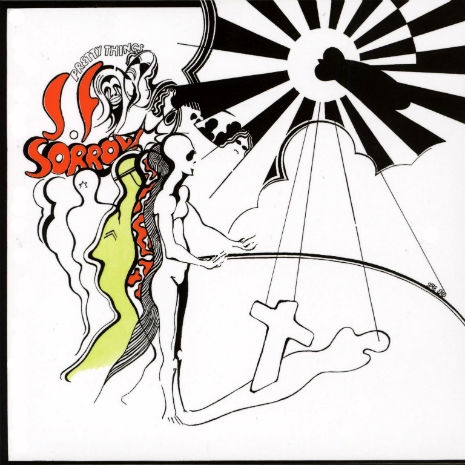
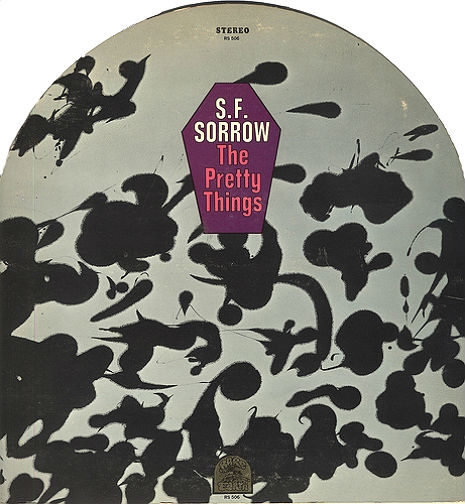
With their fourth album, “S.F. Sorrow”, the Pretty Things decided to shake it up a bit and create a psychedelic rock opera that some regard as a “lost”—or at least unfairly underappreciated, A mini masterpiece . It’s held in the same high regard as another “lost” 60s classic, Odessey and Oracle by the Zombies. In fact, S.F. Sorrow was the actually the very first rock opera, not Tommy. Although Pete Townshend has pointedly denied that S.F. Sorrow was an influence on Tommy, this seems unlikely at best: They were both of the same London scene.
Possibily the first rock opera. As good a document of what a band infatuated with the blues could do within the burgeoning psychedelic scene. The cradle-to-grave story of S.F. Sorrow. Classic songs include “I See You,” “Baron Saturday,” “Old Man Going” and “Defecting Grey.” (Note: latter releases include the five-minute version of the latter and is not to be missed for its sheer ferocity.) To quote Richie Unterberger: “And it does show a pathway between blues and psychedelia that the Rolling Stones, somewhere between ‘Satanic Majesties,’ ‘We Love You,’ ‘Child of the Moon,’ and ‘Beggars Banquet,’ missed entirely.” This British group the Pretty Things, was released in December 1968, is generally considered to be among the first creatively successful rock concept albums, in that each song is part of an overarching unified concept – the life story of the main character, Sebastian Sorrow.
S.F. Sorrow was recorded between December 1967 and September 1968 at Abbey Road Studios. The sound incorporates the sitar, Mellotron, flute, dulcimer and several tripped out sound effects. At the same time as the sessions for S.F. Sorrow, at Abbey Road their album’s producer, Norman Smith was also working with Pink Floyd on their A Saucerful Of Secrets album and The Beatles were recording their White Album there as well. (S.F. Sorrow came out the same week as the White Album and the Rolling StonesBeggars Banquet. What a week for music.)
The Pretty Things S.F. Sorrow The title comes from the sad-sack protagonist who wanders through life unhappy before going nuts from regret. The opera’s libretto came in the form of liner notes that told the story of one SebastianF. Sorrow, an ordinary fellow who works at the “Misery Factory” and is drafted into World War I. His life descends into meaninglessness after he witnesses a hot-air balloon carrying his fiance crash and burn. Along the way he has an encounter with a mysterious whip-cracking character called “Baron Saturday” who is based on the voodoo deity Baron Samedi. The opera ends on a sad note as the desolate Sorrow realizes that he can trust no one and that he will die alone.
It’s a landmark because it ranks as the first rock opera. Rumor has it Pete Townshend started wringing his hands and concocting “Pinball Wizard” after hearing this.


 The Fat Angel Sings