Posts Tagged ‘Peakes’

May be an image of 3 people, people standing and nature

Leeds trio Peakes carry the feat off their new album with aplomb. The band’s debut album ‘Peripheral Figures’ introduces Springsteen-esque gutsiness and a clubby sheen to their already expansive electro-pop DNA. 

John Cale once said he and Lou Reed followed a mantra of “don’t bore us, get to the chorus”. It’s clear that Peakes have been adhering to something similar. Their tunes usually hover around the three-minute mark and never outstay their welcome. Like all the best pop, with many of these songs there’s a little intro, the singing starts quickly, in comes the chorus and you’re out in less time than it takes to boil a crap kettle. For all the dreaminess conjured by the hazy washes of synthesizer and thick bass, there’s always an insistent backbeat and a big chorus to regiment the detachment. No messing about.

Weirdly, one thing that struck me about this record was the manner in which Peakes end their songs. There’s a great bit in Joe Thompson’s book ‘Sleevenotes’ where he encourages (“instructs” might actually be a more fitting word) live bands that “when your time is up, please stop”. The songs on ‘Peripheral Figures’ are great because they turn on a dime and end with a bang – no gauzy trails of feedback, no sizzling arpeggios that trail off for thirty seconds. Peakes’ songs stop dead. 

The moments where this album really flies are when Maxwell Shirley, Molly Puckering and Pete Redshaw look to the dancefloor rather than within for inspiration. A few of the tracks – ‘Day and Age’, ‘An Infinite Divide’, ‘Nameless Machines’ – have a real hands-aloft energy to them. ‘Day and Age’ in particular is an exhilarating highlight, with the track featuring a brilliant squealing, distorted synth line that works perfectly with the careening propulsion of the beat. I’m frequently reminded of New Order at their most anthemic.

The production is very well-rendered on ‘Peripheral Figures’. I love the way the bassline (a Roland 303?) in ‘Fascination’ flutters into view before disappearing, ditto the chewy bass in ‘Nameless Machine’ that’s redolent of ‘Silver Eye’-era Goldfrapp. The percussion consists of mostly live drums, a choice which provides a nice, organic counterpoint to the cyborgish electronics and Puckering’s vocals. 

This album sounds like Springsteen! I will explain. Peakes share that heart-on-sleeve chest-thumpingness with The Boss. Lyrics like “I can see my way through this clouded space between us” or “we all left behind, an infinite divide” have that kind of slogan-y, universally-applicable quality which means that they are just made to be belted out. Together with the driving rhythms, it all sounds like The Boss, Steven Van Zandt and the rest of the E Street Band got bang into eye shadow, drum machines and The Human League. 

‘Peripheral Figures’ is a cracking debut from Peakes. It has definable sound, and while ‘Peripheral Figures’ features some of the most boring song titles I’ve seen this year, there are some absolutely brilliant moments where the heady dynamism of the best electronic music is suffused with a wistful yearning.
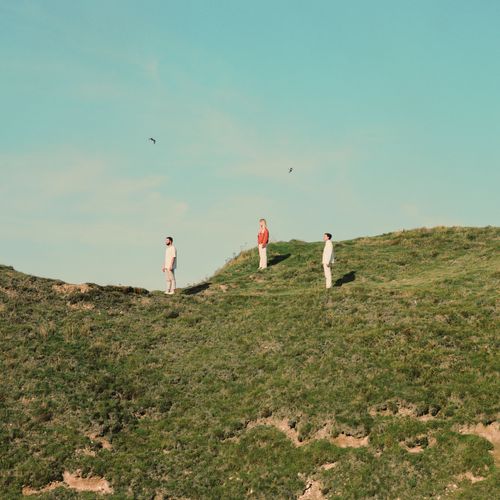
Peripheral Figures

The infinite divide is the chasm that grows between our real selves and our projected selves when we choose to exist online. In the song we question our need to condense our lives into show reels and flattering narratives and what affect that has on our relationships and our ability to connect with others.”

The sound of Peakes has always been steeped in isolation, crafting hymnal electro-pop that floats, weightless and suspended, over the world they move through.

Using the lens of nostalgia as a kind of refuge, their synth-led dreamscapes defy any sense of time and place: their sound is both current, yet transportive like a memory. since their formation in 2017, vocalist Molly Puckering, synth-player and producer Max Shirley and drummer Pete Redshaw, have been solidifying what it means to be Peakes. with a smattering of Eps and singles laying out their statement of intent, each one a run-up growing in momentum, their trajectory was clear: get into the studio and bring the music to the stage. this was the plan for the Leeds-based trio in 2020 – until the world stopped. No one could have predicted that touring and recording, an artist’s lifeblood, would grind to a global halt, and Peakes could never have predicted that in a year defined by impossibilities, they would make their debut album, “Peripheral Figures”. “I think last year, when you had everything taken away from you, it made it easier to try something new,” says Molly.

Having released their four-track EP ‘pre-invented world’ on the cusp of the covid-19 pandemic, amidst the world’s disorder, their music fell into a void: the appetite for new music had understandably dried up, and there was nothing Peakes could do to change that. so rather than dwell on it, they took a step back and returned to the drawing board and went back to basics, learning to fall in love with music again through the purest sense of creation. Yet despite the logistical hurdles they had to overcome during the pandemic, where ten minutes might as well have been ten thousand miles away, “Peripheral Figures” is their most personal, hands-on project yet – and it’s entirely their own. Molly recorded her vocals in the wardrobe of her bedroom, while Pete’s drums were sent in a file-sharing back and forth over email: a departure from the sessions they’d had with producers in fully-fledged studios. “This is the closest that we wanted everything to sound like,” Max says. “whereas before, it was someone else’s vision too, this time, we’ve had the final say, and it feels great.” the suspended time allowed them to experiment without a timeframe, having the opportunity to dedicate hours to perfecting the details, rather than minutes. what started as a means of escapism developed into an album which not only serves as the definitive realisation of Peakes’ potential, but acts as a capsule for the universal feeling of isolation channelled through boundless imagination. another freedom that the pandemic afforded them was to step away from a singles-driven mindset, Embracing slow-burning songs that didn’t necessarily meet the tick-box requirements of upbeat with the ability to instantly connect with a listener. “Clouds”, one of the most interesting tracks on “Peripheral Figures”, wouldn’t exist if they weren’t writing in an album state of mind. Sonically stripped back, Molly’s entrancing, almost spoken vocals, carry it. “we’re quite nostalgic in the sounds we use and the world we want to create,” says Max. inspired by the hazy dreamscapes of shoegaze, Peakes choose to bring those elements forward, leaning towards synth rather than guitar. “Infinite Divide” merges the retrospective, synth-driven energy of the 80s and brings it to the brink of modernity. experimenting with distortion, Peakes welcomed the grittiness that their diy production created over the far more polished, studio-level sheen they’d been used to.

While the two tracks stand in contrast to one another, they are also the band’s favourites: “We’d never written two songs with that much energy from the start,” says Molly. “Day and Age” was written with nightclubs in mind, with its propulsive, entirely electric new-wave beat dreaming of crowded spaces. their lyrics, penned between Max and Molly, usually came from a place of observation: “We didn’t realise how much we were influenced by being out in the world until we weren’t in it anymore,” Molly says. using limitless imagination as a crutch, they started to explore scenarios in their head, embedded themselves into different stories. “Nameless Machines” was a concept song, built upon Max’s lyric: “nameless machines / statistical dreams”, envisioning someone working the same nine-to-five office job, being consumed by it and trapped within it. “I loved getting into the mindset of that and writing from it,” Max says. Peakes’ music is a catalogue of reference points, from essentials such as Gary Numan, Depeche Mode and New Order the wonky german electro-beats of grauzone.

peakes-sq

While Max is indebted to 80s new age, Molly looks to the female-led electronic renaissance of the 00s, with Portishead, Goldfrapp and Moloko being enormously influential for her own approach as the band’s frontwoman. The band met at university while they were studying at the Leeds conservatoire in 2017 after cramming into an eight-bed house together, discovering that they shared a similar vision. Molly, as well as being Peakes’ vocalist and lyricist, is also the architect behind the “Silent Stuff”,

Having styled all their outfits with an eye for dreamy, whimsical aesthetics that they bring into their artwork. Max, whose multi-hyphenate role extends to lyrics, production and instrumentation, brings a meticulous eye for detail that means that every track is finished to a sky-high standard, and Pete is Peakes’ grounding force and peacemaker – not to mention their roadman (he’s the only one with a driver’s license). with the release of “Peripheral Figures”, Peakes feel one step closer to their vision than ever: their debut album was hard-won, and yet stands brightly as an example that out of trauma, there is a possibility to build something beautiful.