


It’s difficult to overestimate the importance of “Are You Experienced” in rock history. The Jimi Hendrix Experience’s debut album was a game-changer for rock guitarists, a mind-mending collection of songs and sounds, a sonic embodiment of psychedelic 1967 and the Summer of Love.
Hendrix conjured both love and confusion by astounding the British and American rock establishments with the Experience’s live performances. He alters how nearly every guitarist on the third stone from the sun will approach the instrument for the next 50 years, and beyond. That’s a pretty crazy legacy for an album first released on May 12th, 1967.
As his all-too-brief recording career bloomed and wilted, sonic virtuoso Jimi Hendrix grew into his role as a recording studio visionary, helping change perceptions of what a rock song could sound like. He perfected his blend of psychedelic songwriting and wizard-like electric guitar flourishes on 1967’s Axis: Bold as Love, but on “Are You Experienced?”, his debut album with The Experience that included (drummer Mitch Mitchell, bassist Noel Redding), he harnessed the sound of a raw, thrilling power trio at the peak of its power. “Foxy Lady” has one of the downright nastiest guitar riffs ever recorded, and “Fire” is the most appropriately titled song in rock history ever. At Chandler’s encouragement, Hendrix began to write songs, just as sessions were beginning for the debut. Because he was a novice, Hendrix would take inspiration from anywhere. The rock classic “Fire” wasn’t the result by incendiary passion, but a desire to get warm on a cold night at Redding’s mother’s house. “Move over Rover and let Jimi take over” was literally about him getting the family dog to make room next to the fireplace.
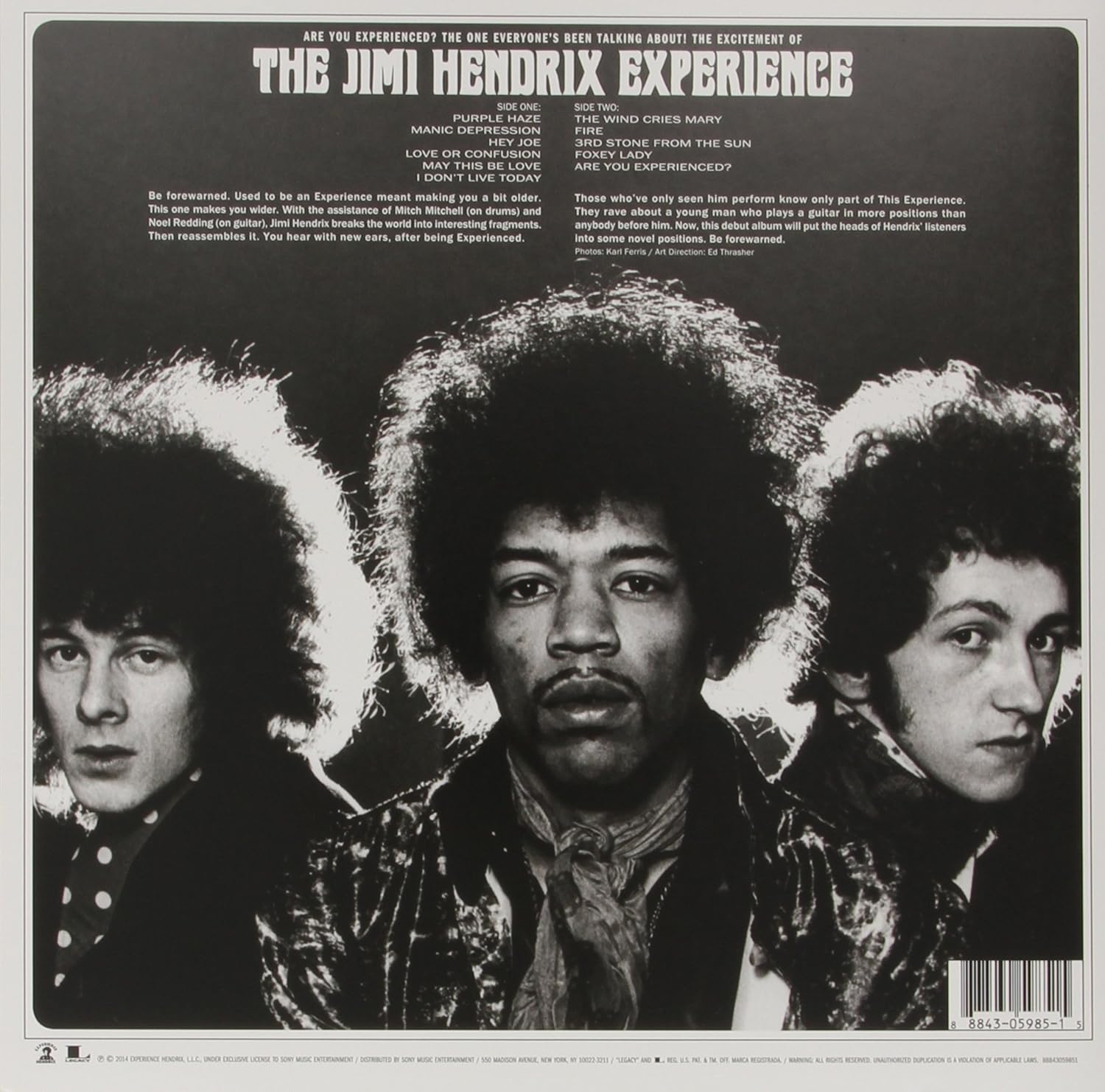
Hendrix introduced the Octavia pedal on ‘Are You Experienced.’ Created for Hendrix by sound technician Roger Mayer, the effects pedal doubles the guitar sound with the same pitch an octave higher or lower and adds some fuzz. You can hear it at work on the “Purple Haze” guitar solos. Later, when the recording was sent to Hendrix’s U.S. label, it was attached with a note – “Deliberate distortion: Do not correct.”

After growing up in Seattle and teaching himself to play guitar as a teenager — flipping right-handed guitars upside down to accommodate his left-handed playing, thereby helping him to approach the instrument in radical new ways Jimi Hendrix did a brief stint as an Army paratrooper. Then he moved to Tennessee and spent about four years on the Chitlin’ Circuit as a guitarist for the Isley Brothers, Little Richard, and Curtis Squires, also gigging with his own band the King Kasuals alongside future Band Of Gypsy’s member Billy Cox. In 1966, at the urging of Linda Keith, he moved to London and met the Animals’ Chas Chandler, who became his manager and helped him form the Jimi Hendrix Experience with British rhythm section Noel Redding and Mitch Mitchell. The story goes that both drummers Mitch Mitchell and Aynsley Dunbar both auditioned to join the Experience. Hendrix liked them equally, so fate was left to a coin flip (which benefited the jazz-influenced Mitchell). Dunbar ended up doing all right, playing with Jeff Beck, David Bowie and Frank Zappa, as well as getting inducted into the Rock and Roll Hall of Fame as a member of Journey. Mitchell drummed with the Who a few years earlier, just before they hired Keith Moon, while Hendrix wrote “Foxy Lady” about Heather Taylor, who later married Who singer Roger Daltrey.
They scored some minor UK hits, won essentially all of England’s rock royalty as fans, and hit the studio to record their debut album. ‘Are You Experienced’ was recorded in three different London studios – CBS, De Lane Lea and Olympic – largely because of Chandler’s shortage of ready cash. New to management, Chandler thought he could pay for time upon completion of the album. He ran into difficulties when owners demanded payment right away. Polydor, Track Records’ distributor, guaranteed Chandler a line of credit so the Experience could finish the album at Olympic Studios.
Apparently, Polydor was so excited about ‘Are You Experienced’ that the distributor released Hendrix’s debut album early. Track Records was surprised when an error caused 2,000 copies to be sent to London stores two weeks before the planned release date, on May 12th, 1967.
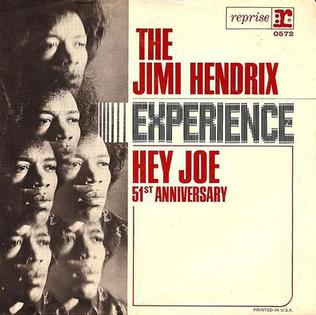
Although the Experience were having massive success with their first three singles (“Hey Joe,” “Purple Haze” and “The Wind Cries Mary”) and debut LP in the U.K., American record companies weren’t sure Hendrix would be a hit in the States. But Reprise Records became convinced after the trio’s wild performance at the Monterey Pop Festival in June. Unlike the British edition, the U.S. version would include the singles, which replaced “Red House,” “Can You See Me” and “Remember.”

What they came up with was unlike any album ever released — and not just because of Hendrix’s inventive guitar work, though there’s no downplaying his revolutionary approach or the way it shaped everything else about his sound. Like a mutant who’d gained full mastery over his powers, he ably controlled every available weapon in a guitarist’s arsenal: feedback, effects pedals, the whammy bar, even his teeth. In concert, that skill set played into wild exhibitionism that extended all the way to his wardrobe, his gigs so explosive that they often ended in smashed instruments (and, famously, once with a guitar set aflame). That showmanship is a huge part of his legend, but Are You Experienced presents him as more than just a marvelous instrumentalist.
“I Don’t Live Today” (along with Cream’s “Tales of Brave Ulysses”) helped popularize the “wah-wah” guitar effect. But, at that point, the famous pedal didn’t exist. On the solo for “I Don’t Live Today,” Hendrix created the spectral glide – which seemed like a voice saying “wah-wah” by hand. That sound inspired Vox to create the wah-wah pedal, bestowing a shortcut on legions of guitarists.
On the LP, all that power is reined in and meticulously deployed, often with a subtlety you wouldn’t expect from such a showboat. A controlled chaos lingers in the album’s background and ramps up at strategic moments, a wave of noise that sweeps through and irreparably alters the landscape of a song. Even if you’ve never listened to Are You Experienced, you’ve heard it in the tumultuous closing moments of “Purple Haze” one of the most famous rock songs in history. It manifests elsewhere in the tumbling rhythms of “Love Or Confusion” and the tripped-out space travels of “Third Stone From The Sun” and even the gently drifting ballad “May This Be Love” And it’s all over the madcap freakout “I Don’t Live Today” the record’s closest parallel to Hendrix’s untamed stage show. And on the remarkable title track, it’s flipped backwards, chopped up, and pieced back together into an otherworldly statement of intent.
Just as often, though, Are You Experienced demonstrates how much this trio could accomplish without a blaring wall of sound. The spare and visceral “Manic Depression” weaves insane riffs and even crazier drums into the foundation for a new kind of blues. “Fire” is similarly combustible, initiating with a riff so startling. “The Wind Cries Mary” is a simple, beautiful display of Hendrix’s softer side; to me, his clean, aqueous rhythm work, also heard throughout “Hey Joe” was and is every bit as revelatory as his fireworks displays.

 The Fat Angel Sings