Posts Tagged ‘Jim Morrison’

“Roadhouse Blues” is a rock song written and recorded by the American rock band The Doors. The song, which appeared along with the B-side of “You Make Me Real”, was first released as a single from the album Morrison Hotel in March 1970 and peaked at number 50 on the U.S. Billboard chart, The song quickly became a concert staple for the group, a live version appearing later on the posthumous album An American Prayer and that same version, which has been called “probably one of the best live performances of any song”,again on In Concert and Greatest Hits. During this version, Jim Morrison talks for a short while to a female audience member about his Zodiac sign and, with a sudden, ironic twist that causes the audience to erupt in laughter, denounces his beliefs in it. The song was also featured twice in the movie The Doors; the studio version in the film, and the aforementioned live version over the end credits. The line “Woke up this morning and I got myself a beer” was inspired by Alice Cooper as stated on his Planet Rock morning show.

The song took two days to record in November 4th and 5th, 1969) with the producer Paul A. Rothchild striving for perfection. Several takes from these sessions were included on the new 2006 remastered album. Surprisingly, he does not comment on Morrison, who is apparently intoxicated, “going into full blues singer mode” in the words of engineer Bruce Botnick, improvising and simultaneously fluffing several lyrics and repeating the blues phrase “Money beats soul every time”. The phrase can be found on the When You’re Strange: Music from the Motion Picture soundtrack, with the next track being a live version of “Roadhouse Blues”.

The sessions only took off on the second day, when resident Elektra guitarist Lonnie Mack joined in on bass and harmonicist John Sebastian (appearing under the pseudonym G. Puglese out of loyalty to his recording contract or to avoid affiliation with The Doors after the Miami controversy joined in on the sessions and Ray Manzarek switched from his Wurlitzer electric piano to a tack piano the same used on The Beach Boys “Good Vibrations” A studio version of the song with John Lee Hooker sharing vocals with Jim can be found on the Stoned Immaculate: The Music of The Doors album.

A long-standing misconception states that Lonnie Mack contributed the guitar solo on the track in addition to bass guitar, despite only being credited for the latter. In actuality, guitarist Robbie Krieger is responsible for all guitar parts on “Roadhouse Blues” and Mack’s contribution is limited to bass guitar; Jim Morrison shouts “Do it, Robby, do it!” where the single vocal track can be separated from other instruments, at the start of the guitar solo. The solo on record is representative of Robbie Krieger’s finger style playing and is identical to all his Roadhouse Blues solos played in the previous sessions the day before on 5th November 1969. Subsequent interviews with members of The Doors and Paul A. Rothchild confirm this.

The complete song was fully composed and rehearsed before Lonnie Mack was invited to play bass on Roadhouse Blues and Maggie M’Gill (Ray Neapolitan, regular bass player during Morrison Hotel sessions, couldn’t arrive on time that day due to a traffic jam). Drummer John Densmore and guitarist Robbie Krieger provided additional details about the Roadhouse Blues sessions which are quoted here:

According to the book, Light My Fire by Ray Manzarek, a bandmate of Morrison’s, the song refers to Morrison’s waking after an alleged three weeks of drug-induced sleep and the actual lyric sung is “woke up this morning and I got myself a beard”.

<em>Morrison Hotel</em> (1970)

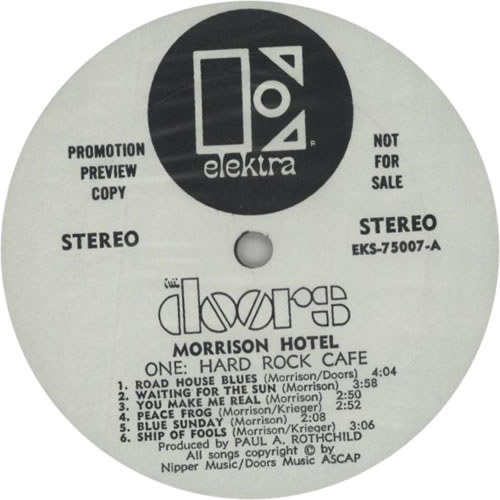
“Morrison Hotel” (sometimes referred to as Hard Rock Café from the title of the first side of the LP, with the second side titled “Morrison Hotel” is the fifth studio album by the American psychedelic rock band The Doors, recorded from between August 1966 and November 1969 and released by Elektra in February 1970. The group went back to basics and back to their roots. On this album, there is a slight steer towards the  blues sound, which would be fully explored by the band on their next album, “L.A. Woman“.

Between Jim’ Morrison’s, tour-killing obscenity charge (stemming from a Miami concert where he may or may not have exposed himself on stage), declining sales, and the negative reviews given to their previous two albums, many people gave up on The Doors.  but “Morrison Hotel” , with its tougher, back-to-basics sound, reestablished them as America’s greatest rock & roll band. It became a Top 5 album, but it’s only single, “You Make Me Real,” didn’t even make the Top 40. Still, “Roadhouse Blues” (the single’s b-side), “Peace Frog,” and “Waiting For The Sun” have since become some of The Doors’ best-known songs.

The cover photo was taken at the actual Morrison Hotel located at 1246 South Hope Street in Los Angeles. The band asked the owners if they could photograph the hotel and they declined, so the band went inside when nobody was looking and took the photograph anyway.  The desk Clerk wouldn’t let the Doors shoot their cover shot in the Lobby, but when he stepped out for his break photographer Henry Diltz stayed outside the hotel, snapping away while the band rushed inside and gathered behind the hotel’s now famous window. The rear cover features a photograph of the Hard Rock Café on 300 East 5th Street, Los Angeles.  The founders of the later and otherwise unrelated Hard Rock Cafe chain used the name, having seen it on the Doors’ album. The original cafe is no longer open. After they wrapped up their hit-and-run cover shoot, The Doors hit LA’s skid row to grab a drink. They settled in to a dive called the Hard Rock Café, where Diltz took the photo for the album’s back cover. After the album came out, two guys called to ask if they could use the name of the bar for a new restaurant they were opening in London, paving the way for hundreds of restaurants, hotels and casinos. When it was originally released on vinyl, side one of Morrison Hotel was labeled Hard Rock Cafe. Side two was Morrison Hotel.

One of Morrison Hotel’s most revered cuts was actually supposed to be the title track to an earlier album. “The artwork was done, but the song wasn’t ready,” said keyboardist Ray Manzarek. It took a year, but they finally got “Waiting For The Sun” right.

doorsmorrison

You’d think having your hotel on the cover of a seminal rock album would inspire you to fix up the place and raise the rent, but the owners of the Morrison were among LA’s most notorious slum-lords. By the time the hotel was shut down, they’d been convicted on 21 counts of violating fire, safety and health codes, with the city citing vermin infestations, broken heaters, lead poisoning, and raw sewage leaks among the offenses.

Even though no major hit singles were drawn from the album, “Morrison Hotel” re-established the Doors as favorites of the critics, peaking at No. 4 on the US album chart. The album also became the band’s highest charting studio album in the UK,

For the 40th anniversary the album was re-released in completely remixed and remastered form. This practice extended to incorporating vocal and instrumental components which were not part of the original album. According to Ray Manzarek, “There are background vocals by Jim Morrison, piano parts of mine that weren’t used and guitar stingers and solos by Robby Krieger that never made the original recordings that can now be heard for the first time.

morrisonhotellabel

Lonnie Mack, who plays bass on “Roadhouse Blues” was better known as a top-shelf blues guitarist. In fact, Stevie Ray Vaughan said that, as a kid, he practiced guitar to one of Lonnie’s albums so many times his dad destroyed it.
The stripped-back recording sessions toughened up and focused The Doors on stage as well as in the studio. Before it was even released, “Roadhouse Blues” became a fixture in their set lists and many fans still consider it their best live cut.

Love this mash up really fits both songs so well, two of the biggest rock icons ever,

Powered by the lead single “LIGHT MY FIRE” the Doors debut release in 1967 served as the dark cousin to the summer of pop, the band went on to become one of the most Influential and controversial rock acts ever, also adding to the myth frontman lyricist and iconic Jim Morrison’s strange death in a Paris hotel in 1971 only added to the many myths this band have conceived

The Doors music album