

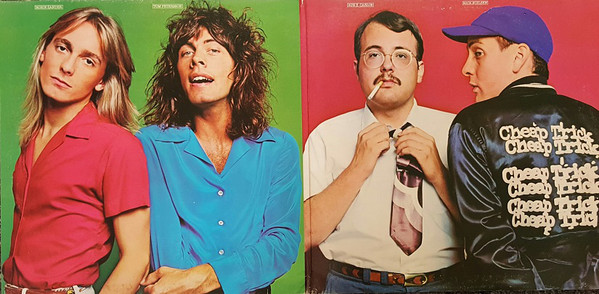
Cheap Trick’s second album release, “In Color”, which celebrates its 45th anniversary in September, sounds every bit as fresh as its first—and so, frankly, do the band’s third and fourth studio albums. And there’s a reason: The band (notably chief songwriter and guitarist Rick Nielsen) had stockpiled scores of worthy songs long before the band had ever entered the studio.
As one who grew up in Illinois, aware of Cheap Trick a full year before the band’s Epic Records signing and February 1977 debut album, I was hearing songs from the first four albums as early as October 1975. It was then that, on a tip from a kindred musical spirit, I checked them out at a 150-capacity dive called the UpRising Tavern in the university town of DeKalb, Ill.
There, for a $5 cover that seemed steep at the time, one was treated to three sets with that line up that look, that logo, and, best of all, those songs. The band’s 1977 self-titled debut album captured its edge, an unvarnished document of what we saw onstage around that time. Jack Douglas took the Rockford, Ill. band to New York’s Record Plant in fall 1976 and emerged with edgy power-pop songs like “He’s a Whore,” “Elo Kiddies” and “Taxman Mr. Thief.” Combined with the band’s unconventional look (two pretty boys, two nerds), the quirky songs turned heads and the album became a full-fledged critical sensation.
So when it came time to record the second album, the band changed coasts, and producers. Tom Werman (Blue Öyster Cult, Motley Crüe) took the band to Los Angeles’ Kendun Recorders, and a few other changes were made. Keyboardist Jai Winding was brought in as a session player (he was retained through subsequent albums “Heaven Tonight” and “Dream Police”, also produced by Werman). Winding’s keyboard swirls softened the occasionally stark spaces between Nielsen’s guitar runs and gave singer Robin Zander’s vocal phrasing a new platform. For Epic’s purposes, it also brought Cheap Trick closer to the radio—even if it would eventually take a live version of one of the “In Color” songs “I Want You to Want Me”, culled from the band’s 1978 live “At Budokan” album, to finally break through.
For us Midwest fans with a few road miles already logged, “In Color” collected many of the songs we’d seen in the band’s early live sets: “Hello There” with Nielsen’s ear-nabbing guitar chords remains their onstage opener to this day; “Downed,” “Oh Caroline” and “You’re All Talk.”
The latter, a raw sounding rocker, would have been at home on the Jack Douglas-produced debut. But it brought some needed edge to “In Color.”
There were also songs we hadn’t yet heard onstage, but would become imminent concert classics: “Big Eyes,” “Southern Girls,” “So Good to See You” and of course “I Want You to Want Me.”
The band always held back a few good non-LP B-sides, and the flip to the original 45 of “I Want You…” was an uptempo guitar-driven instrumental called “Oh Boy.” Nielsen jokingly said in an interview, “[‘Oh Boy’] marks the singing debut of Bun E. Carlos. But since Bun E. has never sung, there are no vocals on it.” (In fact, there eventually was a vocal version of “Oh Boy” also—Zander on vocals, of course, not Carlos recorded in 2003.
Reviews were solid: Rolling Stone called the songs “anthemic.” Robert Christgau, in his Consumer Guide, noted that Cheap Trick “doesn’t waste a cut.” Stephen Thomas Erlewine’s review in AllMusic, commissioned long after the life of the album, inevitably noted Werman’s “shiny, radio-ready sound,” while commending Nielsen’s “encyclopedic knowledge of rock ’n’ roll, as well as the good sense to subvert it with a perverse sense of humor.” He concluded, “Portions of the album haven’t dated well, simply due to the glossy production, but the songs and music on “In Color” are as splendid as the band’s debut.”
No fewer than five of “In Color’s” songs were included in the live album “At Budokan“, released 19 months after “In Color“. And the song many had thought the least likely to break the band, “I Want You to Want Me,” live rendition, distinguished by Zander’s English-as-a-second-language introduction of “I…want…YOU…to…want…ME.” And the band was off for the big time.
“At Budokan” may have reflected Werman’s production, Cheap Trick recorded another live album in that window. It was an edgier, grittier set recorded at the Whisky a Go Go in the middle of “In Color’s” L.A. sessions, yet not released until last year. It was titled “Out to Get You! Live 1977″, and has been called one of the best live albums of the rock era.
Cheap Trick went on to record two more studio albums with Werman, and a discography that (by my count) comprises 18 subsequent albums.




 The Fat Angel Sings