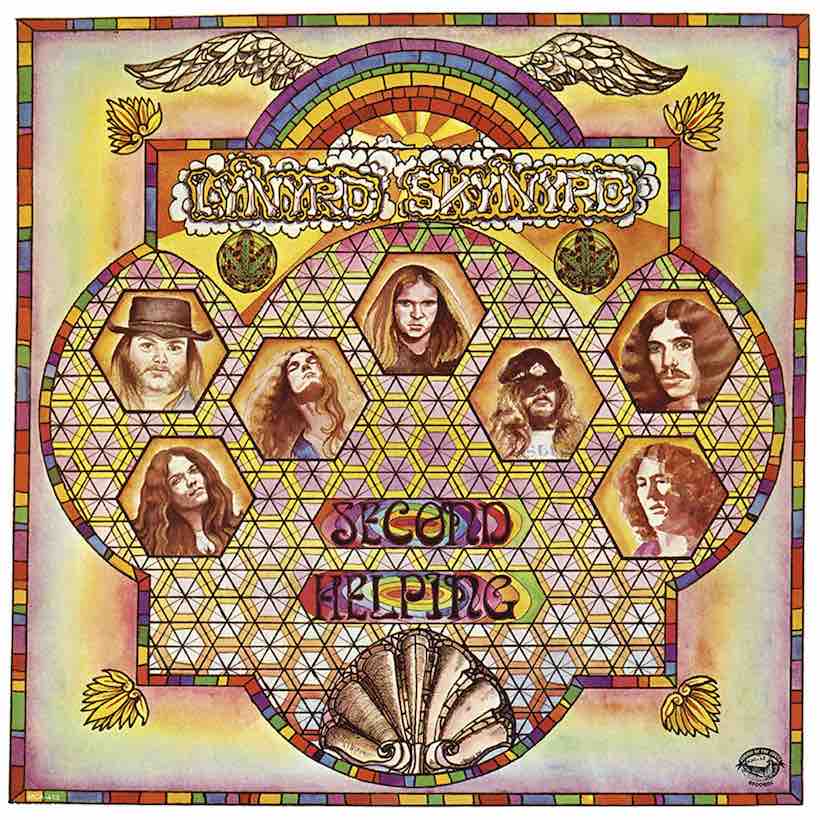
“Second Helping”, was the record that contained their biggest hit single and perhaps greatest rock theme tune of all time, ‘Sweet Home Alabama,’ was released on 15th April 1974. An answer song to Neil Young’s “Alabama” and “Southern Man”. Skynyrd’sfan base had continued to grow rapidly throughout 1973, largely due to their opening support slot on the Who’s Quadrophenia tour in the United States.Second Helping features Ed King, Allen Collins and GaryRossington all collaborating with Ronnie Van Zant on the songwriting.
After the success of their debut album, 1973’s Lynyrd Skynyrd (pronounced ‘lĕh-‘nérd ‘skin-‘nérd), the Second Helping LP was recorded chiefly at the Record Plant in Los Angeles. That was apart from that signature hit, which the band laid down in Doraville, Georgia. Recording sessions started in June 1973, a matter of weeks after they had signed off on the one before. Their producer, as with the first album and 1975’s third release Nuthin’ Fancy, was Al Kooper, whose notoriety already stretched back some 15 years to his teenage success with the Royal Teens. Kooper’s association from the mid-1960s with Bob Dylan was augmented by appearances with hundreds of other artists, not to mention his own recordings from 1969 onwards.
Kooper was also one of the musicians on Second Helping, singing and playing piano on two tracks. ‘Sweet Home Alabama’ featured the vocals of Merry Clayton, Clydie King and others. Clayton, famously the powerful female voice of ‘Gimme Shelter,’ was not the only Rolling Stones alumnus on the Skynyrd album. Saxophonist Bobby Keys played on ‘Don’t Ask Me No Questions’ (the first single from the set, before ‘Alabama’) and Skynyrd’s cover of JJ Cale’s ‘Call Me The Breeze.’
Second Helping outdid its predecessor, which had peaked at No. 27 in the US, by peaking at No. 12. It was certified gold by September 1974 and went both platinum and double platinum on the same day in 1987. “A vast improvement over their first album,” ruled Billboard in their original review at the time, “and a tribute to the combination of skill and good taste.”
It was one of the biggest hits of 1967 and remains one of the most memorable, an intoxicating psychedelic-lite feel-good tune dripping with kaleidoscopic organ, taut and tough guitar licks, uplifting vocal harmonies, a bit of cowbell and prototypically opaque Summer of Love lyrics urging listeners to “Turn on, tune in, turn your eyes around.”
It was called “Incense and Peppermints,” and the group, in the spirit of the times (Vanilla Fudge, Chocolate Watch Band, Peanut Butter Conspiracy), was Strawberry Alarm Clock. As is so often the case in rock lore, there’s more to the story than you might have known.
For starters, there was the lead singer, who was not even a member of Strawberry Alarm Clock. But that’s getting ahead of ourselves. They began as Thee Sixpence, a Los Angeles-based garage-style band that had already cut four singles for Bill Holmes’ All-American Records:“Long Day’s Care” b/w “Can’t Explain.” “My Flash on You” b/w “Fortune Teller,” “In the Building” b/w “Hey Joe” and “Heart Full of Rain” b/w “First Plane Home.”
For their next All-American single, the band recorded an original titled “The Birdman of Alkatrash,” with “Incense and Peppermints” as the intended B-side. The song was based on an instrumental concept by Thee Sixpence’s keyboardist, Mark Weitz, and guitarist, Ed King, but when it was released, full credit had been given to John S. Carter and Tim Gilbert, who had come up with the lyrics and part of the melodic idea but were not even members of the band.
In an interview Weitz explained: “I wrote the intro (the oriental-sounding riff), the verses and the ending (the major sevenths) while Ed King, at my request for some help on completing the song, co-wrote the bridge (the F # part) and of course the lead guitar parts. At the time when the music was recorded at Art Laboe’s Original Sounds studio in Hollywood, there was only a temporary title to the song, and lyrics had not yet been written. Our producer Frank Slay decided to send the fully mixed music track (recorded on eight tracks of mono!) to John Carter, a member of the band the RainyDaze, who Slay also produced at the time. John Carter was solely responsible for conjuring up the lyrics and the controversial melody line extracted out of the finished musical track. Frank Slay ultimately credited that melody line solely to the writing team of John Carter and Tim Gilbert. To this day, they have received 100 percent of the royalties.”
There would be one other strange development before the single was released. While the SAC was in the studio recording the track, a visitor who sang with a band called the Shapes ended up becoming the uncredited lead singer of the soon-to-be hit. The others—King, Weitz, guitarist Lee Freeman, bassist Gary Levetro, drummer Randy Seol were relegated to playing the instruments and singing harmonies and backup vocals. Steve Bartek, a non-member at the time, played flute on the song.
Weitz again said: “When it came time to record the vocal tracks, none of the members of the Alarm Clock sounded right for the lead vocal. We all tried. Greg Munford (a 16-year-old guitar player also produced by Holmes) was a guest in the studio that day, and gave a go at it. His voice sounded best, and we all agreed on keeping his vocal track on the final version.”
Munford never became a member of Strawberry Alarm Clock, but it’s his voice you hear when you play that recording.
“The Birdman of Alkatrash” was released as the A-side by All-American but, before long, disc jockeys had discovered the B-side and began playing it on the radio instead. MCA Records also heard it and decided to pick up the distribution, re-releasing the single in May 1967 on its Uni subsidiary—with the band’s name now Strawberry Alarm Clock, the flavorful part taken from the Beatles’ “Strawberry Fields Forever” and the rest from a small alarm clock in Weitz’s bedroom.
It took a while, but “Incense and Peppermints” finally entered the singles chart at the end of that September. By the week ending November. 25th, it had reached #1, and became 1967’s #23 biggest hit overall.
They also appeared in two films, 1968’s Psych-Out, a hippie exploitation film starring a young, ponytailed Jack Nicholson as a character named Stoney and 1970’s cult Beyond the Valley of the Dolls. For the former, they contributed four songs, including the self-explanatory and utterly enchanting “The Pretty Song from Psych-Out,” which played over the opening credits.Although they are known largely as a one-hit wonder today, Strawberry Alarm Clock stuck around long enough to place three further singles on the chart. Their Incense and Peppermintsalbum itself rose up the charts largely on the strength of the hit single. SAC constantly underwent lineup changes during its brief reign—Bartek and George Bunnell, a guitarist and bassist, joined the group after the “Incense” sessions and the latter became one of the group’s main songwriters and the group—and managed to release three further albums into 1969, none of which cracked the chart.
In 1971, no longer affiliated with a record label, Strawberry Alarm Clock split up. The following year, guitarist EdKing relocated to the South in order to join a group that had opened for Strawberry Alarm Clock on tour. Their name: Lynyrd Skynyrd.
Various reunions have taken place since the early ’80s, and the current lineup of Strawberry Alarm Clock includes Weitz, Bartek, Seol, Bunnell and drummer Gene Gunnells from an early incarnation.



 The Fat Angel Sings