The Pretty Things have released two tracks in memory of their late singer Phil May. May died at the age of 75 on May 15 at the Queen Elizabeth Hospital, Kings Lynn, Norfolk, after being admitted earlier that week following a fall from his bike. The singer had undergone emergency hip surgery, after which complications set in.
The Pretty Things had been working on new material following their retirement from live touring in December 2018, with the two tracks unveiled today covers of Will Varley’s “To Build A Wall” and Gillian Welch’s “Devil Had A Hold On Me”.
A statement reads: “These recordings are taken from the work that the band had been doing, following lengthy discussions about whether they could actually create meaningful new music in a stripped back, acoustic-driven format.
“It seems that they could, and Phil May and Dick Taylor – together with manager and producer Mark St. John – began work on a new album, in an entirely acoustic format.
“Featuring strong, intuitive arrangements from Taylor, who reminds us of his well-earned place as one of Britain’s finest guitarists, these recordings set the scene for some of the most vulnerable, intimate and achingly moving vocals that we have ever heard from Phil May.
“This is the sound of authenticity, experience and deep pain and longing. The sound of two long, long lives in art and music that have always been at the cutting edge, and that have always worked as they did at the very start, in their teenage years, with absolute honesty. “Both of these new recordings are taken from a stripped back new album due for release later this year.”
The Pretty Things played their last show, The Final Bow, at London’s Indigo at the O2 in December 2018, where they were joined onstage by David Gilmour and Van Morrison.
Phil May, frontman of the riotous band the Pretty Things who were acclaimed peers of David Bowie and the Rolling Stones, The Lead singer with legendary, cult, first-wave, British, R&B band The Pretty Things died following tragic accident. It is with very deep sadness that the management of the Pretty Things have to announce the death of the band’s lead singer.
Phil May passed away at 7.05am on Friday 15 May at the Queen Elizabeth hospital, Kings Lynn, Norfolk. He was 75 years of Age. He had been locked down in Norfolk with his family and, during the week Phil had suffered a fall from his bike and had undergone emergency hip surgery, after which complications set in.
The Pretty Things first came to prominence in the 1960s when they caused great controversy because of the length of their hair and outrageous behaviour. Fights at shows were commonplace and questions were even asked in parliament. But over the years the band retained their uncanny relevance across generations of rock music.
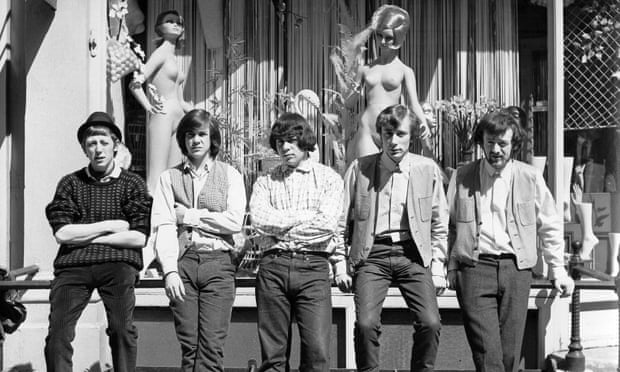
Born in Dartford, Kent, May formed the Pretty Things in 1963 with guitarist Dick Taylor, who had recently left the nascent Rolling Stones. The band’s line-up coalesced with John Stax, Brian Pendleton and Viv Andrews, with May as frontman.
The Pretty Things were fundamental in the development of British music. They enjoyed much critical success and were a huge influence on artists as diverse as David Bowie, Aerosmith, The Ramones, Bob Dylan, The Sex Pistols, The White Stripes, Kasabian, The Lightning Seeds and countless more. The Pretty Things seem to have existed in a state of chaos from the moment they began. They were a genuinely ground breaking band. At a time when most British R&B artists treated their US source material reverentially – “as if it were written in stone and you can’t fuck with the Bible”, says May – the Pretty Things tended to charge at old Willie Dixon and Jimmy Reed songs head on, with thrillingly explosive results. “We were incompetent reprobates,” chuckles Taylor. “It was thrash R&B.” At least part of the Pretty Things’ nonpareil ability to attract trouble was linked to May’s appearance: he had grown his hair down to his shoulders while at art school, a remarkable move in early 60s Britain. “By the time the Pretty Things hit the TV screens, I was used to being abused and spat at and getting into punch ups, because it had happened when we were art students. We’d done our apprenticeship at being outsiders.
They signed to Fontana Records and released a string of hit singles: “Rosalyn”, “Don’t Bring Me Down”, “Midnight to Six Man”, the latter a paean to the life of a jobbing musician so evocative you can almost smell the sweat, cigarette smoke and chip fat in the Blue Boar service station as it plays.
But they also attracted trouble: May and Taylor are full of tales about touring that begin with the band gamely setting off in their van “with some sandwiches Dick’s mum made us” and end with them causing a riot, or being run out of town by the police, or discovering that a guitarist has vanished without trace, unable to cope with the bedlam, only to reappear years later, having opted for a quieter life selling insurance. Should anyone think these stories are exaggerated, there is some footage of them performing in the Netherlands in 1965: they don’t seem to be playing a gig so much as providing the soundtrack to a public disturbance, the music getting more and more chaotic as the crowd fights. Then there was their drummer Viv Prince, a typical anecdote about whom begins: “He was drinking a bottle of whisky a day and there were a number of incidents with a tear-gas gun he’d got hold of in Germany.” A 1965 tour of New Zealand would have gone badly anyway – the press were upset by the band’s appearance, the chaotic nature of their performances and May’s loud questioning of the country’s treatment of its Maori population – but it was Prince who managed to cause so much trouble that the band were deported and the New Zealand parliament barred them from the country for life.
A clip exists of them performing Private Sorrow on French TV that gives you a flavour of what it might have been like: drummer John “Twink” Alder does a mime in white face and Napoleon hat, while May shoots him a succession of furious glares. He looks as if he wants to kill him. “Oh God, yeah,” nods May. “We all did. He got completely carried away. It was like: what are you fucking doing? It was his Marcel Marceau period.
There was also their penchant for what Taylor calls “musical anarchy” on stage – their performances degenerating into improvised noise – and their fondness for drugs. They obviously were not the only mid-60s rock band who fell under the influence of acid, but they may have been the most blatant. Other artists wrote subtly coded songs, wreathed in metaphor, that tipped the wink to listeners in the know: White Rabbit, I Can See for Miles, Tomorrow Never Knows. The Pretty Things wrote songs called LSD and Tripping. “I don’t think we were trying to be surreptitious about anything at that time,” shrugs May.
Radio was equally disinclined to play their astonishing 1967 single Defecting Grey, a saga of cruising in a park while on acid. If May was at least a little more circumspect about his bisexuality than his drug use, he was still fond of swapping the gender pronouns around in old R&B songs, enlivening one mid-60s BBC performance by singing, “I’m in love with your little girl, and your little boy’s in love with me” during a version of Mama, Keep Your Big Mouth Shut.
The group became a key part of the London blues-rock scene who were in thrall to US blues players but were also bringing in new elements of pop and psychedelia. They had an early Top 10 hit in “Don’t Bring Me Down” and other moderately successful songs like “Honey I Need” and “Cry to Me”, and became known for their drug-taking and raucous on-stage behaviour.
May was bisexual, wore his hair long and marked himself out as a countercultural figure. He remembered in “By the time the Pretty Things hit the TV screens, I was used to being abused and spat at and getting into punch-ups, because it had happened when we were art students. We’d done our apprenticeship at being outsiders.”
The band earned their most enduring fame for their 1968 concept album SF Sorrow. It is regarded as the first rock opera album, a tale of the life of the fictional Sebastian F Sorrow, ahead of similar experiments like the Who’s album Tommy. The record was released by Motown offshoot Rare Earth, making them Motown’s first ever UK signing, though it was a flop on release and only later became a cult favourite.
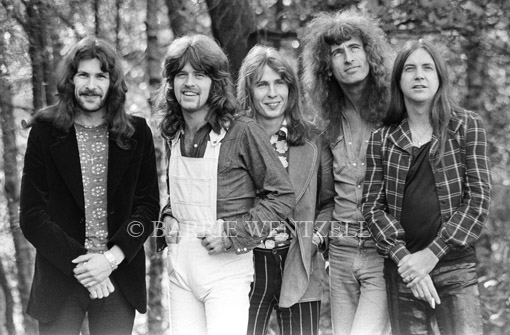
The band created a rich music catalogue including top-level albums such as The Pretty Things, S.F. Sorrow & Parachute, and remained a significant artistic and creative force throughout their entire 55+ year career.
They were revered by artists as diverse as Jimi Hendrix, Aerosmith, the Ramones and Kasabian, and while there were spells of inactivity, the band never split up, enjoying a 55-year career. They played their final concert in 2018, with guest appearances by David Gilmour and Van Morrison.
May and Taylor have a lot of stories like this. They have spent 55 years, on and off, as frontman and guitarist of the Pretty Things, with no end in sight to their career, although the was to be their last as an electric band. May had emphysema, which makes touring tough, although they planed to continue performing acoustically. It is a life that has left them with an apparently bottomless fund of anecdotes about everything from the snobbery of the south London blues scene from which they and the Rolling Stones emerged – “they kind of dismissed me and Keith Richards as punks; they wouldn’t allow us onstage,” says May – to microdosing LSD, a practice May thinks may have been invented by a keyboard player who performed with the band in the 70s. “He used to have a little lick of acid every morning while standing on his head, doing his yoga exercises.” And did it help him psychologically, as latter day devotees of microdosing claim it can? “Well, no, not really,” sighs May. “He went pretty loony, to be honest.”
May also released a solo blues-rock album as Phil May & the Fallen Angels in 1976, which had a fraught gestation – half the album was written and performed with band members from Fleetwood Mac and Humble Pie, who later quit, leaving May to finish it with a fresh set of personnel.
In 2014, he was diagnosed with chronic obstructive pulmonary disease and emphysema, and took a break from touring. He recovered, and the following year the band released their most recent album, The Sweet Pretty Things (Are in Bed Now, of Course…). An album of new material is also slated for release this year.
They continued to release iconic and influential recordings, right up to the present day, with a new album due for release this year. Phil had been in poor health for some time when the Pretty Things played their last live concert, ‘The Final Bow’, on 13th December 2018,
Phil May leaves behind his son, Paris May, his daughter, Sorrel May and his partner, Colin Graham.
The Pretty Things started as blues-rock band in the early 1960s, and they’re often described as being “meaner, louder, uglier and with longer hair” than the Rolling Stones. (Pretty Things guitarist Dick Taylor originally played bass in the Stones). Their gritty, primitive R&B sound was heavily influenced by Bo Diddley’s beat.
Their fourth album, S.F. Sorrow , thePretty Things decided to shake it up a bit and create a psychedelic rock opera that some regard as a masterpiece . It’s held in the same high regard as another lost 60s classic, Odessey and Oracle by the Zombies. In fact, S.F. Sorrow was the first rock opera, not Tommy.
S.F. Sorrow was recorded between December 1967 and September 1968 at Abbey Road Studios. The sound incorporates the sitar, Mellotron, flute, dulcimer and tripped out sound effects.. At the same time, the album’s producer, Norman “Hurricane” Smith was working with Pink Floyd on their A Saucerful Of Secrets album and The Beatles were recording their White Album. (S.F. Sorrow came out the same week as the White Album and The Stones Beggars Banquet).
The 50th anniversary box set edition of the Pretty Things’s groundbreaking 1968 concept album (featuring the 1998 ‘Live At Abbey Road’ recording – with David Gilmour and Arthur Brown described as “A psychedelic masterpiece.”The Pretty Things, were iconic 1st wave cult heroes, created some of the most exciting and innovative records of the 1960s and 1970s. Winners of the Hero award at the 2009 Mojo Honours, the band have been a huge influence on artists as diverse as David Bowie, Aerosmith, The Ramones, Bob Dylan, The Sex Pistols, The White Stripes, Kasabian and many, many more.
In 2018 The Pretty Things celebrate their 55th anniversary as a band with their final live tour and final studio album. 2018 also marks 50 years of the world’s first Rock Opera, S.F. Sorrow. The album stands favourable comparison with Sgt Pepper and Piper At The Gates Of Dawn as one of the defining records of the Psychedelic era. Originally recorded at Abbey Road in 1967 and 1968 it was one of the first true concept albums.
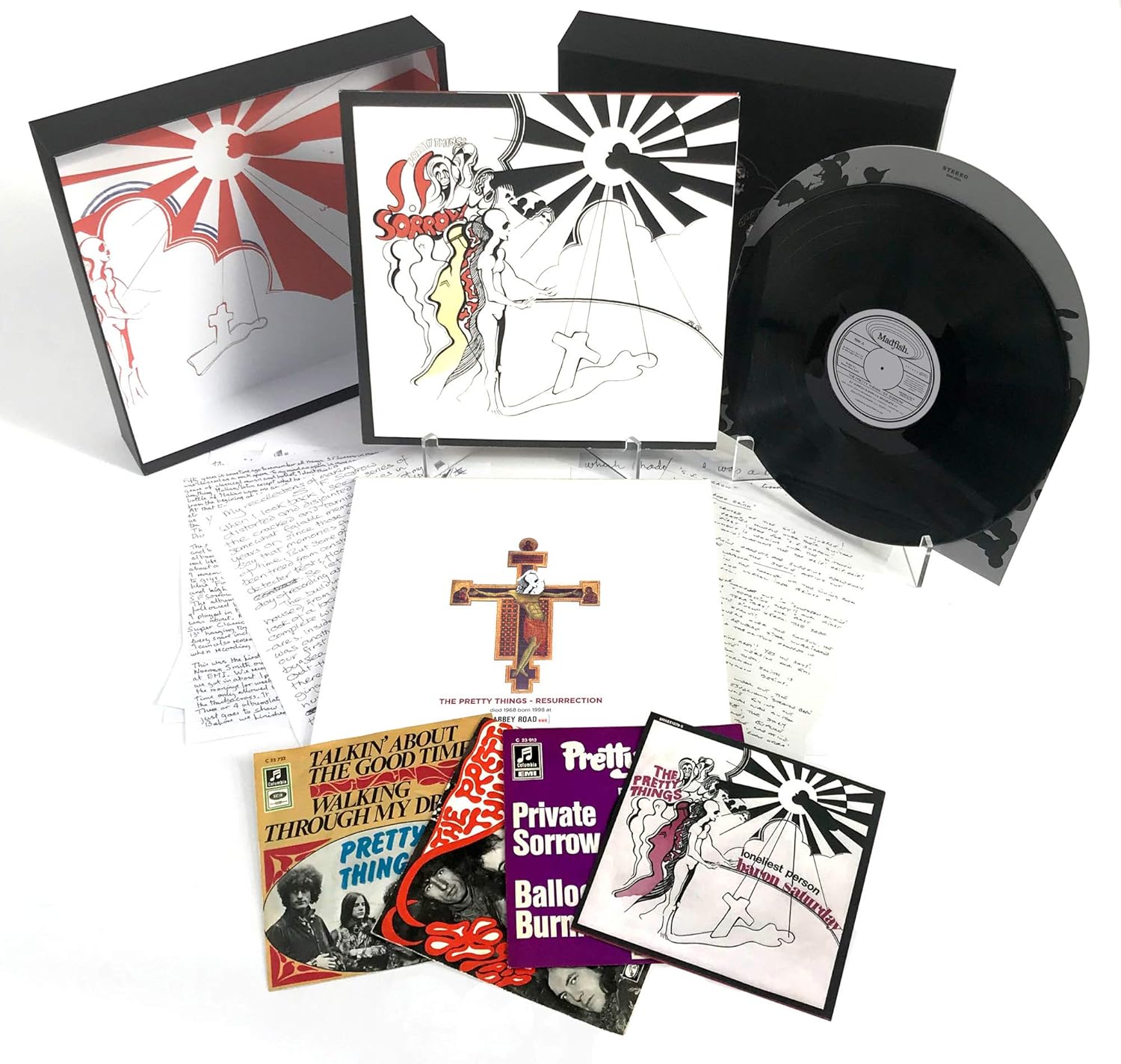
The S.F. Sorrow deluxe vinyl box set features four 12″ LPs, four rare European 1960s picture sleeve 7” singles, and handwritten recollections from Phil May, Dick Taylor, Jon Povey and Wally Waller on individually signed inserts.
The first two LPs feature the mono and stereo versions of the album cut from the original Abbey Road master tapes packaged in facsimile versions of the original UK gatefold and USA ‘Tombstone’ sleeves respectively. The third and fourth LPs comprise a 2LP set of the 1998 Live At Abbey Road anniversary recording with Gilmour and Brown on vinyl for the very first time.
The opera’s libretto came in the form of liner notes that told the story of one Sebastian F. Sorrow, an ordinary fellow who works at the “Misery Factory” and is drafted into World War I. His life descends into meaninglessness after he witnesses a hot-air balloon carrying his fiance crash and burn. Along the way he has an encounter with a mysterious whip-cracking character called “Baron Saturday”.
Saturday “borrows his eyes” and takes Sorrow on a trippy trip through the Underworld (something that seems to mirror the Acid Queen’s unorthodox therapy in Tommy, The opera ends on a sad note as the desolate Sorrow realizes that he can trust no one and that he will die alone.
The Pretty Things were really out there. With ‘SF Sorrow’ they really were pushing it to the absolute mac. They were pushing it just as hard as The Beatles but in a different direction. They recorded it at Abbey Road. It’s a record you go back to if you need to be reminded what being in a rock’n’roll band is all about.”


 The Fat Angel Sings