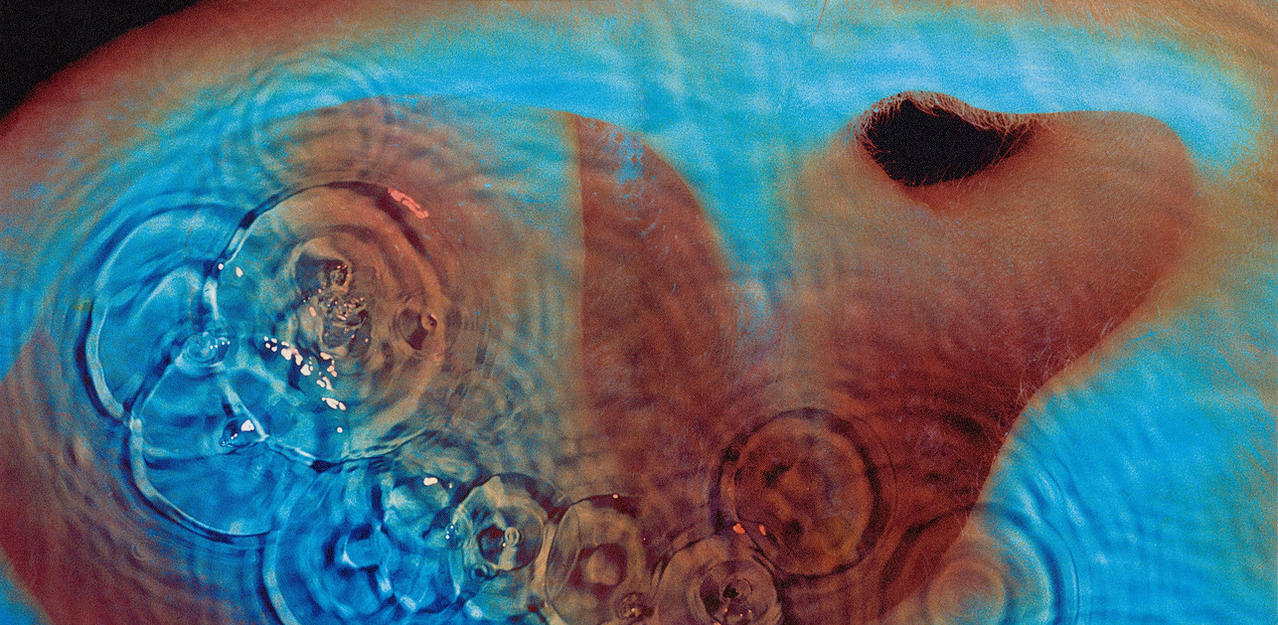
‘Meddle’ didn’t have a very auspicious start, having evolved out of a series of experiments in music making with everyday objects titled ‘Nothings,’ ‘Son of Nothings’ and then ‘Return of the Son of Nothings.’ Yet, in exploring so far outside of the realm of the every day, they were clearly onto something. ‘One of These Days’ and ‘Echoes’ (both featuring weirdly involving instrumental elements) became signature favorites, while an unused song evolved into ‘Brain Damage’ for ‘The Dark Side of the Moon.’ They were mere steps away from greatness.
Arriving bereft of ideas, Pink Floyd did something that was becoming increasingly rare on Meddle: They collaborated together in the studio.
At first, this didn’t lead to much. The album, before its arrival on October. 31st, 1971, was actually known as Nothing, Parts 1-24. Recorded in a series of locales around London between concert dates, Meddle eventually came together with help – both instrumentally and lyrically – from all four members, a stark contrast to the Roger Waters-dominated albums to come in the ’70s.
“When we started on Meddle, we went into it with a very different working basis to any previous album in so much that we went into the studios with nothing prepared, and did a month of – well, we just called them nothings,” NickMason said Ted Alvy of KPPC-FM in 1971. “I mean, they were ideas that were put down extremely roughly. They might have been just a few chords, or they might have been a rhythm idea, or something else – and this was just put down, and then we took a month and examined what we got.”
What emerged was the bridge between their earliest recordings and the career-making triumph of 1973’s The Dark Side of the Moon. Meddle still boasted the wide-open improvisational gumption of transitional albums like 1968’s A Saucerful of Secrets, 1969’s Ummagumma and 1970’s Atom Heart Mother, but their focus started to narrow. In some ways, the LP represents the best of both worlds.
They got there together, swapping musical ideas and – in the case of the album-opening “One of These Days” – even swapping places. David Gilmour took up the bass as the song opens, before being joined by Waters. (You’ll notice the second double-tracked instrument has a flatter sound. “We didn’t have a spare set of strings for the spare bass guitar, so the second bass is very dull sounding,” Gilmour told Guitar World in 1993. “We sent a roadie out to buy some strings, but he wandered off to see his girlfriend instead.”) Mason takes a rare vocal turn on “One of These Days,” as well.
A swirling breeze links that song to the tender “A Pillow of Winds,” which was inspired by time spent by Waters and Mason with their wives in the south of France. Waters’ “San Tropez” – the only song here not co-written with Gilmour – also recalls trips to the French Riviera. Together, Pink Floyd bring an impish humor to songs like “Fearless,” which features a field recording of a Liverpool soccer club singing “You’ll Never Walk Alone” – forcing Pink Floyd to co-credit Rodgers and Hammerstein – while “Seamus” includes the howling of Small Faces/Humble Pie vocalist Steve Marriott’s dog, whom Gilmour was watching.
Meddle will always be defined, however, by its side two-encompassing closing track, “Echoes.” The song, which stretched to 23 minutes, again grew out of a collaborative moment – this time onstage, when the song was reportedly introduced as “Return of the Son of Nothing.”
Richard Wright wrote the long piano intro and the chord progression, while Waters added lyrics – after coming up with the idea of running Wright’s original “ping” sound through a Leslie rotating speaker. Gilmour achieved the seagull sounds by reversing the inputs on a wah pedal.
“Things like ‘Echoes’ would be all of us in a rehearsal room, just sitting there thinking, playing – working out ideas to see if they went anywhere,” Wright told Rolling Stone in 1987. “It’s a nice way to work – and I think, in a way, the most ‘Floyd-ian’ material we ever did came about that way.”
“Echoes,” which later provided the title to a career-spanning retrospective, was Pink Floyd’s breakthrough moment. An complex and stirring finale, “Echoes” holds together as one narrative piece, unlike the lengthy title track from Atom Heart Mother.
‘Meddle’ (1971): “Echoes”
Pink Floyd spreads way, way, way out on this extended epic – at 23-plus minutes, the length of an entire side of vinyl. It’s not the duration of “Echoes” that’s noteworthy, only that the extra running time allows for such a wealth of noises and ideas. If the early, psychedelic Floyd stuff was “space rock,” this is “deep sea rock,” and just as enchanting. Wright creates a submarine-like “ping” while Gilmour dreams up a pod of whales by plugging a wah-wah pedal in backwards. Nick Mason guides the ever-changing song, and Roger Waters writes of wind, water and, more importantly, humanity. The band believed this mix of outward-looking lyricism and dynamic sounds was the stepping stone to full album suites, like Dark Side of the Moon. (And, if you agree with Waters, this descending chord motif led to Andrew Lloyd Webber’s Phantom of the Opera.)
“I think ‘Echoes’ is the masterwork of the album – the one where we were all discovering what Pink Floyd is about,” Gilmour told Guitar World. “Meddle is really the album where all four of us were finding our feet – the way we wanted Pink Floyd to be, much more than on Ummagumma or Atom Heart Mother. Although Atom Heart Mother has some pointers and directions as to where we would finally go, it’s not as important as Meddle was.”
Even though Meddle reached No. 3 in the U.K., the U.S. was proving a tougher market to conquer. The album actually finished 15 spots further back from Atom Heart Mother, at a paltry No. 70. Still, the stage was set – as evidenced by the appearance in these sessions of “Brain Damage,” which would later help close out The Dark Side of the Moon.
“All those stages are part of a general evolution, made of progression and dead times,” Mason mused in 1973, as Pink Floyd found themselves finally on the cusp of superstardom. “They weren’t exactly succeeding experiments, but rather exercises about a particular aspect of music, so you could evolve after that. Anyway, we never did an album saying, ‘That’s it, we reached the zenith.’ On the contrary, we always asked ourselves: ‘What will we do next?’”
Pink Floyd’s sixth album was a turning point of sorts, as the band inched closer to more structured songs, as opposed to the atmospheric set pieces that dominated their previous records. ‘Echoes,’ ‘Meddle”s highlight, still runs more than 23 minutes, but its mix of long instrumental passages and vocal patches is a precursor to the career-changing ‘The Dark Side of the Moon.’
Pink Floyd, released on 31st October 1971 by Harvest Records.
Originally envisioned as a soundtrack to ‘The Wall’ film, this didactic “band” project became a stand-alone effort when Waters became outraged over England’s involvement in the early-’80s Falkland Islands conflict. By this point, Wright was already out the door, and Gilmour clearly didn’t feel like fighting anymore. He had only one vocal, and a few bursts of guitar brilliance. The rest was Waters, who unleashes a series of searing diatribes on the kind of conflicts that tore his family apart – but without the magisterial musical accompaniment that used to give them flight.
Almost 10 years to the day since the release of The Dark Side Of The Moon, Pink Floyd’s album “The Final Cut” was released. A decade earlier, the material for Dark Side had been worked up thoroughly on the road, and all four band members had writing credits on the record. With The Final Cut, the group – a trio, following the sacking of keyboard player Rick Wright – had become, through default more than by design, a method of carriage for the words and music by de facto leader Roger Waters alone, with session musicians featured heavily throughout its recording.
The album had few discernible hooks, no standout commercial moment, and Floyd never played anything from it live. Initially that didn’t stop the Floyd juggernaut though. Fans worldwide had been waiting three and a half years for a new album, their longest wait to date. And so, on its release in March 1983, The Final Cut became Pink Floyd’s first UK No.1 album since 1975’s Wish You Were Here. Some press gave it the full five stars, and suggested that it might be “art rock’s crowning masterpiece”.
But the juggernaut would soon jackknife. The Final Cut disappeared almost as soon as it arrived, leaving the album, a single and a 19-minute ‘video album’ as its only footprints. There were no promotional appearances, no group publicity photographs, no tour. If the album featured at all in later interviews by both Roger Waters and David Gilmour, it was portrayed as coming from a period of abject misery.
“That’s how it ended up,” Gilmour told David Fricke in 1987. “Very miserable. Even Roger says what a miserable period it was and he was the one who made it entirely miserable, in my opinion.”
“It came and died, really, didn’t it?” says Willie Christie, who shot the album’s cover photo. Christie has great insight into the album and the period. Waters was his brother-in-law, and at the time Christie was living in an outhouse over the garage at Waters’s house in Sheen, “after a relationship had gone south”.
“Because the break-up was on the horizon,” he adds, “I think David was finding it very tough; Roger for different reasons. That was a great shame. David had said publicly that the songs were off-cuts from The Wall. Why regurgitate? I never saw it like that. While it would probably be a perverse fan who would name The Final Cut as their favourite Pink Floyd album, it’s certainly worth a lot more credit than it’s usually given. Yes, the album is the greatest example of high-period megalomaniac that is Roger Waters. However, for all his writing and singing, it needs to be taken as a PinkFloyd release, and not a solo Waters one – it also has some of DaveGilmour’s best guitar solos, and drummer Nick Mason curated some of the best sound effects in Floyd’s career.
‘What have we done to England?’Waters sings on opening track “The Post War Dream”, as a brass band, that most quintessentially British sound, plays out. It locates the album squarely in the post-Falklands-invasion landscape of 1982, while looking back to the World War II beachheads of 1944. As Cliff Jones noted in Echoes: The Stories Behind Every Pink Floyd Song, it was “the most lyrically unequivocal of all Pink Floyd albums”.
Moreover, the album is phenomenally significant in the group’s career. Had it been a far better experience and a bigger seller, it might have allowed PinkFloyd to conclude, or perhaps continue, on a triumphant, cordial high. Instead it left a nagging sense of unfinished business, which led to the split, the commercial triumph of the Gilmour years and the group’s enormous afterlife.
The genesis of The Final Cut is well known. Some of its material dates from five years previously, when Waters came up with the original recording’s of The Wall in the summer of 1978.
He had written around three albums’ worth of material. He was driven in a way that the other band members, who seemed to want to escape Floyd at the time, simply were not.
Pink Floyd as we knew them finished on June 17th, 1981 at London’s Earls Court Arena, when the last of the 31 “The Wall” shows ended. That year’s return to touring was to gather material for the Alan Parker-directed filmed version of The Wall. There was talk of a soundtrack album to the Parker film, but there was hardly a great deal of material: versions of In The Flesh (with and without the question mark) performed by the film’s Pink, Bob Geldof; The Wall out-take When The Tigers Broke Free; and What Shall We Do Now?, which was left off the album.
This project evolved into Spare Bricks, where these tracks were supplemented with additional The Wall off-cuts Your Possible Pasts, One Of The Few, The Hero’s Return and The Final Cut. However, when Argentina invaded the Falklands – the British-ruled islands in the South Atlantic in April 1982 – and UK Prime Minister Margaret Thatcher sent a task force to counteract this, Waters suddenly had his subject matter.
The pointlessness of the ensuing 74-day conflict, resulting in the loss of 907 lives, evoked again the death of Waters’ father Eric in World War II, at Anzio in 1944. Waters relished the merging of the past and the present. He was going to write a modern requiem. And so Spare Bricks became The Final Cut. Its title was a Shakespearean reference to Julius Caesar being stabbed in the back by Brutus: “This was the most unkindest cut of all.”
“The Final Cut in film terminology is the finished article,” Gilmour explained in 1983. “When you stick all the rushes together basically in the right order, you call it the ‘rough cut’, and when you’ve cleaned it up and got it perfect you call it the ‘final cut’. It’s also an expression for a stab in the back, which I think is the way Roger sees the film industry.”
Waters’ had frequent run-ins with director Alan Parker on the making of the film are no secret. It was also clear that the members of Pink Floyd, never the chummiest of groups, were growing ever further apart. The UK premiere of The Wall on July 14th, 1982, at the Empire Theatre in London’s Leicester Square, was the only time the three-man Pink Floyd – no one knew yet that Rick Wright was no longer in the band, with the party line being that he was ‘on holiday’ – were ever seen together in public.
“When The Tigers Broke Free” was issued as a single in July 1982, was full of pathos and huge in its intent. Not since Apples And Oranges, released back in 1967, had so many eyes had been on the chart performance of a Floyd single, Tigers being their first single since Another Brick In The Wall, Part Two in 1979. Tigers, which was fundamentally Waters along with the Pontarddulais Male Voice Choir and an orchestra, was labelled as being from The Final Cut. Ironically, it didn’t make it on to the album until the track listing was re-configured for CD in 2004. Tigers reached only No.39 in the UK chart.
“The relationship was definitely frosty by that stage, So the time that Dave in particular – and Roger were in the studio together, it was frosty. There’s no question about it.” Yet this frostiness made for great art. There was innovation too. Italian-based, Argentine-born (which no doubt would have appealed to Waters’s sense of humour) audio inventor Hugo Zuccarelli had approached the group to try out his new ‘Holophonic’ surround sound that could be recorded on stereo tape. For a group so associated with their audio pioneering, this was a positive boon.
The system used a pair of microphones in the head of a dummy. Zuccarelli played Mason, Gilmour and Waters a demo of a box of matches being shaken that sounded as if it was moving around your head. The group were of one mind to use the system. Mason began to gather the sounds in the Holophonic head (which, as he noted in his Floyd history Inside Out, “answered to the name Ringo”).
He duly recorded Tornado aircraft at RAF Honington, the sounds of cars passing, the wind, and various ticks, tocks, dogs, gulls, steps, shrieks and squawks. On the album, sound effects careened between left and right channels. The missile attack at the start of “Get Your Filthy Hands Off My Desert” is arguably the greatest sound effect on any Pink Floyd record.
Ray Cooper played percussion, Raphael Ravenscroft added saxophone, and on closing track “Two Suns In The Sunset” veteran drummer Andy Newmark took Nick Mason’s place. It took two players to replace Rick Wright: Michael Kamen on piano, and Andy Bown on Hammond organ.
“It was wonderful to work for them in that live situation. It’s rare to meet a rock band that know how to behave,” Bown recalls. “And the Floyd organisation treated the hired guns very well indeed. Recording is different you’re not living with each other in the same way. I remember almost nothing from those sessions. Waters’s exacting attempts at nailing a vocal recording led to the well-reported incident of Kamen doing a Jack Nicholson in The Shining, writing furiously in the control room. When Waters went to investigate what he was doing, he saw that Kamen had written repeatedly: “I must not fuck sheep”. According to Andy Bown, Kamen was “a lovely cuddly bear with a wacky sense of humour”.
“It was obvious Roger was making all the running,” Nick Mason said of a period of recording at Mayfair Studios. “Roger is sometimes credited with enjoying confrontation, but I don’t think that’s the case. I do think Roger is often unaware of just how alarming he can be, and once he sees a confrontation as necessary, he is so grimly committed to winning that he throws everything into the fray – and his everything can be pretty scary… David, on the other hand, may not be so initially alarming, but once decided on a course of action is hard to sway. When his immovable object met Roger’s irresistible force, difficulties were guaranteed to follow.”
“I was in a pretty sorry state,” Waters said. “By the time we had got a quarter of the way into making The Final Cut, I knew I would never make another record with Dave Gilmour or Nick Mason.” Gilmour said in 2000: “There were all sorts of arguments over political issues, and I didn’t share his political views. But I never, never wanted to stand in the way of him expressing the story of The Final Cut. I just didn’t think some of the music was up to it.” After much arguing with Waters, Gilmour surrendered his producer credit on the album – but not his share of producer royalties. He was even to say: “It reached a point that I just had to say: ‘If you need a guitar player, give me a call and I’ll come and do it.’”
In 1983 he said: “I came off the production credits because my ideas of production weren’t the way Roger saw it being.”
“I was just trying to get through it,” Gilmour told me in 2002. “It wasn’t pleasant at all. If it was that unpleasant but the results had been worth it, then I might think about it in a different way. I wouldn’t, actually. I don’t think the results are an awful lot… I mean, a couple of reasonable tracks at best. I did vote for The Fletcher Memorial Home to be on Echoes. I like that. Fletcher, The Gunner’s Dream and the title track are the three reasonable tracks on that.”
Overlaid with Waters’s disgust at the Falklands War, and grieving for the father he never knew, the narrative of The Final Cut focuses on the figure of the teacher from The Wall, who had been a gunner in the war, staring down modern life. The central character of The Wall, Pink, makes an appearance on the title track. Waters is frequently self-referential in his choice of words. For example, ‘quiet desperation’ and ‘dark side’, two most Floydian phrases, are used.
Of the original album’s 12 tracks, The Hero’s Return and The Gunner’s Dream are two of Waters’s finest moments side by side: full-bleed paranoia, with his unlimited capacity for beauty and empathy. The Hero’s Return began life as Teacher, Teacher from The Wall. The band’s demo from January 1979 has a synth drone, with Gilmour on loud slide guitar; here, the hero is haunted by images of the war he can’t discuss with his wife.
On The Gunner’s Dream there’s little guitar but plenty of saxophone, so much a feature of 1973-75 Floyd. Here, as with a lot of the album, Waters’s voice is the lead instrument. The song examines the sudden powerlessness of a situation when confronted by the jackboot. Referencing war poet Rupert Brooke, Waters delivers one of his finest vocal performances. It also introduces the imaginary character Max, an in-joke name for producer Guthrie from the sessions. And the screaming doesn’t stop. A decade and a half after his wails on Careful With That Axe, Eugene, possibly Waters’s career-best bellow is on The Gunner’s Dream, where he howls for a full 20 seconds. Rolling Stone said it contained some of the most “passionate and detailed singing that Waters has ever done”. And it’s certainly there, as he enunciates every vowel as if his life depends on it.
“Not Now John” It’s almost as if, deep into his work on The Final Cut, Waters remembered that satire could be fun (and that music could be exciting). He also seemed to recall that Gilmour was just sitting there on the bench. David makes the most of his game time on the rocking “Not Now John,” ferociously tearing into lyrics that are a head-spinning mix of Waters’ personal and political demons come to life. For those who tut-tut at the song for being boorish, it’s a shame they can’t bask in the pleasures of this buzz bomb, complete with female backing vocalists screaming “fuck all that.”
The Fletcher Memorial Home, where ‘colonial wasters of life and limb’ assemble, delivers another standout moment, with Waters giving tyrants past and present the chance to get together before applying a final solution to them. Gilmour’s solo and Kamen’s beautiful brass arrangement enhance the song’s gravitas.
While the title track is similar to Comfortably Numb in its arrangement, Not Now John is the album’s rocker. It’s a call and response between Gilmour and Waters – one as the jingoistic right winger so celebrated in the early 80s, the other attempting reason. The US, sensing the one song that resembled conventional rock (complete with Gilmour’s ultra-Floyd guitar work), suggested a radio recut, with Gilmour and the backing vocalists singing ‘stuff’ loudly over the song’s obvious use of the word ‘fuck’.
It was issued as a single, accompanied by a Willie Christie-directed video, in May 1983 and scraped into the UK Top 30. Album closer “Two Suns In The Sunset” was inspired by Waters’s recent viewing of the banned docudrama The War Game. In the end the hero drives off and sees a nuclear explosion, a result of someone’s anger spilling over to the point where the button is pushed. He now understands ‘the feelings of the few’. As the explosion comes, Waters suggests: ‘Ashes and diamonds, foe and friend, we were all equal in the end.’
The final track from ‘the original Pink Floyd’ ends with a session sax player, a session drummer, and a producer playing piano. By then it seemed that even Waters had been removed from his own story.
Even designers Hipgnosis, The long-time Pink Floyd collaborators, and cartoonist/illustrator Gerald Scarfe were now surplus to requirements. Scarfe has said he had done a test version of a cover for The Final Cut, but Waters himself oversaw the artwork with graphic design company Artful Dodgers. His brother-in-law, Vogue photographer Willie Christie, was brought in to take the photos for the sleeve. With Christie Waters’s house guest at the time, the pair discussed the concept at length.
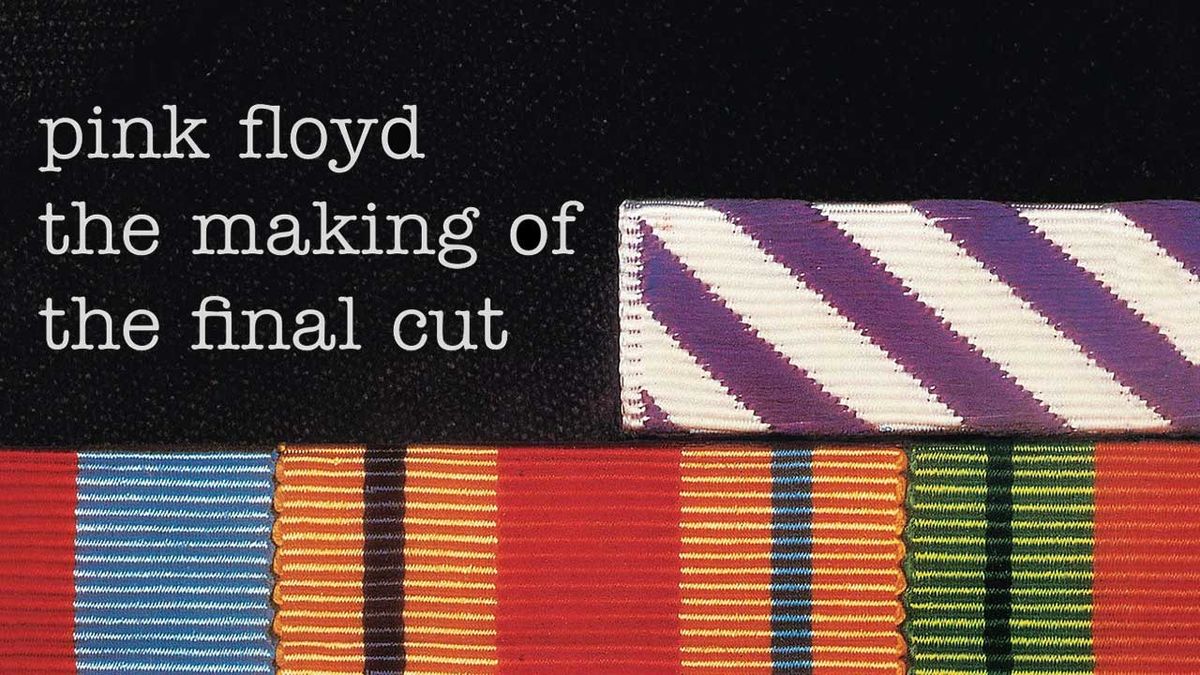
“We were talking about it all the time from conception,” Christie says. “Roger asked me to do the stills. They came out of ideas we had talked about – poppies featured a lot because of the theme of it. I did the stills – the poppies and the strip of medals – in November 1982. The field was near Henley. We needed a field of corn, and I’d done a Vogue shoot down there in 1977. A prop company called Asylum made me up some poppies, as real poppies don’t last.”
Asylum also made two uniforms, complete with the knife in the back. Christie’s assistant, Ian Thomas, modelled the outfit, holding a film canister under his arm. “That was the whole idea of the knife in the back and the film canister,” Christie says. “That [Alan] Parker had stabbed him [Waters] in the back.”
In another shot, Thomas is seen lying dead in the poppy field, watched over by Stewart, the Waters’s pet spaniel. In the gatefold, Thomas can be made out in the distance, while the outstretched hand of a child holds poppies. The sleeve also contains an image for Two Suns In The Sunset, and the Japanese welder for Not Now John which was shot in Christie’s London studio.
Christie recalls showing the group his work in progress: “David hadn’t been involved or consulted. I slightly found myself in the middle. It was a little bit awkward, as I’d been talking to Roger. But David’s a really good bloke, a genius. Gilmour looked at the photographs and then told Christie: “Well actually, the knife wouldn’t go in like that, it would go in sideways, as your rib cage wouldn’t allow it to go in straight, vertical.”
The cover image is a powerful close-up of a serviceman’s lapel, showing a poppy and his medals. The back of the sleeve listed just three members of Pink Floyd. This was the first time the wider world became aware that Rick Wright was no longer a member of the group – and that this was clearly a work ‘by Roger Waters, performed by Pink Floyd’.
It’s difficult now to convey just how exciting the release of The Final Cut was, The critics were, of course, deliciously mixed. Richard Cook wrote in the NME that Waters “picks out the words like a barefoot terminal beachcomber, measuring out a cracked whisper or suddenly bracing itself for a colossal scream… The story is pitched to that exhausting rise and fall: it regales with the obstinacy of an intoxicated, berserk commando.” The review ends with the extremely perceptive comment: “Underneath the whimpering meditation and exasperated cries of rage, it is the old, familiar rock beast: a man who is unhappy in his work.”
A week later, Kurt Loder duly obliged, with a five-star review that included: “This may be art rock’s crowning masterpiece, but it is also something more. With The Final Cut, Pink Floyd caps its career in classic form, and leader Roger Waters – for whom the group has long since become little more than a pseudonym – finally steps out from behind the ‘Wall’ where last we left him.
“The end result is essentially a Roger Waters solo album, and it’s a superlative achievement on several levels. By comparison, in almost every way, The Wall was only a warm-up.”
But not good enough for what Pink Floyd had become in popular perception. As Nick Mason later wrote: “After The Final Cut was finished there were no plans for the future. I have no recollection of any promotion and there was no recollection of any live performances to promote the record.” Had there been a tour to support it, The Final Cut could have been a huge, sustained hit. There’s just something about it, like much art from that strange 1980-83 period in the UK, It could be said that Pink Floyd were the only ones doing what they always did – or at least post-1975 Floyd. But, as said, it wasn’t enough.
The early 80s, unless you lived through them, are very hard to explain. The 60s and 70s seemed clear-cut. When people do think of the 80s, it’s that later flash, brash, wedges-of-money time. We also need to review where Floyd’s 70s peers were by 1983. Led Zeppelin were long gone. Queen were licking their wounds from an ill-advised, all-out assault on disco. Genesis had gone ‘pop’. Yes were, quite by accident, about to reinvent themselves as a techno stadium monster.
Waters his other 1978 concept idea, The Pros And Cons Of Hitch Hiking, done with much of the same team as The Final Cut. (“That was jolly good fun,” Andy Bown recalls. “And terrific musicians to work with. Bloody good album too.”)
In October 1985, Waters issued a High Court application to prevent the Pink Floyd name ever being used again, considering it a ‘spent force’. With that, he finally had the nerve to make the final cut. Gilmour and Mason, however, did not, and the next chapter of Pink Floyd was about to begin, one that would see the band going back to stadiums and making a noise that sounded like the best of Floyd’s albums from 1971-75.
The legendary Pink Floyd concert at the First International Pop Festival in Rome in May 1968. This well recorded performance captures RogerWaters, Dave Gilmour, Richard Wright and Nick Mason in their very early Post-Barrett era; the time when the band was busy trying to reinvent themselves after the crucial split with genius Syd Barrett. This was even before the release of their second album, when Waters and Co. really began to extend the classic three / four minute song format towards longer and more open sound forms. A marvelous track list including seminal compositions and psychedelic manifestos such as Astronomy Domine, Set The Control for the Heart of the Sun andInterstellar Overdrive all great sparks for visionary instrumental progressions and far out improvisations. The album ends with an excerpt of Roger Water’s voice from a radio interview broadcast.
Side A:
1. Astronomy Domine
2. Interstellar Overdrive Side B:
1. Set The Controls For The Heart Of The Sun
2. Roger Waters Interview
LP – Limited Edition of 500 Copies on Green Vinyl.
Pink Floyd released Animals on 23rd January 1977. Although it was the seminal band’s tenth studio album, it remains one of their most famous for its Orwellian socio-political critique, an iconic cover and early prog inclinations.
Animals also marked the beginnings of dissent within the band over a chief songwriter. Three years after it’s release keyboardist Richard Wright would leave the band and The Wall would be hit shelves, casting a gargantuan shadow across the humble forerunner. Steeped in woeful political distaste and harder rock breakdowns, Animals rates as highly as Pink Floyd’s most well-known albums for more intrepid fans, but it’s recording process was one of the shakiest they ever accomplished. Here’s five things you didn’t know about the birthday record and it’s mascot, Algie the pig.
Animals is a concept album, based on the flaws of capitalism. Various castes in society are represented as different types of animals (Dogs as the businessmen, sheep as the powerless pawns, and pigs as the ruthless leaders). Although this album mainly attacks capitalism, several components are similar to George Orwell’s novel “Animal Farm”: In the book various animals (mainly pigs, sheep, dogs, etc.) represent different roles assumed by individuals in a communist society.
A bracing reinvention of the Orwell theme from ‘Animal Farm,’ ‘Animals’ found Pink Floyd pushing back – and hard – against the looming, punk-driven idea that they had grown soft into middle age. At the time, this searing commentary on societal decay in the late-’70s couldn’t have seemed more different from its predecessors. Today, it’s clear that ‘Animals’ represents the first stirrings of Waters‘ more political bent (one that would dominate his recordings past his association with the group he co-founded), even as it finds Richard Wright making his last important contributions of the Waters era.
Behind Dark Side of the Moon and The Wall towers Animals, as the third iconic Pink Floyd record but feels more important than ever. Oddly the cover’s concept was conceived by Roger Waters himself. This being said, Floyd approached long time collaborators Hipgnosis to make the final product happen.
While Hipgnosis were originally approached by Floyd in 1968 to design the artwork for their second album A Saucerful of Secrets, it was the album cover for Dark Side of The Moon in 1973 which shot the design group to international fame. Hipgnosis’ surreal photographic style used old school film manipulation techniques such as multiple exposures, mechanical cut-and-pasting and general darkroom wizardry, which served as a precursor to modern, digital forms of photo manipulation. Manual photoshop, if you will.
Animals’ best track “Dogs” delivers even more incredible guitar work from Dave Gilmour, who makes his instrument cry and cackle, moan and mock, surge and slice. But this 17-minute leviathan is a brilliant collaboration between Floyd’s members – not just co-writers Waters and Gilmour (who each sing lead for a while), but also Mason (who pounds and cracks his way through the song’s changing tempos) and Wright (who plays no less than five different keyboards to bring a variety of textures to the epic). As lyricist, Waters is in full-on deride mode, as he writes about Machiavellian menace, but the writing is so crisp and clever (“And it’s too late to lose the weight you used to need to throw around”), the scoffing becomes sport.
The Pig, While Hipgnosis may have been a pioneer of collage techniques, there was no photo trickery involved in the cover of Animals. Floyd commissioned German company Ballon Fabrik and Australian artist Jeffrey Shaw to collaborate on the construction of the 12 meter long piggy, which was manoeuvred into position on December 2nd 1966.
The pig has gone on to serve as a motif for political vitriol, English rock and everything Pink Floyd. It appeared in the backdrop of a shot in Alfonso Cuarón’s thriller Children of Men which imagines a dystopian England similar to Animals’ vision of the future . Danny Boyle made a more lighthearted reference to the porcine balloon in his short Isle of Wonder for London’s 2012 Olympics.
The Studio, Previously to 1975, Floyd had struck a deal with EMI which allowed them unlimited recording time in return for reduced earnings from sales. When this deal expired the band bought a three story block in North London and made it their own. Britannia Row Studios was largely comprised of church halls, and Animals was the first album recorded there after it’s renovation. Pink Floyd went on to record The Wall in the same location, the echoing school chorus of “Another Brick In The Wall” owing it’s sound to the towering studio.
While singer and guitarist David Gilmour is only credited for the music of one track, the epic “Dogs” (previously known as “You Gotta Be Crazy”), this song and “Raving and Drooling”, a Waters song which would later become “Sheep”, were created at the same time as “Shine On You Crazy Diamond”, and originally destined for Wish You Were Here. Their creation process was similar to the method the band used during the late sixties and early seventies. They would adapt and expand their compositions by performing them live, and later in the studio find a more coherent form and concept for the whole album, with Waters writing the lyrics. Animals was the last Pink Floyd album created in this way, as the subsequent The Wall and The Final Cut, were primarily conceived by Waters and worked out in the studio with some input from Gilmour. Although Rick Wright admittedly did not contribute much compositionally, he had some influence on the arrangement of the songs, including solo playing on “Dogs” and “Sheep”. As with “Welcome to the Machine” and “Wish You Were Here” , Waters wrote “Pigs on the Wing” and “Pigs (Three Different Ones)” to tie together the other songs in the album’s concept. His dominance in the writing credits and the discrepancy with the actual creation process is directly related to the increasing tensions within the band.
Animals began to be formulated 20 years after George Orwell published the canonical Animal Farm, a political allegory of the Russian revolution and Stalinist era of the soviet union.
Pink Floyd’s album borrowed heavily from the ruleset of Orwell’s fable, and each song’s title represents an element, or animal, within the capitalist British regime of their time.
The album is bookended by parts one and two of Pigs on the Wing, a short intro and outro on a record otherwise dominated by immensely long jams. Dogs represents the businessmen, deceptive, vicious but ultimately lonely. The narrative within the lyrics tells of two dogs, one younger and one older, coming to realise the doomed reality of their own existence, while the young is encouraged to break the mould and dissent from his fate.
As with Animal Farm, Pigs (Three Different Ones) represents the flawed, gluttonous personalities which sit at the top of society’s ladder despite their horrific traits. The Sheep suffer under the power of pigs and dogs, mindlessly following suit with the herd around them. Parts 1 and 2 were linked by a guitar bridge performed by Snowy White (subsequently available on White’s 1996 album “Goldtop: Groups & Sessions”),
The anti-establishmentarian soul of Animals has never been as relevant as it is today. If you need some proof, here’s a video Roger Waters posted which depicts him playing Pigslive to 300,000 screaming fans in Mexico City:
For many fans, Animals represents the turning point at which Roger Waters took the reigns of Pink Floyd. The entire album save for Dogs, which was co-written by David Gilmour, was written by Waters.
Speaking to Mojo Magazine in 2008, Gilmour had the following to say.
“Roger’s thing is to dominate, but I am happy to stand up for myself and argue vociferously as to the merits of different pieces of music, which is what I did on Animals. I didn’t feel remotely squeezed out of that album. Ninety per cent of the song “Dogs” was mine. That song was almost the whole of one side, so that’s half of Animals.”
Animals was almost a fully-realised artistic vision for Waters, but the control didn’t end there. When work on the album ceased, Waters pitched the concept of The Wall to his band mates, who were initially cautious but agreed to follow Waters once again.
In 1985 Waters left Pink Floyd, eventually calling them a “spent force” and splitting the band in their separate directions.
The giant, helium-filled pig seen on the cover was actually flown over Battersea Power Station for the photo shoot (under the direction of Storm Thorgerson). On the first day of shooting, a marksman was on hand in case the pig broke free. However, according to Thorgerson, this was considered an “insurance problem”, and he was not hired for the second day of shooting. Ironically, on December 3rd, 1976, during the second day, a gust of wind broke the pig free of its moorings. Because there was no one to shoot the pig down, it sailed away into the morning sky. A passenger plane reported seeing the pig, causing all the flights at London Heathrow Airport to be delayed. A police helicopter was sent up to track the pig, but was forced to return after following the pig to an altitude of 5,000 feet. A warning was sent out to pilots that a giant, flying pink pig was loose in the area. The CAA lost radar contact on the pig near Chatham in Kent, at a height of 18,000 feet and flying East. It finally landed in a farmer’s field, without much damage.
Roger Waters has revealed a failed attempt at civility with his former Pink Floyd bandmates over a reissues of the “Animals” album, He discussed the attempted peace meeting during a conversation with Rolling Stone. “I wrote out sort of a plan,” Waters explained, adding that both David Gilmour and Nick Mason were in the room for this conversation. “But my plan didn’t bear fruit.”
Pressed on whether his peace plan was part of a bigger Pink Floyd reunion discussion, Waters was defiant. “No, [a reunion] wouldn’t be nice,” he said. “It would be fucking awful. Obviously, if you’re a fan of those days of Pink Floyd, well, then you have a different point of view. I had to live through it. That was my life. And I know in the wake of it, I’ve been cast as something of a villain by whoever, whatever. So be it. I can live with that. But would I trade my liberty for those chains? No fucking way.”
Waters also revealed that the discussion with Gilmour and Mason was focused on reissues. “[The conversation] was just can we release the remastered vinyl of Animals without it turning into the third World War?” he explained, referring to the 5.1 surround sound mix of Pink Floyd’s 1977 album, which has been in the works for more than two years now. “I actually suggested going democratic,” Waters noted. “I said, ‘Why don’t we just have a vote? There’s only three of us. And then we can decide all those like that.’ And at least we can just get on. But they wouldn’t have that. They didn’t want it.”
Waters was recently forced to postpone his 2020 This is Not a Drill tour as a result of the coronavirus pandemic. That hasn’t stopped the musician from continuing to plan and create. “I’m working on the tour every day,” he confessed, adding that he’s been writing a new song to fit in with the This is Not a Drill set list.
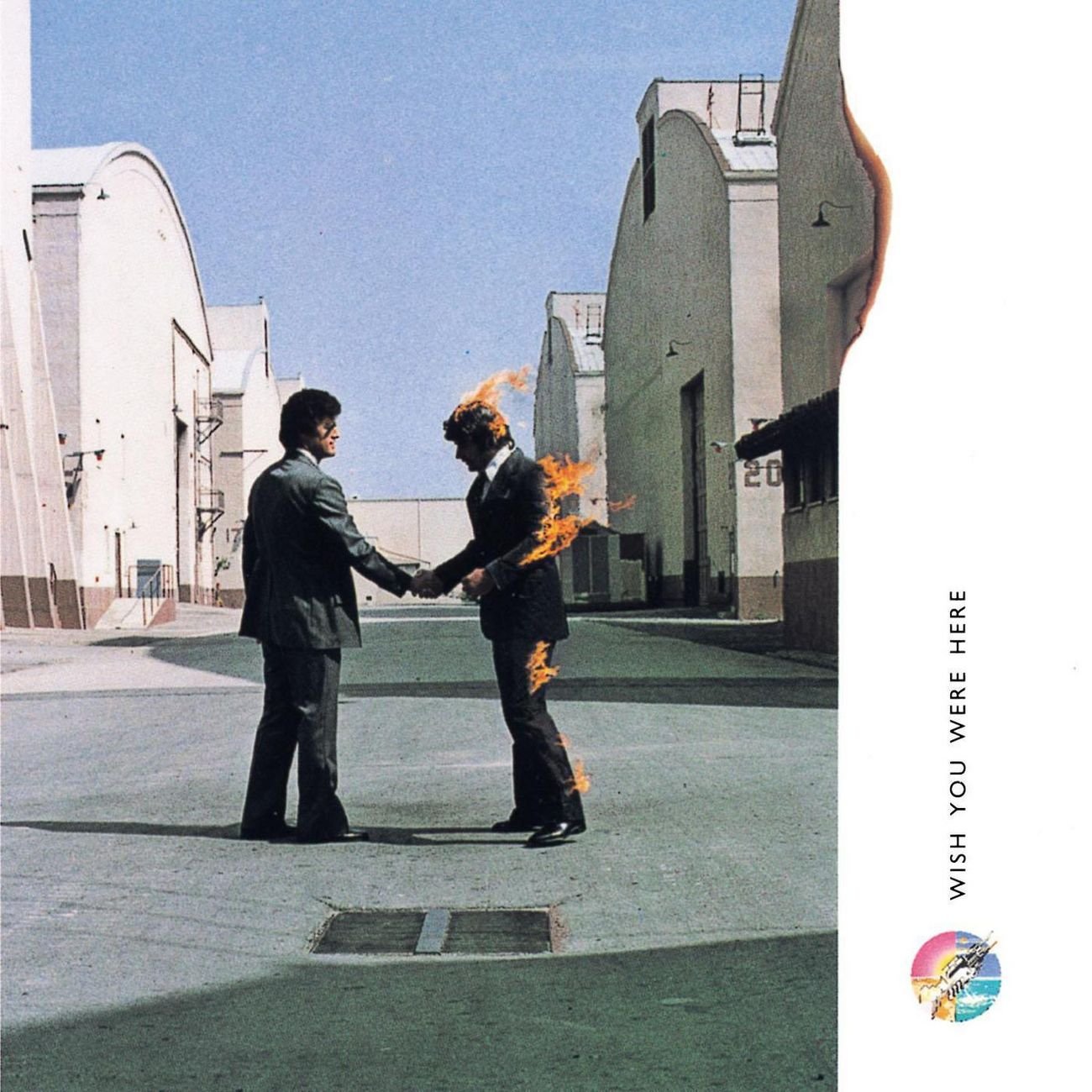
Wish You Were Here is the ninth studio album by English rock band Pink Floyd. It was first released on 12th September 1975 in the United Kingdom by Harvest Records.
It debuted at No. 1 on both sides of the Atlantic, and has been tabbed by both Gilmour and Wright as their favourite Pink Floyd album. Still, ‘Wish You Were Here’ was no ‘Dark Side of the Moon’; it never could be. And that – as much as anything seems to have relegated this 1975 follow-up to a life of perpetual underrated status. It’s a pity. There isn’t a more conceptually concise Pink Floyd album, nor one as musically inviting. Even as DaveGilmour and, in particular, Richard Wright pushed the work into deeper, more progressive musical themes, they helped fashion the last truly collaborative studio project between RogerWaters and his increasingly disgruntled bandmates.
Inspired by material the group composed while performing in Europe, During 1974, Pink Floyd sketched out three new compositions, “Raving and Drooling”, “You Gotta Be Crazy” and “Shine On You Crazy Diamond”. These songs were performed during a series of concerts in France and England, the band’s first tour since 1973’s The Dark Side of the Moon.
The album was recorded in numerous sessions at Abbey Road Studios in London. Two of its songs criticise the music business, another expresses alienation, and the multi-part composition “Shine On You Crazy Diamond” is a tribute to Pink Floyd founder Syd Barrett, who had left seven years earlier due to mental health problems. The band used studio effects and synthesizers, and brought in guest singers: Roy Harper, who provided the lead vocals on “Have a Cigar”, and Venetta Fields, who added backing vocals to “Shine On You Crazy Diamond”. After several weeks, Waters began to visualise another concept. The three new compositions from 1974’s tour were at least a starting point for a new album, and “Shine On You Crazy Diamond” seemed a reasonable choice as a centrepiece for the new work. Mostly an instrumental twenty-minute-plus piece similar to “Echoes”, the opening four-note guitar phrase reminded Waters of the lingering ghost of former band-member Syd Barrett.Gilmour had composed the phrase entirely by accident, but was encouraged by Waters‘ positive response.Waters wanted to split “Shine On You Crazy Diamond”, and sandwich two new songs between its two halves.
The album begins with a long instrumental preamble and segues into the lyrics for “Shine On You Crazy Diamond”, a tribute to Syd Barrett, whose mental breakdown had forced him to leave the group seven years earlier. Barrett is fondly recalled with lines such as “Remember when you were young, you shone like the sun” and “You reached for the secret too soon, you cried for the moon”.
Wish You Were Here is also a critique of the music business. “Shine On” crosses seamlessly into “Welcome to the Machine”, a song that begins with an opening door (described by Waters as a symbol of musical discovery and progress betrayed by a music industry more interested in greed and success) and ends with a party, the latter epitomising “the lack of contact and real feelings between people”. Similarly, “Have a Cigar” scorns record industry “fat-cats” with the lyrics repeating a stream of cliches heard by rising new-comers in the industry, and including the question “by the way, which one’s Pink?” asked of the band on at least one occasion. The lyrics of the next song, “Wish You Were Here”, relate both to Barrett’s condition, and to the dichotomy of Waters’ character, with greed and ambition battling with compassion and idealism. The album closes with a reprise of “Shine On” and further instrumental excursions.
Wish You Were Here topped the charts in the United Kingdom and the United States, and Harvest Records‘ parent company EMI was unable to print enough copies to meet demand. Although it initially received mixed reviews from critics, the album went on to receive critical acclaim,
Everyone wanted a piece of Pink Floyd after ‘The Dark Side of the Moon’ sold a gazillion copies , especially the shady music-industry types Waters never trusted. ‘Have a Cigar’ is all about those clueless suits. “By the way, which one’s Pink?” sings guest Roy Harper, a British folkie, summing up the era.
‘Shine on You Crazy Diamond’ was originally released as a two-song, eight-part, 26-minute suite on the band’s follow-up to the mega-popular ‘The Dark Side of the Moon.’ And like several Floyd projects from the period, the song references former bandmate Syd Barrett’s descent into mental illness. It’s an epic piece, the bookends to one of the group’s most durable LPs.
The members of Pink Floyd were still friendly with Syd Barrett after he left the group in 1968. He even showed up in the studio, somewhat unrecognizable, while they were recording of their ninth album. ‘The Dark Side of the Moon’ touched on the mental illness that crippled Barrett, but ‘Wish You Were Here’ was an album-length tribute to both his genius and madness. The title track ties Barrett’s plight to Waters‘ own distancing from society.
The band played much of Wish You Were Here on 5th July 1975 at the Knebworth music festival. Roy Harper, was also performing at the same event, on discovering that his stage costume was missing, proceeded to destroy one of Pink Floyd’s vans, injuring himself in the process. This delayed the normal setup procedure of the band’s sound system. As a pair of World War II Spitfire aircraft had been booked to fly over the crowd during their entrance, the band were not able to delay their set. The result was that a power supply ssue pushed Wright’s keyboards completely out of tune, damaging the band’s performance. At one point he left the stage, but the band were able to continue with a less sensitive keyboard, a piano and a simpler light show. Following a brief intermission, they returned to perform The Dark Side of the Moon, but critics displeased about being denied access backstage savaged the performance
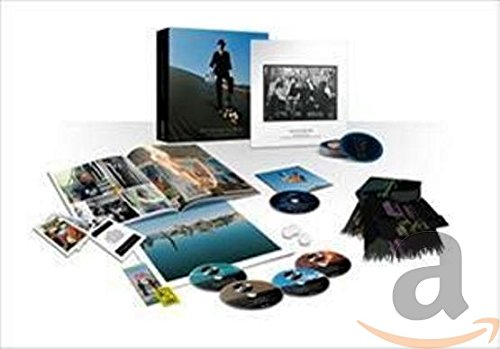
The Wish You Were Here – Immersion Box Set includes the new stereo digital remaster (2011) by James Guthrie on CD, an unreleased 5.1 Surround Mix (2009) by James Guthrie on DVD and Blu-ray, a Quad Mix (which had been released only on vinyl LP and 8-track tape) on DVD, as well as the original stereo mix (1975) on DVD and Blu-ray
Pink Floyd
David Gilmour – vocals, guitars, lap steel guitar, EMS Synthi AKS, tape effects, additional bass
Following up a hit record is no mean feat for any band, and even under the best of circumstances, Pink Floyd might have found it all but impossible to come back from the massive success of Dark Side of the Moon.
Unfortunately, when the band returned to the studio in January 1975, conditions were far from favorable in the band for a variety of reasons — not the least of which was the fact that, as they adjusted to life after a worldwide smash record, the members of the band found themselves more disoriented than fulfilled. Compounding the problem was a growing disconnection between bassist Roger Waters and the rest of Pink Floyd, particularly guitarist David Gilmour.
“We were all having to assess what we were in this business for,” Gilmour said in the 2012 documentary The Story of Wish You Were Here. “Whether we were artists or businessmen. Having achieved the sort of success and money out of it all, it could fulfill anyone’s wildest teenage dreams, why we would still continue to want to do it? Roger has said he thinks we may have been finished at that point, and he may have been right.”
It also didn’t help that, as drummer Nick Mason said in a separate interview filmed for the movie, the band didn’t exactly have a ton of material stored up for their next album. After spending years rotating through the industry’s tour-and-record cycle, they hunkered down on their Dark Side follow-up basically bereft of material — and some of the songs they had written ended up being thrown out of the running order.
The songs in question, “Raving and Drooling” and “You Gotta Be Crazy,” were excised from the album after a fight between Waters and Gilmour, prompted because Waters felt the songs they had didn’t hold together as a cohesive whole. In his view, it was better to expand one particular track — titled “Shine On You Crazy Diamond” — into a bookend that essentially enveloped the rest of the record. As Waters later revealed, the piece was largely inspired by his heartbreak over the self-imposed exile of the band’s founding guitarist and first leader, Syd Barrett.
“I’ve never read an intelligent piece on Syd Barrett in any magazine, never,” Waters is quoted as saying in Mark Blake’s book Comfortably Numb: The Inside Story of Pink Floyd. “I wrote and rewrote and rewrote and rewrote that lyric because I wanted it to be as close as possible to what I felt. There’s a truthful feeling in that piece. That sort of indefinable, inevitable melancholy about the disappearance of Syd. He’s withdrawn so far away that he’s no longer there.”
Waters’ feelings regarding Barrett’s absence could have been applied, to some degree, to the rest of Pink Floyd. “No one was really looking anyone in the eye,” he complained. “It was all very mechanical.”
“It was disengagement,” concurred Gilmour. “It was not being willing to apply yourself sufficiently. Lots of moments when any one of us might have been much more interested in thinking about what we were doing that weekend […] The concentrated activity was rather diluted, and I’m sure for a very pushing, driving sort of person like Roger, it was more frustrating than it was for anyone else — although it was very frustrating for all of us, I suspect.”
Thus preoccupied by feelings of alienation and disillusionment, the members of the group — primarily pulled along by Waters — cobbled together a set of songs built around absence, starting with the withdrawal of their friend Barrett and spilling over into the creeping disappointment they’d found with one another and in the industry they’d enriched with Dark Side of the Moon. In the midst of the recording, Barrett himself made an unannounced appearance in the studio, looking so different that the members of the band initially failed to recognize him.
Drummer Nick Mason, for one, later remembered Barrett looking like a “large, fat bloke with a shaven head, wearing a decrepit old tan mac and carrying a plastic shopping bag,” while keyboard player Rick Wright recalled a sad denouement to their former leader’s surprise visit: “Syd stood up and said, ‘Right, when do I put the guitar on?’ And, of course, he didn’t have a guitar with him. We said, ‘Sorry, Syd, the guitar’s all done.’”
Such was the band’s disconnect that one song on the album, titled “Have a Cigar,” ultimately ended up being sung by someone outside the lineup. After Waters and Gilmour tried and failed to lend the requisite degree of vocal snark to their sarcastic ode to music business cynicism, they ended up turning to singer songwriter Roy Harper, who was sharing the studio with them and happened to be in the room one day while they struggled to find a solution.
“Roger can write songs but he’s never going to be in the top one hundred as a rock singer,” observed Harper. “He tries hard, he’s a good lad. Anyway, neither of them could get up there. I just stood at the back, leaning against a machine and laughing. I said, ‘I’ll sing it for you,’ and someone said, ‘OK,’ and I said, ‘For a price.
Recording finally wrapped in the summer of 1975, and after settling on a typically evocative cover design from legendary artist Storm Thorgerson, the members of Pink Floyd sent their ninth studio LP — titled Wish You Were Here, after a particularly disaffected Gilmour-Waters cowrite — to their label. Scheduled for release on September. 12th, it immediately became one of the most highly anticipated albums of 1975.
Not that Pink Floyd necessarily acted like a band delivering a major piece of product. In fact, their only concession to the promotion machine was a single syndicated live show, recorded at the Los Angeles Sports Arena in the spring of 1975, which was broadcast in an array of major markets ahead of the tour booked to support Wish You Were Here. The sold-out set, which still included “Raving and Drooling” and “You Gotta Be Crazy,” also featured an extended “Shine On You Crazy Diamond” as well as “Have a Cigar,” “Echoes,” and “Dark Side of the Moon” — as well as an expanding roster of special effects that now included expensive and unpredictable pyrotechnics.
In spite of inevitably mixed reviews, Wish You Were Here went on to top the charts on both sides of the Atlantic, and although it couldn’t hope to match the gargantuan sales of Dark Side of the Moon, it enjoyed substantial success in its own right, selling more than six million copies in the U.S. alone. And while the Floyd machine would continue to churn out product on a regular basis in the near future — starting with 1977′s Animals, which included the jettisoned Wish tracks “”Raving and Drooling” and “You Gotta Be Crazy” the writing was already on the wall for Waters’ eventual departure from the band. As he pointed out in The Inside Story of Pink Floyd, even the biggest sales figures can’t balance out creative dysfunction.
“The dream,” shrugged Waters, “is that when you are successful, when you’re a star, you’ll be fine, everything will go wonderfully well. That’s the dream — and everybody knows it’s an empty one.”





 The Fat Angel Sings