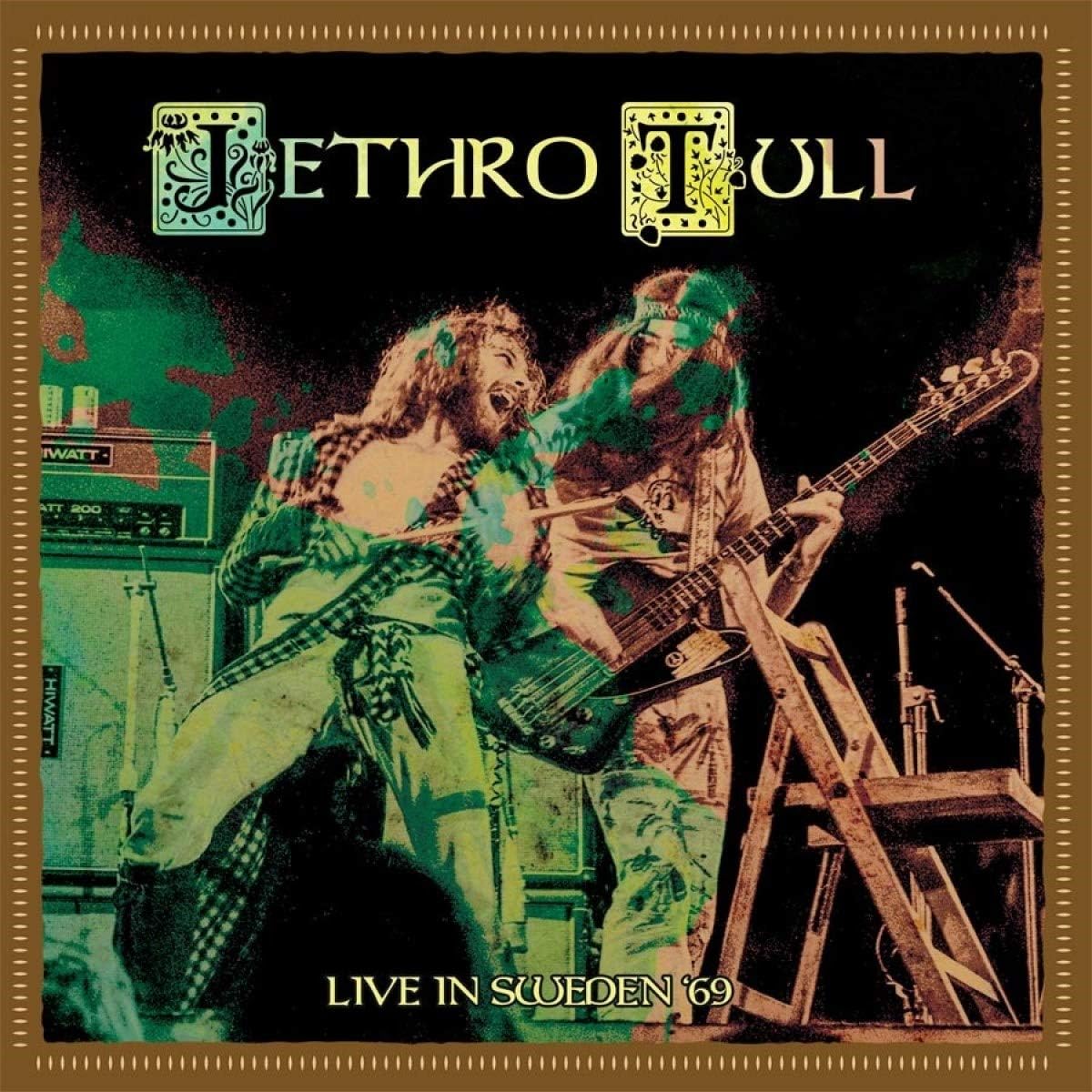
Incredible performance live from Stockholm, Sweden Includes the entire SVR2 radio broadcast Digitally remastered for greatly enhanced sound quality, This is a good example of what Jethro Tull sounded like in the late ’60s.
This show was after guitarist Mick Abraham left the band to be replaced by Martin Barre. Unfortunately the sound could be better. Both Ian Anderson and Glenn Cornick are too high in the mix. The bass especially is too boomy and up front though most of this show–and I’ve been a fan of Cornick’s playing since the “Stand Up “ album. And Barre’s guitar is mixed way too low on some tracks. Anderson is just a bit too high in the mix but is still okay as is the drums.
But overall–sound not withstanding–this is what Tull sounded like way back then, including Anderson’s comments between songs, which give this album an authentic period feel. There’s some good flute from Anderson plus harmonica, and even a kazoo. Barre gets a chance to show his guitar skills on “Martin’s Tune”, but he could be higher in the mix. Plus there’s a drum solo from Clive Bunker on “Dharma For One” which doesn’t get too monotonous because of his time changes during the tune.
Setlist: 1. My Sunday Feeling 2. Martin s Tune 3. To Be Sad Is A Mad Way To Be 4. Back To The Family 5. Dharma For One 6. Nothing Is Easy 7. Song For Jeffrey
Today marks the 50th anniversary of the release of Jethro Tull’s third studio album, ‘Benefit’.
The album featured pianist and organist John Evan for the first time and was the last to include bassist Glenn Cornick. As with its predecessors, it was recorded at Morgan Studios in London. Speaking about the album, Ian Anderson described it as much darker than ‘This Was’ and ‘Stand Up’.
For some reason Jethro Tull are never spoken of in the same hushed tones of awe as Led Zeppelin or King Crimson. Or Deep Purple and Yes. Or Wishbone Ash…
Quite why that is may be down to the fact that their style was very difficult to pigeon hole and emulate, therefore no one has been obviously influenced by them. You never hear of any up and coming bands naming Tull as an influence, they never got name checked by the likes of The Mars Volta or Tool. Tull weren’t embraced by younger generations like the majority of their peers were and perhaps they never will.
“Benefit” was not the huge leap forwards that Stand Up had been from This Was, but what it did was consolidate Tull’s position as one of the best rock bands in the world. It’s a far more moody and darker album than anything they had recorded previously, relying on sweaty riffing and studio trickery to create the ambiance. Unlike a lot of Tull’s albums there’s little in the way of good humored material, with only the satirical “Son”, the strangely poppy “Inside” and the reflective “For Michael Collins, Jeffrey And Me” doing anything to lift the mood slightly.
On the flip side that means that the album is liberally studded with unsung riff-rock, the best example here is the glorious “To Cry You A Song”, and the album closes with one of it’s best tracks, the acoustic “Sossity; You’re A Woman”.
Musically the band is on form throughout and were playing as well as ever. They temporarily recruited keyboard player John Evans, who actually stuck around for the next decade or so, which broadened their sound somewhat, but the keyboards here act as a compliment to the rest of the music and they are utilised only when absolutely necessary.
Ian Anderson said that Benefit was a “guitar riff” album, recorded in a year in which artists like Cream, Jimi Hendrix and Led Zeppelin were becoming more riff-oriented. Anderson also noted that Benefit is “a rather dark and stark album and, although it has a few songs on it that are rather okay, I don’t think it has the breadth, variety or detail that Stand Up has. But it was an evolution in terms of the band playing as ‘a band.'” Overall, Anderson considered the album “a natural part of the group’s evolution”.
According to Martin Barre “To Cry You a Song” was a response to Blind Faith’s “Had to Cry Today”, “although you couldn’t compare the two; nothing was stolen … The riff crossed over the bar in a couple of places and Ian and I each played guitars on the backing tracks. It was more or less live in the studio with a couple of overdubs and a solo. Ian played my Gibson SG and I played a Les Paul on it
In many ways Benefit is Jethro Tull’s forgotten album, book ended as it is by two of the band’s most popular albums on either side. I get the increasing feeling though that its relative obscurity will (oh dear) benefit it in the end though, because it’s often obscure albums like this that catch the ear of younger generations.
Jethro Tull doing ‘Teacher’ from the ‘Benefit’ album, 1970. On Beat-Club was a German music program that ran from 1965 to the end of 1972. It was broadcast from Bremen, Germany initially on Erstes Deutsches Fernsehen, the national public TV channel. Beat-Club was replaced by the programme ‘Musikladen’ in 1972.
By April 1970, Jethro Tull had already released a pair of studio albums, but their career-defining fourth LP, Aqualung, wouldn’t arrive until March of the following year, at which point it would almost overshadow its predecessor, the underrated Benefit.
On the one hand, group members Ian Anderson (who provided vocals, flute and acoustic guitar), guitarist Martin Barre, bassist Glenn Cornick and drummer Clive Bunker were somewhat at odds with their record company, and worn out by extensive touring. On the other, they were enjoying a rare moment of lineup stability (though future keyboard player John Evan was already unofficially on hand), and the success of the previous year’s Stand Up had given them the confidence to carry on experimenting, moving ever further from their Brit-blues roots of 1968’s tellingly named This Was …
So for Benefit, “transition” may indeed have been the operative word, as the band unveiled an eclectic set containing a little bit of the old, a little of the new and some things that would never be repeated.
‘Benefit’ is guitarist Martin Barre’s favourite Jethro Tull album.
John Evan, who played piano and organ on the album “for our benefit”, and subsequently joined the band for ten years, was actually named John Evans. His missing ‘s’ was a deliberate hangover from the pre-Jethro Tull group The John Evan Band, because it sounded ‘cooler’.
Michael Collins, name-checked in the song For Michael Collins, Jeffrey And Me, was the member of the Apollo 11 space-mission who stayed in the main capsule while Neil Armstrong and Buzz Aldrin landed on the moon.
Jethro Tull is one of those utterly amazing bands that is sadly very difficult to explain to those for whom they seem to hold no obvious appeal. Although once one of the very biggest concert draws in the world of music—and don’t get me wrong, they’re still a popular group—their fanbase is getting older each year and I don’t think it’s exactly getting any bigger with the passing of time. But for the sake of “the younger people” who are reading this I’m going to try to get across why I think JethroTull are truly a great band and why they deserve your attention.
Rhino’s re-release of their classic 1971 long player “Aqualung”, an album that I’m absolutely crazy about, on a 2 CD/2 DVD box set. I hope my enthusiasm will be contagious enough that you’ll give it a listen yourself.
Critics remembered “the scuzziest hippies smoking skunk weed and listening to that piece of crap.” He was there. “who the fuck is the audience for this jester-hat-wearing Renaissance Faire bullshit?” while acknowledging that its multi-platinum record status indicated there must have been quite a large one. Some see Jethro Tull as the sort of group that “old bikers listen to at keg parties in Cincinnati,” in the same category with say, Steppenwolf.
All of these reactions are perfectly understandable. If you don’t really know what Jethro Tull are all about, being confronted with this scraggly-looking comically leering hirsute and freaky Dickensian hobo-sage character wearing thigh-high boots and a glittering codpiece playing the flute is simply confusing.
My familiarity with Jethro Tull’s music began with the single “Living In The Past”, one of the very first 45s that I ever bought for the most part I knew some of the greatest hits. Steven Wilson’s 5.1 surround revisioning of their 1970 “Benefit” album in the package with something else that I’d asked for. I’ll listen to anything Steven Wilson has remixed for 5.1 and I was utterly floored by Benefit. Because I had no expectations one way or the other, Benefit hit me like a bolt from the blue. I was completely smitten with that album pretty much upon the first listen.
I gorged myself on that album and fanned out through their back catalog. I liked their second effort Stand Up quite a bit and I also got way into their Living in the Past compilation. Their first album “This Was” I was less enthusiastic about—it’s just a basic blues thing, music they’d already outgrown before its release, hence the title—but the one that came after Benefit—that’s Aqualung—blew my doors off. If you consider yourself a fan of say, King Crimson, Captain Beefheart, Frank Zappa or even Nick Cave (who named one of his sons Jethro he was such a fan) you might have the same reaction I did: “How did I miss out on this?”
Obviously any discussion of Jethro Tull begins—and ends with the group’s leader, the singular Ian Anderson, a rather brainy and idiosyncratic figure surely seen in retrospect (if not necessarily at the time) as the unlikeliest of arena rock gods. Anderson always read very “old” to me. At the time Aqualung was recorded he was just 23 year of age, but what a wizened old 23 he seemed to be. Some people are born old men, I guess, but by this age his lyrics were already becoming quite dark and deep. Aqualung‘s brooding, philosophically sophisticated subject matter included seeing homelessness people and doing nothing about it; how whatever kernel of truth there had been in Christianity had been co-opted by the Church of England and a cynical ruling class; and in “Locomotive Breath” one of their signature numbers—humanity’s mad dash towards Hobbesian overpopulation.
Aqualung‘s liner notes included the following statement, an audacious sentiment to express in the early 1970s:
In the beginning Man created God;
And in the image of Man created he him.
2 And Man gave unto God a multitude of names,
that he might be Lord over all the earth when it was suited to Man.
3 And on the seven millionth day Man rested
and did lean heavily on his God and saw that it was good.
4 And Man formed Aqualung of the dust of the ground,
and a host of others likened unto his kind.
5 And these lesser men Man did cast into the void. And some were burned;
and some were put apart from their kind.
6 And Man became the God that he had created
and with his miracles did rule over all the earth.
7 But as these things did come to pass,
the Spirit that did cause Man to create his God
lived on within all men: even within Aqualung.
8 And Man saw it not.
9 But for Christ’s sake he’d better start looking.
Anderson’s decidedly bleak themes were backed by the majestic, intricately braided medieval tapestry of his acoustic guitar (Anderson’s thought of as the manic pirate flautist perched on one leg, of course, but his Bert Jansch-inspired guitar work is out-fucking-standing), his flute and the powerful dynamics of lead guitarist Martin Barre—one of rock’s single greatest riffmeisters.
The ensemble playing on Aqualung which also included Clive Bunker on drums and percussion, the incredible John Evan on piano, organ, mellotron and “Jeffrey Hammond-Hammond” on bass guitar—is tight and agile, possessing an almost “classical” element, but not one that was bombastic like Emerson, Lake & Palmer or even necessarily orchestral for that matter. Jethro Tull had a “thing” which was unique to them. Take for instance the gorgeous magical, swirling opening to “Cross Eyed Mary”: When I first started listening to Aqualung, I’d play that particular song over and over and over again. Try “Hymn 43”: The mighty and propulsive “Locomotive Breath” as used very effectively for a scene in ‘Fargo’
From Stand Up to Aqualung Jethro Tull were an absolutely incredible band. Admittedly after that my interest falls off slightly. Thick as a Brick, War Child, Passion Play, the inspiration seems lacking, probably from exhaustion, the band toured almost constantly in the 1970s—but at this point in my life as one of the world’s most inveterate rock snobs I’d have to say that I easily consider Aqualung to be the equal of any Led Zeppelin album (and incidentally it was recorded in an adjacent studio to where Led Zeppelin were recording their own fourth album at Island Records’ newly opened facility in London.)
Rhino’s latest edition of Aqualung is a more economical release of Steven Wilson’s spectacular 2011 “40th anniversary” remix (both in sparkly stereo and a beyond amazing 5.1 surround version) more in line with the packaging and formatting of their other classic Jethro Tull sets of recent years. Aqualung was never considered to be a good-sounding “audiophile” album. It was recorded in a large, cold-sounding studio that had only recently been opened, and where the kinks (and the wiring) still needed to be worked out. The resulting mix was thin and murky, but apparently Wilson was able to coax magic from the multi-tracks (he compared his job to renovating the Sistine Chapel). When you listen to the stereo mix of “Cross Eyed Mary” posted above, imagine how crazy gorgeous that sounds coming at you from six speakers.
Jethro Tull the British progressive rock group. Their music is characterised by the vocals, acoustic guitar, and the flute playing of Ian Anderson, who has led the band since its founding, and the guitar work of Martin Barre, who has been with the band since 1969, after he replaced original guitarist Mick Abrahams.
The complete session recorded by Jethro Tull on 16th June 1969 for John Peel on the Top Gear show on BBC Radio 1 and broadcast on the 22nd of that month. Ian just didnt realise the greatness of Glenn Cornick r.i.p and Clive Bunker..this was magic..the other line ups were good. Clive was along with ginger baker and mitch mitchel..the best if their era.bonzo was the best thumper and barlow best technician.
Recording date: 16th June 1969 First broadcast: 22nd June 1969.
Tracklist: Bourée / A New Day Yesterday / Fat Man / Nothing is Easy
John Peel was a great supporter of the 1968 incarnation of Jethro Tull , the band did their first session for TopGear before their first LP was released. He was present when the band played at a free concert in Hyde Park on 20th June 1968, and both Peel and Tull can be seen in a (silent) British Pathé film clip made at the event. In an enthusiastic account of the festival , Peel wrote: “Jethro Tull had bee preceded to the park by rumours of their goodness. They played with fire and brought out the first rays of the sun…..” In another of his IT columns, a few months later, he praised their debut session: “I wonder did you hear Jethro Tull on Top Gear – they were very good and I look forward to their LP..”
John Peel was a fan of Mick Abrahams‘ guitar playing, which can be heard on the band’s debut single “A Song for Jeffrey”, whose psychedelic-blues style shows the influence of Captain Beefheart’s Safe As Milk LP. But once Abrahams left (replaced by Martin Barre), After he left Jethro Tull, Mick Abrahams‘ own bands (Blodwyn Pig and Mick Abrahams Band) got plenty of airplay on Peel’s shows, and Abrahams did sessions for them.
Peel lost interest in the band. This, apparently, caused a sort of altercation between Peel and Ian Anderson which led to Peel abandoning the band.
Ian Anderson dedicated the 40th anniversary edition (released in 2010) to John Peel, stating that he was regretful that he never had the chance to make up with him. During the months following the recording and release of This Was, our little Blues band featured on a number of BBC Radio sessions, some on the John Peel show, some for other broadcasters (note: all the sessions the band did in 1968 were recorded for “Top Gear”) and the results – amazingly enough – were retained by the BBC in whatever cavernous vaults and audio dungeons line the bowels Bradcasting House in Portland Place, then and now the home of the “Beeb”. These sessions were, as far as I remember, completely live recordings and stand the test of time surprisignly well. Sonically, they are pretty damn fine. […]
But John, who had a soft spot for original Tull guitarist, Mick Abrahams, was not to be so supportive of our next effort. He advised me, at a co-appearance in a Devon club in early ’69, that he didn’t like the new songs of Stand Up and thought it at mistake that we had apparently lost touch with our blues roots and Mick in particular.
Martin and I were a little stung by this and so the mood was not good when we recorded the songs for Peel’s live sessions show four moths later. John Peel, himself, didn’t turn up, which made us feel somewhat unloved! Peel’s producer John Walters reported some of this bad feeling to his master and thus began a long and regrettable period of disassociation from one of the two or three people most supportive and influential in getting Tull’s career started.




 The Fat Angel Sings