Posts Tagged ‘Brain Salad Surgery’

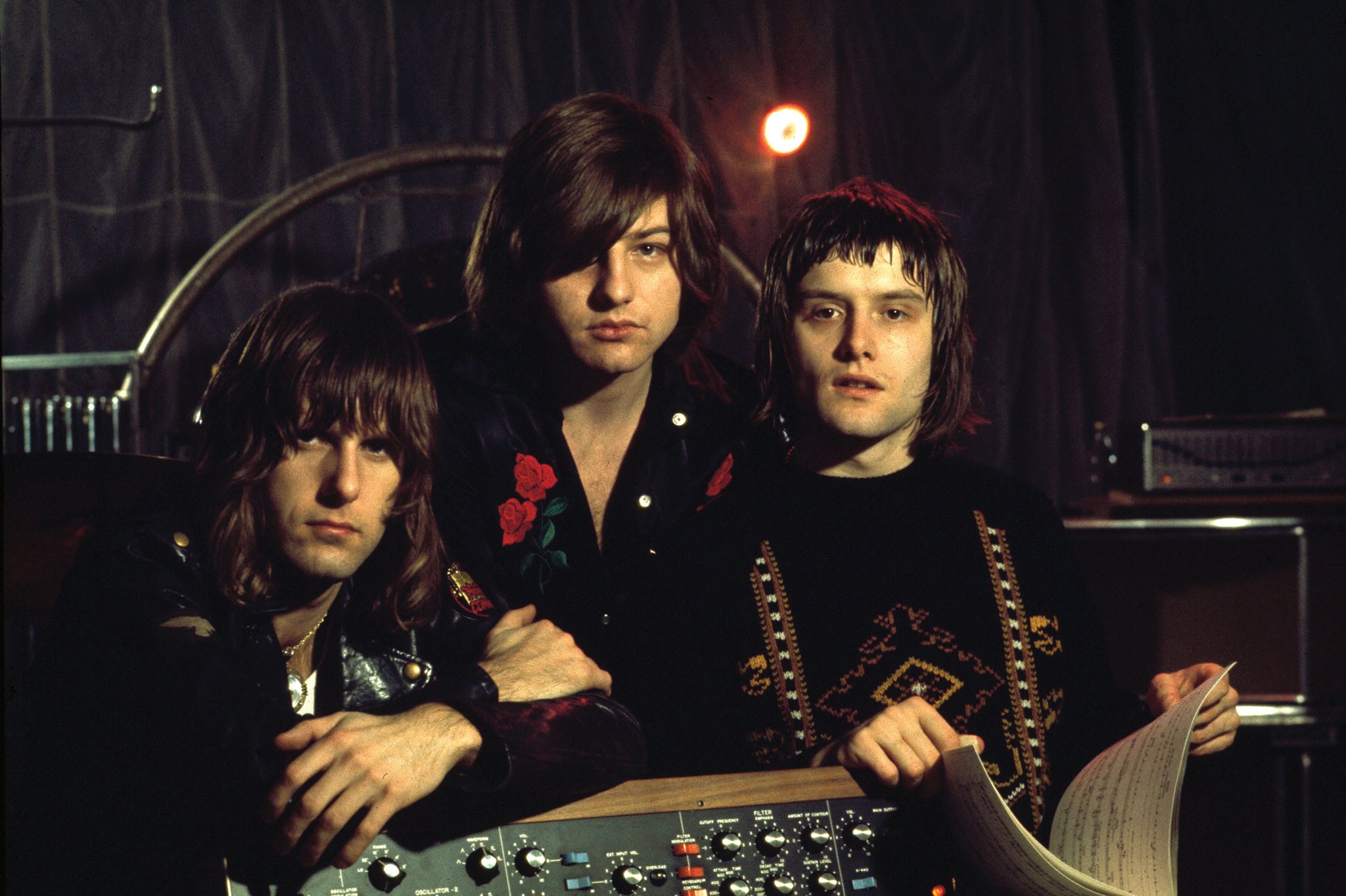
With the release of “Brain Salad Surgery”, Emerson, Lake and Palmer had outgrown any initial perceptions that they were simply a trendy supergroup possessing limited commercial appeal. Instead, they were now finding themselves well positioned on the precipice of mainstream success. To be sure, they were still seen as something of a phenomenon; after all, Keith Emerson’s over-the-top keyboard antics, Greg Lake’s engaging vocals and Carl Palmer’s thundering percussion placed them within a decidedly higher musical pantheon, one that found them capable of attracting audiences of stadium-sized proportions.

Thanks to the success of their preceding live album, “Pictures at an Exhibition”, Emerson, Lake and Palmer had become accredited practitioners of a prototypical prog/classical crossover configuration, one that boded well for continued accreditation. Emerson had initiated that stance with his previous group, the Nice, only to have it further realized with ELP, courtesy of a refined and sophisticated sound accompanied by a solid instrumental undertow. The fact that the three musicians were capable of such an achievement had never been in doubt, but with “Brain Salad Surgery“, that reputation was indelibly entrenched in both pedigree and practice. The group had bought a cinema in Fulham, which they renamed the Manticore Cinema, and they rented it out as storage and rehearsal space to groups. But in the rehearsals for “Brain Salad Surgery“, they left their gear set up on stage and rehearsed it as if playing a live show.

Released on November 19th, 1973, “Brain Salad Surgery” didn’t contain the same variety of instantly accessible music that songs like “Lucky Man” and “Take a Pebble”—both culled from ELP’s eponymous debut—had offered early on. Like the ELP albums that followed in its wake, it bore a sound that was increasingly more complex, built on majestic motifs that were far removed from what most people would have ever identified as an easy listening experience. Their fourth album, 1972’s Trilogy, had reached Number Two in the UK and Number Five the USA, but in rehearsing and arranging the music for “Brain Salad Surgery, ELP made a decision to pursue a quite different approach. “Music technology was really expanding,” Lake explained. “Tape recorders were going from 8-track to 24-track. 

And yet, it did have one singular song in particular—“Still…You Turn Me On,” a wistful ballad that Lake sang with a certain soothing assurance is one of his dreamiest acoustic songs. These had always provided dynamic contrast to ELP’s power play, both live and on record, and here Emerson joins in on harpsichord. Was the idea that the song was addressed to a certain person in the audience?. Given the fact that Palmer played no part in its recording, the idea of releasing the track as a single was nixed entirely. So, too, because at least half the album consisted of elegiac suites (dubbed “Impressions”), part of an extended work titled “Karn Evil 9,” there was very little material that could be considered a possible choice as far as selection as a single. “Benny the Bouncer,” composed by Lake and his one-time King Crimson colleague, lyricist Pete Sinfield, might have been an option, but the hokey theme and fickle approach didn’t really represent the band’s artful approach, their purpose or their prowess, and, as a result, it was never a real contender.

The album opens in a blaze of light, though, with a flamboyant version of William Blake and Hubert Parry’s “Jerusalem“, with Palmer playing gongs and timpani, and executing lavish multiple tom-tom rolls around his stainless steel kit. Emerson garnishes proceedings with exultant Moog clarion calls, while Lake’s magisterial voice holds the middle ground. “Jerusalem” was the consensus pick, but the BBC quickly vetoed that idea due to its refusal to play anything that was perceived to be sacrilegious. Although the album reached the upper tiers of both the British and American charts and sold well enough to be certified gold the lack of a viable single seemed to hinder its overall possibilities. Palmer still laments the fact that “Jerusalem” was stillborn as far as a singles candidate was concerned. “We wanted to put it out as a single,” Palmer saying. “We figured it was worthy of a single…I think there was some apprehension [as] to whether or not we should be playing a hymn and bastardizing it, as they said, or whatever was being called at the time … We thought we’d done it spot-on, and I thought that was very sad…I actually thought the recording and just the general performances from all of us were absolutely wonderful. I couldn’t believe the small-mindedness…It got banned and there was sort of quite a big thing about it. These people just would not play it. They said no, it was a hymn, and we had taken it the wrong way.”

Another portion of the album initially presented a problem as well. “Toccata” was a piece Emerson had first considered for the Nice, but the idea of doing it with ELP hadn’t surfaced until Palmer suggested spicing it up with an extended drum solo. However, its complexity proved to be a handicap due to the fact that Lake didn’t read music and Palmer couldn’t find a musical score that adapted the piano arrangements for drums. Those difficulties were overcome, but the real problem lay in the fact that the publisher of the piece refused to grant the group permission to do an adaptation. That led to Emerson flying to Geneva to personally play the group’s arrangement for the publisher’s representatives, in hopes of persuading them to change their minds. The tack worked, and the publishers, duly impressed with what they heard, eventually allowed ELP to proceed. “Toccata” would eventually coalesce into a spectacular mesh of sound, fury, flash and finesse, a standout selection that ranks as one of the highpoint of the entire LP.

The aforementioned “Karn” suite became notable in its own right, due not only to the trio’s usual over-the-top instrumental antics, but also because the computerized voice featured in its third movement gives Emerson his only vocal credit of the entire ELP lexicon. Likewise, the second section of the first movement boasts the lyric that would become one of the most famous lines in the entire prog rock canon: “Welcome back my friends, to the show that never ends.” It would famously become the title of the band’s epochal three-LP live album a few years later.

Brain Salad Surgery” is the group at the pinnacle of its powers,” says drummer Carl Palmer of Emerson Lake & Palmer’s fifth album. “It’s very well recorded and it was definitely one of our most creative periods. If I had to choose one of our albums, that would be the one.”

It’s a viewpoint echoed by his erstwhile bandmates. Keyboard player Keith Emerson sees it as a “step forward from the past”, which “represented the camaraderie of the band at the time”. Bass player and vocalist Greg Lake reckons that it was “the last original, unique ELP album”.

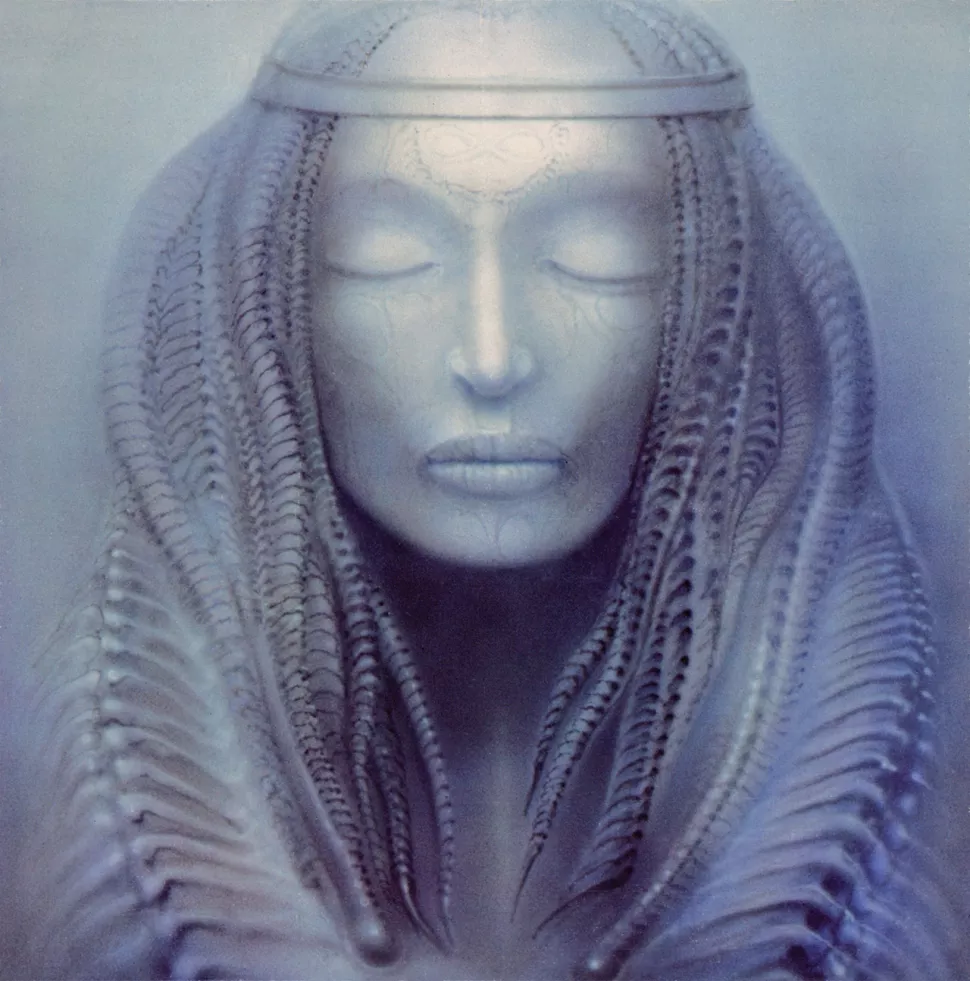
The fold-out cover sleeve, designed by the Swiss artist H.R. Giger, was also notable and, in fact, considered quite innovative as well. Given that the working title of the album had been “Whip Some Skull On Ya“—shorthand slang for fellatio—the skull triptych designs Giger was working on at the time seemed to find a perfect fit, even after the title was changed to Brain Salad Surgery.

emersonlakepalmer

On November 19th, 1973, Emerson, Lake & Palmer released their fourth  album “Brain Salad Surgery”. Greg Lake wrote the lyrics for the album with the assistance, on two tracks, “Karn Evil 9: 3rd Impression” and “Benny the Bouncer” of former King Crimson bandmate Peter Sinfield. This was the first Emerson, Lake & Palmer album to have no songwriting contributions from Carl Palmer. The cover art is by H. R. Giger.
After they released Trilogy, the band decided to make an album that they could perform live. Trilogy was recorded on the 24-track machines with a lot of overdubbing, and that made the music difficult to recreate the songs on stage. The band purchased a cinema and would perform the music “live” on the stage, then write, perform again, write, etc., resulting in a feeling of addressing the audience directly and a more Live feel to the production.

For ELP were huge, their every gesture enormous, their deliciously overblown muse utterly titanic and, my God, were we impressed?

Even the ever-cynical bubble-popping hacks of the NME saw their prose grow ever more purple as they snatched desperately for the requisite adjectives to describe just how ‘not worthy’ we all were. Carrying an Emerson Lake & Palmer album under your arm became the schoolboy equivalent of Mensa membership; it screamed to all who gazed upon you that: ‘He gets this: ergo he is old enough to shave, Here, then, was true sophistication, a vinyl passage-to-manhood in a cardboard sleeve.

Prog-rock behemoth Emerson Lake & Palmer unleashed their ultimate album: Brain Salad Surgery, the record that marked the pinnacle of their creative extravagance,

ELP had long since abandoned the constraints of the stultifying three-minute form. By introducing both classical and jazz elements to cutting-edge rock technology, ELP appeared to be nothing less than larger-than-life progenitors of a giant evolutionary leap forward; One day, we mused, all bands will be as unapologetically enormous as this. But, with our awe-stricken pre-punk appetites whetted for the unfeasibly massive, we craved something even more gargantuan from our three heroes, and like all true thrill-seekers were compelled to push the envelope yet further.

We wanted the hugest, most ear-boggling sounds from the furthest technological frontier available to modern man; we wanted the fastest and most intricate keyboard runs and percussive paradiddlings audible to the human ear; we wanted lyrics that we couldn’t possibly understand; and, most importantly of all, we wanted them in morbidly obese half-hour slabs.

Coming up to the recording of Brain Salad Surgery, Emerson Lake & Palmer seemed unassailable. They’d been voted, both collectively and individually, to the very top of every readers’ poll extant and had just set up their own Manticore label which ostensibly gave them greater artistic freedom than ever before.

“We’d had a long lay-off,” Keith Emerson recalled, “and were really unsure of what direction we should go in. All our previous stuff had gone gold, which we were very thrilled about, and we simply wanted to augment upon that. But it took me a long time because I never like to jam around and play indiscriminately whatever it is that comes into my head. But I do remember arriving at Advision Studios with this fugue design, Greg learning the notes and it being a pretty painless procedure. We were all inspired and one thing would lead to another. We’d all contribute and that’s what a band should be. Whether or not you regard yourself as a composer, it doesn’t really happen unless everybody else involved enjoys playing what you’ve written.”

“We quickly learned that whatever you put on a record you’d have to play live,” added Greg, “So we started preparing the records in the same way that you’d prepare a tour. Brain Salad Surgery was made by rehearsing live in a cinema. We bought a cinema – now that was an indulgence – and rehearsed it in there until we got it in a state where we thought it was good. Then we took it to the studio for an upgrade, but would essentially record live – which was one of Keith’s great abilities. That way, when we finally took it back on to the stage we knew how to play it.”

“It was recorded at a time when the band felt incredibly warm to each other,” said Carl, “and, while I think it marks the height of ELP’s creative powers, it came very quickly. I can’t remember having to labour over much of it, and I don’t think it took more than six weeks to make. “I just remember it as being a very lovable period really. Just so experimental; I was laying cymbals on the floor for overdubs to get a different sound, and we were putting keyboards into different rooms, putting a microphone into the street to get ambient noise and it was just fantastic. It was one of those things that just happened and you wish would happen every time you go into the studio.”

“Brain Salad Surgery” included extra lyrics from Pete Sinfield (Greg Lake: “I worked with him in King Crimson and while I’m not a bad lyricist, Pete’s better”), stunning cover art from the then relatively unknown HR ‘Alien’ Giger.  “The working title was Whip Some Skull On Ya,” expounded Keith, “until our tour manager pointed out a Dr John lyric that features the line ‘give me some Brain Salad Surgery’ which, in the vernacular, means the same as Whip Some Skull On Ya: a blow-job, basically.”

Emerson Lake & Palmer  toured tirelessly (not least in support of Brain Salad Surgery) and with their own proscenium arch, as well as every kind of revolving instrument that you ever thought possible, including some that you hadn’t, like a grand piano that flipped end-over-end while a strapped-in Emerson hammered manfully at the ivories like an unholy cross between Arthur Rubinstein and Biggles. But according to an ostensibly impenetrable party line the trio were usually far too pooped from on stage improvisation to reach for the proverbial mud shark.

Keith Emerson’s father played piano competently enough by ear, but when his young son started to mimic his decidedly amateur ivory-tinkling he insisted upon paying for some expert tuition for the boy. Lessons with Mrs Smith were “really boring to begin with”, but the benefits of his new-found skill soon began to pay dividends: “I became popular at school,” remembered Keith, “and avoided a lot of bullying simply by playing all the rock’n’roll tunes of the day.”

After making his first public appearance at the local rifle-club dinner and dance Emerson set about honing his own style: “I wasn’t into the genre of the day – The Beatles, Stones and Yardbirds – I fancied myself more as a jazz player. Then I got more into blues and – after hearing guys like Brother Jack McDuff on the Hammond organ.” In late summer 1965, Emerson joined established Brighton-based R&B group, Gary Farr & The T-Bones: “I found playing with them acceptable because Gary Farr, who was a pretty good blues singer, had jammed with Sonny Boy Williamson and when T-Bone Walker came over to play the clubs we’d back him.”

Following a brief spell with Island Records’ first non-Jamaican recording artists, The VIPs, Emerson formed The Nice, a band that rapidly developed a flamboyant style of virtuoso cross-generic experimentation, but started life as the relatively anonymous sidemen to PP Arnold: a former Ike & Tina Turner Ikette, hand-picked for stardom by Mick Jagger and summarily signed to Andrew Oldham’s Immediate label. “[Nice bassist] Lee Jackson was a late addition to the T-Bones,” Keith recalled, “and we’d often jam backstage at gigs. I’d play some Brubeck or Bach.

“I loved the guitar,” smiled Greg Lake, his reminiscences still characterised by the slightest suggestion of a lilting Dorset burr. “I loved playing, not only was it an open door to a career, there was also this mass adoration thing. It was the early days of The Beatles so it became the fashion to scream; I remember distinctly coming out of gigs and the van would be completely covered in lipstick. Following a couple of years spent gravitating through the ranks of The Time Checks and The Shame Greg ultimately relocated to London to join future Uriah Heep members Lee Kerslake and Ken Hensley in The Gods. Heavy duty gig rotation earned the band a deal with EMI, but on the eve of their first recording date The Gods fell apart.

“When we were boys,” said Lake, “Robert Fripp and I went to the same guitar teacher – a guy called Don Strike – and used to play duets together. Robert would come along and watch me before he was in a band, but he eventually formed a very strange outfit called Giles, Giles & Fripp. They’d made this album for Decca called The Insanity Of Giles, Giles & Fripp.

Robert gave me the call and said, ‘Hello, my dear’ in his West Country accent. ‘Would you be interested in being the lead singer for the band?’ he asked, and I said, ‘Yeah’ – because they had a record deal, which was fantastic. But then he said, ‘The only thing is, we don’t need two guitarists. Will you play bass?’ So that’s how that started.”

The Lake-augmented combo were re-named King Crimson. King Crimson, featuring the quintessentially English, choirboy clarity of Greg Lake’s vocals, had supported The Nice on a number of previous occasions but it wasn’t until this crucial juncture that Emerson really started to take notice of their singer’s not insubstantial melodic potential. And, when he was informed that not only could Lake double up on bass but also played lead guitar, offered the choice between remaining with Robert Fripp or accepting a fresh challenge with Keith Emerson, Lake ultimately opted for the latter. You’re probably comfortably ahead of me here, and primed for the inevitable arrival of pot-free zone Carl Palmer in the soon-to-be-revolving drum stool.

Upon answering a classified advertisement in The Birmingham Mail, young Carl Palmer found himself auditioning for local R&B chancers The King Bees at the Plaza Ballroom, Handsworth, conveniently situated at the top of his road. “I expected them to give me music and they didn’t,” remembered Palmer, “They gave me a bunch of forty-fives and said, ‘Learn those and come back tomorrow’. I thought that was kind of bizarre, so I dashed home, charted them out immediately and couldn’t believe how easy they were.”

Carl Palmer was a King Bee before the day was out. Eight months of gruelling all-nighters later and the tireless 16-year old caught the eye of Chris Farlowe who offered him a job on the spot. Carl’s transition from moonlighting Black Country schoolkid to scene-making London circuit pro was nothing if not swift: “I left school on the Friday, left home on the Sunday, did the audition on the Wednesday and was working in Chris Farlowe’s Thunderbirds by the following weekend. It was an exciting time, certainly, but Palmer remained uncommonly astute, and set about securing all the extracurricular session work he could find. Tireless networking paid off when star management team Kit Lambert and Chris Stamp called Carl in to record sessions with The Crazy World Of Arthur Brown, for when the band’s original drummer Drachen Theaker bailed for “some kind of religious sect” midway through an hallucinogen-fuelled American jaunt, it was Palmer who leapt into the breach.

The Crazy World were riding high after their hit single, Fire, but as the band endeavoured to snort Haight-Asbury whole, the drug experience began to take its toll and after a few months of sustained psychedelic fame Arthur disappeared and Carl formed Nice-styled, super-heavy power trio Atomic Rooster with keyboard player Vincent Crane. “I was only ever interested in playing in a three-piece group,” Palmer recalled, “but when Keith asked me if I was interested I was apprehensive because Atomic Rooster were doing incredibly well and I’d just bought a Mercedes van. I knew of The Nice, obviously, but I didn’t know who Greg Lake was. I knew of King Crimson but I didn’t know he was the singer, so I was a bit apprehensive.

ELP made their big-league debut at the 1970 Isle Of Wight festival,

Happy 41st Birthday to “Brain Salad Surgery”. Welcome back my friends,