

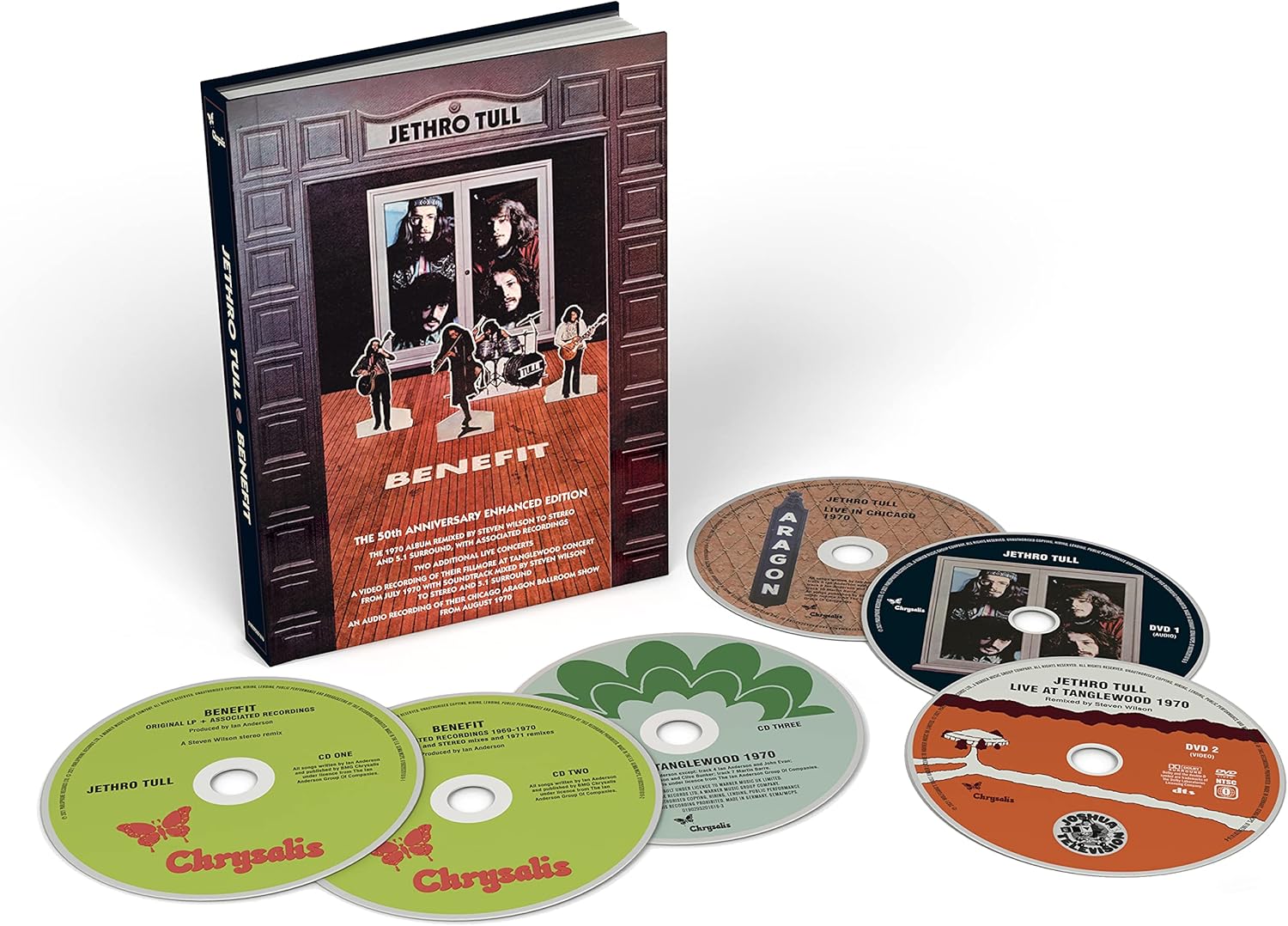
Jethro Tull’s 1970 classic “Benefit” will be celebrated with a 4-CD/2-DVD set, featuring remixes by Steven Wilson, and an abundance of previously unreleased material. After pandemic-enforced delays, Benefit (The 50th Anniversary Enhanced Edition) will be released on November 5th, 2021, via Rhino.
[Note: The title was announced on Sept. 28 but didn’t appear on Amazon until Oct. 5. Best Classic Bands is an authorized affiliate of Amazon.]
The set is packaged within a deluxe hardback book, containing 100 pages of commentary from numerous contributors alongside images of memorabilia from the era, and of the band creating and performing their first million-selling album.
From the announcement: Following the successes of This Was (1968) and Stand Up (1969), Jethro Tull returned in 1970 with their third studio album in as many years. For Benefit, Ian Anderson (flute, guitars, vocals), Martin Barre (guitars), Glenn Cornick (bass), and Clive Bunker (drums) were joined by John Evan on piano and organ, who would go on to play on all of Jethro Tull’s albums throughout the 70s. The album featured more advanced studio techniques, such as a backward-recorded flute on “With You There To Help Me” and a sped-up guitar on “Play in Time.”
Compared to Stand Up, although containing a similar mix of bluesy hard-rockers and melodic acoustic numbers, Benefit had, as Anderson put it, a “harder, slightly darker feel” compared to previous material. Peaking at #4 in the U.K. Singles Chart, “The Witch’s Promise” continued Tull’s success in the charts, with the album faring equally as well. Benefit charted in the top 10 across six countries, including U.K. (#3), Australia (#4), and Germany (#5), while peaking at #11 on the Billboard 200 in the U.S., where it was certified Gold.
The new edition contains a previously unreleased Steven Wilson remix of Jethro Tull performing at Tanglewood in 1970, as well as previously unavailable film footage of that show.
During the summer of 1970, Bill Graham presented an extraordinary series of concerts at Tanglewood, the renowned classical music venue located in the scenic Berkshire Hills of western Massachusetts. Much like his approach at the Fillmores, Graham’s “The Fillmore at Tanglewood” series presented diverse handpicked triple bills, but with the added advantage of a beautiful open-air venue and plenty of informal lawn seating. With the Fillmore East crew providing technical support, these concerts would be hailed as a technical and artistic triumph and would entertain the largest Tanglewood audiences to date.
The July 7th presentation at Tanglewood, featuring the Who as headliners, Also on the bill that night were San Francisco’s It’s A Beautiful Day and an up and coming English group Jethro Tull, then in the midst of their first tour of America as headliners.
1970 was a pivotal year for Jethro Tull, when their relentless roadwork and perseverance began paying off. The group’s third album, “Benefit” was their most ambitious and original work to date. In terms of the band’s profile in America, 1970 was the year Jethro Tull had truly arrived. The previous album, “Stand Up” introduced guitarist Martin Barre to the fold and found the band stretching well beyond the parameters of the blues-based debut. Both albums conveyed Anderson’s growing confidence as a songwriter and with Barre on board, the group’s originality and style had come into sharper focus.
The 1970 American tour would find the group expanding to a quintet, with Anderson’s longtime cohort John Evan joining the group on keyboards, further expanding the sonic palette. With Evan on board, the group’s sound became more compelling. Classical elements now entered the already heady brew of blues, jazz, traditional English folk, and hard rock that defined the band’s sound. Extended soloing, often featuring an extraordinary amount of spontaneous improvisation, became a major ingredient on stage. This tour would primarily focus on choice material from the group’s first three albums. The one notable exception was the introduction of a new song, more scathing than anything Anderson had written before, titled “My God.” Destined for the centrer position on “Aqualung” the most popular album of Tull’s career, this new number wouldn’t see a release until the following year, and then in considerably shorter form.
Jethro Tull’s performance from that legendary summer night at Tanglewood opening for the Who, freshly mixed multitrack masters for the first time ever. Although occasionally self-indulgent, this recording clearly captures an inspired moment in Jethro Tull’s career, when their creativity was soaring. Anderson’s song writing was becoming distinctly original and the musical chemistry of the group on stage had become more seductive than ever. Yet as powerful as this performance is, for the Tanglewood audience it was only the middle of an extraordinary night of live music, as the Who would soon follow Jethro Tull onstage.
There’s also a newly remastered mono version of a previously unreleased concert at Chicago’s Aragon Ballroom in 1970. The 100-page book, enclosed within the elegant, hardback book packaging, contains an essay from Martin Webb, who expands upon the 2013 “A Collector’s Edition” booklet notes. Following that are comments on each of the album’s tracks from Anderson, Barre, Cornick, and Bunker, as well as interviews with Robin Black (studio engineer of Benefit and many other Jethro Tull albums), Chrysalis’ Terry Ellis (executive producer of Benefit), Joshua White who directed the 1970 Tanglewood Festival which features on DVD2, and Wilson explaining the mixing of Benefit in 2013.


 The Fat Angel Sings