Posts Tagged ‘Aqualung’

Jethro Tull is one of those utterly amazing bands that is  sadly very difficult to explain to those for whom they seem to hold no obvious appeal. Although once one of the very biggest concert draws in the world of music—and don’t get me wrong, they’re still a popular group—their fanbase is getting older each year and I don’t think it’s exactly getting any bigger with the passing of time. But for the sake of “the younger people” who are reading this I’m going to try to get across why I think Jethro Tull are truly a great band and why they deserve your attention.

Rhino’s re-release of their classic 1971 long player “Aqualung”, an album that I’m absolutely crazy about, on a 2 CD/2 DVD box set. I hope my enthusiasm will be contagious enough that you’ll give it a listen yourself.

Critics remembered “the scuzziest hippies smoking skunk weed and listening to that piece of crap.” He was there. “who the fuck is the audience for this jester-hat-wearing Renaissance Faire bullshit?” while acknowledging that its multi-platinum record status indicated there must have been quite a large one. Some see Jethro Tull as the sort of group that “old bikers listen to at keg parties in Cincinnati,” in the same category with say, Steppenwolf.

All of these reactions are perfectly understandable. If you don’t really know what Jethro Tull are all about, being confronted with this scraggly-looking comically leering hirsute and freaky Dickensian hobo-sage character wearing thigh-high boots and a glittering codpiece playing the flute is simply confusing.

My familiarity with Jethro Tull’s music began with the single “Living In The Past”, one of the very first 45s that I ever bought for the most part I knew some of the greatest hits. Steven Wilson’s 5.1 surround revisioning of their 1970 “Benefit” album in the package with something else that I’d asked for. I’ll listen to anything Steven Wilson has remixed for 5.1 and I was utterly floored by Benefit. Because I had no expectations one way or the other, Benefit hit me like a bolt from the blue. I was completely smitten with that album pretty much upon the first listen.

I gorged myself on that album and fanned out through their back catalog. I liked their second effort Stand Up quite a bit and I also got way into their Living in the Past compilation. Their first album “This Was” I was less enthusiastic about—it’s just a basic blues thing, music they’d already outgrown before its release, hence the title—but the one that came after Benefit—that’s Aqualung—blew my doors off. If you consider yourself a fan of say, King Crimson, Captain Beefheart, Frank Zappa or even Nick Cave (who named one of his sons Jethro he was such a fan) you might have the same reaction I did: “How did I miss out on this?”

Obviously any discussion of Jethro Tull begins—and ends with the group’s leader, the singular Ian Anderson, a rather brainy and idiosyncratic figure surely seen in retrospect (if not necessarily at the time) as the unlikeliest of arena rock gods. Anderson always read very “old” to me. At the time Aqualung was recorded he was just 23 year of age, but what a wizened old 23 he seemed to be. Some people are born old men, I guess, but by this age his lyrics were already becoming quite dark and deep. Aqualung‘s brooding, philosophically sophisticated subject matter included seeing homelessness people and doing nothing about it; how whatever kernel of truth there had been in Christianity had been co-opted by the Church of England and a cynical ruling class; and in “Locomotive Breath” one of their signature numbers—humanity’s mad dash towards Hobbesian overpopulation.

Aqualung‘s liner notes included the following statement, an audacious sentiment to express in the early 1970s:

In the beginning Man created God;
And in the image of Man created he him.

2 And Man gave unto God a multitude of names,
that he might be Lord over all the earth when it was suited to Man.

3 And on the seven millionth day Man rested
and did lean heavily on his God and saw that it was good.

4 And Man formed Aqualung of the dust of the ground,
and a host of others likened unto his kind.

5 And these lesser men Man did cast into the void. And some were burned;
and some were put apart from their kind.

6 And Man became the God that he had created
and with his miracles did rule over all the earth.

7 But as these things did come to pass,
the Spirit that did cause Man to create his God
lived on within all men: even within Aqualung.

8 And Man saw it not.

9 But for Christ’s sake he’d better start looking.

Anderson’s decidedly bleak themes were backed by the majestic, intricately braided medieval tapestry of his acoustic guitar (Anderson’s thought of as the manic pirate flautist perched on one leg, of course, but his Bert Jansch-inspired guitar work is out-fucking-standing), his flute and the powerful dynamics of lead guitarist Martin Barre—one of rock’s single greatest riffmeisters.

The ensemble playing on Aqualung which also included Clive Bunker on drums and percussion, the incredible John Evan on piano, organ, mellotron and “Jeffrey Hammond-Hammond” on bass guitar—is tight and agile, possessing an almost “classical” element, but not one that was bombastic like Emerson, Lake & Palmer or even necessarily orchestral for that matter. Jethro Tull had a “thing” which was unique to them. Take for instance the gorgeous magical, swirling opening to “Cross Eyed Mary”: When I first started listening to Aqualung, I’d play that particular song over and over and over again. Try “Hymn 43”: The mighty and propulsive “Locomotive Breath” as used very effectively for a scene in ‘Fargo’

From Stand Up to Aqualung Jethro Tull were an absolutely incredible band. Admittedly after that my interest falls off slightly. Thick as a Brick, War Child, Passion Play, the inspiration seems lacking, probably from exhaustion, the band toured almost constantly in the 1970s—but at this point in my life as one of the world’s most inveterate rock snobs I’d have to say that I easily consider Aqualung to be the equal of any Led Zeppelin album (and incidentally it was recorded in an adjacent studio to where Led Zeppelin were recording their own fourth album at Island Records’ newly opened facility in London.)

Rhino’s latest edition of Aqualung is a more economical release of Steven Wilson’s spectacular 2011 “40th anniversary” remix (both in sparkly stereo and a beyond amazing 5.1 surround version) more in line with the packaging and formatting of their other classic Jethro Tull sets of recent years. Aqualung was never considered to be a good-sounding “audiophile” album. It was recorded in a large, cold-sounding studio that had only recently been opened, and where the kinks (and the wiring) still needed to be worked out. The resulting mix was thin and murky, but apparently Wilson was able to coax magic from the multi-tracks (he compared his job to renovating the Sistine Chapel). When you listen to the stereo mix of “Cross Eyed Mary” posted above, imagine how crazy gorgeous that sounds coming at you from six speakers.

thanks to Dangerous Minds

Jethro Tull Go Off The Rails For “Locomotive Breath,” And It’s A Wild Ride From Start To Finish | Society Of Rock Videos

Featured on Jethro Tull’s 1971 album Aqualung, ‘Locomotive Breath’ is as known for its intricate flute solo as it is for its social commentary on a world quickly headed off the rails and when performed live, singer and flautist Ian Anderson is a human dynamo that embodies the overall feeling of being completely out of control – in the best possible way, of course!

Filmed in 1982, this exclusive concert footage features Jethro Tull performing ‘Locomotive Breath’and to say that it’s a wild ride is an understatement; much like an actual locomotive, the performance starts off slowly with its long, bluesy piano introduction and builds gradually with a blistering guitar solo by Jethro Tull guitarist Martin Barre before reaching its pinnacle as Ian Anderson appears onstage, looking like a man out of time with a story to tell.

It took a few attempts to record this song, as Anderson had to impress on the band that musically, it was supposed to feel like a train on the tracks, not one that goes off and explodes.

If this is what a train going off the tracks sounds like, then sign us up! Jethro Tull, more so than any other progressive rock band, had a tremendous gift for turning their songs into epic stories that when performed live, appealed to you on a visual level; while they weren’t big for flashy displays, Ian’s stage presence is what sells songs like ‘Locomotive Breath,’ and you can’t deny how much fun there is to be had with a band like Jethro Tull!

“Sitting on a park bench…” It’s one of the iconic opening lines in rock music, set against one of its most distinctive riffs, the listener’s introduction to the world of Jethro Tull’s “Aqualung“, released on March 19th, 1971.

Jethro Tull’s, “Aqualung” most famous sound Dun dah-dah, dah DUN DUN, allowed Ian Anderson and company to make an album that was two concepts in one. Side A is about some perv street person and Side B is a rumination on organized religion. This split is also reflective of the accompanying music: one part hard rock and one part British folk. Dun dah-dah, dah DUN DUN. “Aqualung” features Ian Anderson on his distinctive flute, acoustic guitar and vocals; Martin Barre on electric guitar; and Clive Bunker on drums and percussion for what would be his final album with the band. Rounding out the line-up were newer recruits John Evan on keyboards and Jeffrey Hammond

Jethro Tull had already hit the top spot on the U.K. album charts with their 1969 release, “Stand Up“, Their third album, 1970’s “Benefit”, came close to the U.S. Top 10, but stopped one mark short, landing at No. 11. It wasn’t until the band issued their landmark album “Aqualung” in 1971 mainstream acceptance flung open in a big way. The album, a deft mix of pastoral folk-rock, thundering proto-metal and nascent prog, is generally regarded as Jethro Tull’s undisputed masterpiece. But as Ian Anderson wasn’t initially sure that the record’s broad blend of styles was a slam-dunk.

“We were getting quite esoteric on the album, and I felt that we might have pushed things too far in that regard,” he says. “What gets you noticed in one territory might not have the same appeal elsewhere. The record had a lot of more acoustic singer-songwriter material on it, and Jethro Tull had become thought of as more of a rock band. The riffy rock material had a pretty immediate appeal to live audiences, so I felt reasonably confident and gratified. But you never know until you put it out, and then the record did very well, so it all worked.”

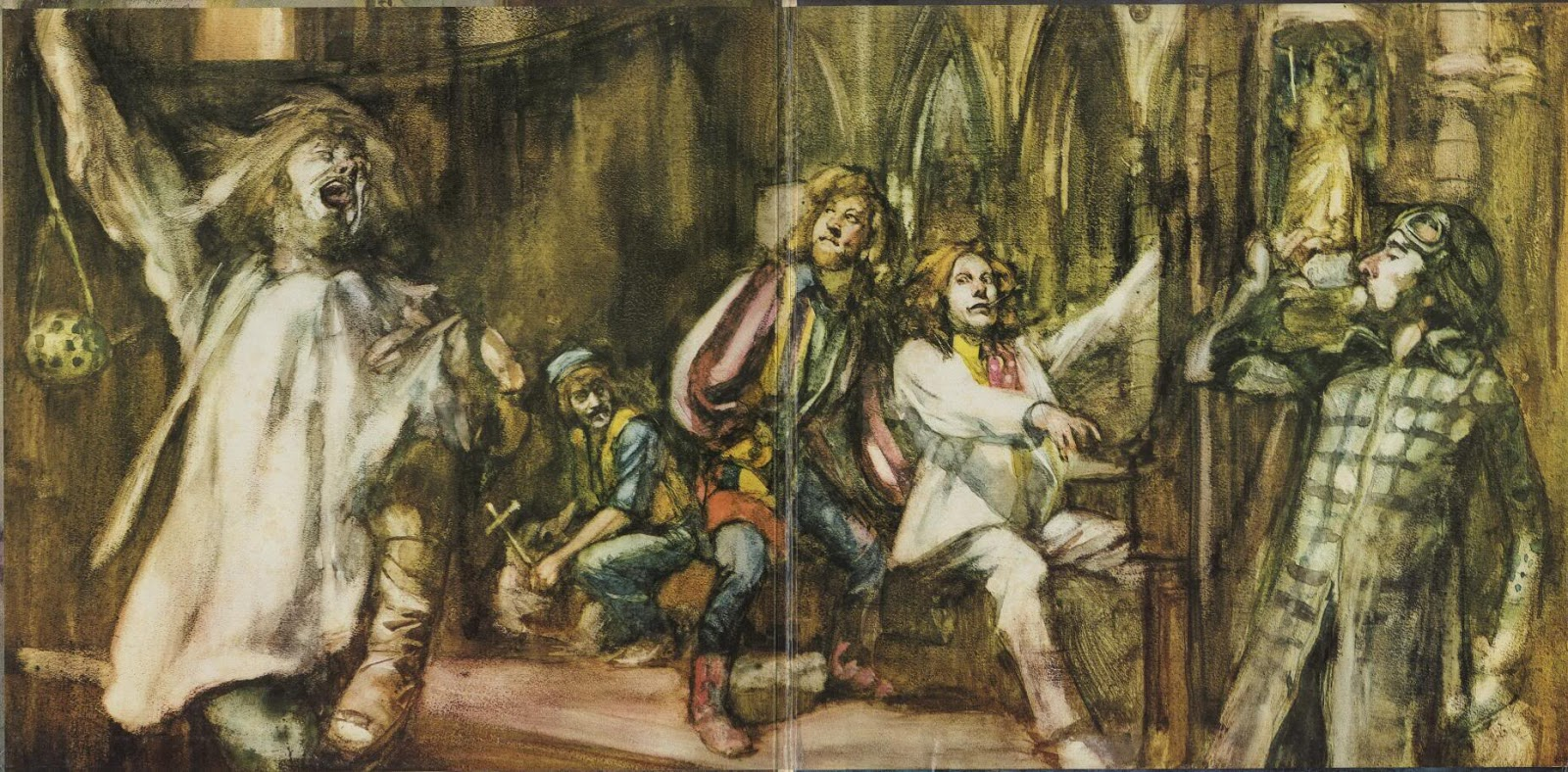
It was never a concept album in my eyes said Anderson. Yes, it certainly set out with the idea that there would be a few songs that kind of hung together, but there were a whole bunch of songs that didn’t have anything to do with the others. When it came to the artwork for the album cover, which I rather left in terms of the pictorial images to our then manager, Terry Ellis, I thought that that would be best illustrated in terms of text by trying to give it some sense of order, by making it hang together a little bit more as a package. I guess that’s what made people think it was a concept album.

There were just a few songs as I say that were in a similar vein and on a general topic of, I suppose, religion and growing up, and I still to this day would not call it a concept album by any means. Of course, speaking to the concept album question, I said, “I’m going to get my comeuppance next time around,” and we did with “Thick as a Brick“, something quite surreal and preposterous—and we got away with it. [Laughs]

‘Aqualung’ has some incredible riffs, like the title track, “Hymn 43″, “Cross-Eyed Mary” and “Locomotive Breath“. They all began very much on the acoustic guitar, and then you try to imagine taking them into the world of large-scale rock rather than hearing them as singer-songwriter acoustic-y things.

This was the first album with keyboardist John Evan as a full-time member, the first with bassist Jeffrey Hammond, and it was the last album with drummer Clive Bunker. Anderson commented It was a rather dark mood, actually, and it was a bit frustrating for me because the recording was being done in the then new Basing Street Studios, which was a converted church that Island Records had bought and turned into a pair of studios. Led Zeppelin were working in the smaller studio downstairs, which is a much nicer acoustic room, much cosier and more like a proper recording studio. Upstairs it was the big, cavernous church hall, which had a rather spooky and threatening atmosphere. It was quite difficult acoustically and technically there were problems and shakedown issues with the equipment and wiring. It was a real struggle.

The contrast between the tramp’s socially unacceptable behaviour and the descriptions of his condition—his “leg hurting bad as he bends to pick a dog-end” and his reliance on the Salvation Army for comfort—is mirrored by the musical complexity. Anderson’s vocals are at once grisly and howling, then delicate and soft. Meanwhile, the band channels heavy rock, with Barre delivering searing riffs and solos. They point to their blues roots, then alternate to folksy intimacy. That’s not to mention the stark contrast between heavy rock instrumentation and Anderson’s flute. As an opener, it’s an introduction to the revitalized Jethro Tull, to their story-based songs, and to the themes that would carry on through the album. 

The beginning tells the story of the character “Aqualung”. It’s an unforgettable Jethro Tull song as is “Cross-Eyed Mary”, kicking off the album on a strong note. There are many primarily acoustic tracks like “Cheap Day Return”, “Wand’ring Aloud”, “Slipstream” which are short and sweet and act as “bridges” between the main songs.

Some personal favourites include “Mother Goose” (actually one of my all time favourite Jethro Tull songs), “My God” and the adrenaline releasing “Locomotive Breath”, with their great folky melodies and arrangements.

It’s followed by perhaps the most personal song on the album, a love ballad called “Wond’ring Aloud.” “We are our own saviours as we start both our hearts beating life into each other,” Anderson sings against his acoustic strumming, punctuated by orchestral swells and the occasional weaving piano line. The song was originally recorded as a seven-minute epic, leftover pieces of which can be heard on “Wond’ring Again” on the 1972 compilation album “Living in the Past”. A complete alternate version of the suite turned up as “Wond’ring Aloud, Again” on a 2011 expanded reissue of “Aqualung“.

The side closes with “Up To Me.” It’s a riff-heavy blues-rock burner featuring winding electric guitar leads against Anderson’s gentle acoustic guitar and snaky flute lines, a perfect contrast to the breezier songs that precede it and a primer for the heavier material to come.

All of which makes it more difficult when you’re trying to convey to other musicians what you’re driving at. We had stepped away from the early Jethro Tull sort of music, and Clive Bunker found it sometimes beyond his points of reference. For Jeffrey Hammond, it was his very first album, so he was kind of just being given a list of notes and told how to play them. I was confident he would get it, but it was a little nerve-racking for him. Here, too, it was a little frustrating for me, trying to convey things to the other guys, which is why I just recorded some things on my own and then they came and overdubbed their bits afterwards.

The brief “Cheap Day Return,” clocking in at just over a minute, shows off Jansch-like guitar figures, along with complementary orchestrations by Dee Palmer. “[It’s] about a day I went to visit my father in hospital in Blackpool,” said Anderson in 1971. “I caught a train at nine, spent four hours traveling, four hours with my father, and four hours to get back again. It was a long song mainly concerned with the railway journey, but the section on the record is about visiting my father. 

“Locomotive Breath” was a particularly hard song to record because we just couldn’t get a metronomic, solid feel. It just kept being kind of a bit scrappy and whatever, so I went out and played tambourine or something, or maybe I clicked two drumsticks together or something. I played bass drum and hi-hat all the way through the song, and everybody overdubbed their parts to that. I think I played one of the electric guitar parts as well, just to try and get something that would convey the feel of the song to the other guys. Then John went out and recorded the introduction part, which we edited onto the body of the song. But yeah, it wasn’t a great atmosphere. By the end of it, I was quite relieved to get out of there.

When you were working on the record, did members of Zeppelin ever drop by? Did you pop into their sessions at all?. I think I might have popped my head downstairs. Some people quite like it when they get visitors, and they rather enjoy the camaraderie, but I felt like it would be very intrusive to go in while somebody else is doing a session, whether they’re working on a backing track or doing overdubs or whatever.

Once or twice we did manage to get some work done in the studio downstairs when Zeppelin weren’t in. The only time I remember seeing anybody from that band is when Jimmy Page came in when Martin Barre was recording the guitar solo for “Aqualung,” and Jimmy sort of was standing behind me in the control room and waving some support to Martin.

‘Aqualung’ has gone on to be the band’s biggest seller. Are you OK with that, or do you wish that distinction were for a different record? Well, I’m glad it was that album and not some other ones. It was at a time when there was kind of a maturity coming about in terms of my writing and my understanding of music, so for me it was a very important album. It marked my move towards a more dynamic range in music, my understanding of creating more tension between loud and quiet passages, between simple and more complex pieces. Anderson says I’m very happy how successful ‘Aqualung’ has been. It wasn’t a huge hit out of the box, but it was a steady seller over the years, and that continues to this day. It’s clocked up a lot of mileage, which has put it in that sort of top echelon of rock albums from that era. I’m quite happy with how it’s regarded.

The album was inspired by photographs of homeless people on the Thames Embankment taken by singer Ian Anderson’s wife Jennie.

A great classic album. Like Ian Anderson said, this isn’t a concept album (like the follow up was) but just a bunch of songs. What an excellent bunch of songs though! Overall, it’s much more engaging than “Benefit” and although the song writing is just as good, the music has a different feel to it. “Aqualung” is much fresher, more inspiring and heartsome.

Aqualung” has sold more than 7 million units worldwide according to Anderson, and is thus Jethro Tull’s best selling album. The album was generally well-received critically, and has been included on several music magazine best of lists. The album spawned one single, “Hymn 43”.

“Aqualung” explodes like “Jesus Christ Superstar” sitting on a keg of dynamite, here starring Ian Anderson as our self-appointed conscience. The light and dark tones of “Benefit” are put into sharper relief this time by alternating disarming acoustic songs with a theosophical din of diabolical intent. The addition of Jeffery Hammond-Hammond on bass (yes, the very same “JEFFREY” chronicled on their earlier albums) doesn’t change the sound of Tull much, nor does the full-time addition of John Evan, who gets buried in the band’s sonic onslaught most of the time. Ian Anderson the performer and “Aqualung” the character may be alarming to some, but wasn’t it just a natural outcropping of the rock opera movement? Music fans proved they were interested in the persona as much as the player, and Anderson gave them something to think about: a composite sketch of a demigod drawn from Jesus, Loki, and Merlin among others. It’s just that songs like “Aqualung”, “Cross-Eyed Mary, “Hymn #43” and “Locomotive Breath” are such epic clashes of morality and reality that “Aqualung” assumes the scale of a Greek tragedy. The acoustic breaks are sometimes no more than lovely little bits of fluff (“Cheap Day Return”, “Wond’ring Aloud”) and sometimes a mortal analysis of the world around us (“Mother Goose”, “Wind-Up”).

The closing track, “Wind Up,” is the culmination of all the ideas that had run thorough the album so far, but more directly a condemnation of organized religion as a charade and its influence on youth. As Anderson recalled in a February 1971 interview, “[My parents] sent me to Sunday school when I was young but I rebelled after the first visit and I was never forced back. I think my parents are the exception, though, and there is so much religion today forced onto children simply by virtue of their parents’ race or creed—and that in itself is inherently wrong.” Here, he describes religion as an action done to erase sins, something that becomes a performative ritual, but is never truly embraced as a pathway to enlightenment. “To me, religion is something that you grow up to find in your own way,” he said to NME in March 1971. “I am sure that a lot of other people believe in God the same as I do, that faith is a form of goodness around which you relate your life.”

“Aqualung” is a great leap from songwriter to storyteller, though some felt Tull slipped too far into the fabled woods for the inscrutable “Thick As A Brick” and “Passion Play”.

Jethro Tull released their 4th LP titled “Aqualung” on March 18th, 1971. Many people have thought that it was a concept album, but the band strongly disagrees with the thought. The records success marked a turning point in the band’s career, who went on to become a major radio and touring act.

Aqualung” would be a very memorable addition to your collection. 5 shining stars.