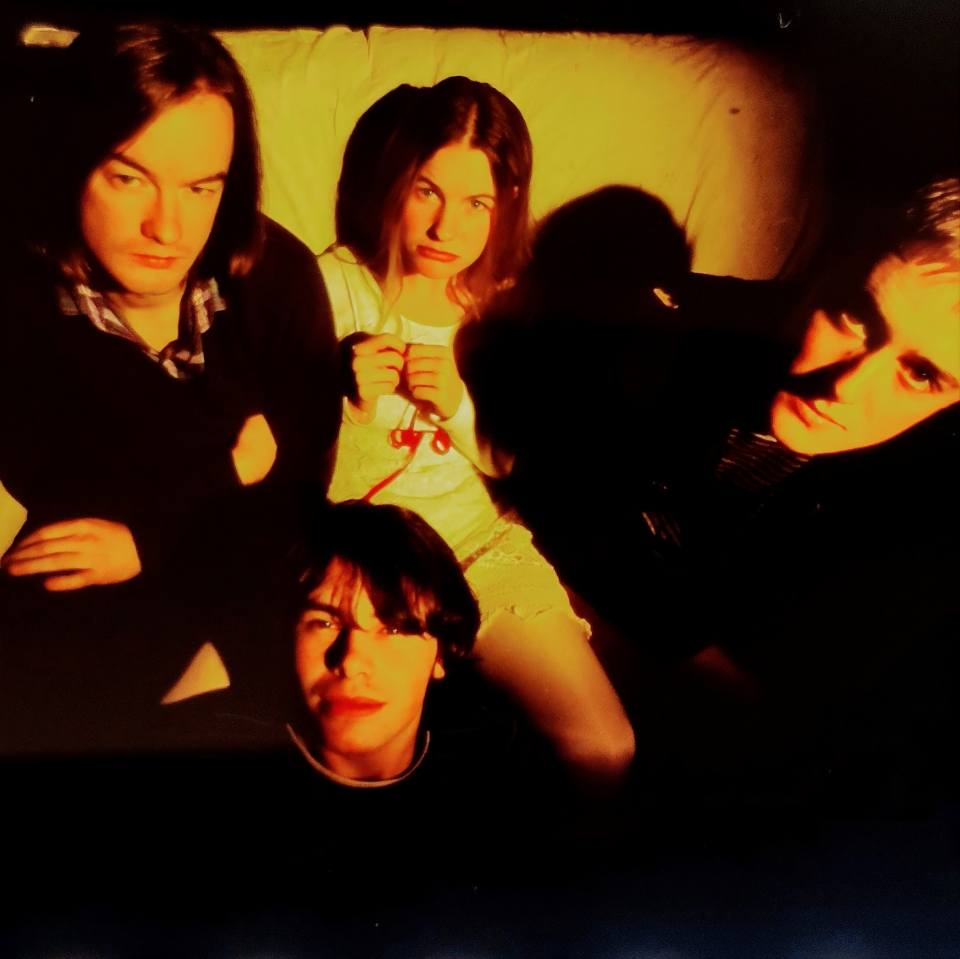
Die Spitz ‘Something To Consume’, photo by Third Man Records

Die Spitz “the best new band in the world”, and on the evidence of this album it’s difficult to argue. “Something To Consume” sounds like a record from four women who’ve grown up with brilliantly compiled playlists, rather than genre restrictions, and they’re happy to defiantly mix metal, grunge and snarling punk savagery as if it were the most natural thing in the world, all while swapping instruments willy-nilly. Never has fury sounded like so much fun.

“‘Something To Consume’ darts between styles with brutish energy and a sense of anarchic fun. At times, it feels like you’re a teenager discovering synapse-fizzing sounds all over again as they pinwheel between punk, shoegaze and classic rock.”

Die Spitz are rad as hell. Look no further than their resume: The punk foursome have opened for (and earned big ups from) bands like OFF!, Amyl and the Sniffers, Viagra Boys, and Sleater-Kinney. Any questions? “Something to Consume“, their debut full-length, arrives via Third Man Records and sees the 22-year-old Austinites strike a chord between their multifarious influences with punk chutzpah and grunge grit. While the opening pop-punk/alt-rock numbers go down smooth enough, the clobbering doom-metal chug of “Throw You On The Sword”—Black Sabbath jump scare!—followed by “American Porn” feminist rage à la Hole, will set you straight. As the contorted, monstrous figures on the album cover might suggest, Die Spitz wrestle with the American condition of being both the consumed and the consumer, both politically and personally.

On its softer moments, like the atmospheric “Sound To No One” or the languid “Go Get Dressed” with its Xanned-out slide guitar, romance and drugs become means of escape as one consumes to disappear, while a song like “Voir Dire” pushes back against the games that the elite play in our face (“You can get what you want, but you’ll beg for what you need”).

Other tracks like the tongue-in-cheek “Red40” (“I don’t want it, but I need that shit”) and punk thrasher “RIDING WITH MY GIRLS” are a more lighthearted means to an end (the end being surviving under patriarchy and capitalism). They’re fierce, they’re brash, they’re hot and cool—Die Spitz have quickly risen to the top of my list of “Bands I Need to See Live.”

GEESE – ” Getting Killed “

Posted: January 2, 2026 in MUSIC

Geese went from little-known cult New York act to your dad’s favourite new band over just a few months at the end of last year after the release of their fourth album “Getting Killed” in September. Soon, frontman Cameron Winter, who had released his own solo album earlier in the year, was being hailed as the next Bob Dylan/Tom Waits/Leonard Cohen/Jesus and his show at the Roundhouse caused pandemonium.

As such, Geese’s show at the Kentish Town Forum in March not so much a hot ticket as a ticking time bomb… their ramshackle shaggy indie brilliance fits the venue but their level of fame suddenly does not. It’s going to be a hell of a show, if you can get in. As for those still mystified why they have gone massive against others of their ilk, well, just give “Getting Killed” another listen… takes a few spins but once you get it, you really get it. Geese to take the year again? Well, if they drop another album, as this prolific outfit tend to do whenever they feel like it, you wouldn’t be surprised.

I kept thinking about his use of the word warlike as I spun Geese’s revelatory new album, “Getting Killed”, which wastes no time pointing to the carnage all around while spending most of it in a fervid, ludicrous freefall that fills the gaps between the bizarre chaos of 2023’s “3D Country” and Cameron Winter’s solo album “Heavy Metal”. It rides a car with a bomb, becomes the car, becomes the road going nowhere. why its lawlessness felt so graceful: there’s something Godlike about it. 

Desperation looks good on Geese. In the past four years, the New York band has demonstrated an ability to rock out and sprawl out with the best of them, but it took until vocalist Cameron Winter’s understated solo album, “Heavy Metal”, for the emotional core to surface. Part of this breakthrough can be attributed to Winter’s voice: a slurred, straining warble whose cryptic delivery can feel like both sides of an argument you’re overhearing through apartment walls. He gets your attention in jarring ways, then turns around and breaks your heart. No artist has muttered the phrase “fuck these people” so meaningfully in a piano ballad.

As evidenced by this moment, occurring just under a minute into his tender 2024 solo single “$0,” Geese can give the impression of an ambitious band skeptical of its own ambition, fitting for a group formed when its members were in high school. Like a lot of precocious young people, they seem energized by the possibility of an audience recognizing their potential before they do, a tension they have used to subvert their more crowd-pleasing turns. This is how “Cowboy Nudes,” a highlight from 2023’s “3D Country”, winds up with a soulful chorus that could have landed on any generation’s FM rock radio alongside a series of exclamations that might be edited out by any generation’s record executives.

Trinidad

Geese may be positioned as young luminaries salvaging rock ‘n’ roll for the new generation, but they make one thing clear: their music is hardly effortless. Not just because they’ve proved themselves more than a group of prodigious post-punks, as “Projector” gave some the impression, but because they’re so quick to squander the genre’s easy tricks. In place of any kind of swaggering riff, ‘Trinidad’ staggers about, as actual geese might, portending chaos. Before repeatedly shouting the JPEGMAFIA-assisted refrain, “There’s a bomb in my car!” Cameron Winter begins by singing the words “I tried,” adding in a “so hard” as a haunted double echoes the exhaustion. The threat is a jolt of adrenaline, sharpening his pen as well as his emphatic intonation. The apocalypse is well underway: “Nothing’s been said for four and a half days/ When that light turns red I’m driving away.” Here the double swirls over Winter’s lead, panned to mirror the voices in his head, as the rest of the band gestures toward what might only be called self-implosion.

Cobra

If you heard ‘Taxes’ before the album’s release, its most quotable line, “There is only dance music in times of war,” will spring to mind when ‘Cobra’ comes on. Having fervently established these are times of war, Winter sings, over a woozy jangle, “Baby, let me dance away forever.” Far from joyously rebelling, though, he’s entranced with no semblance of control, stuck in eternal obedience before defiantly despairing, “You can make the cobras dance/ But not me.” The double meaning of the opening line dawns on you: “Let me dance away forever.” Dispel the curse.

Husbands

The album’s first substantial groove, but compare that to IDLES’ ‘Gift Horse’, another equestrian-themed track from another Kenny Beats-produced album, Tangk: This is not about how fast and muscular his horse is, about “Look at him.” It’s not about making people move, either. The punishing bass and jumbled percussion, instead, evoke just how arduous it is to get ahead, tracing the weight on the singer’s body: “There’s a horse on my back/ And I may be stomped flat/ But my loneliness is gone.” Maybe not, he concedes – maybe no amount of pressure can numb the gnawing feeling out of existence. “And if my loneliness should stay/ Well, some are holiest that way.” You’ve probably heard that rationalization from a disaffected, hard-working man in your life; unless, of course, it’s buried in your head. 

Getting Killed

A Ukrainian choir sample stands in for everybody in the world – a cacophony over which Winter can’t hear himself talk, so he must belt out one of his most impassioned performances, treading the line between operatic and just frantic. Yet underlying it is a professed emotional bankruptcy – “I can’t even taste my own tears/ They fall into an even sadder bastard’s eyes” – that could push any lover away. The loneliness allows him to indulge in escapist tendencies that illuminate and lend credence to the album’s title: “I’m getting killed by a pretty good life.” There’s a blink-and-you’ll-miss-it cut in the middle of the track that sounds like losing your mind for a small second, then falling inconspicuously back into the rhythm of that same life that almost snapped you out. 

Islands of Men 

Guitarist Emily Green and bassist Dominic DiGesu stab at their instruments as if trying to force the truth down our throats: “You can’t keep/ Running away/ From what is real/ And what is fake,” Winter sings, accusatory but unable to extricate his own narrator from the delusion. As if literally responding to Winter’s call, the band literally stops, again, halfway through, then picks up the slow-burn, letting Winter’s poetic improvisations take the back seat while occasionally aligning in holy harmony. Instead of Winter’s voice, it’s for once the high piano notes and touches of brass that serve as harbingers of ecstasy. Not even he can outrun them. 

100 Horses

Unlike ‘Gift Horse’, the stomp of ‘100 Horses’ is not sleek – it’s skronked-out, trashy, borderline violent. Still, the song – even as Winter hilariously clarifies that it’s “maybe 124” – is nothing short of bombastic, getting fired up on the sarcasm and dance, two things he still has the absolute freedom to practice in times of war. “He said that I would never smile again, but not to worry,” he sings, referring to one General Smith, and you can practically see the nervous grin on his face. “For all people must stop smiling once they get what they’ve been begging for.” Some people have been begging for an album like “Getting Killed,  that captures the current feeling of a burning circus without sounding, for a lack of better word, cringe Geese deliver because they’re good at cringing at the world around them while sounding absolutely serious. “We have danced for far too long and now I must change completely” is not the best marketing pitch, but it’s one hell of a closer. Grooveless Geese could still kill it.

Half Real

The change comes in the form of the album’s first (sort of) ballad, one that sways with the force of Winter’s idiosyncratic and humorous spirituality, contending, “You may say that our love was only half real/ But that’s only half true.” He tries to find some grace in the beatific arrangement, but a lobotomy sounds more worth it for the price. When another voice joins him in pleading to “get rid of the good times too,” you cannot doubt the heart of this record. You won’t be able to get it off your mind, either. 

Au Pays du Cocaine

The song hews closest to the ragged lullabies of “Heavy Metal“, but nothing on that album was quite so emotionally or musically direct, if only to highlight its own obliviousness. When Winter’s voice shrinks to declare that he’s alright (way less convincing than the preceding “It’s alright”), you can’t help but feel the defeat, never more pronounced than when he sings, “You can change and still choose me.” The guitar line sounds like sunshine sparkling on waves, the rhythm almost like a breeze. Fake, obviously – he’s standing on a sinking boat – and the reality of his desperation is just as unassailable. He realizes he can’t run away from either, so he must believe.

Bow Down

The narrator must transform again: “I was a sailor and now I’m a boat/  I was a car and now I’m the road.” (On the title track, he was “a TV on the road.”) This is the band’s ragtime depiction of hell, reaching the point of mania where even the singer’s close circle sounds bemused by his self-talk, each musician going off on their own unhinged tangent. 

Taxes

When ‘Taxes’ dropped in July, it felt like a first taste of “Getting Killed’s” unique lunacy. As the penultimate track on the album, it almost sounds like a comedown, a moral reckoning. Compare the way Winter sings “Now I’m in hell” on the previous song to the utter resignation with which he sentences himself there. At this point, there’s no telling what the difference is between defiance and despair, not even when he intones, “Doctor, doctor! Heal yourself!” What’s clear is that any sort of faith beyond the self has been crushed; he’s not clinging to love. “I will break my own heart from now on,” he belts, barely piecing himself together.

Long Island City Here I Come

Equal parts percussive workout and spiritual catharsis, ‘Long Island City Here I Come’ reveals the album’s origins as a series of jams, and you can easily imagine Geese stretching this one back out to 10 or even 20 minutes (as if they need more convergence with the world’s biggest jam band). But it’s also the sound of a band (or a frontman urging his band) pummeling towards uncertainty, through total annihilation. In a spectral vision, Winter is told “a masterpiece belongs to the dead.” Which means it belongs to the scared and nervous, who may well find home in “Getting Killed”

“Getting Killed” by Geese

From New York’s dive bars to Times Square billboards, Geese have somehow spun pure chaos into unstoppable global momentum. The reaction to their 3rd album has been explosive. So it has deservedly earned its place as our second Dinked ‘Heavy Rotation’ Edition – brought to you in a fancy new colourway with a bonus 7” of 2 exclusive live tracks recently recorded in London at The George Tavern.  

Getting Killed” lands like a seismic shock – a chaotic comedy, shambolic in structure but laser-focused in vision. It trades classic rock mythology for something stranger and more self-destructive, balancing big riffs and choir samples with lyrics about war, anxiety, and emotional ruin. The result is a jagged, joyfully unhinged triumph that is clear testament as to why this quartet are being hailed “one of the most respected bands of their generation”.

SAMIA – ” Bloodless “

Posted: January 2, 2026 in MUSIC
Samia - Bloodless

Samia’s third album was an astonishing step up, a vehicle to explore the idea of selfhood and how the world shapes us even without us realising. It would be easy for a weighty subject like that to drag a record down, but in Samia’s hands, it became warm and rich, each song an engrossing vignette. 

Samia’s third album was an astonishing step up, a vehicle to explore the idea of selfhood and how the world shapes us even without us realising. It would be easy for a weighty subject like that to drag a record down, but in Samia’s hands, it became warm and rich, each song an engrossing vignette. 

When we excise parts of ourselves to appeal to a friend or lover, is that process something like cattle mutilation, gory but “bloodless?” Samia reckons with this weighty concern on her third album, which is also her most varied, ambitious, and appealing release yet. After the pop-forward “Honey“, she broadened her sonic palette on “Bloodless”, which reaches from gentle folk to almost post-rock heaviness – and in the case of “Carousel,” both in the same track.

These are songs that stick with you, from their ear-worm melodies to their vivid lyrics, with references to Diet Dr. Pepper, a Nikon Coolpix camera, and a pair of Levi’s drawing you ever further into Samia’s world. She went viral on TikTok this year with her plaintive lyrics and delivery on “Pool,” the opening track of her 2020 debut, “The Baby”, and since then she’s only become more adept at evoking emotion.

Viagra Boys: viagr aboys – Album Review

Bog people and talking dogs with dental problems, a wellness shaman and meth-smoking miscreants: Viagra Boys’ fourth LP might have a nightmare-fuel cast, but it also has eclectic, exciting art-punk hooks coming out of every orifice. 

That single point of light and a knowing smile is a common thread with Viagra Boys, who, despite taking a more punk-based approach to their singular endeavour, sound pin-sharp and laser focused on their goal, whatever that happens to be. What they have to say may be veiled in allegory and buried beneath sarcasm and piss-taking, but it still isn’t that difficult to find. Unremarkable men in tracksuits they may be, but on this album, there’s more funk than a cowshed’s guttering and enough great titles alone to earn them kudos. After all, unless it’s related to the chorus, the thought a band puts into titling a song may tell you a lot.

This theory starts us off neatly at “Man Made Of Meat“, a dissection of masculinity and its various social standings, as singer Sebastian Murphy consistently puts himself in the first-person narrative, the firing line where no artist is allowed to be with irony. This sounds not dissimilar to that other well-known Swedish punk band, The Hives, though they are a more linear, obvious outfit. Spiked, aggressive riffs, short and staccato, characterise the beginning of this record, sonically bass heavy and occasionally reminiscent of LCD Soundsystem, it is a great opening track, surly, snarly and danceable, and an outstanding video, that via Tony Hancock’s The Rebel, layers another meaning on top, in case of dissemination.

“The Bog Body” may be a short essay on beauty standards, or it may be completely literal, but importantly, it does feature a full verse on the difference between a swamp and a bog, so it’s at least educational. Resolutely old school musically, it’s beautifully bass-heavy and from the Pistols/Dead Boys/Damned school of acceleration and also has a brilliant and pointed video worth watching for the genuine unsettling strangeness of the Bog Lady alone. “Uno II” is, for all intents and purposes, an ‘80s pop-rock chart hit, a la The Bangles or The Cars and sounds great for it, a tale of Xenophobia and self-obsession that will hopefully find its way to Classic Rock radio without notice.

Like the Amyl And The Sniffers album, there’s a lot going on here, under the surface, but you’re not obliged to take that dive, even if you should. Ultimately, the surface sounds great too, and all culture meant as art has other meanings. “Pyramid Of Health” has the arrangement of ‘90s pop-grunge classics, the Husker Du/Pixies motif and it is employed to excellent effect over lyrics reflecting the selling out of the hippie dream, or possibly a real-time witnessing of the Mescal worm. There are mentions of bodily health in this and “Uno II“, perhaps an underlying concern after so much touring.

“Dirty Boyz” is a discofied arse shaker with a Scissor Sisters swagger and enough sass to silence Tik-Tok, in a sane world it would be a huge hit song or become culturally significant after some obscure remix finds it used at every sports event, but that is for the future to decide, it will put a smile on your face regardless. “Medicine For Horses”, if you forget the deeply wonderful lyrics, sounds similar to early Go-Betweens, with that same world-weary longing and broken desire, but there doesn’t appear to be any songs written by McLennan or Forster about having the freedom to be kicked to death by horses. The whole lyric deserves to be singled out as immaculate poetry, but ..” I need your credit card; I need to pay a guy to get my pineal gland re-calcified..” is next-level brilliance.

There’s a level of uncapitalised genius at work, as the running means you don’t notice the cross-genre perfection at work. Same with the aesthetic, the exaggerated postmodernism, it all just works.

“Waterboy” is a great example of the band’s ability to inhabit the characters they sing about from that first-person perspective, while the mix of keyboard and guitar riff makes a sound like a beefed-up Elastica, and more health concerns played out as personality traits. “Store Policy“, meanwhile, is possibly about the gentrification of our neighbourhoods by pony-tailed men and their floral-dressed wives, buying up cheap housing stock for profit with a smile, but it is definitely a cracking, post-acid-house chemical boogie, another almost industrial swipe of excellence in a long line. “You N33d Me” is a dancefloor-packing monster about Toxic Masculinity, or loneliness, or both.

“Best In Show pt.IV” hinges on yet another monumental bass line, handclaps, but no actual drums, that still move majestically, while musing on the vagaries of organised religion. It moves almost unnoticed into a Stooges LA Blues type saxophone breakdown of unexpected but welcome magnificence, skronking all the way to church.

The final song “River King” appears to be a heartfelt love song, a piano-led thing about the ease of love and Chinese food, It is an interesting way to end the album. “Fully Robot Rock” compatible, an inspired collision of Mark E Smith, James Murphy and Jello Biafra, this collection of unreconstructed, deconstructed, and reconstructed punk-funk wonder is as good as modernism gets.

An Irish folk super-trio comprising Landless’s Ruth Clinton, Lankum’s Cormac MacDiarmada and their live drummer John Dermody, Poor Creature diverted from the intensity of their other groups to make one of 2025’s most surprising, haunting and gently poppy debuts. The title track and “Adieu Lovely Erin” spring off digital rhythms to sound like Broadcast entering the whirlpools of folk, while in “Willie-O” and Irish love song “An Draighneán Donn (The Blackthorn Tree)”, they build up delightful, dream-like layers of texture. Fiddles and guitars mix with theremin, mid-century organs and modern-day synthesisers to create an intriguing new palette for the genre. 

The latest gorgeous release from the fecund Irish folk scene doesn’t begin with bassy dread in the Lankum mode, but a mood of gentle, haunting psychedelia. “Adieu Lovely Erin” starts by evoking Broadcast swirling around a maypole; then it’s as if Cocteau Twins had been transported to a traditional music session. Its sweet, high female vocals also evoke the improvisations of sean-nós singing, while simmering, krautrock-like drums build drama.

Poor Creature comprises three musicians expert in heightening and managing atmosphere: Landless’s Ruth Clinton, Lankum’s Cormac MacDiarmada plus live Lankum drummer John Dermody. Their debut album steeps cowboy songs, Irish ballads, bluegrass and other traditional songs in a misty, playful lightness that somehow also carries an eerie power. “Bury Me Not” is a 19th-century American song about a dying sailor desperate not to be buried at sea, and Clinton delivers its lamenting lyrics with a bright, shining innocence. MacDiarmada leads “Lorene“, a rolling, country ballad by Alabama duo the Louvin Brothers, with a similarly soft, brooding magic. Singing as a boy desperate for a letter from his beloved, despite clearly knowing he’s being ghosted, the song’s melancholy slowly rises as voice and guitar mesh together.

Cate Le Bon’s seventh album “Michelangelo Dying” is a luminous exorcism of love, loss, and solitude, her most vulnerable work to date. Produced and performed largely by Le Bon herself, it expands on the otherworldly textures of “Reward” and “Pompeii“, weaving guitars, saxophones, and ghostly vocals into an iridescent song cycle. At once intimate and alien, the record captures what it means to grieve, to reach for connection, and to ultimately meet yourself.

Cate Le Bon is releasing a new album, “Michelangelo Dying”, on September 26th via Mexican Summer. This week she shared its second single, “Is It Worth It (Happy Birthday)?,” via a music video. Fellow Welsh musician H. Hawkline directed the video.

Le Bon previously shared “Michelangelo Dying’s” lead single “Heaven Is No Feeling.”  “Michelangelo Dying” is Le Bon’s seventh full-length and the follow-up to “Pompeii”, which was chosen among ther Top 100 Albums of 2022 list.

Le Bon produced “Michelangelo Dying” with collaborator Samur Khouja.

Le Bon, who has worked as a producer with St. Vincent, Wilco, and others, said in a previous press release: “There’s this idea that you could do everything yourself, but the value of having someone you completely trust, as I do Samur, be your co-pilot allows you to get completely lost knowing you’ll get pulled back in at the right moment. We have come to quietly move as one in the studio.”

Cate Le Bon is releasing a new album, “Michelangelo Dying“, on September 26th via Mexican Summer.

ROCKET – ” R is for Rocket “

Posted: January 2, 2026 in MUSIC

The band behind the fuzz are ready to rise, too: they’ve already warmed stages in the UK for their pumpkin-smashing forbears and signed to taste-making label Transgressive, all before the release of their debut album. Relatively speaking, it’s taken Rocket a hot minute to deliver “R is for Rocket”. After all, it was in high school that Alithea Tuttle and Cooper Ladomade added Baron Rinzler and Desi Scaglione to their in-crowd to become a quartet. (Tuttle and Scaglione have been dating since this time, too.)

As of 2021, the four had officially become Rocket the band. And now, in their twenties, it seems the band is mastering the art of growing together with patience. All this to say: “R is for Rocket” is a fantastically confident and truly complete debut. It’s not perfect, but there’s nothing missing either. We’ve had bands in this genre space start hesitant and bedroom-y before tip-toeing into bolder self-actualization, like Snail Mail or Momma or Cryogeyser—and maybe some of that endearingly DIY uncertainty would have been nice to see from Rocket. But if they ever reckoned with that awkward growing stage, it was never publicized. Instead, to make their debut album, they strutted into not one but two of rock music’s sought-after studios: 64 Sound and the Foo Fighters’ Studio 606, utilizing the latter’s thunderstorm drum sound and the former’s storehouse of vintage gear.

But rather than call in John Congleton or Chris Walla—or any of the go-to producers behind the big indie-rock statement albums of the last decade—to shepherd this process, Scaglione opted to wrangle the consoles. He made “R is for Rocket” sound big. His and Rinzler’s guitars whip up a hurricane, leaving only Tuttle’s bass to cling to. Their big pedalboard and bigger amps wail to the high heavens, reaching their extremes on “Wide Awake,” a track that’s less about the notes they’re playing than the mad-scientist way they go all Lee and Thurston with it. 

out now via Transgressive Records/ Canvasback:

DOVE ELLIS – ” Blizzard “

Posted: January 2, 2026 in MUSIC

There’s not a thesis statement to the Dove Ellis album “Blizzard“, but the more I listened, the more I returned to that same sentiment, albeit from multiple angles. Naturally, it resonates across the record—within individual songs “Little Left Hope,” “Love Is,” “Heaven Has No Wings,” “It Is A Blizzard,” and so on) and as a subtle connective tissue across the arc of the album.

Even sonically, It’s littered with instrumental creaks and scrapes that sound almost accidental—an off-beat brush of a stick against a drum, a faint blurted shriek from a reed, a barely-there tick of a metronome. You feel as if you’re in the room during the recording the cracks of Dove Ellis’ made-for-indie-folk voice ringing in your ears. The production is kept light and dry, adding an immediacy to the deceptively dense arrangements: percussion from Matthew Deakin and Jake Brown grounds the restless tempo while Reuben Haycocks and Louis Campbell’s guitar fleshes out the rest of the sonic foundation. Lili Holland-Fricke’s cello, Saya Barbaglia’s strings, and Fred Donlon-Mansbridge’s reeds, on the other hand, flutter around the edges, feeling almost like characters themselves.

Yet the emotional depth of the album rarely inhibits Ellis’ apparent ability to churn out radio-ready hooks. His voice, meanwhile, remains the centerpiece—a flexible instrument that winds through octaves and moods with disarming warmth. To be blunt, he’s been blessed (or cursed) with what might be ideal of a white male indie-folk-rock voice.

Every breath seems to conjure a reference: namely, a Jeff Buckley cry, or perhaps a Thom Yorke murmur, or maybe a Cameron Winter vibrato. I even heard Will Toledo in there somewhere (the refrain in “Love Is” calls to mind Teens of Denial-era Car Seat Headrest), as well as Andrew Bird (the whole of “Jaundice” and, for a split second, Xiu Xiu’s Jamie Stewart (the eerie near-whisper at the end of “To The Sandals”. Crucially, though, it never feels derivative. Where many peers echo past voices to trade on nostalgia, Ellis uses those echoes as scaffolding for his own tonal world.

Gracie Abrams | Tickets Concerts and Tours 2023 2024 - Wegow

Like her inspiration, benefactor, and collaborator Taylor Swift, Gracie Abrams has enmeshed herself within the Eaux Claires extended universe. Abrams, the hit-making folk-pop singer-songwriter, is multiple albums deep into a recording relationship with the National’s Aaron Dessner, a big-deal indie producer who became a big-deal pop producer when Swift recruited him to produce her 2020 album “Folklore“. Dessner worked on Abrams’ 2021 EP “This Is What It Feels Like” and was the main credited producer on both of her full-lengths, 2023’s “Good Riddance” and 2024’s “The Secret Of Us“.

Dessner has worked closely with Bon Iver’s Justin Vernon for many years. He welcomed Vernon into the fold for those Taylor Swift albums during the pandemic. Before that, Dessner and Vernon co-founded the Eaux Claires music festival in Vernon’s Wisconsin home turf, which is about to return next summer for the first time since 2018. Even earlier, they formed the band Big Red Machine for a song on the scene-defining 2009 compilation “Dark Was The Night”. Big Red Machine became more of a going concern a decade later, releasing a pair of fantastic albums in 2018 and 2021. The latter, “How Long Do You Think It’s Gonna Last?”, featured Swift on two tracks.

Now there’s a Gracie Abrams song that features both founding members of Big Red Machine. “Sold Out,” a new track out today, is billed as a collaboration with Bon Iver and Aaron Dessner. Written after a school shooting last year, it’s a benefit for the gun safety organization Everytown. As such, it’s not available to stream, only to purchase.

The artists shared this statement:

We made this song last year in the wake of a school shooting. I was reminded of it this week as our hearts were broken yet again. It’s a sad one to share during the holidays, but the world is hurting and we shouldn’t look away. We are proud to support Everytown, an organization dedicated to ending gun violence in America. We are releasing this song to raise awareness of their mission of reducing gun violence. Please visit their website for more information on the unbelievable work they do. http://www.everytown.org

Sending so much love to you all.

Gracie Abrams, Aaron Dessner, Justin Vernon

Since, releasing his fourth studio album “Idols”, aspiring rock god Yungblud has had a nice streak of wins predecessors aside — in the name of rock ‘n’ roll, including an Aerosmith collab and a few Grammy nominations. One of those nominations is Best Rock Song for the ballad “Zombie.” Yungblud breathes new life into the nominated track, while also crossing off another name on his list of idol collabs. He’s released a new version of “Zombie” featuring the Smashing Pumpkins.

The British rocker revealed that he was “channelling “Siamese Dream” while making “Zombie.” He shared: “It was really the sadness and the melancholic emotion mixed with the aggression of Billy’s fucking guitars … Billy, as a songwriter, was really at the forefront of my inspiration when I was making this album. When ‘Zombie’ came along, I knew I wanted to do a new version if it.”

 “I called Billy and I was like, ‘Billy, please help me scratch this itch. I want this record to dig in harder.’ There still needs to be an almost Jekyll and Hyde element, there needs to be the version that’s full of light and full of life and optimism, but then there needs to be this dark version that is pessimistic and a little bit bitter and a bit aggressive.”