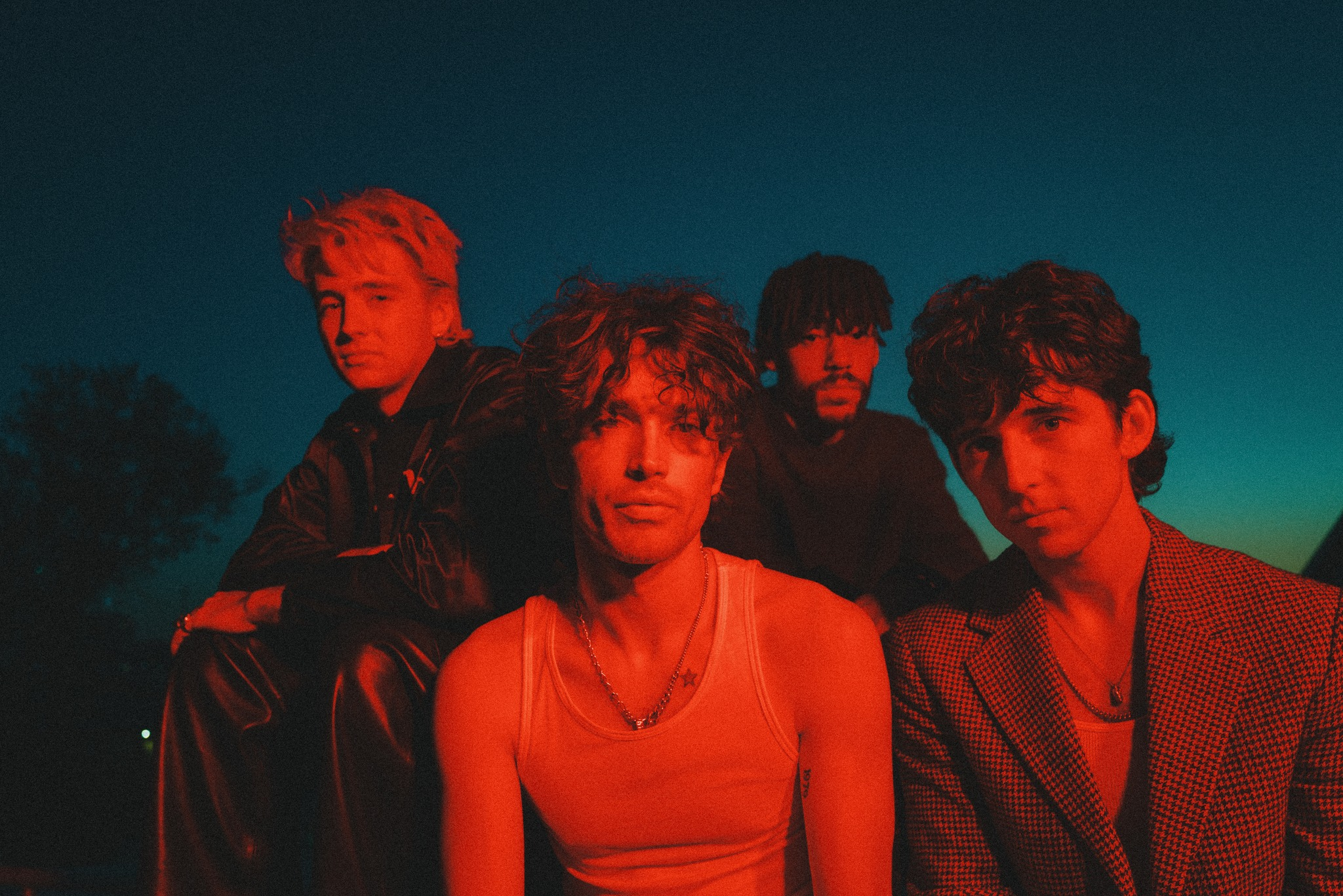
Sabrina Teitelbaum has returned with a new Blondshell single entitled “What’s Fair.” The recording serves as a bridge between her 2023 self-titled debut and her forthcoming album, which is reportedly close to being complete. The track features Teitelbaum’s signature blend of vulnerable vocals with alt-rock guitar wails and massive drums.
Regarding the track, Teitelbaum said: “I think that any relationship between a mother and a daughter is inherently complicated. Maybe it’s because of my own relationship, which was grounded in a lot of trauma and loss, but I think it’s always confusing. What are you allowed to expect, what is normal, what behavior from a parent is OK or not OK, etc.? And to what extent does ‘normal’ even matter when your experience is all you have? I was just trying to sift through the past when I wrote this song and I mostly had a lot of questions.”
John Murry’s music penetrates to the very heart of you, searing with its burning honesty, its unsparing intimacy and its twisted beauty. His classic album “The Graceless Age: The Ballad of John Murry”
The story of American singer-songwriter John Murry who was on the cusp of greatness until he became addicted to heroin, creatively exhausted, and went to Ireland a broken man…. The film has already won Best Irish Documentary at the 35th Galway Film Fleadh and will be premiering in the UK later this year. Directed by Sarah Share best known for her multi award winning ‘If I Should Fall from Grace’ – the Shane MacGowan Story.
John Murry is an American singer-songwriter known for his emotionally charged and critically acclaimed music. Born in Tupelo, Mississippi in 1979, he gained recognition with his debut solo record, “The Graceless Age,” released in 2013. This album received high praise from critics and music publications, establishing Murry as an artist of major stature. His music delves into themes of drugs and near-death experiences, offering a raw and introspective experience for listeners. Murry has collaborated with other notable musicians and continues to captivate audiences with his dreamy falsetto and evocative lyrics. With his Mississippi roots and connection to literary figure William Faulkner, Murry’s unique blend of musicality and introspection has garnered him a dedicated fan base.
John Murry will release a new album 20th September 2024 on Deluxe CD & Download via TV Records with distribution from Shellshock John Murry And Michael Timmins – “A Little Bit Of Grace And Decay”
The Soundtrack to accompany the Award winning Documentary, The Graceless Age: The Ballad Of JohnMurry. Written and performed by John Murry and Mike Timmins (Cowboy Junkies). Tracks include stripped back versions of songs from “A Short History Of Decay“, disarmingly poignant new songs, and sections of the luminously, atmospheric score.
Recorded in Toronto at The Hangar. Produced, Mixed and Recorded by Michael Timmins.
‘An instant classic. The Graceless Age is a Masterpiece. Murry’s songs are unforgettable’ UNCUT 9/10.
‘Ink-black gothic country gospel. Formidable stuff’ MOJO 5 STARS
‘Intensely beautiful… Like Father John Misty, Mark Lanegan and Josh T Pearson rolled into one really broken dream’ Q MAGAZINE 4/5
‘The Graceless Age” …is a Classic… from a compelling honest, deeply emotional, singer-songwriter’ THE TIMES
Madfish Records have shared details of “8314 Boxed“, a limited-edition deluxe boxset tribute to Jethro Tull frontman Ian Anderson’s treasured solo works. The package, set for release on 23rd August, will include –
First-time vinyl releases of “Divinities: Twelve Dances with God”, “The Secret Language of Birds” (2LP), and “Rupi’s Dance” (2LP)
“Walk Into Light”, “Divinities: Twelve Dances with God” and “Homo Erraticus” remastered at half speed by Air Studio
“Roaming in the Gloaming” LP offers previously unreleased live recordings from 1995-2007
Beautiful side D etchings on 3 of the 10 records
96-page book with foreword by Ian Anderson, extensive liner notes by Paul Sexton and exclusive pictures
“Since 1983, I have made a few solo albums, not as dissatisfaction with fellow musicians or the group identity but usually just to try something a bit different, whether sonically, stylistically or in terms of instrumental line-up. These records all stand out for me as being quite different from each other and in some ways demonstrate a broader depth of my songwriting. The flute instrumental “Divinities” record is one of my favourites to this day” – Ian Anderson
Ian Anderson’s solo albums explore different sonic landscapes and instrumental line-ups, each record in this boxset standing as a testament to his versatility. From the electronic experimentation in “Walk IntoLight” and the profound narratives of “Homo Erraticus”, to the acoustic serenity of “The Secret Language of Birds“, these albums are a reflection of Anderson’s unending creativity and his ability to seamlessly blend diverse musical styles into cohesive, captivating works.
“Wig Out! Freak Out!,” the latest compilation from Two-Piers, dives into the world of Freakbeat, Psych and Mod from 1964-1969. Pulling the cream of tracks from the UK and United States Freakbeat and Garage scenes of the time. Featuring tracks from The Sonics, The Kinks, The Action, Chocolate WatchBand, The Haunted, The Standells, Paul Revere and The Raiders, The Shadows of Knight, The Yardbirds, The Seeds and more “Wig Out! Freak Out!” is packed full of Freakbeat and Mod classics as well as rare sought after nuggets.
Talking about “Wig Out! Freak Out!” Two-Piers compiler Mark McQuillan says “The album was inspired by my many happy DJ nights promoting my club night ‘Club Pod’ down in Brighton in the 1990s and my love of all things Sixties Freakbeat. I wanted to put as many great tracks as I could on one compilation to hopefully bring across the feeling sheer joy of spinning these awesome tracks in a club and seeing the place go off. This compilation isn’t supposed to be a rare crate diggers album, but rather a gateway to give listeners a flavour of the scene and allow them to go off and discover new and brilliant hidden gems within the Freakbeat and Mod Psychedelia genre, and if ‘Wig Out! Freak Out!’ does that job done!”
Aimed squarely at the Alternative and 60s Club Dancefloors “Wig Out! Freak Out!” Kicks off with the fuzz guitars of The Sonics ’Shot Down’, The Standells epic ‘Dirty Water’, and lesser known gem ‘1-2-5’ by The Haunted, before taking you down a road of pure riotous Freakbeat joy with tracks by the likes of The Birds ‘You’re on My Mind’, The Wimple Winch ‘Save My Soul’ and The Remains ‘Don’t Look Back’.
Add the epic Freakbreat grooves of The Eyes ‘You’re Too Much’ and The Open Mind ‘Magic Potion’ an chuck in some brilliant covers by The Kinks, with their take on ‘Louie Louie, Paul Reeve and The Raiders sublime version of ‘I’m Not Your Stepping Stone”, Girl group The Starlets garage cover of ‘You Don’t Love Me’, ‘Gloria’ reworked by The Shadows of Knight, and The Action covering ‘Land of 1000 Dances’ and making the track their own, and your feet can’t help but move.
The compilation contains lesser known gems such as The Satans ‘Makin’ Deals’, Count Five ‘Double Decker Bus’, The Poets ‘Wooden Spoon’ and The Pirates ‘Cuttin’ Out’. It also takes a turn into Mod Psychedelic territory with the Hammond led grooves of The Quik ‘Berts Apple Crumble’, The Spencer Davis Group ‘I’m A Man’ and the glorious ‘Indian Rope Man’ by Julie Drsicoll, Brian Auger and The Trinity, before ending on the instrumental blues psych rock of Davie Allan and The Arrows ‘Blues Theme’ – a journey through the very best of Freakbeat and Mod Psychedelia at the peak of its powers 1964-1969.
Two-Piers the label has brought to you such wonderful compilations as the “Pop Psychédélique”, “Garage Psychédélique” and “Lounge Psychédélique” compilation series introducing the listener to the worlds of French Psychedelic Pop, Garage Psych, and Lounge and Exotica Space Age Bachelor Pad Music, Waves of Distortion (The Best of Shoegaze 1990-2022) and Music for The Stars (Celestial Music 1960-1979).
English rock band UFO‘s 1979 live album “Strangers in the Night” is being reissued as an 8CD deluxe edition. Capturing the band at the peak of their powers the original double album was compiled from recordings made at six shows during in October 1978 on an American tour. This new 8CD box set includes all six complete original concerts for the first time (five previously unreleased) as well as a newly remastered version of the original album (across two CDs). Four of the shows have actually been newly mixed from the original tapes.
“Listen to the album. There are some wrong notes on that song. I hate mistakes.” More than 30 years after the event, Michael Schenker still recalls the straw that broke the camel’s back and prompted his exit from UFO. The year was 1978, and the band were holed up in New York’s Record Plant studios, mixing their double live album “Strangers In The Night”.
Tensions had been building within the band for years. Personality clashes between the loose-cannon German guitarist and his equally wayward British colleagues had already seen Schenker warn the rest of UFO that he would leave the band after the tour for 1978’s “Obsession” album. But no one expected his departure to be quite so sudden. Schenker had been at loggerheads with producer Ron Nevison over which version of his showcase song “Rock Bottom” to use on the live album. The guitarist was unhappy with the producer’s choice of take, and insisted that he either change it or let him overdub it. Nevison refused.
“Michael’s entitled to believe that there were better takes of “Rock Bottom” that might have been used,” says Nevison, “but a guy like Michael Schenker is only listening for Michael Schenker. As producer I listen to the bigger picture. Michael was never what you’d call a ‘band guy’.
For singer Phil Mogg, this studio flashpoint provided a moment of unintentional comedy. “I can still see Michael, who was becoming more and more distanced from the band, going out of the studio mumbling: ‘Poor, poor “Rock Bottom’,” Mogg recalls with a smirk. “And that was the last we saw of him.”
Chaos has always reigned supreme in the world of UFO, but never more than in the late 70s. The combustible mix of five flamboyant, eccentric personalities – Mogg and Schenker plus bassist Pete Way, guitarist/keyboard player Paul Raymond and drummer Andy Parker – combined with various alcohol and drug-fuelled excesses, was a sure-fire recipe for the worst kind of pandemonium.
Schenker had left his original band, Scorpions, to join UFO in 1973 when he was just 18 years old. Tensions between the German guitarist and his British bandmates were apparent early on, with Schenker and Mogg enjoying a particularly fractious relationship. At times it seemed like the pair were intent on re-enacting World War 2 on a daily basis. “I always said that I would quit the band if Phil Mogg hit me,” Michael recalls. Inevitably, a physical altercation did eventually ensue – though neither party is clear as to where, or even when, it occurred. “The fight with Phil might have happened in Germany – maybe Strangers In The Night had already been recorded,” says Schenker. According to Mogg the fracas happened years previously, possibly as early as 1974’s Phenomenon album. “There were often times when I wanted to belt Michael,” says the singer.
Such was the bad blood, Schenker had even quit the band once before, around 1977’s “Lights Out“, only to be talked out of his decision by bassist Pete Way.
Despite all this, by 1978 UFO were on the verge of their big breakthrough. “Obsession” had added a new-found maturity to their powerful hard rock thunder in the shape of the strings-assisted “Looking Out For Number One” and “Born To Lose“, and the album had followed “Lights Out” into the US Top 50.
The time was right for the band to record a live double album. And, unlike Kiss, whose “Alive!” LP, had been the ultimate shit-or-bust statement, UFO’s live album would capture a band already well on their way to stardom. Strangely, though, not everyone concerned was convinced by the idea.
“I didn’t even want to make a live album,” admits Mogg. “At that point the band was so up and down, depending on who’d been doing what. Wine, women and song was our priority, in that order. Suppose they recorded a dodgy night?”
Drummer Andy Parker agrees that the partying – not to mention the bust-ups – affected the band’s performances. “The intake was astonishing,” he says. “We’d have different types of booze for times of the day, for Christ’s sake. There’d be white wine for the sound check – nothing too heavy – and it would build from there during the gig and afterwards. You’d be up till four in the morning, then get up and do it all over again.”
Schenker insists that he was always in control on stage, though what happened afterwards “is another thing completely”. As well as his extra-curricular activities, Schenker’s problems were compounded by the fact that he suffered from crippling stage fright. To combat this he was taking the same anti-depressants that would kill The Who drummer Keith Moon just a few months later. “It was a very, very bad time for me,” Schenker recalls. “I stopped taking those tablets after Strangers In The Night.”
Phil Mogg is less sympathetic. “The pills made Michael’s face go red as a beetroot,” he says. “You weren’t supposed to take them with alcohol. But back then everybody knew their own personal limits.”
The songs that would appear on “Strangers In The Night” were recorded on the US leg of the “Obsession” tour in Autumn 1978. To minimise potential disaster, the band’s label, Chrysalis, hired the Record Plant’s remote unit and dispatched Ron Nevison – who had produced UFO’s previous two albums – to record six shows on the tour. Despite gravel-voiced stage manager Steve Brooks’s opening rallying cry of: “Hello, Chicago. Would you please welcome, from England… U!… F!… O!”, the album was eventually pieced together like an audio patchwork quilt. “There are some things about that record that Mike Clink [who co-manned the mobile truck and would go on to produce Guns N’ Roses’ “Appetite For Destruction“] and I still can’t remember,” admits Nevison. “I don’t even recall recording the show in Louisville, Kentucky, but apparently we did so. And then, of course, there’s also some conjecture over the amount of ‘fixing’ that was done.”
The post-production ‘fixing’ he’s referring to has been the subject of much debate over the years. A name-check for Schenker’s eventual replacement in UFO, former Lone Star guitarist Paul ‘Tonka’ Chapman, on the sleeve of “Strangers In The Night” prompted rumours that Chapman had touched up some of Schenker’s guitar parts in the studio following Michael’s departure from the band. For once, though, on this both Michael Schenker and Ron Nevison are in agreement.
“No bloody way,” says the guitarist. “If that were true you’d be able to hear it.”
“I’ve never even met Paul Chapman,” Nevison says. “No, no. That’s complete bullshit.”
However, certain ‘fixes’ were made. In order to accommodate four sides of vinyl, Nevison was forced to rearrange the running order of the set as it had been played. Two of the songs that appear on the album – Mother Mary and This Kid’s – were also re-recorded in the studio afterwards and overdubbed with crowd noise from the tour. “Some people will say: ‘Oh, then it’s not a real live album,’” says Andy Parker. “But we set up the gear like we’d have done at a gig and played the damned songs. It really was as live as you could get.”
One thing that no one disagrees with is that the album’s distinctive title was proposed by its producer, Nevison. There is, though, still some disagreement over the identity of the open-mouthed fan pictured on the front cover. According to some, the colourful face is that of the band’s long-time publicist, Joe O’Neil (who died in 2008).
“Are you sure?” says Mogg. “I always thought it was Peter Curzon from [sleeve designers] Hipgnosis.” If the devil is in the detail, UFO are positively angelic.
Despite all the chaos surrounding “Strangers In The Night” the album would give UFO their biggest ever hit, reaching No.8 in the UK chart and No.42 in the US. In 2009, the album was reissued with the as-performed running order restored, and with two additional tracks in the shape of “Hot ’N’ Ready” and “Cherry“. That reissue also exhumed some of Mogg’s previously unheard stage patter. “We’re getting a bit confused up here; it’s your licensing laws,” the singer tells the crowd at one point. “We’ve just taken a vote, and apparently this is something called Natural Thing.”
These days, UFO are still very much a going concern, The guitarist himself talked about putting together a band called “Strangers In The Night” with UFO bassist Pete Way and former Scorpions drummer Herman Rarebell to perform songs from the album of the same name, along with other choice material from his career. That idea has since been mothballed, but at least Schenker seems to have got over the stage fright that plagued him for so long. “Isn’t it funny? I’ve developed an extreme liking for being on stage,” he says.
More than 30 years on, a surprisingly large number of musicians have spent time as a member of UFO, but it says much about “Strangers In The Night” to note that many of the songs on that album are still in the band’s live set. “Strangers is our best album, and I’m blown away that it’s still considered important,” says Andy Parker today. “We made some great studio albums, but to understand UFO you always had to see us live. It remains the epitome of what we’re about.”
“It has a lot of vigour and strut,” adds Phil Mogg. “As a doubting Thomas that hadn’t wanted to do it, I was very, very wrong.” Nevison himself adds: “Everybody agrees that “Strangers In The Night” is one of the best live albums ever, so I didn’t do such a bad job. Whatever complaints Michael Schenker might have, he can stuff them.” After all these years, even Schenker himself has learned to live with what he calls the album’s “mistakes”. “Those notes might have been wrong,” he concedes, “but they became classic wrong notes.”
Neil Young is set to release a new box set “Archives Vol. III” covers the period from 1976 through 1987, an extremely productive and musically diverse period in Neil Young’s career that included the release of several classic albums including “Comes A Time”, “Rust Never Sleeps”, “Live Rust”and the electronic “Trans”. Spanning 11 years, this Archives box set covers more years, and includes more music and video than the previous two volumes in the Archives series.
There are a total of 22 discs, with 17 CD’s in 11 soft-paks and 5 Blu-Rays in 3 soft-paks. There are 11 films on Blu-Ray, 4 previously unreleased. The 198 total musical tracks include 121 previously unreleased versions of live, studio, mixes, or edits, and 15 previously unreleased songs, available here for the first time ever. 62 tracks have been available on various recordings. The Blu-Rays include 128 tracks, over 14 hours of film. The box also includes a 176-page book and a poster. With over 28 hours of total content, listening the entire time.
The limited edition Deluxe Edition of “Archives Vol. III”,will be available on September 6th exclusively at NeilYoungArchives.com, The collection includes recordings and films together that show the unheralded sweep of Neil Young’s efforts from the 1976-1987 period of his journey.
The box set includes recordings and films together that show the unheralded sweep of Young’s efforts from the 1976-1987 period of his journey. It is one of the most extensive anthologies in his recorded history.
In addition, a double vinyl LP only set titled “Takes”, will also be available on the same date. “Takes” is a 16 track compilation featuring one track from each of the 16 out of the 17 CD’s in the “Archives Vol. III” Box Set. This collection will include 3 unreleased songs and 12 previously unreleased versions and will be the only vinyl edition to feature these songs.
Released September 6th, Neil Young release’s the deluxe edition of “Archives Vol. III”. The set includes previously unheard recordings and films that capture the musician’s 1976-1987 efforts across 22 discs. Totalling 198 tracks, the set consists of 121 unreleased versions of live, studio, mixes, and edits, in addition to 15 debut songs.
The Neil Young Archives series is a living music museum curated and carefully deliberated by Young and is considered one of the most complete artist anthologies in recorded history. The newly announced package implies said status with an exuberant offering of over 28 hours of music–as noted in the artist’s press release, Of the 198 songs included, 62 have been available on various recordings.
In addition to the sizeable margin of first-time releases, the Blu-Rays consist of 128 numbers, over 14 hours of film. Also included in the box set is a 176-page book and a poster. Also positioned for the September. 6th release date is a double vinyl LP-only set titled “Takes”, a 16-track compilation featuring one from each of the 16 of the 17 CDs from“Archives Vol. III”. This specific collection includes three unreleased songs and 12 previously unreleased versions and represents the only vinyl edition to feature these songs.
For those who pre-order “Archives Vol. III”, they will receive a free 16-song bonus CD Sampler with the tracks from the “Takes” collection before the release of the vinyl edition, along with an exclusive NYA enamel pin.
Neil Young’s ‘Archives Vol. III Takes’ is a 16 track compilation featuring one track from 16 out of the 17 CD’s in the Archives Vol. III Box Set. This collection will include 3 unreleased songs and 12 previously unreleased versions and will be the only vinyl edition to feature these songs. The Neil Young Archives series has been something like a living musical museum that can be visited in a personal way, curated by the person who actually created all of the music and films. It is ever-changing as it moves forward through the life of someone who does not stop, continually looking forward as he studies and shares a past that stays alive.
The expression of hard-fought optimism encapsulates “The Good Kind”, an album exploring themes of sexuality, relationships, community, and illness. Our Girl’s trademark dynamics permeate the record, from heavy guitars and soaring lead lines to ear worm choruses and intimate vocal moments. Filled with warmth and honesty, “The Good Kind” is a celebration of determination – of choosing to recommit to what matters, against all opposition. “A lot of the songs are about taking setbacks and turning them into superpowers” says drummer Lauren Wilson.
We were lucky to have some wonderful collaborators on this song, including Stella Mozgawa who helped bring this song to life in its early stages – when it was just a baby demo before it came to be what it is now. Another one was Fern Ford who, in the final moment of working on the album, put the glorious cherry on top of the middle 8 of this song. The song was fully tracked, including the strings, but it felt like something was missing in the middle 8 – it wasn’t giving us the heightened swelling feeling we were after. Fern opened up the strings section and added these swoops that felt so perfect, they sounded like fireworks and it just tied everything together. It’s the best feeling to love something so instantly and to be able to tell someone that. Was a good way to finish the record!
We hope you like this song and thanks as always for being on our mailing list and supporting us, we appreciate you!
Gene Clark – (1944-1991) Gene Clark was a founding member of the seminal 1960s Rock group the Byrds and the principal songwriter for the band for its first three albums. He penned some of the most beautiful songs of the decade: “Here Without You,” “I Feel A Whole Lot Better,” “She Don’t Care About Time,” and “Set You Free This Time,” and the majestic “The World Turns All Around Her,” He also co-wrote the classic “Eight Miles High,” Clark departed the band in 1966 partly because of his deathly fear of flying and partly because McGuinn sang lead on the singles and Bob Dylan songs,
Also, there was the resentment of other band members that Clark was more highly paid because of his song writing credits. It was the group’s loss because they were never better than when he was in the band He was the heart and soul of the Byrds. Clark next signed as a solo artist with the Columbia label, releasing “Gene Clark and the Gosdin Brothers,” that also featured the Byrds Chris Hillman on bass. The album was a critical success, but because it was released at the same time as the Byrds “Younger Than Yesterday,” in 1967, it disappeared without a trace.
A short stint with the Byrds after David Crosby left ended after three weeks. In 1968, Clark hooked up with banjo player Doug Dillard, guitarist Bernie Leadon (later of The Flying Burrito Brothers and the Eagles), bassist David Jackson and mandolinist Don Beck – and for a short time Byrds drummer Michael Clarke joined the group, They delivered two albums, “The Fantastic Expedition of Dillard & Clark,” (1968) which was a landmark work of acoustic country rock, featuring a collaboration between Clark and Leadon on “Train Leaves This Morning,” (later covered by the Eagles), and “Through the Morning, Through the Night,” (1969) which leaned toward traditional bluegrass. Then Clark decided to move on. He continued to record quality solo albums such as “White Light,” (1971) which included perhaps Clark’s masterpiece “For a Spanish Guitar,” which Bob Dylan embraced. But Clark failed to promote the album, and it was a commercial failure except in the Netherlands. “Roadmaster,” was released in 1973 to the same fate. A reunion Byrds album in 1973 didn’t fare as well either.
David Geffen signed Clark to his new label Asylum Records in 1974, and the ensuing album “No Other,” over $100K in production costs. It featured the Allman Brothers Band and a host of other session musicians. The music was overarching in its ambition with a blend of Country Rock, Folk, Gospel, Soul and Choral Music. Clark’s songwriting included some of his finest work including “Silver Raven,” “Some Misunderstanding, “Life’s Greatest Fool,” and “No Other.” Critics loved it but Geffen agitated by the cost failed to promote it properly, “Two Sides to Every Story,” followed in 1977 with tracks such as “Hear theWind,” and “Sister Moon.” Clark considered it his best album, but it was yet another failure on the charts. He regrouped with McGuinn and Hillman on the album “McGuinn, Clark, and Hillman,” in 1979, and had better luck. He contributed four songs including “Backstage Pass.” The album, though slick, was a success, . Unfortunately, Clark’s substance abuse and dissatisfaction with the production resulted in his leaving the band. Later in the 1980s, Clark recorded a highly acclaimed duo album with Carla Olson called “So Rebellious a Lover,’ (1986) which for a time rejuvenated his career. But ulcers and alcohol had left him with serious health problems. The Byrds were inducted into the Rock and Roll Hall of Fame in 1991, and Clark performed together with the band for the last time. He died on May 24th, 1991 at age 46, another tragic casualty in the long line of Rock Stars succumbing to alcohol or heroin addiction.
Clark’s songwriting became revered after his death: his songs were covered by Tom Petty, Ian Matthews, Alison Krauss and Robert Plant – just a few of his fans. Clark was a hard-luck guy, who was unable to sustain a long career, but his songwriting craft has been rediscovered, and his Byrds’ compositions are timeless.
Originally released in September 1974, “No Other” is an absolutely extraordinary album of Country-steeped rock and roll balladeering from The Byrds founding member, Gene Clark. An LP of huge innovation and terrible luck.
By 1973, Gene Clark had ended his third stint with The Byrds, the hall of fame rock band he founded alongside Roger McGuinn, David Crosby, Michael Clarke and Chris Hillman. As amicable and volatile as they ever were, 1973 found the original members back together and recording, although the album was an all-out critical and commercial disaster. With a renewed inspiration and the opportunities afforded to him by Asylum, Clark began work on his magnum opus.
This is another album that demands to be listened to as a whole flowing between musical styles in an easy manner. The album feels like it was delivered from the heavens to us to soothe our souls. Reading about how it was made and the fact that it apparently only made number 144 on the Billboard album chart reminds me that sometimes it takes time to recognise genius.
The album was reissued in 2019 with all of the bells and whistles including multiple versions of the tracks on the original.
Eight years and three solo albums after leaving the Byrds, Gene Clark released “No Other,” an album that truly lived up to its title. At the time, there was no other record like “No Other,” which cost more than $500,000 to produce and was seen as a masterpiece by Clark. However, the experimental use of overdubs and other effects were just a bit ahead of their time, leading to heavy criticism by the press, who called the effort bloated, pretentious and overproduced. (Fleetwood Mac used many of the same techniques just a year later to great success.) As a result, Asylum Records refused to promote the album and basically disowned it, damaging Clark’s career so badly that he would never recover. Sadly, it wasn’t until after the artist’s death in 1991 that “No Other” would see a reissue, re-evaluations by critics and the respect it (and Clark) rightfully deserved.
“No Other” is one of the most important albums of the 1970s. It has the Laurel Canyon vibe (although it was primarily written at his coastal home in Mendocino and recorded in downtown LA across various stints with producer Thomas Jefferson Kaye). It is also rich in Gospel stylings, with complex and full harmonies that would inspire many dozens of albums across the decade that followed. There are flashes of Country (the album includes a vast array of session musicians, including members of The Section and the Allman Brothers Band) and all bound to his wistful and spiritual songs. Although each of its nine tracks are different, they sit together beautifully and create the most vivid and coherent flow. Like all timeless albums, you can just keep flipping it over and bathing in the opulent world it creates.
But, like many classics, it was an album not of its time and failed to find an audience on release. It is tragic that this wonderful album’s renaissance would arrive after Clark had died, but it remains one of the most seminal albums of the period.
Misunderstood, mismanaged and one of the greatest ever fumbles (alongside Big Star’s #1 Record), “No Other” is a visionary work of such artistry. It is an album of dichotomy, both sonically and thematically focused on the balance between light and dark. Joyous and rousing, pensive and mournful, it really does cover the spectrum of emotions and there is not one wasted second.
The story goes that in 1989, while recording “Oh Mercy”, Bob Dylan exclaimed to producer Lanois, ‘This is archaic music we’re making.’ In other words, Dylan realised he was no longer on the cutting edge of rock music, Listening to some of these recordings from 1999, I’m struck by how 1950s the sound is, or at least how obviously and deeply rooted in the origins of rock music Dylan’s music is. Call it primitive, call it primal, call it dance music, call it roots music, call it whatever, Dylan determinedly evokes music from a previous age. Not just rock music but rock-and-roll, pre-rock. While the album “Time out of Mind” shows the influence of that ‘archaic music,’ more consciously and deliberately than “Oh Mercy”, his live performances tap directly into the music of a previous age.
listening to Dylan performing the song at Tramps, New York, ‘Not Fade Away’ is not an isolated example. ‘Alabama Getaway’ is a Robert Hunter song, released by the Grateful Dead in 1980, but it taps right into Chuck Berry and the more ‘primitive’ tradition of 1950s countrified blues. I imagine Dylan likes the song because it’s doing what he wants to do, ‘Tombstone Blues’, for example, takes us right into the simple, jangling chords of old rock-and-roll, jump music. Dylan’s twin guitarists, Charlie Sexton and Larry Campbell, make all this possible with their happily expert, retro playing.
Bob Dylan was back in the game. After a decade of hit-or-miss releases; six years without releasing a new, original song; and a near-fatal heart infection, “Time Out of Mind” came out of nowhere with a sound that was both timeless and brand-new, and a resurgence of the language and form that characterized his greatest song writing. It won the Grammy for Album of the Year and marked an entirely unexpected creative explosion as Dylan neared sixty. The live shows were getting more consistent, too. For a co-headlining tour with Paul Simon, his band had settled into a line-up (Larry Campbell and Charlie Sexton on guitar, Tony Garnier on bass, David Kemper on drums) that would be his most formidable group since the mid-‘60s performances with The Band. Prior to two nights at Madison Square Garden, Dylan booked a last-minute date at a Chelsea nightclub that captured all of this new momentum. It was a magnificent set, leaning surprisingly hard on his ‘60s masterworks (including a miraculous ‘Visions of Johanna’), but also turning a forgotten song like ‘Seeing the Real You at Last’ into a thrilling highlight. With Elvis Costello joining in for a final take on ‘I Shall Be Released’, the full show remains something of a marvel and is now released on vinyl for the first time on this new two-instalment set.
‘Down Along the Cove’ comes as the second to last track on “John Wesley Harding” (1967), but we had to wait until 1999 to get the first live performance. Bringing it forward at this point, nested among the “Time out of Mind” songs, and antique songs, is yet another indication of the influence of this retro music on Dylan’s own songs. It’s a Dylan song but could almost be someone else’s. It’s a straight no frills rock blues. A treat for the ears.
in ‘Highway 61 Revisited,’ another retro sounding song, although less obviously derived from the blues. Again the complexity of the lyrics is set against a simple, ‘primitive’ jump music structure. It’s a lot of irreverent fun. This Tramps performance really pushes it along, the wild lyrics flying by before we can get a hold of them. Taming Dylan’s lyrics to the page hardly does justice to the madcap, whirling effect this song creates.
Bob Dylan & His Band performing at Tramps, New York City on 26th July 1999 –
Complete [-1] set. 1. Oh Babe It Ain’t No Lie (Elizabeth Cotten) 2. The Times They Are A-Changin’ 3. Boots Of Spanish Leather 4. John Brown 5. Visions Of Johanna 6. Seeing The Real You At Last 7. Ballad Of A Thin Man 8. Most Likely You Go Your Way (And I’ll Go Mine) 9. Every Grain Of Sand 10. Tombstone Blues 11. Not Dark Yet 12. Highway 61 Revisited — [ 13. Love Sick – missing here, copyrighted, officially released ] — 14. Like A Rolling Stone 15. It Ain’t Me, Babe 16. Not Fade Away (Norman Petty/Charles Hardin) 17. Blowin’ In The Wind 18. Alabama Getaway (Robert Hunter/Jerry Garcia) 19. I Shall Be Released – [Elvis Costello is in town and joins Dylan & His Band on the last one] Line-up: Bob Dylan (vocal & guitar), Charlie Sexton (guitar), Larry Campbell (guitar, mandolin, pedal steel guitar & electric slide guitar), Tony Garnier (bass), David Kemper (drums & percussion), Guest – Elvis Costello – guitar & vocals on “I Shall be Released”