Austin psych greats The Black Angels release new double LP “Wilderness of Mirrors” on Friday and have shared one more preview before dropping the whole thing. “‘Empires Falling’ is a critical and reflective plea that examines humanity’s repetitive art of violent mass destruction,” say the band. “As we say in the chorus, “it’s history on repeat.” We are living in a “Wilderness Of Mirrors”, where it’s hard to tell what’s right from wrong, up from down, or the truth from lies as we navigate through these times where the fate of humanity is being refracted and reflected from one state of panic to another. The world is a “bleeding animal” and we are left exhausted, polarized, and “pleading from street to bloody street.”
The best music reflects a wide-screen view of the world back at us, helping distill the universal into something far more personal. Since forming in Austin in 2004, The Black Angels have become standard-bearers for modern psych-rock that does exactly that, which is one of many reasons why the group’s new album, “Wilderness of Mirrors”, feels so aptly named. In the five years since the band’s prior album, “Death Song“, and the two-plus years spent working on “Wilderness of Mirrors”, pandemics, political tumult and the ongoing devastation of the environment have provided ample fodder for the BlackAngels’ signature sonic approach.
“Wilderness of Mirrors” expertly refines the Black Angels’ psychedelic rock attack alongside a host of intriguing sounds and textures. There are classic blasts of fuzzed-out guitars meant to simultaneously perk up the ears and jumpstart the mind, alongside melancholy, acoustic guitar-driven newfound experiments. Mellotron, strings, and other keyboards also play a more prominent role on “Wilderness of Mirrors” than ever before.
Even amidst these new experimentations, The Black Angels remain masterfully true to psych-rock forebears such as Syd Barrett, Roky Erickson, Arthur Lee and the members of the Velvet Underground, all of whom are namechecked on album highlight “The River.” “The Velvet Underground song ‘I’ll Be Your Mirror’ – that’s what every Black Angels album has been about,” says vocalist/bassist Alex Maas. “You can’t work out your struggles unless you bring them to the forefront and think about them. If we can all think about them, maybe we can help save ourselves.”
History has proven, time and time again, that without a drastic metamorphosis from our leaders, politics, and ultimately ourselves… “
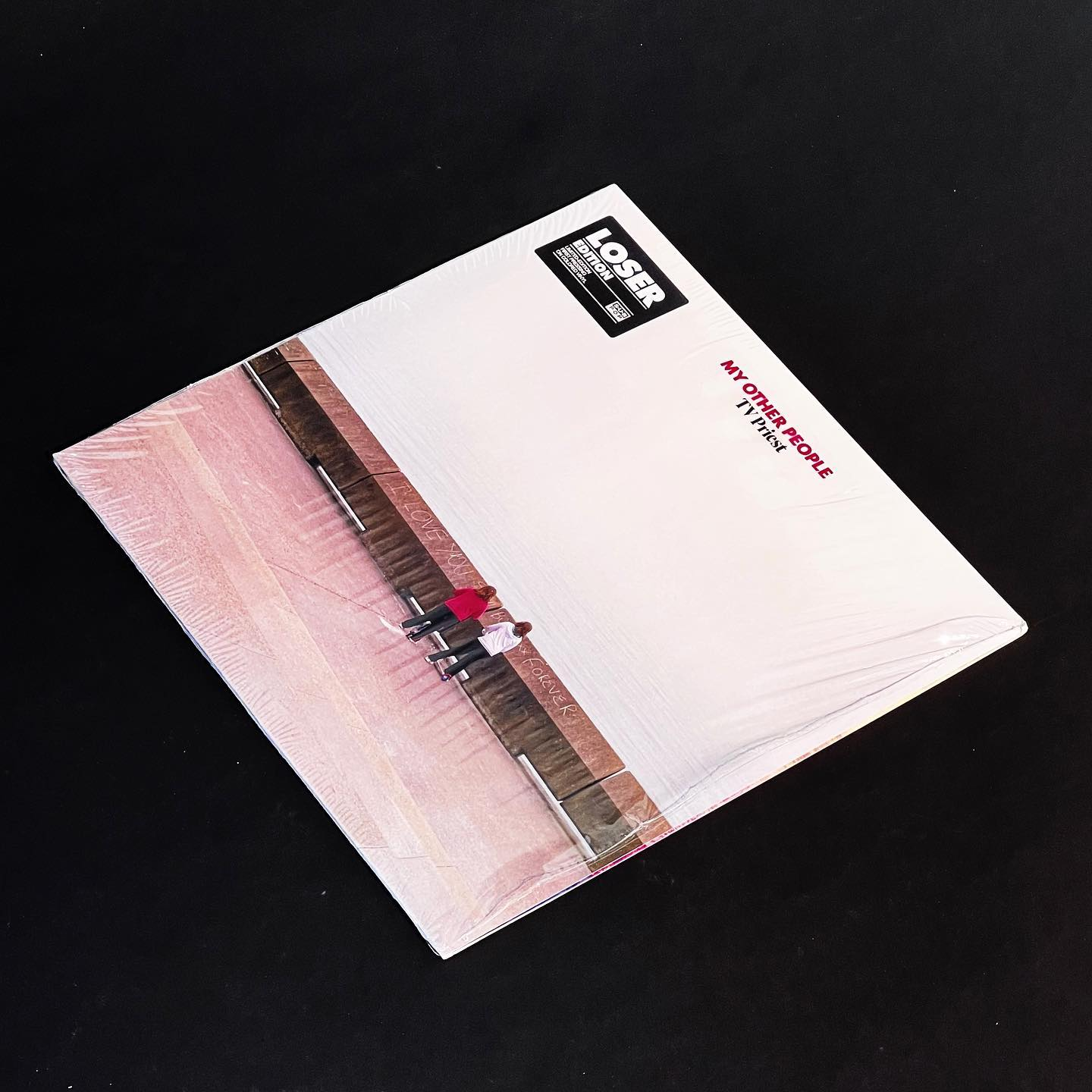
Without a brutal evaluation of their own becoming, TV Priest might have never made their second album. Heralded as the next big thing in post-punk, they were established as a bolshy, sharp-witted outfit, the kind that starts movements with their political ire. There was of course truth in that, but it was a suit that quickly felt heavy on its wearer’s shoulders, leaving little room for true vulnerability. “A lot of it did feel like I was being really careful and a bit at arm’s length,” says vocalist Charlie Drinkwater. “I think maybe I was not fully aware of the role I was taking. I had to take a step back and realize that what we were presenting was quite far away from the opinion of myself that I had. Now, I just want to be honest.”
“My Other People” maintains a strong sense of earth-rooted emotion, taking advantage of the opportunity to physically connect. Using “Saintless” (the closing song from Uppers) as something of a starting point, Drinkwater set about crafting lyrics that allowed him to articulate a deeper sense of personal truth, using music as a vessel to communicate with his bandmates about his depleting mental health. “Speaking very candidly, it was written at a time and a place where I was not, I would say, particularly well,” he says. “There was a lot of things that had happened to myself and my family that were quite troubling moments.
Despite that I do think the record has our most hopeful moments too; a lot of me trying to set myself reminders for living, just everyday sentiments to try and get myself out of the space I was in.”
“It was a bit of a moment for all of us where we realised that we can make something that, to us at least, feels truly beautiful,” agrees Bueth. “Brutality and frustration are only a part of that puzzle, and despite a lot of us feeling quite disconnected at the time, overwhelmingly beautiful things were also still happening.”
Our new single ‘It Was Beautiful’ is out everywhere now.
It’s a love song about the past, present, and future. A reminder that love is the most essential thing. The words came fast; it was recorded in a single session, the first song we wrote together after my family had gone through a difficult experience and I think you can hear that in the kind of melancholy euphoria that plays out as the song progresses. In some ways it’s a coda to the whole album; a reminder to guard your hope fiercely, and hold your loved ones close.
This tension between existential fear born from the constant uncertainties of life, and an affirmative, cathartic urge to seize the moment, is central to “My Other People“, a record that heals by providing space for recognition, a ground zero in which you’re welcome to stay awhile but which ultimately only leads up and out. For TV Priest, it is a follow-up that feels truly, properly them; free of bravado, unnecessary bluster or any audience pressure to commit solely to their original sound.
It’s been a month since we released ‘My Other People’ and we’ve found it very special to see how people have interpreted it and sat with the music . As a thanks we wanted to share some some of the things that went into the record. Nic has put together a digital scrap book of sorts that shows inspiration and lyrics ‘Notes On My Other People’ ’ https://www.myotherpeople.com/
UK musician and This is the Kit member and bassist Rozi Plain has announced a new album, “Prize”, will be released January 13th via Memphis Industries. The first single from the album, “Agreeing For Two,” features vocals from This is the Kit leader and bandmate Kate Stables (who also appears in the video), and saxophone from Alabaster DePlume. “This song was started when I spent a week on the Isle of Eigg writing new music,” Rozi says. “Mainly it’s thinking about how easy it can be to unknowingly make decisions on behalf of other people, thinking you might know what’s best or right for a situation where as maybe it’s just what was easiest for you.. I love the saxophone line that Alabaster DePlume added – brings a bit of his trademark heart and hopefulness.”
Video by Jack Barraclough Rozi says: It was so great to work with jack again for this video . I love his witty eye and resourceful attitude. I’d thought about a spinning platform and Jack had a friend who’d made one! We drove around some scorched heathland in Dartford and found a place to set up . Kate was the perfect up for it co-pilot and someone I can stare at in the face for a long time – it was a really lovely day !
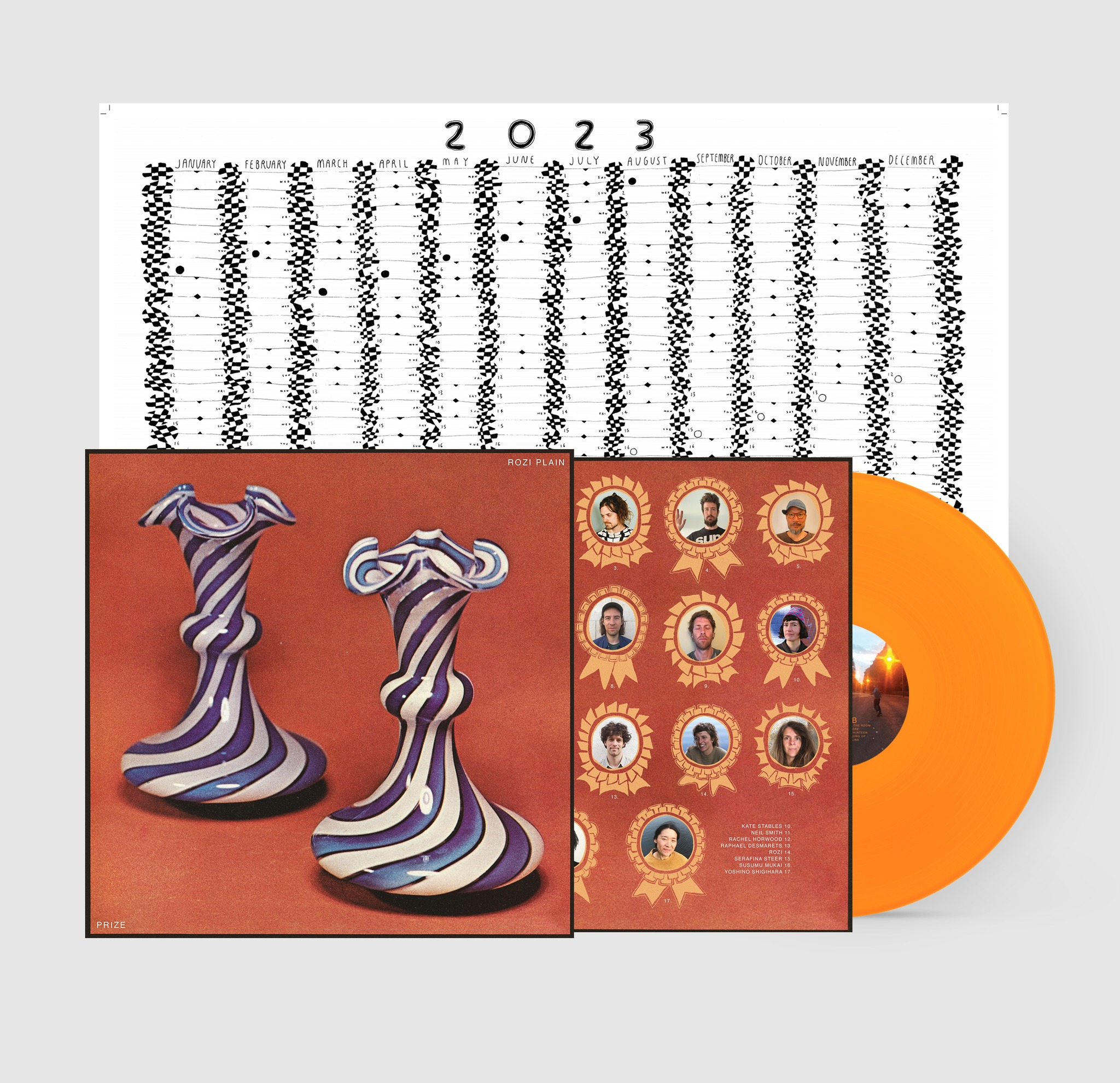
we are also teaming up with @dinkededition and releasing a limited edition version with an alternative cover sleeve, a translucent streetlamp orange vinyl and a !!PROOFREAD!!PROOFREAD!! Rozi designed 2023 wall calendar.
Newly discovered Brighton metallic punk misfits Ditz played a bulldozing gig that blew my ears off. Last March they released their flabbergasting debut LP “The Great Regression“. A contender for album of the year. Their live wall-of-trash-and-crash sound breaks every law about decibels-levels. It’s beyond aural belief, but also scary, earth-shattering, and balls-and-brain-breaking, most of the time. Don’t you love it when you can feel music really physically as if your body gets electrocuted? I do. It makes me feel much livelier than just being alive.
The demonic guitar duo of Anton Mocock and Jack Looker produce an amount of kick-ass electricity that make roofs/walls of venues tremble. Their non-stop chainsaw riff blasts are very loud. The rhythm section of Sam Evans and Caleb Remnant batters with a bad-ass herculean vehemence. Perfect for an Armageddon type battle of bands.
Ditz are big fans ofFugazi, At The Drive-In, Metz, Flipper, Black Flagand other mean noise machines.
Last but not least there’s the psychotic vox and venue-filling presence of Cal Francis. He doesn’t really sing, he rants. He doesn’t look, he stares. He despises homophobes, I want to be who I am haters. capitalist criminals, and other related scum. He’s the bugaboo in Kate Moss disguise. He’s the perfect she-devil to front this perfect devilish band.
The 10-track album has been a long time coming – the five-piece first came together in Brighton at the end of 2015 and released their debut EP the following year. There have been a few line-up changes along the way, but they have been settled since their breakthrough tracks ‘Gayboy’, ‘Total 90’ and a cover of Peaches’ ‘Fuck The Pain Away’ in 2019, which prompted Joe Talbot from Idles to proclaim “DITZ are the best band in Brighton, if not the world”. Even though the various lockdowns slowed the band’s momentum for a while, they turned the situation to their advantage, using the downtime to fine-tune this incredible debut.
Abrasive but accessible, “The Great Regression” is set to be one of the most important British guitar debuts of 2022. First single ‘Ded Würst’ – a ferocious mix of Gilla Band, Foals and a lyric bemoaning the moral quandary of minimum-wage employment – unsurprisingly became an instant favourite of Steve Lamacq on BBC Radio 6 Music. Other highlights include ‘The Warden’, a song all about being too intense, ironically set to an intense backing somewhere between Deftones and Mogwai, and ‘I Am Kate Moss’, which, according to singer CalFrancis, is about “the separation between your visual and personal identities, particularly within the context of masculinity and femininity”.
“The actual definition of the dancefloor is something that has always fascinated us. It’s a space we express ourselves ultimately. However as huge Adam Curtis fans we’ve always been fascinated with origins and definitions. The complex relationships between subjects and the stories we are told to learn about them. When we started researching the history of the dancefloor and found that Thomas Edison was one of the first to film a dancefloor and that he monetized it in the way he did. We think of where we are at now and ask what have we really learned? That is the concept behind the film for “Love and Hate in a DifferentTime.” – Gabriels
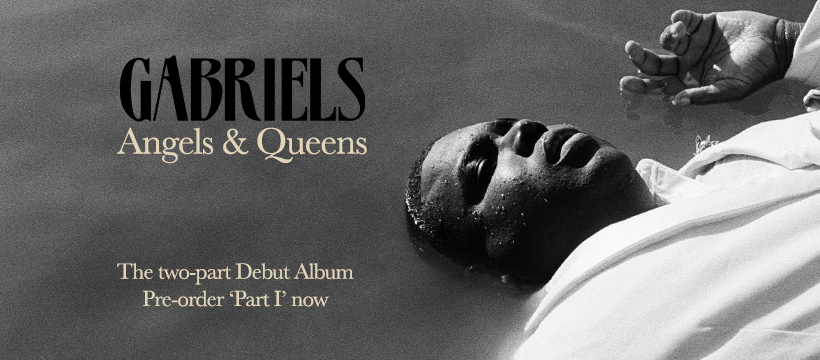
Our debut album ‘Angels & Queens’ is a unique exploration of love and loss from each of our differing perspectives. We were planning to release our album in next year, but got the opportunity to collaborate with some of the most amazing people who initially were strangers, but within weeks became family in the most mind blowing process.
As the first part of the album was recorded, we knew we wanted to share it with you as soon as possible. Couldn’t be more excited to announce that “Angels & Queens – Part I” is coming September 30th, and Part II will follow in March.
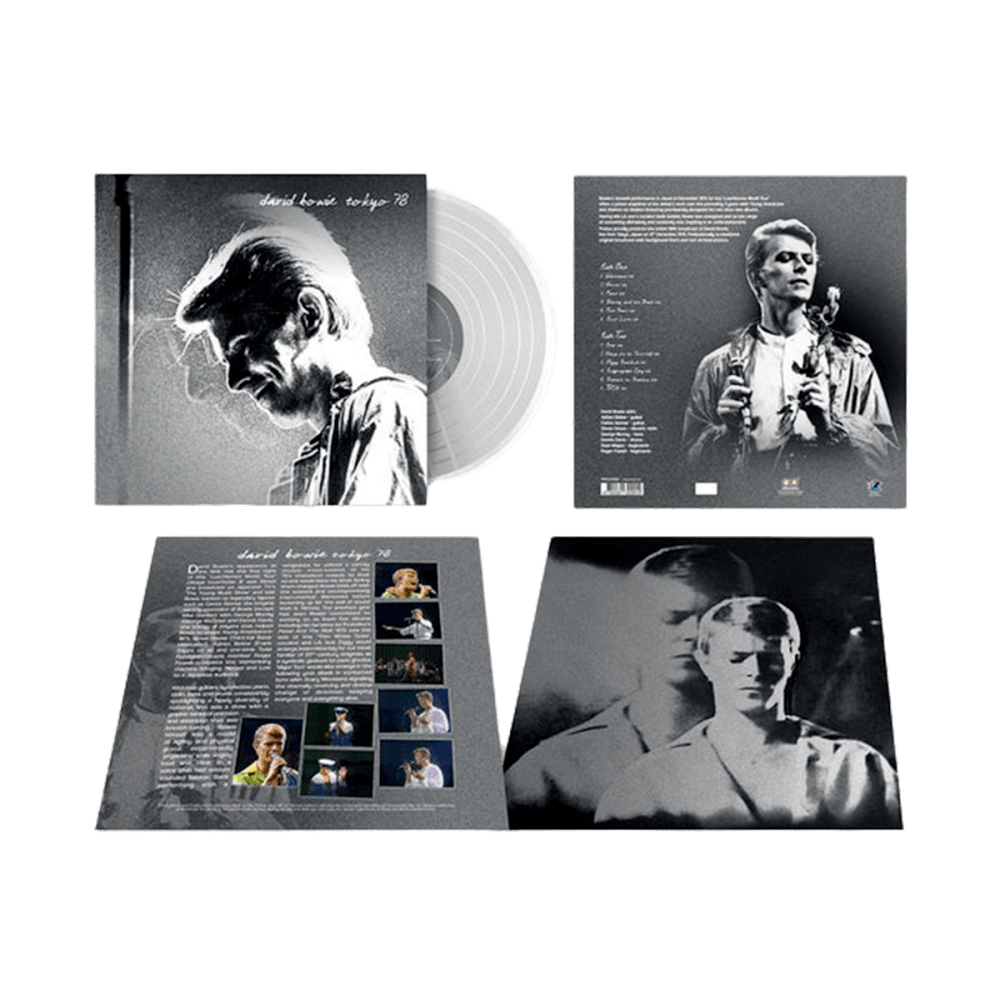
Protus proudly presents the entire NHK broadcast of David Bowie, “Live from Tokyo”, Japan on 12th December 1978. Professionally re-mastered original broadcast with background liners and rare archival photos.
Bowie’s farewell performance in Japan in December 1978 for the ‘Low/Heroes World Tour’ offers a prized snapshot of the artist’s work over the preceding 3 years with “Young Americans” and “Station To Station” featuring prominently alongside his two then new albums. Having left LA and a cocaine habit behind, Bowie was energized and on the verge of something ultimately and creatively new. Inspiring is an understatement.
Pressed on 180g White Vinyl and presented in a hand-numbered sleeve with insert.
Featuring Adrian Belew and Carlos Alomar – guitar; Simon House – electric violin; George Murray – bass; Dennis Davis – drums; Sean Mayes and Roger Powell – keyboards.
For Bandcamp Day, Pure Bathing Culture shared a dreamy new cover of R.E.M.’s “Nightswimming.” “We had such an amazing time exploring this magical song,” they say. “Recorded at home over a few days at the end of August.”
released September 2nd, 2022 Vocals- Sarah Versprille Guitars, bass, mellotron, percussion, drum machine – Daniel Hindman
Weyes Blood has announced her first album since 2019’s “Titanic Rising”. Natalie Mering’s latest is called “And in the Darkness, Hearts Aglow” and it arrives November 18th via Sub Pop Records.
Mering has shared lead single “It’s Not Just Me, It’s Everybody,” which she refers to as “a Buddhist anthem, ensconced in the interconnectivity of all beings.”
“And in the Darkness, Hearts Aglow” was written by Mering, who co-produced most of the album alongside Foxygen’s Jonathan Rado. (Mering co-produced one song, “A Given Thing,” with Rodaidh McDonald.) The new record also features guest appearances from Meg Duffy, Daniel Lopatin, and Mary Lattimore. The 10-track LP was mixed by Kenny Gilmore at 101 Studio and mastered by Emily Lazar and Chris Allgood at the Lodge. “And in the Darkness, Hearts Aglow” is the second album in a trilogy that began with “Titanic Rising”. The third installment, as teased in press materials, will be about “hope.”
Weyes Blood has also announced the “In Holy Flux Tour,” a headlining international touring run for the Spring of 2023 in support of “And In The Darkness, Hearts Aglow”. The UK and EU dates begin on Saturday, January 28th in Berlin at Festsaal Kreuzberg and ending Tuesday, February 14th in Brighton, UK at CHALK.
Since releasing “Titanic Rising”, Mering has collaborated with the Killers, recorded with Tim Heidecker, appeared on Lana Del Rey’s “Chemtrails Over the Country Club“, and more.
I’m very excited and really quite emotional to tell you that this is taken from my new album; “Cacti”
what an truly strange time to be alive. we’re navigating an ever more hostile environment. I know this record only exists because people supported and lifted me at an incredibly fragile time. we have to keep going. creating. what people make helps me to make some sense of it all. sometimes we have to shape-shift. other times we firmly root exactly where we are, as what we are.
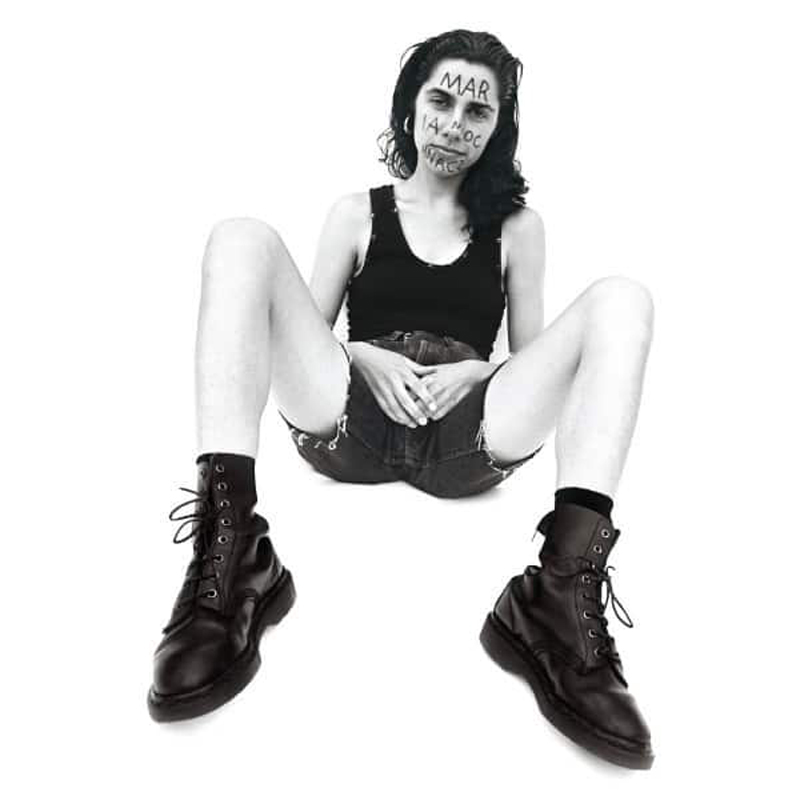
The artist known as Polly Jean Harvey confounds; it’s simply her nature. This year marks the 30thanniversary of her debut album, and therefore her entry into the public consciousness, and we’ve yet to pin her down. She sounds like nobody else, not even herself, from release to release. She’s accomplished the feat of building a carefully crafted aesthetic, sound and even vocal style for each piece of work she puts out, setting stringent barriers between one album era and the next. She picks apart relationships, gender, and her own darkness with more wit than anyone else in the business of writing and performing. She creates characters that go toe-to-toe with the devil himself, narrate an empire’s expansion from above, and seem to run on air between city rooftops. The only constant in the shape-shifting is that each character she creates shares her name. Perhaps only rivalled in duration and consistent acclaim by her contemporary (and one-time performance partner) Bjork, Harvey remains as vital an artist as ever.
Even more impressive is the general consensus that PJ Harvey has never released a truly bad album. Many would argue that every release is a necessary piece of understanding the ever-shifting audiovisual web she weaves.
For the past few years, Harvey has been revisiting the worlds she created with each of her albums for a series of reissues, with each project accompanied by a sibling album of demos. These full-length demo records follow the format first set by “4-Track Demos”, released shortly after 1993’s “Rid of Me”, featuring rough versions of the songs from the studio album to which it was attached.
This marked the first full-length work Harvey had released as a true solo artist “Dry” and “Rid of Me” were technically released under the banner of her band, also called PJ Harvey, whose members decided they should go their separate ways following the tour for the latter album. The message “4-Track Demos” sent was clear: The band was great, but the spark of these songs lay completely in their writer’s head, and they were just as brilliant when she was the only person who had touched them. Each new demo project we’ve finally gotten to hear only solidifies this idea.
Anticipating the final installment of the reissue/demo series with 2016’s “The Hope Demolition Six Project” (and also in light of these recent pictures of Harvey in the studio, hopefully working on a new album),So here are her nine studio albums and two collaborative albums with John Parish, we think you should have all.
The Hope Demolition Six Project (2016)
Named after the HOPE VI program, a U.S. government HUD initiative that was initially created to revitalize public housing complexes (allegedly often just making space for further gentrification instead), “The Hope Demolition Six Project” broke new ground for PJ Harvey, even 24 years into her career. With many of the songs inspired by a trip to Washington, D.C., she picks up where she left off on “Let EnglandShake” five years earlier in terms of observational, slightly removed social and political commentary.
It’s also notable that the whole thing was recorded in front of a crowd in 45-minute periods of time as part of an art installation at Somerset House in London, inviting outsiders into Harvey’s creative process more than ever before. The sense of community behind the record comes through even if you knew nothing about Harvey or the sessions beforehand, and though it may be ranked last here, the album still has some of the most beautiful moments she’s ever committed to record.
The deep, choir-like backing vocals on “River Anacostia” and loping stomp of “The Ministry of Social Affairs” (which features Harvey on saxophone) tower over the torn-up Capitol beneath it, growing to such an overwhelming fever pitch that you’re just waiting for the songs to collapse. “The Community of Hope” also stands as a clear highlight, with the half-joyous, half-sardonic finishing cry of “They’re gonna put a Walmart here!” serving as proof that Harvey hasn’t lost her keen songwriter’s ear or her sense of humour.
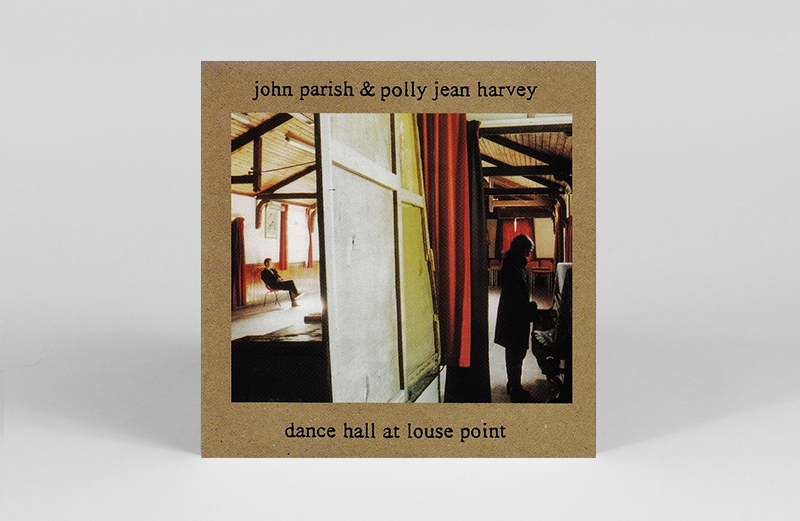
Dance Hall at Louse Point with John Parish (1996)
Harvey has been working with musician John Parish since she was a teenager, previously collaborating with his band Automatic Dlamini and later inviting him to produce and/or play on five of her solo albums. With music by Parish and lyrics by Harvey, “Dance Hall at Louse Point” marked the first collaboration under both of their names, and they entered this new phase of their careers in the boldest way possible.
The album is a disarming, atmospheric walk through a long-standing musical partnership where both feel safe enough to try whatever they want. The results were raw and occasionally frightening; Polly had sung about showdowns with the devil before, but the sinister side of her writing had never quite been put on display like it was here. From the absolute horror of “Taut,” with its eerily whispered “Jesus save me” refrain scattered throughout, to the wobbly, organ-tinged lament of “That Was My Veil,” both musicians are given the room to stretch in the direction of their sparser, more experimental tendencies. The tonally perfect cover of “Is That All There Is?” ties the whole thing up in a bloodstained bow, serving as the center-piece of a project that keeps giving if you’re willing to put the time into it.
From the first of two collaborative records with co-conspirator John Parish came this twanging bluesy piece. The emotive, scratchy guitar of Parish mixes perfectly with PJ’s vox in a performance that captures the air and space of the room in which it was recorded.
White Chalk (2007)
So few artists have discovered so many different ways to unsettle their listeners. After Harvey decided to learn piano and write new music on it after having relied on guitar for so long, ghosts filled the hollows in the barebones soundscapes she created, and “White Chalk” was born. “Disappears in the ether / One world to the next,” she sings on “When Under Ether,” describing the sound of her own voice twisting in and out of these sparse songs that build up around her as they go on, seemingly inventing themselves out of nothing. Details like the repeated, “Oh God, I miss you,” cracking like a revelation carried on the wind on “The Piano,” or the rushing harp runs on “Grow Grow Grow,” reveal a deep-seated urgency that becomes more obvious with each re-listen.
“White Chalk” might stand as one of the most sonically uniform PJ Harvey releases, but still manages to surprise, delight and turn itself inside out with no warning. Clocking in at a relatively brief 33 minutes, it leaves none of its short runtime wasted.
The Peel Sessions 1991-2004
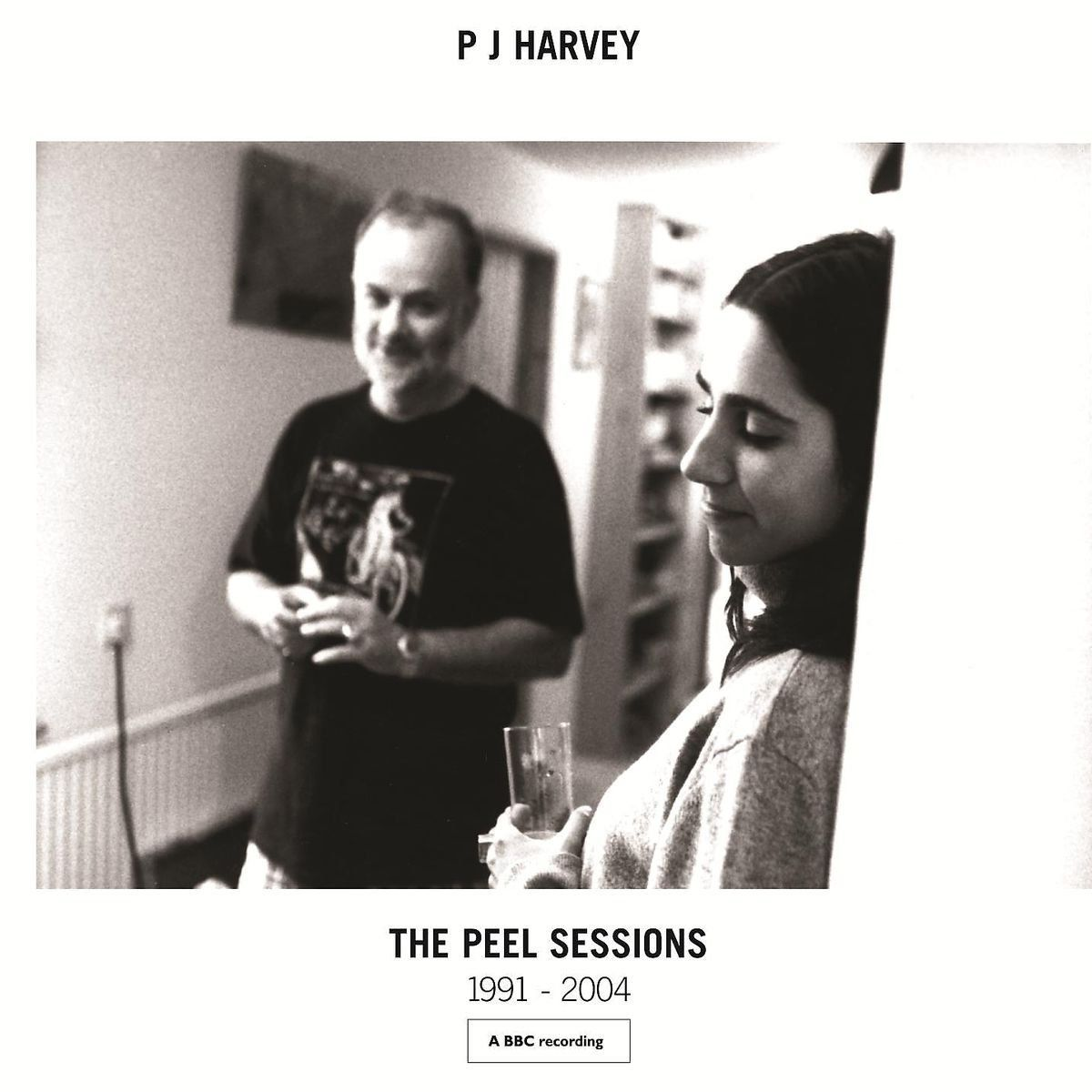
PJ Harvey “The Peel Sessions 1991-2004” album on vinyl, this May via UMC/Island Records. The compilation features choice selections of her sessions with BBC Radio 1 DJ and presenter John Peel from across 1991 to 2004.
The album was originally released in 2006 following Peel’s death in 2004, and is accompanied by a tribute from Harvey, an extract of which reads as follows: “Every Peel Session I did, I did for him. It is with much love that I chose these songs, in his memory. A way of saying ‘Thank You,’ once more. Thank You, John.”
Uh Huh Her (2004)
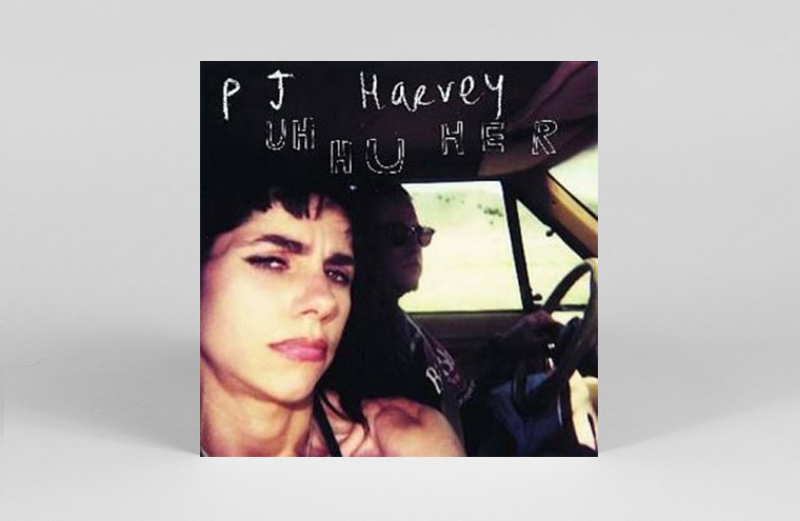
Following the major mainstream attention “Stories From the City, Stories From the Sea” brought Harvey, she almost reflexively stepped back into the slightly weird, sonically risky shadows, a niche in which she’s always been much more comfortable. Marking the first time she had produced a project on her own, she aimed to go back to basics, prioritizing eclecticism over everything else, and this album is what came out. “Uh Huh Her” is a living being, bouncing between styles on a dime as if its aim is to slap you awake, to make sure you’re paying attention.
As she had done before, PJ responded to the success of “Stories From the City, Stories From the Sea” (one of her most popular albums) with a return to a more lo-fi, less commercial sound on “Uh HuhHer”. ‘Pocket Knife’ is a highlight on a record full of them, with its tumbling percussion, and folk-blues acoustic feel. PJ’s genius for a lyrical couplet is again played out, as the song’s protagonist rebukes a suitor: “Can you see my pocket knife? You can’t make me be a wife.”
Moments of beauty on more conventional tracks like “You Come Through” and “It’s You” stand as steady anchors that tether sketches like “Who The Fuck?” and “No Child Of Mine” to the ground. Even if not every musical mask Harvey puts on is to your liking, it’s still fun to watch the balancing act of her constantly switching between them. The fact that she pulls any of it off is impressive in itself.
A Woman A Man Walked By with John Parish (2009)
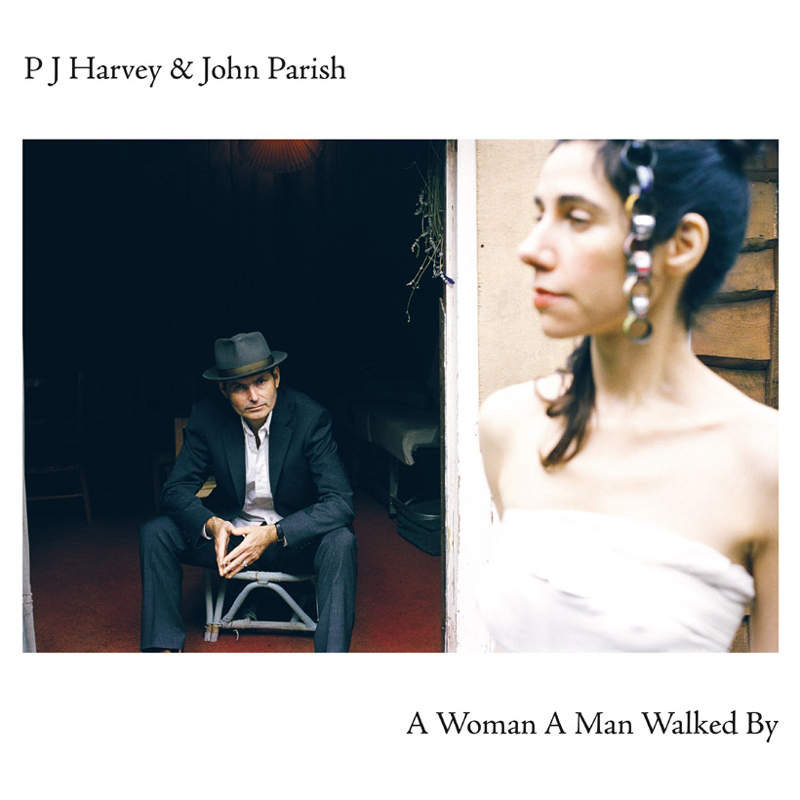
In order to follow up their already fairly inaccessible first collaboration, Harvey and Parish pulled even further away from what one might have been expected from either of them next. Where “Dance Hall” is sparse and burns slowly, easing you into its world of discomfort, “A Woman A Man WalkedBy” is equally impossible to sit and easily digest, but is dense, brutal and really gets up in your face about it. Within the span of individual songs, the sound swings wildly between creaking ballads that feel like they might fall apart at any second and soaring, propulsive rock that eventually peters out after its big crescendos. Polly’s theatrical vocal range is perhaps put on display more prominently here than anywhere else in her discography, seemingly switching between who she’s playing in a given scene, moving between menacing growl and full-throated cry with a flip of the switch.
Also, no other project of hers puts such stock in instrumental invention, adding even further depth to the complex song writing, which demands it. Tracks like “Passionless, Pointless” and “Black Hearted Love” remain major benchmarks in Polly’s ever-evolving catalogue of straight-up excellent songs. It’s also notable in that it’s the only album featuring her barking like a dog ( … so far).
Dry (1992)
It’s rare to come across a debut album that sounds so fully fleshed out, but Harvey had been preparing for the chance to record her own material for years, and wasn’t about to waste it. At this point, “PJ Harvey” was still a band, consisting of its namesake, bassist Steve Vaughn and drummer Rob Ellis. Believing they would never get another opportunity to make a record, they made what, even now, sounds like a core thesis statement that Harvey would only embellish with each subsequent release.
Harvey’s debut record after playing in the band Automatic Dlamini, released through excellent indie label Too Pure, is a thrashy riposte to women-fearing men, using the sheela na gig, or pagan fertility goddess, as a symbol of power. Wrapped in heavy guitars and drums, with a bellicose blues riff at its centre, this strong start remains one of Harvey’s very best songs.
Though that means the production remains fairly simple, with most of the instruments played by the core trio, it’s impressive what they accomplished with their limited resources. The theme of gender roles that Harvey would revisit again comes up early, evident in the sing-along playfulness of singles “Dress” and “Sheela-Na-Gig” (“Heard it before, no more!”). Elsewhere, the immense atmosphere of the incredible “Plants and Rags” and “Water” showed Polly had the song writing and arranging chops of someone who had been doing it professionally for decades. Sure, lots of people had picked up a guitar and made compelling music before, but never quite like this.
Though it’s an easy statement to make when we have hindsight and a whole discography to back it up, let’s make it: Even if this had been the only thing PJ Harvey released, as they’d believed it would be, we’d still regard it as essential.
Let England Shake (2011)
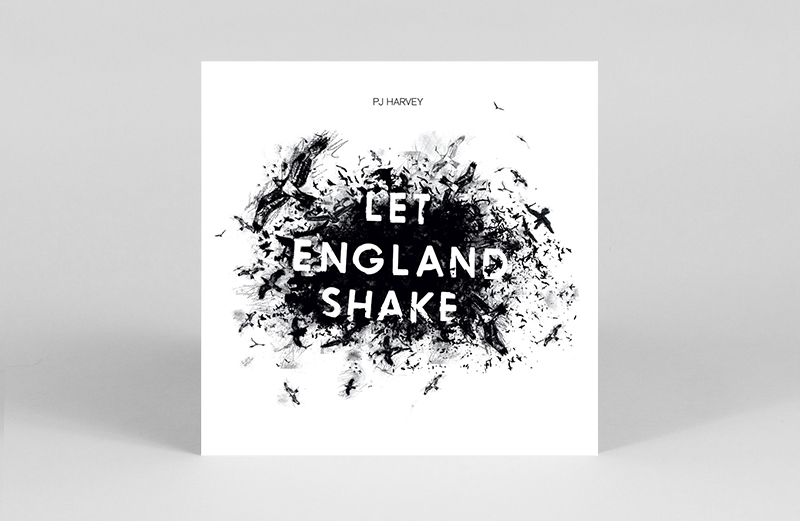
Harvey’s second Mercury Prize winner “Let England Shake” marked another major pivot in a new creative direction, one that required not only historical research, but also the search for an appropriate vocal delivery, quite literally: She spent time crafting a warble higher than any she had attempted before to serve the new material, which saw her acting as omniscient narrator of England’s history of conquest and war. Specifically pulling from the history of the U.K.’s involvement in World War I, as well as the more recent casualties that came as a result of the then-ongoing British army presence in Afghanistan, the record reads as a love letter that can’t help but scorn its deeply problematic subject, even as it holds the nation close.
Of course, she’s since returned with “The Hope Six Demolition Project”, but “Let England Shake“, a record that explores the evils of war, could be Harvey’s most profound statement to date. From it, ‘The Glorious Land’, tackles the legacy of Britain waging war overseas. Wrapped in a distorted, haunting jangle of guitars, and PJ’s FX laden voice, it’s a shiver-inducing masterpiece.
There’s a grandiose elegance to every track, feeling as large and seminal a project as the ever-sprawling story it tells. Though not the most sonically adventurous version of PJ Harvey that we’ve seen thus far, it doesn’t really need to be. It’s difficult to argue that any extra flourishes would have improved the results, which teem with poetic lyrics and effective arrangements. Taking the idea that the artist stays vital by reinventing themselves to a whole new level, “Let England Shake” marked the first time Harvey, known for writing about the darker fringes of human nature, held her lens up to history at large, inventing her own type of epic wartime ballad in the process.
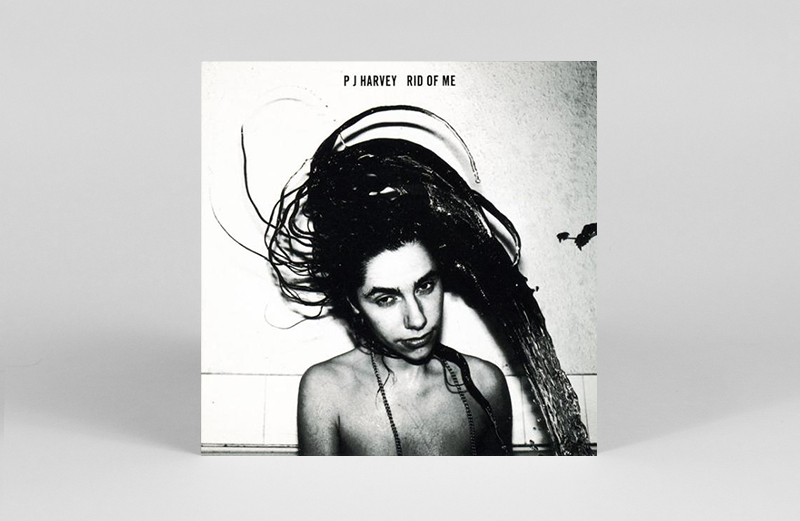
Rid of Me (1993)
For any artist with a devoted fanbase, it’s common that people who get into them have a first album they listened to that changed their life, and therefore, will always represent what that artist means to them, holding a special place in their heart. “Rid Of Me” is that PJ Harvey album for me. The combination of Steve Albini’s divisive (but certainly distinctive) production and Harvey’s daring lyricism sends shivers up the spine every time. Songs like “Man-Size,” “Me-Jane” and “50ft Queenie” twisted all expectation in how someone could write about masculinity and misogyny, not only with a sense of humour, but also with a sense of real danger, like this one person might single-handedly topple everything about the gender roles we force ourselves to fit into.
The closer from her breakthrough album “Rid of Me” is a hell of a way to end a record. Accompanied by Rob Ellis on drums and Steven Vaughan on bass (her core band at this point), PJ delivers a slow, deadly slide guitar riff that could tear the sky in two, while producer Steve Albini captures the trio’s intensity perfectly. Menacing, indigo blue, full of longing, PJ channels Leadbelly via David Lynch.
The way this voice seethed through her teeth on “Man-Size Sextet,” truly howled on “Snake” and sounded like it could collapse into a fit of rage at any second on “Legs” (“And I might as well be dead / But I could kill you instead”) felt powerful, like it held something so heavy, you couldn’t even fathom the substance it contained.
You simply weren’t meant to question her conviction—you just believed her. Yes, she’s king of the world, no follow-up questions. It was this idea of indestructible strength I had never thought someone like me could wield before, building upon what something like Horses had already instilled in me. Never shying away from its own intensity, the album builds a monument to the self that’s both vengeful and freeing. Also, in a career of everlasting songs, the title track might be (or at least should be considered) the definitive PJ Harvey track.
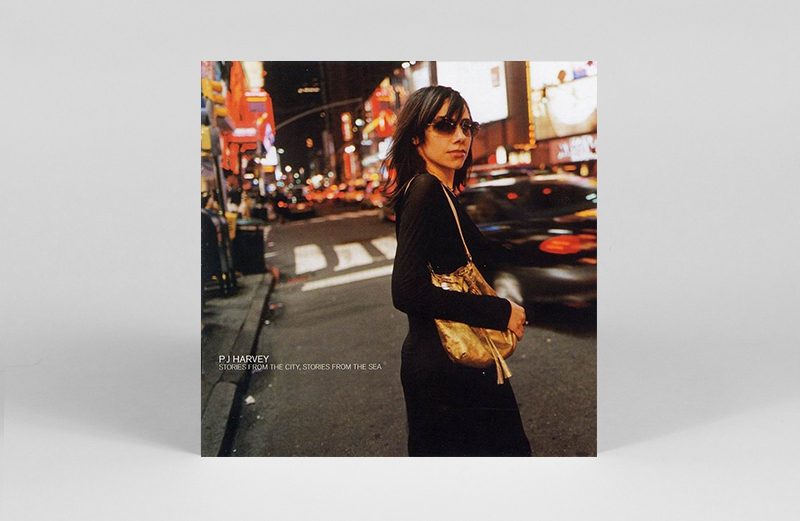
Stories From the City, Stories From the Sea (2000)
“How could that happen again? / Where the fuck was I looking / When all those horses come in?” The line opens “Kamikaze,” but it could easily be repurposed to express how it feels every time Harvey transforms into yet another version of herself, as she does on this Mercury Prize winner. Inspired by a trip to New York in 1998 to film with Hal Hartley, which she ended up extending for nine months after falling in love with the city, she began writing for the project she would refer to as “pop according to PJ Harvey.” Perhaps the most singularly triumphant work in Harvey’s catalogue, “Stories” does defiance in a way she hadn’t yet explored, and feels confident in a way that floats above the rest of the world, rather than fighting back. What else in her discography captures the head-on swagger of something like “Big Exit” or “This is Love”? What else sounds like the gentle glide of Thom Yorke’s voice underpinning Polly’s in “Beautiful Feeling” or the heavy, warm piano march that carries “Horses In My Dreams”? Even the gentle collapse and defeat of “We Float” feels like light flooding your senses in the best possible way.
Although “Stories From the City, Stories From the Sea” marked a return to indie rock and a glossier sound after various musical experiments, the standout on this excellent record comes at the end in the form of the breakbeat-laden ‘We Float’. In its moody piano and lyrics about “heading to black out”, it strikes a disquieting note, before it rises into a beautiful redemptive chorus. It’s hugely uplifting, all the more so for its unexpectedness.
Though it’s unlikely that Polly will ever make anything this purposefully polished again, it’s a little blip of calm in the eye of the larger storm, a moment of shimmering assurance among a back catalogue that largely aims to make the listener uncomfortable. Few albums by anyone have captured that precise feeling, making Stories something truly special.
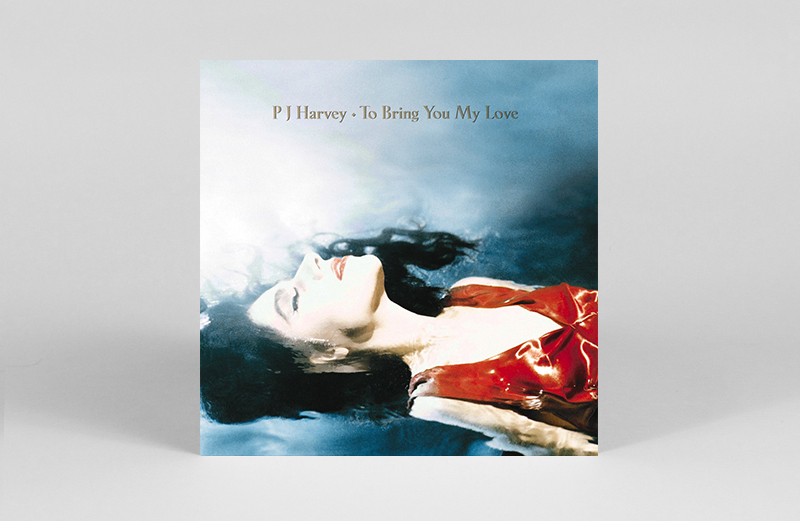
To Bring You My Love (1995)
You could easily argue that PJ Harvey’s third album – and first truly solo record – “To Bring You My Love”, is her finest work, and it’s tough to single out a particular song from this 1995 set. Yet the exquisite minimalism of ‘Working For the Man’ could be its best bit. PJ’s voice barely louder than a whisper, she weaves a creepy spell over skeletal drums and buzzing dub bass, with eerie western guitar and organ the icing on the cake.
Harvey’s collaborated with Nick Cave, Björk, Josh Homme, Marianne Faithfull, Moonshake, Tricky, and her back catalogue is enormous. It’s hard to know where to start (although “To Bring You My Love” should be your first port of call). Several collaborative projects, will help kickstart your own PJ Harvey addiction.
Aiming to write her own versions of the blues standards and Captain Beefheart songs she had loved for years, Harvey re-emerged in the public eye with the devil and God on her mind, and what she called her “Joan Crawford on Acid” look smeared on her face. Despite her assertion that the new theatrical stage look was a cover for how lost she felt in her personal life, it still stands as a lot of the public’s mental image of what PJ Harvey looks like, playing a dragged-out version of herself that communicated these stories of a lost love and literally diving into the pits of hell to retrieve it.
Mirroring the old blues tales of meeting the devil at the crossroads or sacrificing a physical representation of the soul (like, for instance, an imaginary daughter) to him, “To Bring You My Love” balances terror and tenderness effortlessly. Songs like “Meet Ze Monsta,” “Long Snake Moan” and “I Think I’m A Mother” bare their teeth until they split; Harvey growls, “I’m not running / I’m not scared,” and yells, with a smile you can practically hear, “In my dreaming / You’ll be drowning!” and you can’t help but cower like she’s in the room with you.
On the flip side, the ballads reveal a bleeding heart beneath the spiky exterior without ever feeling saccharine or overdone (“Teclo” still stands as one of the loveliest songs we’ve heard from her). Regardless of each song’s specific plan of attack, not a single shriek or whisper sounds anything less than fearless. She hisses, “Come back here, man,” painted grin stretched wide, and you can imagine whatever deity exists down below shaking in their boots.
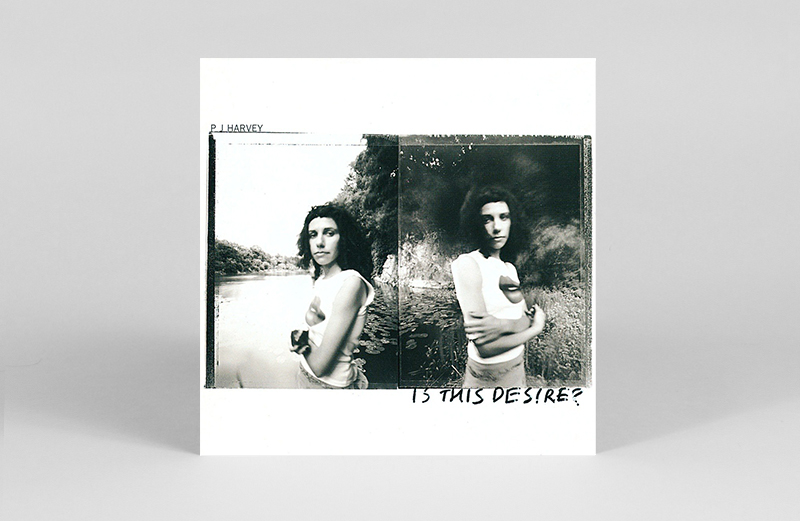
Is This Desire? (1998)
The follow-up to “To Bring You My Love” was the low-key “Is This Desire?”, a more opaque collection that reveals its treasures slowly. The persistent though are rewarded with tracks such as the haunting ‘The Wind’, which builds from dark, strumming guitars into a crisp hip-hop beat laden with weird FX and PJ’s moving, half-spoken, half-sung paean to St Catherine.
Harvey herself has said she considers this the greatest thing she has ever done, despite the fact that its writing and recording period took place while she was at her lowest point emotionally and mentally (according to an interview from the era, it was during a playback of “My Beautiful Leah” that she decided she needed professional help), most likely compounded by the fact that she was going through a fairly public breakup with another well-known musician. As you can expect from that information alone, “Is This Desire?” is hardly an easy listen, arriving like a visceral, uncut diamond stuck chronologically between two of her more commercially viable releases. However, it’s simply the most impressive and daring collection of songs she’s ever put out.
There’s not a single wasted moment on it. It marks one of the few times where Harvey sounds like she’s not taking total control of her situation, instead sitting back and letting the moving, often cruel world wash over her. That newfound openness is hardly a negative; the album also sees her musical backing shifting from straight-up, guitar-driven rock to layered, diverse soundscapes that incorporate elements of trip-hop and electronic music.
Not all of it is immediate, but it certainly demands your attention, pulling beauty from the jagged parts of ourselves that we usually attempt to ignore. This openness also means Harvey writes in the third person about other characters more than she had before, often from the perspective of vulnerable women: Angelene, Catherine, Leah, Joy and Elise each get their own song. They could all be facets of Polly as she sees herself, or even facets of us, the faceless mass to whom she bares her soul for a living.
The album is an open wound willing to receive, not offering any direct solution, but wearing its pain as a sign of life in hopes that we’ll bare our souls back. For this brief moment, Polly Jean Harvey couldn’t get a grip on what was haunting her, so she started haunting us, and what came out of it was sheer magic.
PJ’ Harvey’s lyrical frankness – in her discussions of longing, loss, sexual and global politics – is key to her appeal. What is most worthy of recognition though is her ability to shape-shift. With each record Harvey’s done something new, dabbling in everything from minimalist post-rock to trip-hop, acerbic punk to piano ballads, heavy metal to weird pop, and making these styles her own.