“You Have Fallen… Congratulations! is the fifth full-length album by Porto noise-punk explorers Sunflowers. A jagged, blown-out descent into psychological freefall, the album finds the band refining their chaotic signature while letting go of structure altogether. It’s a record that refuses to look away from the madness of modern existence — choosing instead to laugh, scream, and contort itself into something stranger, louder, and far more unstable. Across eight tracks, the album pinballs between noise-rock, punk, warped psych and a sort of mangled pop sensibility. It’s loud and sharp-edged, but with moments of eerie restraint — like falling through a trapdoor into calm, then being hurled back into chaos. Feedback wails like sirens, drums slam with tribal force, and the bass throbs like a pulse trying to keep steady. It’s a sound that’s constantly falling apart and reassembling in real time. The title isn’t just tongue-in-cheek — it’s an existential shrug with teeth.
A sarcastic trophy for surviving the disintegration. It’s the voice in your head that says, “Congrats, you made it… now what?” And while the album drips with anxiety and tension, it never gives in to despair. There’s a sardonic, almost playful undercurrent running through the whole thing — like dancing in the wreckage just to prove you’re still alive.
A jagged, blown-out descent into psychological free-fall, ‘You Have Fallen… Congratulations!’ finds Sunflowers refining their chaotic signature while letting go of structure altogether: “Chameleon Kid” sets the tone with a high-voltage rejection of social camouflage: a breakneck garage punk anthem for the misfits, channelling the chaos of identity in a world that demands conformity. It’s raw, noisy, and unapologetically wired, just like a Molotov cocktail hurled at social norms.”
Porto noise-punk explorers Sunflowers new ‘You Have Fallen… Congratulations!’ LP The band’s fifth full-length arrives November 7th 2025 and the wild first single ‘Chameleon Kid’ is out everywhere now!
This is our eighth record “Pogo Rodeo” is ramping up to be the album of the decade. The bucking bronco is being chalked by analysts as a major turning point for the human species, a marvel so bold even Galileo’s chisel couldn’t leave a dent on such a pristine work of art. If you’re into ground breaking discoveries then this is the album for you! 100% human grafted, 100% Australian made (give or take some accents), 100% yours to own! The tunes are top notch, the artworks bouncing and the live shows are getting better and better. Can’t wait for you to wrap your ears up with it. Join the Crumpets today and invest in some soul.”
‘The Real Contra Band’ from the new album ‘Pogo Rodeo’ out 29th October 2025. Available on exclusive limited vinyl ONLY through our webstores. our new album ‘Pogo Rodeo’ – 29TH OCTOBER – mark your diaries, snag a copy
Psychedelic Porn Crumpets is a psych-rock band formed in 2014 in Perth, Australia. The band consists of singer-guitarist Jack McEwan, guitarist Luke Parish, drummer Danny Caddy, bassist Luke Reynolds (until 2020), and keyboardist Chris Young. Their music is a drug-induced grunge rock trip: biting synthesizer parts, expertly composed guitar riffs, and unique compositional elements elevate their music to the status of other popular psychedelia artists such as Tame Impala and All Them Witches. Their latest release, is as vast and trippy as their others, and is a musical journey you’ll want to take again and again.
“Thick Rich And Delicious” overflows with hooks. It plays through front-to-back like a power pop classic, but don’t misconstrue pop for soft. The basic tracks were cut live and hot to tape and are presented with minimal overdubs. The band recorded in a Brooklyn studio at extreme volumes, conjuring the spontaneity and electric energy of their legendary live show. Complementing Robert Pollard’s lead vocals, harmonies are sung by Grammy-nominated Bobby Bare Jr. and Pollard (aka The Self-Righteous Bros). The sound delivers on the album’s titular promise — thick, rich and delicious. You can get that satisfaction.”
Doug Gillard: “It’s two-and a-half minutes of power-pop tinged goodness written by Robert Pollard and one of my personal faves on the album – hooky as all get-out, with great lines like ‘Lucy’s world conceals your fate / crystal clearance is not too late.’”
“I’ve known only one Lucy in my life,” when asked if many Lucys have been part of his life and if his songs were inspired by real people. “She was my great aunt and she actually went by Lucille. Real people do sometimes inspire my lyrics but mostly the characters in my songs are fictional. I just use names that have a nice ring. Most of them come to me rather spontaneously or maybe they were written down in a notebook or something. Sometimes they’re the actual names of friends or acquaintances. Sometimes I steal them from characters in books or movies. They come to me in a variety of ways.”
Guided by Voices release new album “Thick, Rich and Delicious” on October 31st
“Everybody Scream” is Florence + The Machine’s first full-length project since 2022’s“Dance Fever”. The record was written and produced over the past two years by Florence Welch, who continues to serve as the creative force behind the band. Welch collaborated with a number of prominent artists,
including Mark Bowen of Idles, Aaron Dessner of The National, and Mitski. Additional contributions come from producer James Ford, known for his work with Arctic Monkeys and Depeche Mode; multi-instrumentalist James McAlister, a frequent Sufjan Stevens collaborator; and woodwind player Stuart Bogie, whose credits include work with Arcade Fire and TV On The Radio.
With “Everybody Scream”, Welch signals an expansion of her creative circle while maintaining the hallmarks of the band’s sound: Theatrical intensity, literary lyricism, and arrangements that build toward cathartic release.”
The official music video for “One of the Greats” by Florence + The Machine, from the new album “Everybody Scream“, out this Halloween.
The sludgy noise rock band Chat Pile and the Fahey-esque guitarist Hayden Pedigo come together for a collaborative album that’s truly greater than the sum of its parts.
Across their two albums and a handful of EPs/other miscellaneous releases, Chat Pile have deservedly become one of the most loved sludgy, noise rock, Melvins/Jesus Lizard-style bands in recent memory. Hayden Pedigo, meanwhile, is a John Fahey-style, “American Primitivism” guitarist who started stirring up buzz in his late teens and early twenties, and who just this year (now at 31 years old) released his most acclaimed album yet with “I’ll Be Waving as You Drive Away”. Hayden grew up in West Texas but now lives in Oklahoma City, which Chat Pile also call home, and the two acts have put their heads together for a fully collaborative album, “In the Earth Again“.
“In The Earth Again” unravels new, yet-to-be-explored layers of complexity for Chat Pile and Hayden Pedigo’s artistic visions. Despite their works occupying what seems like completely opposite ends of the genre and tonal spectrum, Pedigo and Chat Pile’s Captain Ron, Luther Manhole, Raygun Busch and Stin radiate a genuine synergy with one another that extends far beyond their music. Rather than alternating between moments that focused on the quartet’s sludgy noise-rock and Hayden’sJohn Fahey-esque guitar soundscapes, the album sees both Chat Pile and Pedigo explore latent yet previously untapped aspects of their sounds. For Chat Pile, this meant an opportunity to explore moodier arrangements, indulge in sample and tape manipulation, and pen among the most sincere and personal lyrics in their entire discography.
In Hayden’s case, this collaboration enabled the visionary guitarist to translate the masterful craft of his typically tranquil, deep country soundscapes into something more sinister, tinged with a visceral, metallic grit that is no less evocative on a sensory level than their solo material.”
Their first studio album since 2017, this eleven-track collection marks a significant return for the band.
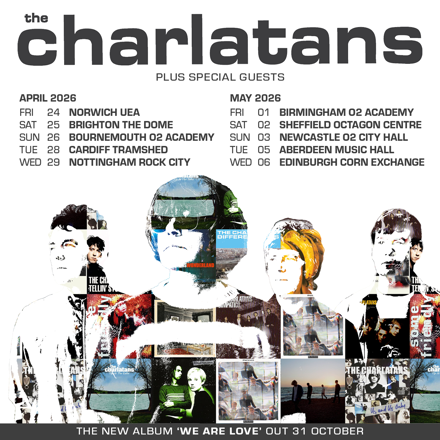
‘We Are Love’ sees The Charlatans pushing their sonic boundaries, featuring exciting collaborations with the acclaimed Dev Hynes and renowned producer, Steven Street, promising a fresh yet unmistakably Charlatans sound.
The Charlatans are back with their highly anticipated new album, ‘We Are Love’. Their first studio album since 2017, this eleven-track collection marks a significant return for the band. ‘We Are Love’ sees TheCharlatans pushing their sonic boundaries, featuring exciting collaborations with the acclaimed Dev Hynes and renowned producer Steven Street, promising a fresh yet unmistakably Charlatans sound.
The Charlatans are back with their highly anticipated new album, ‘We Are Love’. Their first studio album since 2017, this eleven-track collection marks a significant return for the band. ‘We Are Love’ sees The Charlatans pushing their sonic boundaries, featuring exciting collaborations with the acclaimed Dev Hynes and renowned producer Steven Street, promising a fresh yet unmistakably Charlatans sound.
The Charlatans have shared the second single from their upcoming album We Are Love. This one is probably the most Charlatans-esque song on the album with its prominent Hammond organ. “It kicks in with a sense of immediacy,” says Tim Burgess. “It’s Altered States meets Pincher Martin. The Hammond organ leads the way and hands you over to the irresistible and relentless bassline – a sense of giving in to what surrounds you. Sometimes it’s where you should be going. But you only get the answer once you can’t turn back.”
The new album ‘We Are Love’ is out 31st October 2025.
Released in September 1974, the album is regarded as one of the band’s finest and featured a new line-up of the band, which saw the departure of Robert Calvert and Dik Mik, but the arrival of keyboard player and violinist, Simon House. After the success of their Space Ritual tour, Hawkwind were keen to explore new possibilities for their music. The result was the eclectic and much-loved “Hall Of The Mountain Grill”, now released as a nine-disc box set including three live shows from 1974.
Featuring such classic tracks as ‘The Psychedelic Warlords’, ‘Wind of Change’, ‘D-Rider’, ‘You’d Better Believe It’, ‘Lost Johnny’ and ‘Paradox’, the album was formed of studio recordings and over-dubbed live recordings made at concerts at Edmonton Sundown in London in January 1974. ‘Hall of the Mountain Grill’ was another UK Top Twenty hit for the band. At the start of 1974 Hawkwind were very much a band on the up. They’d just completed their first North American tour, with thousands of fans attending every show, and on returning home had immediately embarked on The Ridiculous Roadshow, playing to sold-out concert halls around the UK.
Dave Brock said it was so named “because all our tours are just so silly and disorganised” – but they’d become a serious force to be reckoned with in the British rock world since the success of “Silver Machine” in 1972.
The US shows marked the retirement of the Space Ritual set they’d been playing for over a year, and they wanted to move away from the science fiction image they’d acquired, particularly as space age poet Robert Calvert had temporarily left the band. drummer Simon King said, “Some might talk of the space image as a serious trip, but we’re really a fun band. We enjoy playing more than anything else.”
The first sign of this looser, lighter approach to their material had come out the previous August.“Urban Guerilla” had Calvert raving about making bombs in his cellar. It had ended up being withdrawn after a series of IRA attacks, but musically it was upbeat and catchy, even a little rootsy. The single’s B-side, Brainbox Pollution, really rang the changes, with a central riff that was pure old-school rock’n’roll. Used as The Ridiculous Roadshow’s opener, it set the tone for the rest of the set, with other new songs including “You’d Better Believe It” and “It’s So Easy”.
Brock, in particular, was still interested in the possibilities of electronic music and the potential of adding new colours to their sound. Synth player Del Dettmar had already was moving to Canada once his paperwork came through; and after future soundtrack composer Michael Nyman was briefly considered as his replacement, ex-High Tide and Third Ear Band violinist/keyboardist Simon House was recruited – a decision that would have a profound impact on Hawkwind’s next album.
King had already anticipated how it would turn out: “I’d like to see an album with two distinct parts. The first would be a recording of our new live material. The other side would be very much a studio job, something not really suited for stage. We’d be able to utilise synthesisers, tapes and electronic devices to the full.”
The recording of their next album began in May 1974 at Olympic Studios in Barnes, and concluded the following month.
The first song to emerge from the sessions was The Psychedelic Warlords (Disappear In Smoke), released as a single in August. A Brock composition dating back to 1972, it’s an angry protest song propelled by a fabulously funky riff. On the B-side was a live version of It’s So Easy taken from the January 26 show at Edmonton; given its singalong chorus, many believe it would have made a better A-side – but Brock had apparently gone off it.
Two other live tracks would appear on the album: You’d Better Believe It and Paradox, an aggressive yet melancholic song with a classic stun guitar riff. As with It’s So Easy, the songs were overdubbed significantly by House, who included a bluegrass fiddle hoedown added on the former and sweeping Mellotron on the latter.
The album, punningly titled “Hall Of The Mountain Grill” in honour of both Edvard Grieg and the band’s favourite Portobello Road café, was released on September 6th, 1974. Leading off with the full-length version of The Psychedelic Warlords, it segues into the dramatic, faux orchestral “Wind Of Change“, which gives definitive notice of Hawkwind having moved into new territory. Once again, House makes a major contribution on Mellotron and violin. As Brock understates: “I suppose it was quite proggy, in a way.”
All those tracks were Brock compositions, and he also wrote the edgy psych rock number “Web Weaver”. But it’s the contrasting songs from Hawkwind’s other members that give the album its uniquely eclectic vibe. Nik Turner’s “D-Rider” (as in ‘Dragon Rider’) is strangely weightless, both surging and floating. Turner said: “I wrote it while I was tripping in the woods near Clearwell Castle playing my oboe. It was basically a fantasy, sort of mixing mythology and astrology – ‘Our course determined by our stars.’ It’s introspective and cosmic; I really like that song.”
House’s instrumental title track is an exquisitely sinister pocket symphony, and proof that Hawkwind could now hold their own with their progressive contemporaries if they so desired. Lemmy was a big fan of it, but less keen on his own contribution, the swampy biker rock of “Lost Johnny” (with lyrics by journalist Mick Farren). “It was crap, the Hawkwind version,” he told Carol Clerk in The Saga Of Hawkwind. “But “Hall Of The Mountain Grill” is the best studio album I did with Hawkwind. I was quite to the front.”
Dettmar’s swansong, the proto-ambient track“Goat Willow”, reflected his desire to move in a more experimental direction. After an attempt to remove the frame from a piano led to him nearly being knocked unconscious by a piece of flying wood, he decided to base his piece around an African kalimba, with harpsichord from House, flutes from Turner and piano from Lemmy.
Resolutely ambivalent, Brock said of the album: “Some of it’s all right and some of it isn’t.” Contemporary reviews weren’t exactly glowing either, with the press increasingly critical of Hawkwind’s refusal to conform to standard rock band criteria.
A deluxe nine-disc limited-edition boxed set of the classic 1974 album by Hawkwind, “Hall of the Mountain Grill”, is being released by Britain’s Cherry Red Records on August 29th, 2025. The boxed edition houses seven CDs and two Blu-ray discs, including original album newly remastered from the original master tapes. The original album is presented with new mixes from the original 16-track master tapes by Stephen W. Tayler along with bonus tracks drawn from studio outtakes and rare singles, and previously unreleased full concerts at Edmonton, London (January 1974) and the 1999 Party at Cleveland,USA, in March 1974 and a new mix of the 1999 Party in Chicago.
Hawkwind were staging events rather than just gigs. It was particularly true of the London shows they played at Edmonton Sundown on January 25th and 26th, 1974. Dedicated to “Timothy Leary, a jailed philosopher,” his partner Joanna Harcourt-Smith introduced the shows with enthusiasm, having declared that Leary considered Hawkwind to be “the most highly evolved band on the planet.” Calvert also made a guest appearance, delivering an astonishing poem about Leary called America.
But the most fun was had by the audience, many of whom had entered a mask-making competition, with a first prize of “a weekend on the road with Hawkwind” – though as Lemmy quipped to Canadian magazine Beetle, “Second prize was two weekends on the road with Hawkwind!” He added: “There was one kid who had a TV set over his head with all sorts of lights and things flashing on and off. I thought he was going to be electrocuted.”
In March the band returned to the US, with The Ridiculous Roadshow transforming into The 1999 Party. It was a bigger tour than the previous year’s, consolidating their established base in the Midwest and also playing further afield, including a show in Nashville in the middle of a tornado.
The boxed set also features two region-free Blu-ray discs of a high resolution 5.1 up-mix of “Hall of the Mountain Grill” and a 5.1 mix of HawkwindLive in Cleveland May 1974.
From the announcement from Cherry Red: Released in September 1974, the album is regarded as one of the band’s finest and featured a new lineup of the band which saw the departure of Robert Calvert and Dik Mik, but also the arrival of keyboard player and violinist Simon House.
Featuring tracks as “The Psychedelic Warlords,” “Wind of Change,” “D-Rider,” “You’d Better Believe It,” “Lost Johnny” and “Paradox,” the album was formed of studio recordings and overdubbed live recordings.
This limited-edition deluxe boxed set includes two full previously unreleased concerts. The first was recorded at Edmonton, London, in January 1974, a benefit concert for imprisoned LSD advocate Timothy Leary, which featured a guest appearance by Robert Calvert and Joanna Harcourt-Smith, Leary’s partner. The second is a full concert recorded at the Allen Theatre in Cleveland, Ohio, on March 22, 1974. In addition, the set also includes Stephen W Tayler’s new mix of the full 1999 Party concert at the Auditorium, Chicago, on March 21st, 1974.
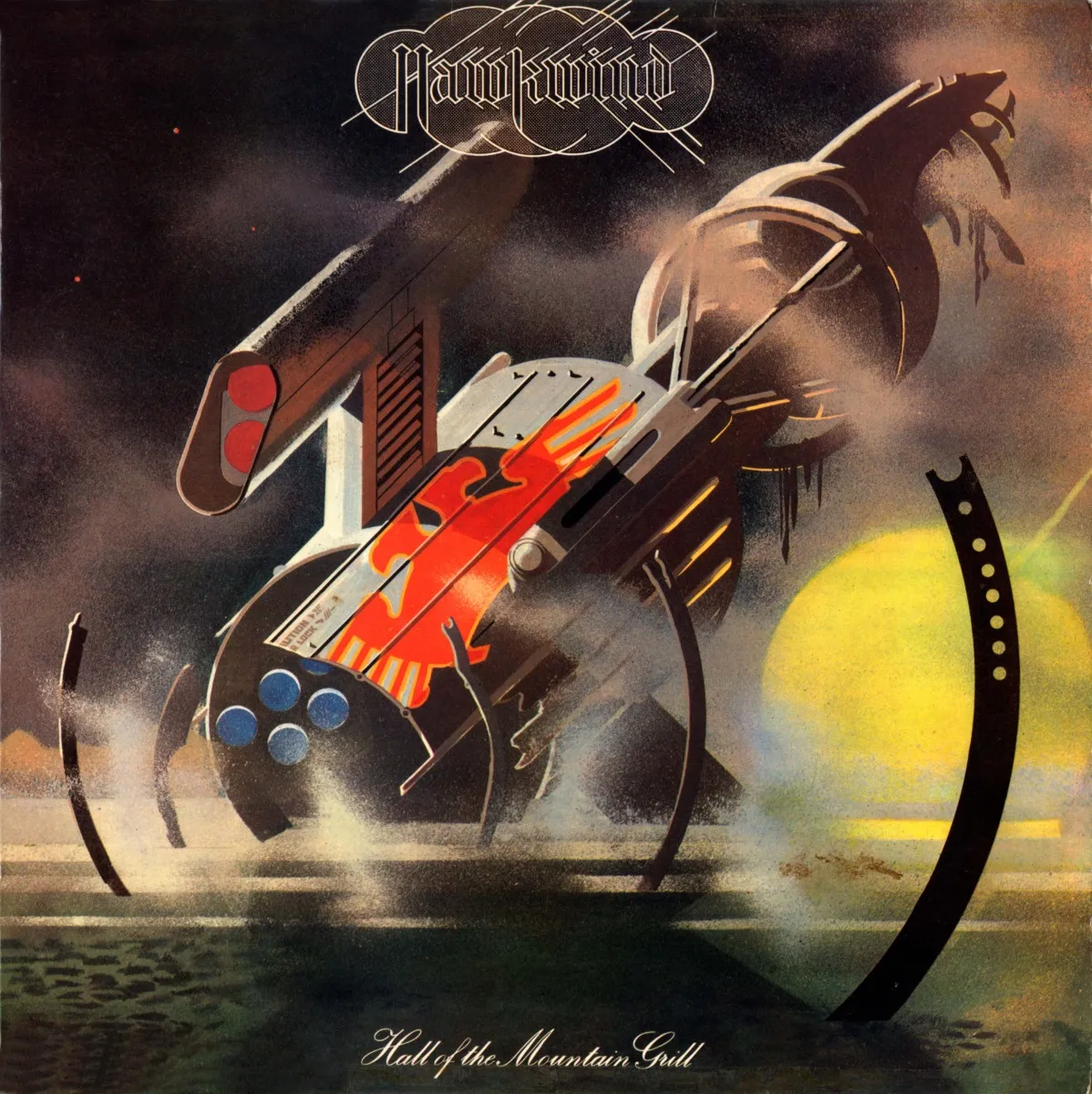
This new edition has been newly remastered from the original master tapes and cut at Abbey Road studios and fully restores the original LP artwork. It also features a bonus 12-inch 45 rpm EP featuring four tracks issued as singles in 1974. This edition has been newly remastered from the original master tapes and features an additional seven bonus tracks drawn from rare singles and studio out-takes. It also includes an illustrated booklet with new essay.
The CD Boxset7CD/2Blu-ray Limited Edition Box Set
This limited-edition deluxe box set comprises seven CDs and two Blu-Ray discs and features a brand new remaster of the original album with seven bonus tracks drawn from studio out-takes and rare singles along with two full previously unreleased concerts mixed by Stephen W Tayler. The first was recorded at Edmonton, London in January 1974, a benefit concert for imprisoned LSD advocate Timothy Leary, which featured a guest appearance by Robert Calvert and Joanna Harcourt-Smith, Leary’s partner. The second is a full concert recorded at the Allen Theatre in Cleveland, Ohio on 22nd March 1974. In addition, the set also includes Stephen W Tayler’s new mix of the full 1999 Party concert at the Auditorium, Chicago on 21st March 1974.
The set also includes two Blu-Ray discs featuring a stunning 5.1 Surround Sound up-mix of ‘Hall of the Mountain Grill’, (the multi-track master tapes sadly lost) and a 5.1 Surround Sound mix of Hawkwind’s concert at the Allen Theatre in Cleveland from the original 16-track master tapes.
The set is completed with an illustrated book with new essay, making this boxed set the definitive release of this legendary album.
Bruce Springsteen promised ‘surprises’ (plural) for his fans in 2025, and he’s certainly delivered on that promise. Not only the seven album ‘Tracks II: The Lost Albums’ and the ‘Springsteen: Deliver Me From Nowhere’ film, but also the well thought-out package ‘Nebraska ’82: Expanded Edition’. This 5-disc set is practically compiled to tell the story of his 1982 solo acoustic masterpiece ‘Nebraska’, including firstly a new 2025 remaster of the original album and also four bonus discs.
The nine-track ‘Nebraska Outtakes’ disc features solo acoustic demos of some familiar titles, underlining how the ‘Nebraska’ and ‘Born In The USA’ writing and recording sessions overlapped. Some of these – or similar takes – had circulated among collectors previously, with two particular exceptions: what Bruce called the ‘psycho gothic’ ‘On The Prowl’ (only known of from two live club performances in 1982) and the chilling suburban ballad ‘Gun In Every Home’ (only known before as an unreleased song title).
‘Losin’ Kind’ and ‘Child Bride’ later evolved into ‘Highway Patrolman’ and ‘Working On The Highway’ respectively. While other takes from these sessions are known to exist, and so this collection is far from complete, it’s a sensibly curated summary of the alternative demo stage for the album.
At the heart of the box are the long-awaited ‘Electric Nebraska’ performances. Starting deceptively with ‘Nebraska’, only subtly different from the known take with minimal but effective band backing to flesh it out, but things really take off dramatically after that. ‘Atlantic City’ immediately recalls the full band version known from live concerts since 1984, although with some different lyrics, and is one song here with rare backing vocals courtesy of Stevie Van Zandt. ‘Mansion On The Hill’ is significantly augmented most notably by swirling keyboards from Danny Federici. ‘Johnny 99’ is also reminiscent of the later familiar concert arrangement, now apparent as the inspiration for that approach.
‘Open All Night’ kicks off rockabilly style in the vein of the contemporary ‘From Small Things (Big Things One Day Come)’, stripped down to just vocals, guitar, bass and drums. It’s all about the rhythm section here. ‘Reason To Believe’ is a fresh, straightforward workout in similar vein, different again from later live evolutions of the song. The most surprising variations come with the wildly paced, almost punk headlong rush of ‘Downbound Train’, making for a remarkable stretch to the eventual final release in 1984; and the previously unknown styling of ‘Born In The USA’. These eight tracks firmly demonstrate that there were not just two strands of music leading to the two albums in 1982 and 1984, but also a hitherto unheard third element here. While not necessarily a complete album as such, it vividly serves as a missing link between those previous records.
The final audio disc is a record of Bruce’s 2025 audience-free theatre performance of the full album in Red Bank, NJ, accompanied only by the almost invisible Charlie Giordano on keyboards and Larry Campbell on guitars. This is also included as a starkly lit (‘Broadway’ style) film on Blu-Ray. Bruce obviously felt a live (mostly) acoustic performance was needed to bring the project full circle, since as he said he had never played the album sequence in full that way, and the contrast of his voice in his seventies with his early ‘80s vocals is apparent. An instrumental version of the title track, with Bruce humming and whistling instead of singing, plays over the closing credits.
The box set is completed by an excellent, well-informed essay from music historian (and Springsteen fan) Erik Flannigan, following his contribution to the ‘Tracks II’ box and accompanying ‘Inside’ promo videos for both sets. Hopefully he will continue as a regular participant that way for future releases. The liner notes helpfully also give much-needed details like full musician credits and recording dates for each track.
For anyone who considered the original ‘Nebraska’ as an oddity apart from Bruce’s more traditional E Street Band music at the time, this welcome package smartly re-frames his acoustic gem, and gives it the attention it deserves.
Bruce Springsteen – Nebraska ’82: Expanded Edition
Released in September 1974, the album is regarded as one of the band’s finest and featured a new line-up of the band which saw the departure of Robert Calvert and Dik Mik, but the arrival of keyboard player and violinist Simon House.
Featuring such classic tracks as ‘The Psychedelic Warlords’, ‘Wind of Change’, ‘D-Rider’, ‘You’d Better Believe It’, ‘Lost Johnny’ and ‘Paradox’, the album was formed of studio recordings and over-dubbed live recordings made at concerts at Edmonton Sundown in London in January 1974. ‘Hall of the Mountain Grill’ was another UK Top Twenty hit for the band.
This limited-edition deluxe box set comprises seven CDs and two Blu-Ray discs and features a brand new remaster of the original album with seven bonus tracks drawn from studio out-takes and rare singles along with two full previously unreleased concerts mixed by Stephen W Tayler.
The first show was recorded at Edmonton, London in January 1974, a benefit concert for imprisoned LSD advocate Timothy Leary, which featured a guest appearance by Robert Calvert and Joanna Harcourt-Smith,Leary’s partner. The second is a full concert recorded at the Allen Theatre in Cleveland, Ohio on 22nd March 1974. In addition, the set also includes Stephen W Tayler’s new mix of the full 1999 Party concert at the Auditorium, Chicago on 21st March 1974.
The set also includes two Blu-Ray discs featuring a stunning 5.1 Surround Sound up-mix of ‘Hall of the Mountain Grill’, (the multi-track master tapes sadly lost) and a 5.1 Surround Sound mix of Hawkwind’s concert at the Allen Theatre in Cleveland from the original 16-track master tapes.
The set is completed with an illustrated book with new essay, making this boxed set the definitive release of this legendary album.
• DELUXE NINE DISC LIMITED EDITION BOXED SET OF THE CLASSIC 1974 ALBUM BY HAWKWIND.
• THE ORIGINAL ALBUM NEWLY REMASTERED FROM THE ORIGINAL MASTER TAPES.
• WITH NEW MIXES FROM THE ORIGINAL 16-TRACK MASTER TAPES BY STEPHEN W. TAYLER OF PREVIOUSLY UNRELEASED FULL CONCERTS AT EDMONTON JANUARY 1974 & THE 1999 PARTY AT CLEVELAND, USA IN MARCH 1974 & A NEW MIX OF THE 1999 PARTY IN CHICAGO.
• INCLUDES 2 REGION FREE BLU RAY DISCS OF A STUNNING HIGH RESOLUTION 5.1 UP-MIX OF “HALL OF THE MOUNTAIN GRILL” & A 5.1 MIX OF HAWKWIND LIVE IN CLEVELAND MAY 1974.
• ALSO INCLUDES A FURTHER SEVEN BONUS TRACKS DRAWN FROM RARE SINGLES AND STUDIO OUT-TAKES.
A record that is at once grand and intimate, awash with romance and flickers of holy imagery, and most of all, it’s an undeniable fulfilment of the innate promise the band have shown since their earliest beginnings. These are emotionally expansive songs, some simmering with an undercurrent of violence, cynicism or fervent discontent (“Anhedonia”, “The Burning of Cork”, “Barbed Wire“) and others gleaming with a bright-eyed vulnerability.
A vivid first half contrasts a darker second and crafts a record with a clear A-side and B-side. A nod to the band’s collective love of vinyl, that tonal shift takes its cue from a variety of expected and unexpected influences – from the brittle honesty of folk to the theatrical melodrama of goth-rock.
“The Burning of Cork” The song takes its name from the act of terror inflicted upon Cork City by the British Army’s Black and Tan forces in December 1920,” says Cardinals’ Euan Manning of their new single. “It’s the record at its heaviest and most menacing.” We agree with his description. Cardinals’ debut album, The album “Masquerade”, is out February 13th via So Young.
Our debut album ‘Masquerade’ will be released on February 13th 2026.




 The Fat Angel Sings