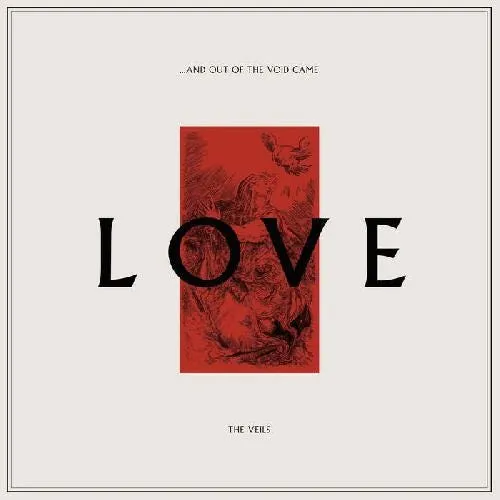
New Zealand-based indie legends The Veils returned after a seven year long absence with a new double album ‘…And Out of the Void Came Love’ and a single ‘No Limit of Stars’ to whet the appetite.
The single is a rich, luxurious delight – delivered with a preacher-like intensity that recalls Nick Cave on the pulpit, and cloaked in an anthemic statuesque finery with sweeping strings and shimmering, sparkling instrumentation. This is a grand presentation: an ebbing and flowing sonic embrace with an endless horizon and a celestial glory. ‘No Limit of Stars’ has the passion and euphoric glory of The National with an antipodean flavour that nods to the pop sensibilities of The Chills.
Finn Andrews says the track reflects the themes of his song writing going into recording the new album:
…the certainty of death, the power of new life, and the dizziness of contemplating your place in an unknowably vast cosmos.
Indeed, the song is expansive and thrilling: bold and imperial with a presence as awe-inspiring as the limitless universe.
Andrews is an enigmatic figure who was signed to Rough Trade at the age of sixteen – is a mesmerising figure fronting the band in the accompanying video directed by Alexander Gandar and produced by FrithArmstrong. Daubed in lush colours and against a stunning backdrop of the night skies and an engrossing melange of images projected on a screen, it is a compelling and immersive film that perfectly matches the celestial music. The band’s absence was the result of a series of unfortunate events.
Following the release of The Veils’ last album ‘Total Depravity’, Andrews released a solo album and began a worldwide tour. One night, while lashing out at a particularly intense moment on piano, he broke his wrist on stage: It sounds wild and Jerry Lee Lewis-esque, but it was an absolute fucking nightmare, e played on and finished the rest of the tour, but it wasn’t until he got it examined much later that he realized what a bad move that was. “
The scaphoid bone in my wrist had died, which I didn’t know was possible. My sister said that at least it was a really ‘on brand’ injury for me. Andrews’s convalescence meant a lengthy hiatus from touring, so he stayed at home and wrote songs. I was in a cast and couldn’t use my right hand. I sang the melody lines, then recorded the right hand piano part, then the left hand part. It might have been an interesting, avant-garde process if it wasn’t also just profoundly annoying.
The years of pent up creativity has resulted in a double album, beautifully entitled ‘And Out Of The Void Came Love’, hinting at a powerful resolve to the wilderness years. It is an album intended to be listened to in two sittings with a short break in the middle, or as Andrews instructs:
The Veils are:
Finn Andrews – Vocals and Guitar Cass Basil – Bass Tom Healy – Pedal steel Joe McCallum – Drums Liam Gerrard – Piano
In the past three-plus years, Australia’s King Gizzard and the Lizard Wizard has self-released nine studio albums and more than a dozen live, remix, and demo collections, grown its audience by a factor of at least 10, jumping from clubs and theatre’s to packed shows in historic venues such as New York’s Forest Hills Tennis Stadium and Los Angeles’ Hollywood Bowl, and somehow managed to find time to function as, you know, actual human beings with spouses, girlfriends, children, and lives not 102% devoted to the all-consuming art of music-making.
For many bands, creating that art can often feel more like work than pleasure. For King Gizzard, comprised of multi-instrumentalists Stu Mackenzie, Joey Walker, Ambrose Kenny-Smith, and Cook Craig, bassist Lucas Harwood, and drummer Michael “Cavs” Cavanagh, it’s nothing but fun and adventure. But where does a band in this privileged position go from there? Play the same hits every summer on the festival circuit? Make big bucks writing tracks for pop stars? No, that would be far too easy, and King Gizzard doesn’t do easy. Instead, its six members have pushed their maximalist aesthetic to a level simply unequaled by any of their contemporaries and now stand largely alone at the vanguard of forward-thinking modern music. After all, if you can’t challenge yourself to do something nobody else has done before, why bother in the first place?
“The maximalist aspect is probably just tied into our personalities and who we are,” chuckles Mackenzie over the phone from his home outside Melbourne. “King Gizzard definitely has a maximalist energy, generally. There isn’t a lot of subtlety. That’s not our strong point. From time to time, we’ll probably exercise it a little bit, but I don’t think that’s our resting place.”
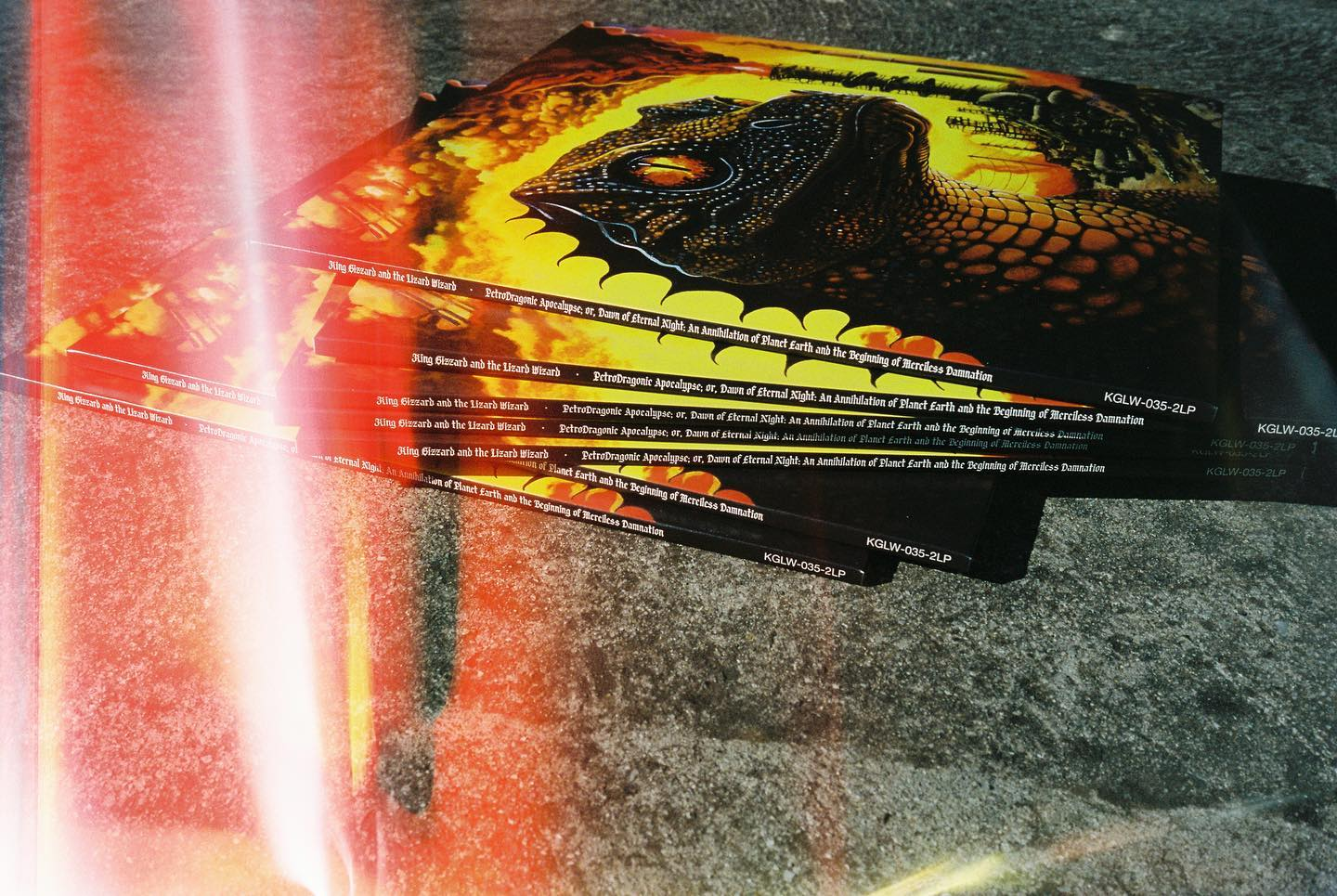
With the June release “PetroDragonic Apocalypse or Dawn of Eternal Night: An Annihilation of Planet Earth and the Beginning of Merciless Damnation” and “The Silver Cord“, due Friday, King Gizzard has created two distinct but related albums out of an idiosyncratically specific conceptual framework — both are seven tracks long, with each song in the running order sharing musical and/or lyrical elements with its corresponding song on the other project. In both cases, each album’s names, song titles, and lyrics were written before a note of music was recorded, giving them time to seep into the band’s collective unconscious long before it turned on the amps.
And while “PetroDragonic” is 48 breathless minutes of thrash, prog, and metal sound tracking a linear tale of planetary destruction at the hand of an unstoppable dragon, “The Silver Cord” is a more nuanced reflection on the circle of life, its 88 minutes bursting at the seams with a studio’s worth of synthesizers and a litany of references to ancient gods and goddesses. “We were thinking about the soul and the spirit and existentialism and why we’re here, birth and death, and rebirth and spirituality,” Mackenzie says. KingGizzard has also edited those “extended mixes” into a more digestible 28-minute edition of “The Silver Cord”, in effect serving as its own remixers in the grand traditions of dance music pioneers such as Giorgio Moroder and Arthur Baker (for reference, opener “Theia” is 20:42 on the long version and 3:24 on the edit).
For fans more partial to Gizzard’s usual guitar-based rock’n’roll creations, “The Silver Cord” will be a dizzying listen, and one during which you’ll discover something new every time. One minute you feel like you’re on ecstasy in the Coachella dance tent (“Set” approximates the Cheshire cat-grinning, rhythmic syncopation of late ‘90s Underworld, with rapping by Kenny-Smith) or a slam-dancing in an underground leather bar (“Gilgamesh” conjures vein-bulging industrial dance/rock a la Nine Inch Nails). The next, you’re floating downstream with your stomach rumbling (“Extinction” is dominated by austere three-note trills that would have terrified Middle Ages aesthetes if played on a church pipe organ) or descending through the alien landscapes of a distant planet (the title track alternates between disturbing electronic vocalizations and moments of Autotuned, major-key beauty).
There are nods to the “hoot hoot” funhouse mirrors and fast-approaching freight train whistles of Kraftwerk, the smooth, synthetic soundscapes of Air, the hyperactive side of Daft Punk circa the TRON:Legacy soundtrack, LTJ Bukem/DJ Hype-style drum and bass, jungle, trance, and Detroit techno. Devotees will also have a field day identifying common elements shared between “Petro” and “The Silver Cord” — the same riffs and melodies turn up in multiple songs, albeit in totally unique musical circumstances, and turns of phrase about witchcraft, Gila monsters, and flamethrowers are woven throughout both albums.
Those with especially astute ears will be able to derive the origin of other shared musical tidbits as Gizzard’s increasingly jam-oriented live shows — for example, the key “Extinction” lyric “I can see everything I can be in the music” was sung on stage by Kenny-Smith as recently as three months ago. The stories of the albums themselves are now even more open to interpretation when viewed as companions, a notion Walker describes as Gizzard’s “main M.O: be didactic about what we want to get across, but leave it open for the fans to create their own lore surrounding what it’s all about. That’s really fun, and it’s definitely an intention of ours.”
It wasn’t clear from the beginning that “The Silver Cord” would be released in long and short forms, but that approach allowed the band to indulge its love of going to many places at once. In typical Gizzard fashion, there are also some musical surprises hidden on the vinyl version of the short “Silver Cord“, if you know where to look. “When we were recording, we weren’t thinking too much about arrangement,” Mackenzie says. “We were looking for what we call endless boogies — when you’re in the pocket and it feels like whatever you’re doing could go forever, like Can or Neu!. We were in there for hours on end just trying to find those pockets and exist in them. Within those endless boogies, we found nuggets that felt like quote-unquote songs, or what normal people think of as songs — not people like us who are happy for a song to just be 20 minutes of ambience.”
“Making two versions was incredibly liberating and freeing,” he continues. “It’s really tied up into the DNA of what the record is, because instead of making one decision for a song, we could make a bunch of decisions and find places for them. It always hurts to mutilate your song, but this time, we could kind of clone it and let it go in two different directions at once, which felt really fun. Maybe we’ll do this again one day.”
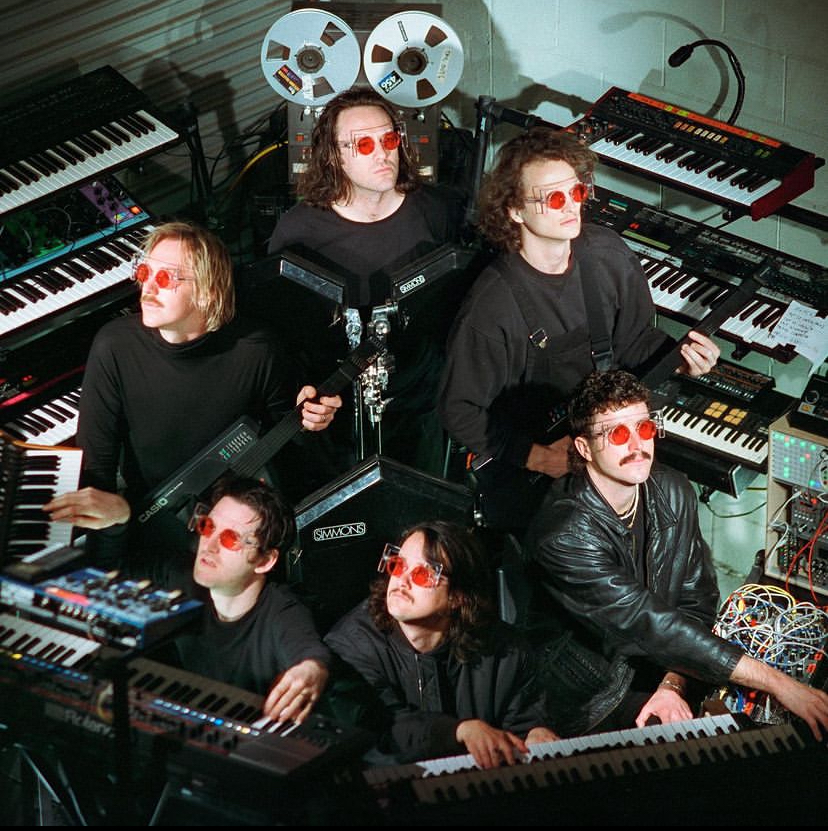
It’s all even more impressive given the band members’ admitted lack of skill on electronic instruments, which they’d really only featured once before when assembling the 2021 synth album“Butterfly 3000“remotely during COVID-19 travel restrictions.
“At that point, “Butterfly” was the most electronic record that we’d made,” says Mackenzie, who is partial to the Juno 60 the band bought while making the 2014 album “Oddments”. “But it was a nightmare trying to figure out how to play it, because it was pieced together part by part during the pandemic. Lately, our shows have become more improvised and loose. We’re listening to each other more, which makes it like spontaneous creation, but that’s with drums and guitars. We thought, how do we do that with electronic instruments? How do we birth two albums from the same world and then let them grow into their own shapes and personalities?”
The answer, as with “Petro” and guitars, was for band members to plug in every possible piece of synth-related gear they could find in their studio, press “record,” and lock in on the ensuing mayhem. Mackenzie recalls, “We did spend several days making very shit music. There were definitely times when I thought, I don’t think this is gonna work. This is just not very good (laughs).” The vibe changed once band members realized they were inhabiting the same dynamic ranges they do on stage, even though they were playing completely different gear.
“Lukey did still play the bass synth on this whole album, so he was still occupying his usual spot,” Mackenzie says. “Same with Cavs, even though he was playing an electronic drum kit. Joe and I are doing most of the top-line melodic stuff, and we’re harmonizing with each other a lot. Cookie and Amby are very much filling in the body of the song. We’re not doing crazy scales or moving our fingers real fast along the keyboard or anything. There’s no virtuosic playing here. If there is a skill in it, it’s things we’ve learned playing other instruments. We still are in our regular little niches, which made it feel like we knew what we were doing.”
What’s more, Mackenzie says the recorded-live aspect of “The Silver Cord” could lead to its material one day making it into the Gizzard concert repertoire, in contrast with the songs on “Butterfly“, only one of which (“Shanghai”) has ever been performed.
“I do think that we will find a way to play a lot of this material,” he says, acknowledging uneven attempts to incorporate a synth workstation into Gizzard’s summer 2023 shows. “Once we crack the nut on one of these songs, it’s possible we’ll crack the nut on all seven of them simultaneously. When we tried to figure out how to play the “Butterfly” songs and rehearse them as a band, we were instantly demoralized and it’s been very hard to go back there and pick it up. That was the seed to do something that just felt more straightforward in that particular sense, and more like a band. We’re a fucking band — let’s play like a band.”
If anything, “Petro” and “The Silver Cord” (the band’s 24th and 25th studio albums since its 2010 formation) reinforce what has become a kaleidoscope Gizzard listening experience — there’s truly something for everyone not only within the discography but also at a concert. “If you’re coming to a Gizz show, you probably wouldn’t have only listened to one of our albums,” Cavanagh says with a laugh. “You would have listened to at least two, and they’re all different. I always think about the people who didn’t want whatever we’ve just put out, but that’s what they got. It’s Gizz, so you’ve just got to prepare yourself for anything.”
It’s an idea the members of King Gizzard deal with on a daily basis, even though their lives are now being planned out some 18 months in advance. Although it was in the studio recording new music every day for a week earlier this month, the band is presently on a rare extended break from touring, which will last until next spring. Its summer 2024 itinerary includes another round of marathon three-hour shows at such locales as Forest Hills, the already sold-out 9,200-capacity Huntington Bank Pavilion outside Chicago, and the 21,600-capacity Gorge Amphitheater outside Seattle, the largest venue it has ever played in North America.
“I can’t just, like, put everything down. It’s not the way my brain is wired,” says Mackenzie, who is expecting his second child any day now. “If I stop making music, I start frantically doing some other non-productive activity (laughs). We’ve got a few projects on the go — not anywhere near completion or anything, but a couple of spinning plates.”
Mackenzie confirms it is “totally possible” King Gizzard will have a new album out by next summer, but even that hint of uncertainty feels unusual for him. “By the time it gets to October, I feel like I’ve got a very solid plan of how the releases are going to sit for the following year,” he reports. “As I’m here now thinking about next year, it’s just going to be what it’ll be. I’m saying that now. I might not be saying that tomorrow. Sometimes you’ve got to make your future and make your reality, and other times you’ve got to sit there cross-legged in Buddha pose and wait for the lightning to strike you. I think both methods in balance and harmony are valid.”
However it keeps happening, King Gizzard is actualizing even the zaniest ideas at an impossibly high level, and more and more fans keep jumping aboard the ride (if it’s any measure, the band’s robust Reddit feed has grown by 24,000 members alone in the past year). “From where I’m sitting, honestly, it all feels very abstract,” Mackenzie admits. “It’s insanely flattering and humbling and just freaky, but it sometimes feels like it’s happening to someone else and I’m just acting this part. Really, I’m extremely grateful, because we get energy from the whole thing. It’s like a beautiful spiral of positivity. As long as people are willing to come watch us play, I’m pretty sure we’re going to just keep playing.”
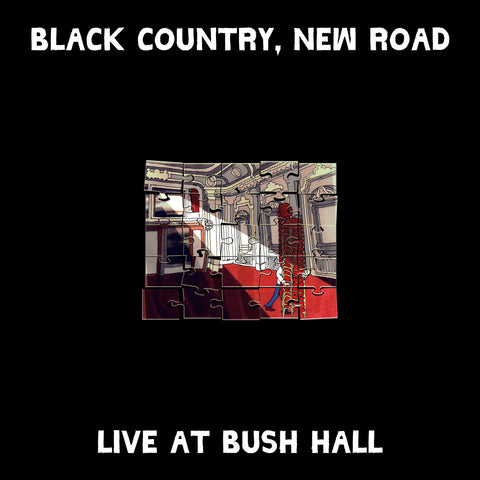
A brand new album of unreleased material from Black Country, New Road, recorded at the historic music venue Bush Hall, in London at a series of unique shows at the end of December 2022. Mixed by John Parish and mastered by Christian Wright at Abbey Road, the new album and material marks a new chapter for the band as a six-piece.
Last month, Black Country, New Road released a concert film called “Live at Bush Hall”. A new live album featuring recordings of all new songs from three shows at London’s Bush Hall last December is being released. It’s out digitally on March 24th and physically on May 26th via Ninja Tune.
The live album follows “Ants From Up There”, which featured frontman Isaac Wood but came out shortly after his departure from the group. The new songs were written by remaining members Tyler Hyde (bass, vocals), May Kershaw (piano, vocals), Jockstrap’s Georgia Ellery (violin, vocals), Lewis Evans (saxophone, vocals), Luke Mark (guitar), and Charlie Wayne (drums).
Fresh from the success of ‘Ants From Up There’ and with a full touring schedule ahead of them in 2022, Black Country, New Road aka Lewis Evans, May Kershaw, Georgia Ellery, Luke Mark, Tyler Hyde and Charlie Wayne, wrote an entire new set of material to perform. Playing to swelling crowds at festivals, including triumphant performances at Primavera, Green Man and Fuji Rock, they entered a new musical phase as they navigated and developed songs that were just weeks old. They also toured the US and headlined two sold-out shows in New York. These new performances have seen the band garner widespread support from across the board with Rolling Stone UK describing their Green Man set as “unmissable”, and the Guardian going on to say that they were “greeted by something close to rapture.” These performances have also attracted a profile from the NY Times, multiple glowing live reviews, and a nomination for Best Live Performer at the AIM Independent Music Awards last year.
Forged in isolation, “Star Eaters Delight” is a vehicle for returning, not just to civilization, but to celebration. A record concerned with binaries – country vs. city, humanity vs. technology, solitude vs. relationship – the intention is to heal our divisions and realise what matters most.
The album is her second for Sub Pop and sketches wider vistas in her sonic collaboration with producer and accompanist Guy Blakeslee, Neale’s is a voice that has known pain and experienced it but still holds onto self compassion. The palette is more cinematic, still sparse yet riven with more detail. The trademark omnichord is still there on the excellent opening track. ‘I Am The River’ that’s minimal beat and tremulous guitar notes that splatter patterns across a canvas are like Suicide if they were given a wider palette. Framing Neale’s wonderful vocal, her melodic stream of consciousness reminds one of Patti Smith. It is at once personal and universal with a gifted warmth enhanced by a nagging ominichord, hoisted to new heights on the back of a repeated“ba ba da da da do na um” refrain that flows right through you. It’s bloody fantastic.
WIth her exquisitely drawn, character laden songs, and a voice of experience, Lael Neale is opening a fascinating window on her world, a world that craves human touch, longs for nature’s beauty and her spiritual quest to hold onto sovereignty over her own mind. Lael still has a flip phone and there were no screens involved in the creation of her new record, “Star Eaters Delight”. In a time when our devices are constantly flooding us with information. Neale offers “not because I don’t like things, but because I value freedom more.” We are in awe of your power Lael.
The song was written and composed by Lael Neale and produced and mixed by Guy Blakeslee.
Blakeslee says of the song, “‘’White T-Shirt’ dates back a number of years to when I used to follow Lael around LA to all of her barely publicized performances. The song never ceased to silence the chatter in the room. There was nothing I could add to this performance, it’s a raw gem that stands alone and cuts through the noise.”
Lo-fi indie rock on Sub Pop from a singer/songwriter recently returned from LA to her native Virginia, LaelNeale’s 3rd album uses mostly guitars and an ancient synthesizer to work its unpredictable magic. Standing apart from any scene or subgenre, the record gives the impression that each song was written with its own approach; most of those will leave you wanting more. Highlights: “I Am The River,” “In Verona,” “No Holds Barred”
from the album ‘Star Eaters Delight’, out April 21st, 2023 on Sub Pop Records
Falcon Bitch and Gumball are best friends. A testament to their ever-playful attitude—one that pours over into their project, Being Dead, in which the band toes the line between jest and sincerity. The nurturing foundation of these platonic soulmates urges both Falcon Bitch and Gumball to be their full, freaky selves, prodding at the absurdity of the world with slick n’ dreamy strums, gritty percussion, and kaleidoscopic harmonies.
Their latest album “When Horses Would Run” propels us into vivid landscapes: desert planes, dirty basements, lush rolling hills. Being Dead is here to create worlds, grabbing our hand and hauling us outside of ourselves, where we can soak in stories of carefree shoplifters, wayward cowboys, and the final moments of a lonely Buffalo on the range. The album doesn’t linger in one place for too long––instead, it dances alongside the periphery, flickering between Super-8 memories and moments. “Our music is really a slice of our friendship,” says Falcon Bitch. “We’ve lived together and we’re always together and I feel like it’s a palpable thing.”
Being Dead’s previous releases garnered acclaim for their ability to mimic the band’s renowned live shows. Merging surf rock, freak pop, and frantic punk, Falcon Bitch and Gumball’s eclectic influences and energetic pull swells on “When Horses Would Run”, charting the band’s progression within Austin’s iconic music scene. “When Horses Would Run” is proof that if we search for the beauty between the cracks––and we don’t take ourselves too seriously––there is joy to be found everywhere.
Opener “Great American Picnic” gallops in with a rush of Western rhythms and chanting vocals, cementing the album as a kind of slap-in-the-face call-to-arms; Being Dead is a band that grabs by the scruff of the neck. On “Last Living Buffalo,” they prod at the casualties of America’s insatiable greed, lamenting a tragic lullaby for the last animal left.
Stand-out track “Muriel’s Big Day Off” showcases Being Dead’s creative process, where instincts and gut reactions are favored over second-guessing or laborious technicalities. The song tells of a character called Muriel and her best friend Friedrick, who spend their day doing exactly what they want: stomping around town, drinking tea, and shoplifting. It was inspired by a Falcon Bitch and Gumball’s acid trip, where––after drinking wine on their porch and “having a really nice time with a tree”––they returned home, enamoured with the patterns of their fingers on the guitar rather than the way the chords actually sounded. The result incorporates elements of jazz, with animated piano runs and driving melodies, alongside the band’s tongue-in-cheek lyricism.
“Oklahoma Nova Scotia” closes the album, and points to Being Dead’s lo-fi leanings. It was the one song recorded to tape and despite trying to later cut it in the studio, the band decided to stick with the more organic approach. “For a lot of these songs, we only knew how to play them live and we weren’t sure what kind of form they were going to take,” Falcon Bitch says.
This spontaneous, gung-ho approach marks a refreshing originality in Being Dead. “When Horses WouldRun” celebrates the nourishing merriment of friendship, the importance of enjoying the here and now, and creating simply for the hell of it. Here we have a reminder that we can not only move through the burdens of our past, but we can have company––and fun––while doing it.
Since the debut of her first album, “Feels Like”, in 2015, Alicia Bognanno (has been releasing music under the moniker of Bully) has been delivering music that achieves a balance between abrasiveness and vulnerability, raucous and serene.
On “Lucky For You”,she presents her most authentic and assured sense of self. Whereas on earlier releases, her voice remained timid despite bouts of characteristically Bully screaming and tracks were characterized by humble DIY presenting production, on “Lucky For You”, Bully steps forward with her most refined yet unrestrained musicality to date.
Out of the gate, the opening track of the album, “All I Do,” serves as a bold taste of what’s to follow. A ringing and childishly sweet guitar melody juxtaposed with a punchy, compressed drum beat lays the groundwork for Bully’s rich vocalization to shine through at the forefront of the song, a point further proven by the songs that follow.
Moving fluidly from track to track, the album thematically and sonically makes its way to a greater point—an epiphany that feels discovered at the end of the album, even if you aren’t quite sure what it is. With each track, a sense of solidarity between Bognanno and the listener is felt, even when there is ambiguity in her lyrical content. The unrestraint in her performance on the album calls the listener to engage with the song, to lean in and relate in whatever way that calls to them.
On some songs, Bognanno is incredibly blunt about the emotions she is experiencing, leaving little room for interpretation on an array of subjects that weigh on her psyche including breakups, the loss of her beloved dog, struggles with addiction as well as the state of our society and her anger towards it. On others, she sings from a place of vagueness, although continually channeling the feelings and thought processes that come with loss and grieving, which ties the album together with an overarching theme.
The lyrics find that perfect balance between poetically specific and purposefully vague. On “How Will I Know,” she sings, “Feeling melancholy when I start to think of you gotta get out of my head, find something else to do, because there’s no point obsessing over what I would’ve changed, save a couple of things I wish I said but I refrained.” Within the ambiguity of that line, she sings them in such a way that feels prophetic and revolutionary, however generalized or commonplace the feelings she is speaking on may seem.
With more grit and vulnerability, on “Ms. America” she sings, “I guess everything falls apart, finding hope in a broken heart, all I wanted was a daughter, try my best to raise her right, but the whole worlds caught on fire, and I don’t wanna teach a kid to fight for you and for me too,” allowing herself to bare more honesty and point directly towards personal experience with a poetic edge.
In the same way she balances two opposing ideas within the construction of her lyrics, Bognanno is also able to do so sonically. Viewing the album in its entirety, Bognanno balances a tenderness reminiscent of popular ’90’s vocalists such as Liz Phair and Tori Amos while packing a punch with her coarse punk vocalization. The specific guitar tone and production of the instrumentation creates a noisy and compressed sound that for one, brings her vocals to the forefront and two, and creates a specific soundscape characterized by an intentional raucous garage rock sound.
Shining with catchy bass lines that pique attention, as well as unique drum patterns, purposefully noisy guitar distortion, and subtly layered vocal tracks, Bully is able to achieve a fully formed sonic landscape with cohesive yet thrilling elements scattered throughout.
“Lucky For You” is Bully’s declaration to the world that she is unafraid to let her deepest insecurities and most painstaking experiences bleed out in her music. It’s a fully polished work that distinguishes itself from other albums in its genre, on the basis that Bully was able to present a sense of pure genuineness on it, a characteristic of music that is often an anomaly today.
Bully the musical project led by Alicia Bognanno — visited The Current studio in late September 2023 while out on tour in support of the band’s latest album, “Lucky For You.” Watch the three-song performance above.
Despite its tinge of grunge instrumentation and full-throated riot grrrl vocals, on Bully’s “Lucky For You“, Alicia Bognanno hews closer to the lesser-known Seattle female-fronted bands, with a straight-up rock ‘n’ roll backbone like Kim Warnick of the Fastbacks and Carrie Akre of Hammerbox and Goodness. The album rips into high gear with a declaration of being fed up and “burned-out wasting tears/ I am done” on opener “All I Do”; detours through the melancholy of mourning with “A Love Profound”; gets anthemic about break-ups with fellow Nashville artist Sophia Regina Allison of Soccer Mommy on “Lose You”; and closes with the Red Aunts-esque short and sweet punk “All This Noise” that encapsulates the media view of our fucked up world by asking, “What else is there to do/ When you can’t escape the news?”
From the album ‘Lucky For You’ out on Sub Pop Records on June 2nd , 2023.
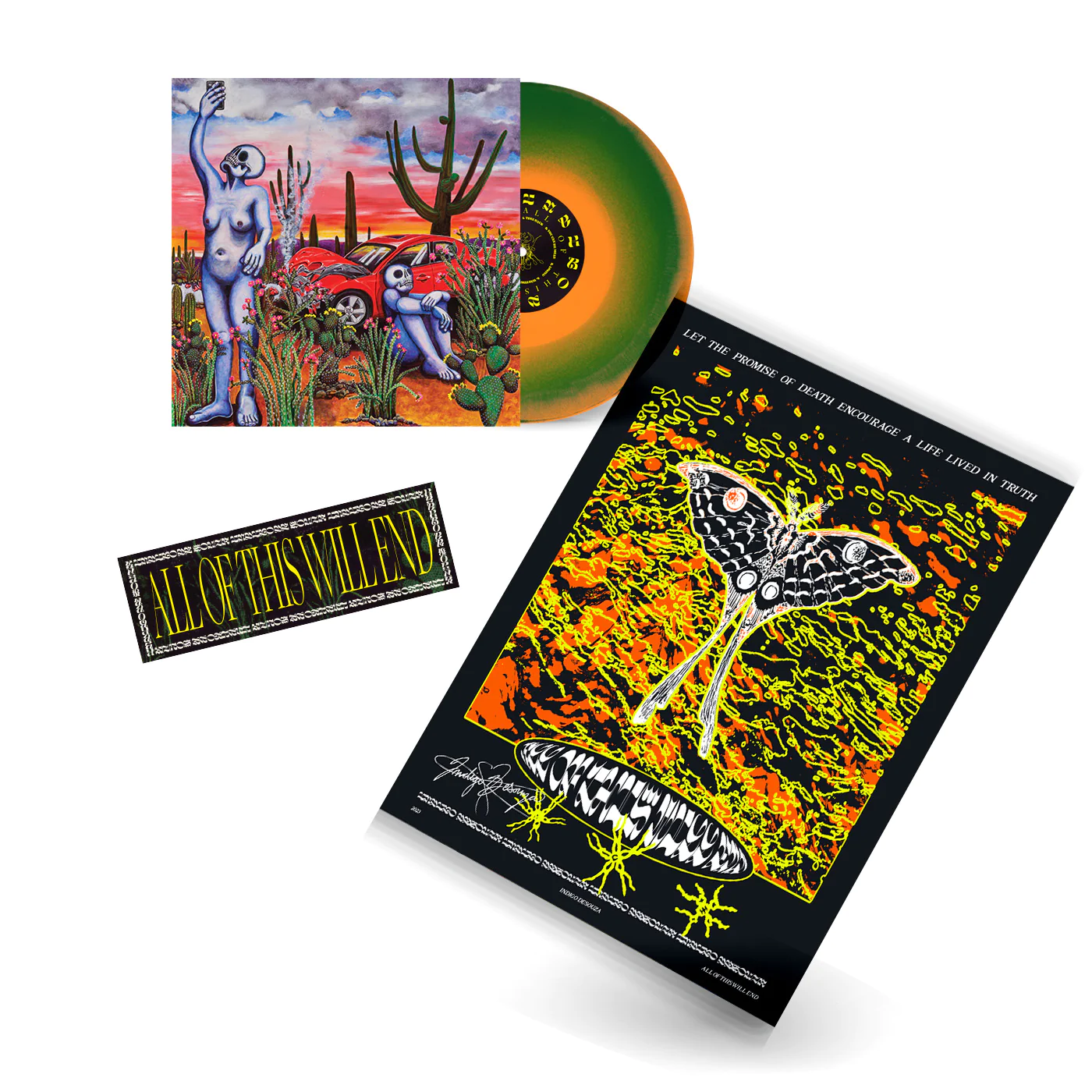
Announcing her latest album “All of This Will End” released back in April on Saddle Creek Records featured “Younger & Dumber”. Indigo De Souza said “I was finally able to trust myself fully,” making her masterful third album “All of This Will End”. Across its 11 songs, the LP is a raw and radically optimistic work that grapples with mortality, the rejuvenation that community brings, and the importance of centreing yourself now. These tracks come from the most resonant moments of her life: childhood memories, collecting herself in parking lots, the ecstatic trips spent wandering Appalachian mountains and southern swamps with friends, and the times she had to stand up for herself. “All of This Will End” feels more true to me than anything ever has,” she says.
Indigo finds recent inspiration from community and stability. “Up until recently, my life felt chaotic,” she says. “Now, so much of the chaos is behind me. I have an incredible community, I love where I live, and I’m surrounded by truly incredible people who are dedicated to deep connection and joy. My music feels like it’s coming from a centered place of reflection.” Opener “Time Back” deals with the necessary forward momentum she cherishes. It’s a song about rising out of struggle, putting things in the past, and moving on where she sings over comforting synths, “I feel like I’m leaving myself behind / And I’m so tired of crying / I wanna get back up again.” The track later explodes with her voice booming over a stunning arrangement. “You can fall into dysfunction or sadness, or allow other people to hurt you and not have boundaries,” she says. “There was a time in my life when that was a lot of what I was doing. I thought this track was a sweet way to talk about coming back to yourself, to your true self.”
Alongside the all-encompassing emotions captured in the first song, the album is bookended with the heartfelt and nostalgic closer “Younger & Dumber,” which Indigo chose as the lead single. One of the first songs she wrote for the album, the track began as a way of her speaking to her younger self. “While I was writing about the time when my music first started to take shape, it was also the worst time in my life and the most unstable I’d ever been,” she says. “I wrote this song paying homage to a younger self that didn’t know any better. I was flailing through life, trying to make something stick, and coming to terms with being on earth.” The song is her most intentional yet, where she sings, “You came to hurt me in all the right places / Made me somebody.” Though the track starts as a whisper, it slowly unfolds to something cathartic and explosive as she belts out, “And the love I feel is so very real it can take you anywhere.” With the clarity that comes with experience and healing, Indigo treats her past self with immense kindness. It’s her most stunning offering yet.
Creatively re-energized from having these songs pour out of her so quickly, Indigo and her band went to Asheville’s Drop of Sun Studios with producer and engineer Alex Farrar, who also worked on “Any Shape You Take. “We just clicked so hard,” she says. “We had such an organic energy flow and we felt really inspired by each other.” Tracks like the pummelling “Wasting Your Time” and the muscular single “You Can Be Mean” highlight the band at their most defiant and locked-in. With lines on the latter like, “I’d like to think you got a good heart and your dad was just an asshole growing up,” Indigo says it’s “about the last horrible guy that I let push me around.” While she lets her band loose in the arrangements, especially guitarist Dexter Webb and drummer Avery Sullivan, these songs come from her own vision. “This time, I was more true to myself and refused to allow other people’s ideas to shape what my songs sound like,” she says. “It also feels really special because Dexter was able to fully express his freaky alien guitar voicings, and played a larger role in the production.” At the same time, Dexter Webb’s guitar work on his 12-string is impeccable, drawing you in with his bright yet melancholy melody lines. It’s hard not to like every song on this album—every minute is worth the listen.
“All of This Will End” boasts songs that run the gamut of human emotion. There’s pain and sadness, sure, but there’s a triumphant spirit of resilience throughout. Take the single “Smog,” which is exuberant, danceable, and about the exhilaration that comes from breaking out of daily monotony. Elsewhere, she’s introspective, like in the soul-shattering “Always,” which excavates her relationship with her father. But in the single “The Water,” she transforms a childhood memory of visiting her best friend into a meditation on growing up and the fragility of relationships. Over a programmed drum beat, she sings, “I think about what it was like / That summer when we were young and you did it with that guy in his car.” Though she’s no longer as close to that person as she was when they were kids, there’s power in reminiscing.
In many ways, “All of This Will End” has become a personal motto for Indigo. “Every day I wake up with the thought that this could be the end,” she says. “You could look at it as a sad thing, or you could look at it as a really precious thing: Today I’m alive and at some point, I will not be in this body anymore. But for now, I can do so much with being alive.” There’s a peacefulness in acceptance throughout. As she sings on the title track, “I’m only loving only moving through and trying my best / Sometimes it’s not enough but I’m still real and I forgive.” She describes the experience of writing this song as “magic,” as if everything about it from the words and melody had felt timeless and intangible and that she was just writing it down. Like the hues of reds and oranges that her mother painted on the LP cover, “All of This Will End” marks a warmer and unmistakably audacious era for her. It’s a statement about fearlessly moving forward from the past into a gratitude-filled present, feeling it all every step of the way, and choosing to embody loving awareness.
The Julia Steiner-led Ratboys have been quietly putting out high quality content for the past dozen years. Their last full length of new material, “Printer’s Devil”, came out at an inopportune moment (February 2020), which makes their return with “The Window” all that more of a moment to celebrate. And celebrate, The Window does well. Whether the spotlight is on Mother Earth “It’s Alive”, being spitting mad “Empty”, or lives well lived “The Window”, Steiner knows no mode other than wearing her heart on her sleeve. Here with a production assist from Chris Walla (formerly of Death Cab for Cutie), every song is a set piece with its own distinct dynamic and every single one of them is fantastic. For a band that already had a well-earned pedigree,
There are approximately 11 very good songs on Ratboys’ newest record “The Window”, but there are two that best illustrate what this band can do better than almost any other on this, or any other, list. “Black Earth, WI” arrived back in March, a few months before the group even announced the album proper, and it immediately entered the pantheon of this decade’s rush on rootsy, twangy indie-rock epics, gliding through its eight-minute runtime like a boozy August night laid bare.
Then, in June, they hit us with the record’s devastating title track. Subdued and sweet, “The Window” is vocalist Julia Steiner at her best, presenting an achingly personal love story through the prism of the catchiest indie rock released this year.
Ratboys are a band of tight hooks and catchy melodies, but it’s the specificity of their song writing that makes the project so endlessly endearing. For a band that arrived so fully formed nearly a decade ago, they continue to outdo themselves with every release. “The Window” will be hard to top, but I don’t think we have any reason to doubt them.
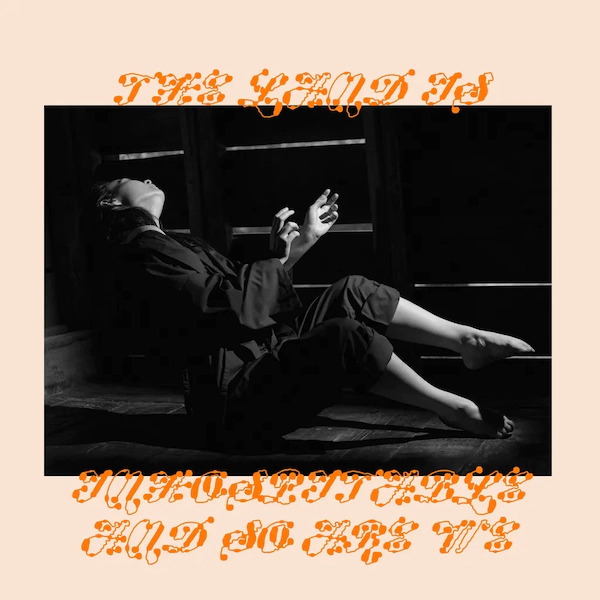
On Mitski’s previous two albums, 2018’s “Be the Cowboy” and 2022’s “Laurel Hell“, the songwriter filled every open space with buzzing effects, disco rhythms, and bright synthesizers—as if to drown out the feelings of loneliness and isolation with the company of flashy sounds. “Bug Like an Angel,” the leadoff track from “The Land Is Inhospitable and So Are We”, opens with nothing more than the spare strum of an acoustic guitar, which until its ascendant chorus backed by a choir, is the barest her music’s ever sounded.
Sometimes, Mitski says, it feels like life would be easier without hope, or a soul, or love. But when she closes her eyes and thinks about what’s truly hers, what can’t be repossessed or demolished, she sees love. “The best thing I ever did in my life was to love people,” Mitski says. “I wish I could leave behind all the love I have, after I die, so that I can shine all this goodness, all this good love that I’ve created onto other people.” She hopes her newest album, “The Land Is Inhospitable and So Are We”, will continue to shine that love long after she’s gone. Listening to it, that’s precisely how it feels: like a love that’s haunting the land.
Love is always radical, which means that it always disrupts, which means that it always takes work to receive it. This land, which already feels inhospitable to so many of its inhabitants, is about to feel hopelessly torn and tossed again – at times, devoid of love. This album offers the anodyne. “This is my most American album,” Mitski says about her seventh record, and the music feels like a profound act of witnessing this country, in all of its private sorrows and painful contradictions. But “maybe it’s beyond witnessing,” she says. At times, it feels like the album is an exercise in negative capability – a fearless embodiment and absorption of the pain of other bodies. When I ask her what the album would look like, if it were a person, she says it would be someone middle-aged and exhausted, perhaps someone having a midlife crisis.
But through the daily indignity and exhaustion, something enormous and ecstatic is calling out. In this album, which is sonically Mitski’s most expansive, epic, and wise, the songs seem to be introducing wounds and then actively healing them. Here, love is time-traveling to bless our tender days, like the light from a distant star.
Mitski wrote these songs in little bursts over the past few years, and they feel informed by moments of noticing – noticing a sound that’s out of place, a building that groans in decay, an opinion that splits a room, a feeling that can’t be contained in a body. It was recorded at both the Bomb Shelter in East Nashville and the Sunset Sound Studios in Los Angeles.
The album incorporates an orchestra arranged and conducted by Drew Erickson, as well as a full choir of 17 people – 12 in LA and 5 in Nashville – arranged by Mitski. And for the first time, it felt important to Mitski to have a band recording live together in the studio, to create this new sublime sound. Working with her longtime producer Patrick Hyland, the album has a wide-range of references, from Ennio Morricone’s bombastic Spaghetti Western scores to Carter Burwell’s tundra-filling Fargo soundtrack, from the breathy intimacy of Arthur Russell to the strident aliveness of Scott Walker or Igor Stravinsky, from the jubilation of Caetano Veloso to the twangy longing of Faron Young.
Mitski has always known how to write music that creates a lush and shimmering atmosphere while simultaneously piercing directly into a listener’s heart. “The Land Is Inhospitable And So Are We” sees the artist in her most boundless state thus far, with dramatic orchestral swells on tracks like “Bug Like AnAngel” and “When Memories Snow” paired with searingly intimate lyricism on “My Love Mine All Mine” and “I’m Your Man.” After considering retirement a few years ago, this album is a stunning declaration that Mitski isn’t going anywhere.
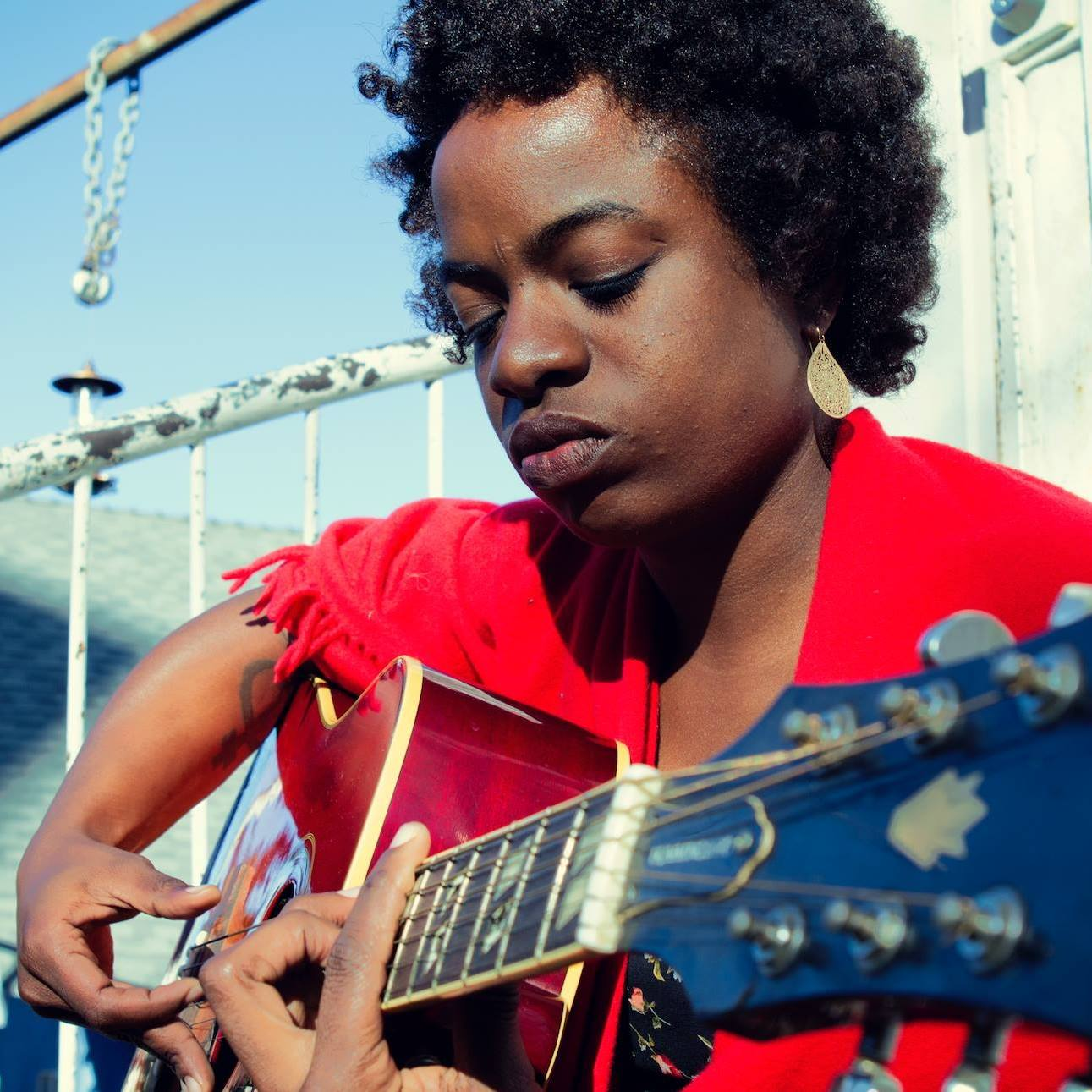
“Good intentions that you keep / Don’t change the fact that you’re a beast,” sings Sunny War on the rollicking “No Reason.” Her fascination with duality and oxymoron predates her ascent as one of Americana’s most exciting voices (she named herself “Sunny War,” for folk’s sake). “Anarchist Gospel” just refines her thesis on the contradictory essence of human nature even as it refines her blues-rooted sound.
Here, with Andrija Tokic (Alabama Shakes, Margo Price) at the production desk and a slew of guests on the track list including Allison Russell and My Morning Jacket’s Jim James, War’s LA busker roots collide with a slicker Nashville sensibility that can lull you into a false feeling of security.
Get caught up in her smooth alto and you might not notice the weighty core of hopelessness and surrender at the heart of “I Got No Fight,” or the apparent children’s choir backing her on…wait a minute, is that Ween’s “Baby Bitch”? No matter who shows up with her in the studio, of course, Sunny War remains a beast of a country blues guitarist—technically dizzying, but also loose, jaunty, and fun all at once.