

After more than Thirty-five years after they burned slow and bright, Galaxie 500 remain one of indie rock’s most quietly untouchable constellations. In conversation with Dean Wareham, Naomi Yang and Damon Krukowski, take anentry to the dimmer recesses of their back catalogue.
Guitarist Dean Wareham, drummer Damon Krukowski and bassist Naomi Yang had met at the Dalton School in New York City in 1981, but began playing together during their time as students at Harvard University. Wareham and Krukowski had formed a series of punk-influenced student bands, before Wareham returned to New York. When he returned in 1987 he and Krukowski formed a new band, with Yang joining the group on bass guitar, the new group deciding on the name Galaxie 500, after a friend’s car, a Ford Galaxie 500.
Across just three studio albums – 1988’s “Today”, the following year’s “On Fire” and 1990’s “This Is Our Music” – they crystallised the indie rock dream in a form that seemed to rewrite early dream pop’s grammar in their own hand, but they spoke it with a different cadence; spacious and stubbornly their own.
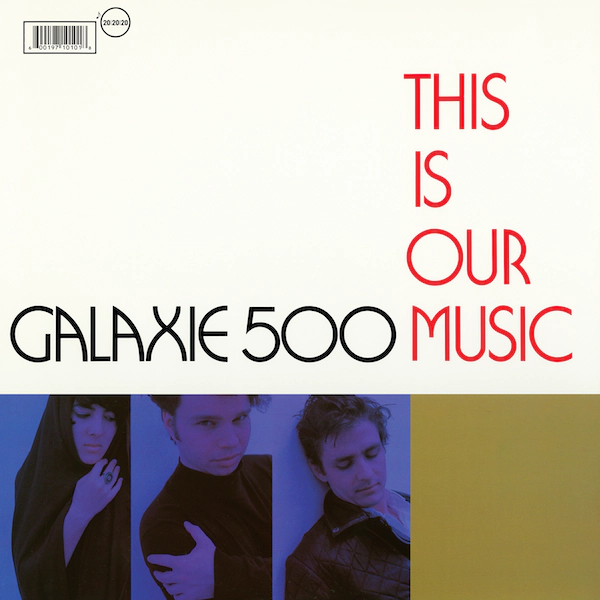
After producing two albums celebrated by a thirsty underground network of fans, Galaxie 500 released what turned out to be their unexpected swansong, “This is our Music”. The title is an intentionally declarative statement. After being labelled masters of the disengaged and forlorn, Damon Krukowsi, Dean Wareham, and Naomi Yang delivered a full-length comprised of their most stately material.
Here, one can hear potential realized, as well as changes afoot. “Fourth of July” is a surprisingly up-front song for the band, with rolling drums and a bass-heavy refrain, and it proved to be their most popular single. The track sets the stage for the dynamism of This is our Music. When Galaxie 500 sounds wistful (Summertime), it sounds like years of yearning actualized; when the band sounds regretful (Sorry), it comes pleading on its knees. The trio found a beautiful balance between increased production values and knob-twiddler Mark Kramers odd handed approach.

“On Fire” is widely recognized as the canonic pinnacle of Galaxie 500’s career. The artwork conveys this, with a low-angle shot of the band, looking up towards an amber sky. This record marked the realization of their signature sound. Nowhere is it clearer than on the album opener, “Blue Thunder“, the closest a song can come to waves crashing on a beach in song-form. Lyrically inconsequential, with a chorus composed entirely of la’s, the tracks power lies in a systematic build and break of intensity that reaches a Spector-like climax. It is the quintessential Galaxie 500 song, encapsulating all that was great about the band. With the Boston trio once again utilizing the bizarre genius of producer Mark Kramer,
“On Fire” sounds like anything but. The guitars are warm blankets enwrapping Dean Wareham’s vocals, percolated by the open percussion of Damon Krukowski and anchored by the emotion-laden bass of Naomi Yang. Songs like “Snowstorm”, “Strange, and Decomposing Trees” have an endless quality, without beginnings or ends, but rather frozen somewhere on a spectrum of melancholy.

When Galaxie 500’s “Today” was released in 1988, it set off a chain reaction of quiet explosions still being felt. Never before had a record so emphasized the calming elements of rock music, transforming what at first seems like a collection of bridges into fully realized songs. and one can draw a straight line from here to the many groups they influenced, like Low, Belle and Sebastian, and Bon Iver.
“Today” is full of idiosyncrasies. The trio of Damon Krukowski, Dean Wareham, and Naomi Yang were recent Harvard grads who intuitively eliminated any histrionic tradition to rock songs, leaving core emotion (not for nothing did they include a cover of “Don’t Let Our Youth go to Waste”, by the kings of feeling, the Modern Lovers). It was produced by Mark Kramer, who was best known for his work with cataclysmic slop rock pioneers such as Bongwater, Ween, and King Missle.
The bands hometown of Boston was just coming out of its love affair with Mission of Burma and pouncing upon the spasmodic electricity of the pixies. despite, or perhaps because of, all these elements, “Today” thrived. More than 30 years after its initial release, its title is still no misnomer. the music, recorded with what many thought at the time was too much reverb, sounds present, alive, and indeed a product of today. Songs like “Flowers”, “Temperatures Rising“, and of course “Tugboat” (the bands debut single) stand the test of time and exist in an eternal now
Playing was always fun. Making the first record was probably the most fun. It turned out a lot better than we expected, and all these years later I find that’s somehow why I write ‘entertainer’ on my tax return.”
Galaxie 500 Live London 1990. Probably recorded February 11th, which is when Galaxie 500 were in London to play at the Falcon. Broadcast on Feb 16th 1990, recorded by me, from analogue satellite Scart connected to an AKAi VCR, recorded at SP. A few promos were shown during this show, but I edited them out, leaving just the interview and live performance.
Few bands embodied cool with such ease as the 80s collapsed into the 90s. Wareham, a New Zealand-born Australian by upbringing, lent the group a sensibility that set them apart from their Boston peers, while Damon and Naomi’s taste and restraint were as decisive as Dean’s guitar. And then there was Kramer: producer, bassist and mercurial in-house architect of Noise New York, the tiny but iconic East Village studio where so many weirdo classics of the era took shape. Kramer’s production didn’t just capture Galaxie 500; it gave them a frame, wrapping their fragility in tape warmth and negative space.
Their refusal to reform made last year’s compilation Uncollected Noise New York ’88-’90 hit all the harder. Galaxie 500’s first release of new archival material in nearly 30 years, it stands as their most comprehensive collection of unreleased and rare recordings to date. Across 24 tracks, it captures the complete Noise New York studio sessions, including outtakes and non-album material, tracing their entire arc. Shaped in lockstep with Kramer at Noise New York, these songs are desire lines toward a certain sorcery.
 The Fat Angel Sings