

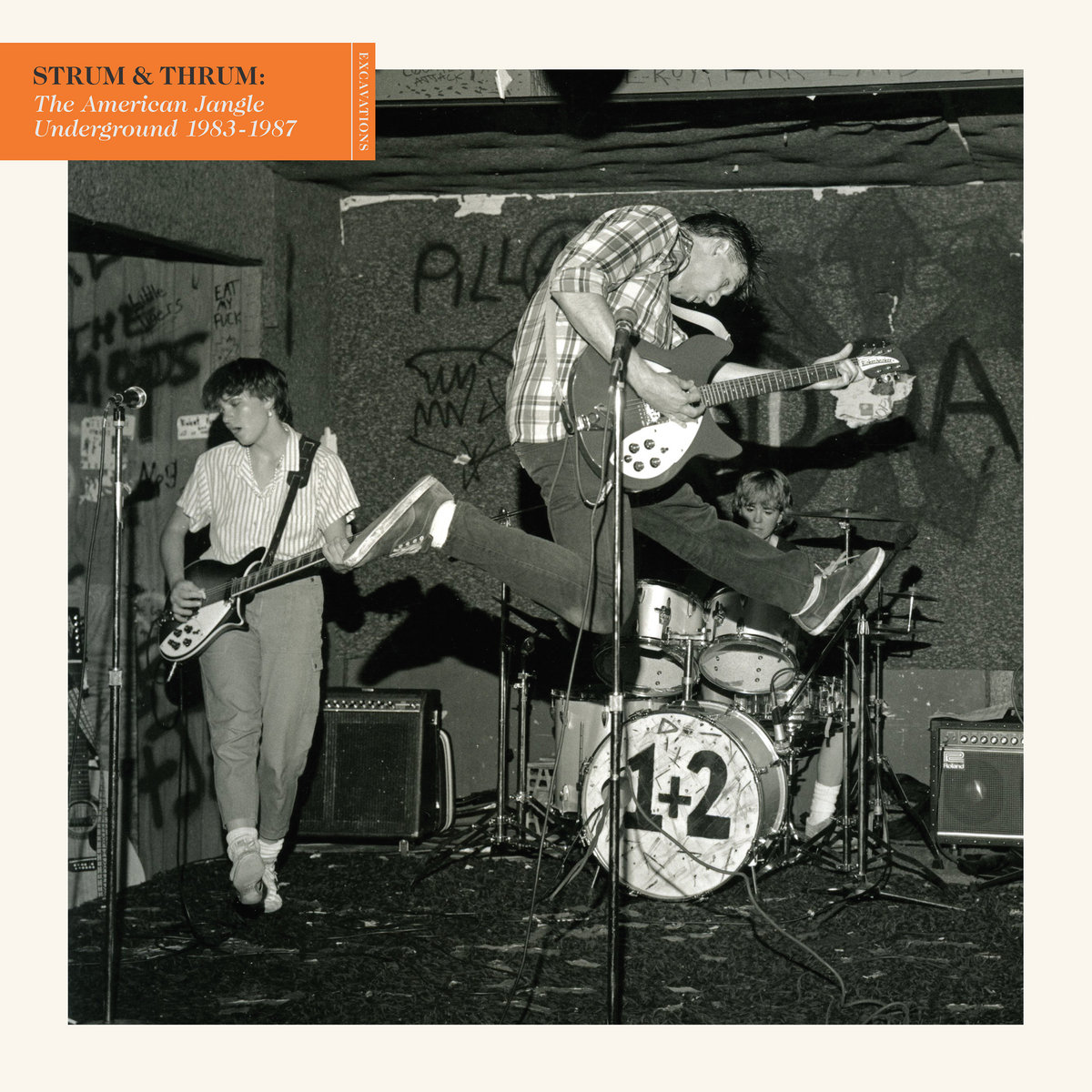
“Strum & Thrum: The American Jangle Underground 1983-1987” is the first volume of Captured Tracks’ new venture into compilations – Excavations.
Inspired by Pebbles, Killed By Death, Soul Jazz and Numero Group compilations, Excavations is a series dedicated to compiling forgotten music from the 1970s – 1990s that has a connection to Captured Tracks’ sound and aesthetic. Much like the Cleaners from Venus, the Wake, and Saäda Bonaire reissues we’ve put out, Excavations releases will bridge the past to our current roster and showcase the kinds of sounds that inspire us.
It makes sense that the first volume of Excavations is Strum & Thrum. As an American label, we’ve often wondered why British, Aussie, and Kiwi indie rock from the ‘80s has had the most influence on modern acts and the collector’s market. Granted, the music released on Creation, Sarah, Cherry Red, Postcard, Flying Nun, et al. during that era was fantastic, but a parallel to this sound existed in the US and Canada as well. Outside of bands like R.E.M., the Rain Parade, the Dream Syndicate, and a few others, most of these bands received little attention from national or international press outlets and markets – unless they opted for a “big ‘80s” sound and signed to a major. The acts on this compilation are the antithesis of that, with a true DiY spirit that lead many of these bands to self-record and self-release within tiny local scenes in small cities and college towns across America.
Though hardcore dominated the American underground at the time, the indie scene was no less vital and operated utilizing many of the distribution channels hardcore set up. The two genres may have sounded nothing alike, but the DiY ethos and dedication to community was the same… But this isn’t the story we’re used to hearing. While noted underground archivist and compilation producer Johan Kugelberg has called the ‘80s the “Dark Ages” of indie rock, Strum & Thrum aims to shed light on this forgotten era of jangly, melodic rock music that emerged from the ashes of post punk and helped kick start the indie rock boom of the early ‘90s that continues to this day. Indeed, many artists featured on Strum & Thrum went on to be part of this boom – Archer Prewitt from the Sea & Cake, Jon Ginoli from Pansy Division, Ric Menck from Velvet Crush, Brent Rademaker from Beachwood Sparks, Barbara Manning, and more went on to be in well known bands in the ‘90s.
We’re very proud of this compilation and guarantee it’s an essential listen for any fan of classic ‘80s indie bands like the Go-Betweens, Felt, the Church, the Bats, Shop Assistants, and the like. And if you’re a fan of the early records Captured Tracks released by Beach Fossils, DIIV and Wild Nothing, you’ll find a lot to love here as well.
At a time when Sonic Youth were imploring people to “Kill Yr Idols,” Strum & Thrum’s musicians were emulating them: They drew sustenance from the Byrds’ radiant Rickerbacker tones; the spare, poignant intro to the Velvet Underground’s “Heroin”; and early R.E.M.’s rambling approximations of Roger McGuinn’s guitar sound. Post-punk and no wave are nowhere to be heard in their orderly compositions. These groups almost uniformly privilege the guitar, and rarely do they disrupt a steady beat—although Start deviate from the prevalent 4/4 and Sex Clark Five dabble with quasi-prog-rock chord progressions and tempo switches. The stylistic niche plowed by most of the 28 acts here is narrow and, culturally and aesthetically, white. Not a scintilla of blues, funk, soul, jazz, or dub exists in these prototypical indie-rock songs. (The main points of Sasha Frere-Jones’s 2007 essay “A Paler Shade of White”—namely, that ’00s indie rock was defined in no small part by its aversion to the rhythmic expressions of mid-20th century, African-American popular music—could apply to Strum & Thrum.)
Music historian (and former Matador general manager) Johan Kugelberg regards the era documented here as American indie rock’s “Dark Ages.” Nevertheless, vibrant scenes were sprouting in college towns and small cities. Captured Tracks has dug deep to find gems from those microcosms. Luckily for these artists scorned by major labels and commercial radio, the college-radio infrastructure was burgeoning, connecting their smart, concisely constructed rock with students and zine-readers nationwide. The uninitiated, and those not alive during Reagan’s bleak reign, can learn much from Strum & Thrum about this stratum of sensitive-person rock.
The deities to which the majority of the comp’s artists genuflect are the Byrds and R.E.M., with occasional nods to the Smiths and Scottish label Postcard’s roster (Aztec Camera, the Go-Betweens). A substantial chunk of the album sounds like outtakes from “Chronic Town” and “Murmur“: For instance, the staccato rock of Holiday’s “Change” is essentially R.E.M.’s “1,000,000,” but with vocals influenced by the vivacious delivery of Kate Pierson, of the B-52’s. Strum & Thrum wholeheartedly champions verse-chorus-verse song structures, with no extravagant solos and few deviations from standard rock instrumentation.
With sonic innovation and political commentary off the table, these bands focused on writing catchy melodies, wittily rendering romantic entanglements and youthful musings, and generating those all-important guitar tones—the “jangle” and its close kin, the “chime.” The radiant timbres here generally signify innocent wonder and indomitable joy, despite the chronic threat of nuclear war fostered by American and Soviet leaders. Columbus, Ohio’s Great Plains slaughter doom with “When Do You Say Hello?,” a song so jittery it makes the Modern Lovers’ “Roadrunner” seem like it’s in first gear. The Ferrets mine party-starting gold with “She Was Unkind,” which audaciously fuses riffs from the Byrds’ “Mr. Tambourine Man” and the Kinks’ “She’s Got Everything.” The Springfields’ Sunflower” attains a peak of Rickenbacker bliss via a fey paean to nature that could make Brian Wilson sigh.
Some of the more interesting songs here skew darker, including “Seven Steps Down,” by Salem 66, a Boston group, founded by three women, that crafted some of the most alluring hooks of the ’80s underground yet never transcended cult status. You can hear seeds of Helium and Liz Phair in their surprising dynamics and bewitching earworms. The modestly triumphant 28th Day rocker “Pages Turn (Alternate Version)” offers an early example of Barbara Manning’s ingenious songwriting and poignant vocals. On Riff Doctors’ “Say Goodbye,” singer Donna Esposito expresses the bittersweet feeling of liberation after a soured relationship, but the music radiates a restrained elation, a trick also perfected by the Smiths. The most rhythmically robust song here, Absolutely Grey’s “Remorse” is an emotional roller coaster in which Beth Brown sings, “I feel a bit remorseful now that you’re dead/But no more darkness in your head” like a female Gordon Lightfoot, her mossy tone catching with overwhelming emotion.
Taking cues from reissue specialist labels such as Numero Group and Soul Jazz, Captured Tracks has unearthed deep cuts from a stratum of rock that’s been swathed in apathy for over three decades and puts them into context. While it might be a stretch to say that Strum & Thrum’s artists influenced many of today’s indie rockers, it nevertheless represents a vault full of potential holy grails for fans of, say, Car Seat Headrest or Cloud Nothings. Captured Tracks owner Mike Sniper wants Strum & Thrum to prove that America’s ’80s underground rock bands merit the same respect as those from their more heralded British and New Zealand counterparts on labels such as Creation and Flying Nun. That’s a tall order, but even if he hasn’t quite succeeded, Strum & Thrum does an admirable job casting some much-needed light on those “Dark Ages” of American indie.
Spread across two LPs, Strum & Thrum includes an 80+ page booklet with an extensive oral history of the ‘80s indie scene, an introduction by Captured Tracks label head Mike Sniper, and tons of archival images and ephemera. Long live the jangle underground!
 The Fat Angel Sings