

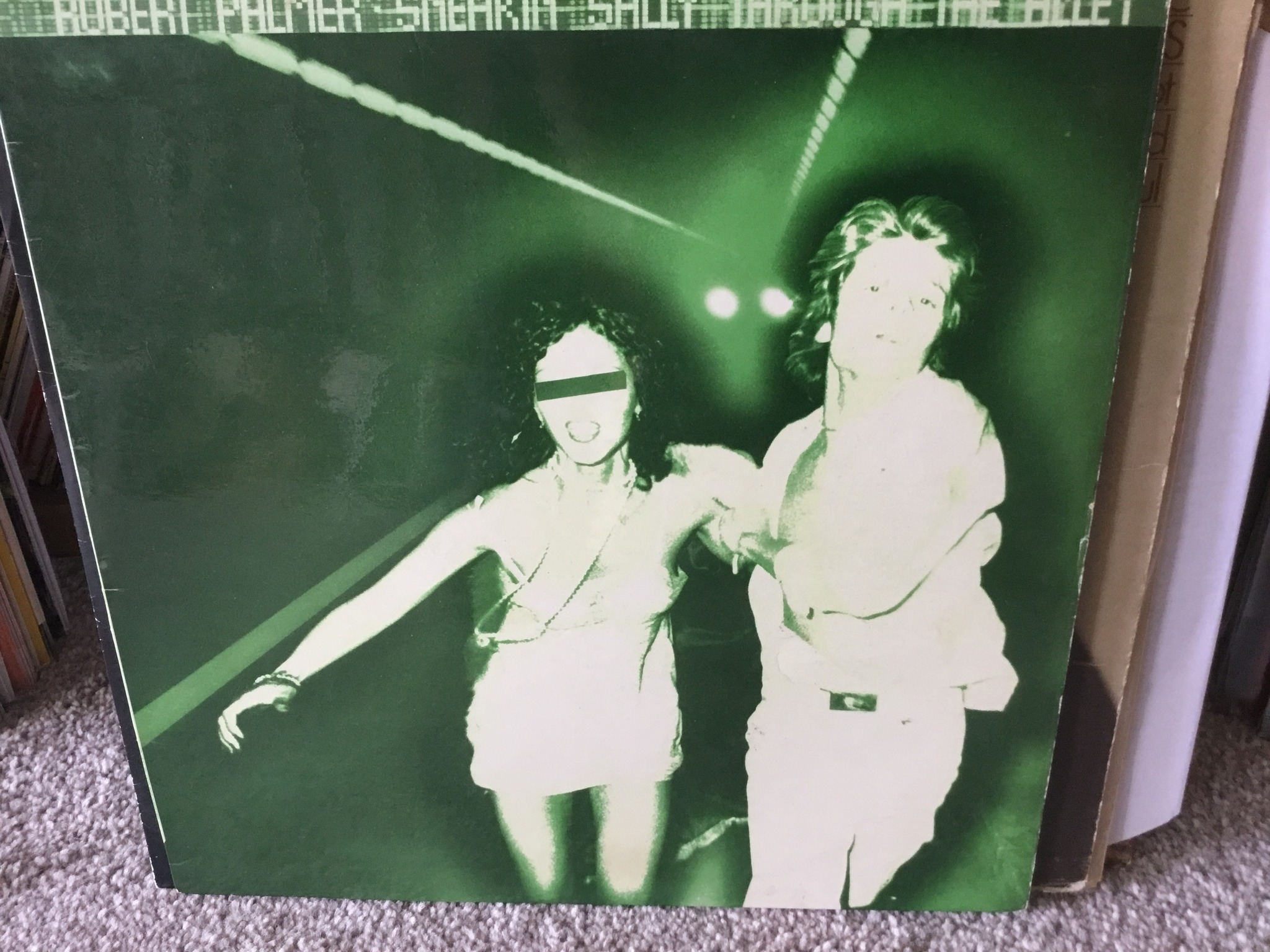
Did you ever wonder who played what and where on Robert Palmer’s “Sneakin’ Sally Through The Alley”? (The album never really listed any credits.) Lets start with the band line up The Meters in New Orleans and Stuff in NYC, add Lowell George from Little Feat, Vicki Brown on backing vocals and sprinkle with other top shelf musicians and you’ll have one of the most funky, iconic records of 1974!
Follow along below as the album kicks off with the most perfect trifecta of tunes, “Sailin’ Shoes” “Hey Julia”, “Sneakin’ Sally Through The Alley”! , when Island Records signed the 25-year-old English singer Robert Palmer, he’d already had a decade of experience, from his Yorkshire high school band the Mandrakes to the Alan Bown Set, the Stax-meets-jazz-fusion big-band Dada, and their more successful offshoot Vinegar Joe.
In that group, Palmer was a relatively sedate co-lead-singer with the raunchy, often alcohol-fueled “wild woman” Elkie Brooks; after three albums Vinegar Joe sputtered out, but both vocalists got solo deals.
Island’s Chris Blackwell agreed Smith would take Palmer in hand. producer Steve Smith, who had cut his teeth working in the famed Muscle Shoals, Alabama, scene, Smith in turn lined up engineer Phil Brown, who’d worked with the Rolling Stones, Led Zeppelin, Jeff Beck and Jimi Hendrix. The album that would be called “Sneakin’ Sally Through the Alley” was starting to develop a deep bench. the Meters were to be Palmer’s main backing band: Art Neville on keyboards, Leo Nocentelli on guitar, bassist George Porter Jr. and Ziggy Modeliste drumming. At Media Sound Studios in New York City, Smith booked the virtuoso session musicians collectively known as Stuff: keyboardist Richard Tee, guitarist Cornell Dupree, Gordon Edwards on bass and Aretha Franklin’s current drummer Bernard Purdie.
There was yet another ace-in-the-hole, Little Feat guitarist Lowell George, who played in both cities after Smith invited him into the mix. “Working with him was great,” Palmer said because you’d catch onto a grain of an idea and the next time you looked at your watch, it was a day later and you hadn’t done anything but gone with that idea. In the meantime, ideas would just fly back and forth. Suddenly, you’d take a left turn and bang, there’d be a song. It was just music, music, music with him. I don’t really find anything wrong with the word ‘obsessive.’ I especially loved the way he played guitar.”
The idea to record Little Feat’s “Sailing Shoes,” which became the opening track, was actually spontaneous, when the Meters, who’d never heard of Little Feat before meeting George, began messing with it in rehearsals with him. Their version is way funkier than Little Feat’s original, and Palmer sings the hell out of it. Neville’s clavinet is out front, and Vicki Brown adds a backing vocal that lights up the chorus.
“Sailing Shoes” runs straight into Palmer’s original “Hey Julia,” which, according to Smith, includes the very first use of a drum machine on a record. As a massive Beatles fan, Smith latched onto the idea of segueing a sequence of songs together: “All I was trying to do was to give Robert as dynamic an opening to his recording career as possible.
Allen Toussaint’s “Sneakin’ Sally Through the Alley,” which Lee Dorsey had first recorded in 1971, erupts immediately after “Hey Julia,” with the Nocentelli/George loose-as-a-goose duo in high gear, an absolutely riveting harmonica part from Steve York, and Palmer pushing his voice with intense authority. The whole track is a highlight reel, but George Porter Jr.’s bass has to get special mention.
The first thing heard in “Get Outside” is Gordon Edwards’ bass guitar. Edwards was James Brown’s go-to bassist for many years, but here he’s in a more contemplative mood, even when the rest of Stuff and Robert Palmer keep turning up the heat. Palmer tries out a number of vocal effects, twisting into growls, grunts and shouts in what sounds like an extended studio jam on the basic structure of his simple and effective melody. George’s slide guitar and Dupree’s electric bring terrific atmosphere, Tee plays a number of keyboards, including organ and acoustic piano, and if you want a drum lesson just listen to Purdie, especially from the three-minute mark. Once more, the “sweetening” sessions in London hit gold, with Vicki Brown singing and Gaspar Lawal’s surprising percussion.
Guitarist Richard Parfitt joins the New York crew for the only Palmer-George co-write, “Blackmail.” According to Smith, George and Palmer went to a hotel room, ordered room service, and came up with this loose little kicker that’s second cousin to Little Feat’s “Dixie Chicken”: “You told me that you weren’t infectious/So I brought no precautions with me/And you said your old man was in Texas/And anyway he’d forgotten his key/So I put my cassette in your bathroom/And threw all my clothes on your floor/Next thing, door bursts open/And there I am caught in the raw.”
“How Much Fun” starts off sounding an awful lot like Little Feat, but gets more Meters-like as it goes on. There’s a full-on female backing chorus, the band’s locked in a nice groove, and Palmer’s lead vocal is fine, but the track’s nothing special in the context of what surrounds it.
The version of Toussaint’s “From a Whisper to a Scream,” which the composer had first recorded himself in 1971, is a winner from the first wah-wah pedal. A swampy atmosphere is immediately established through more stellar work from Porter, George, Nocentelli and guest Chris Stainton, formerly of Joe Cocker’s Mad Dogs and Englishmen band, on acoustic piano. Palmer sounds more than a bit like Free’s Paul Rodgers at this tempo, and that’s not a knock. He even shows he can go into a falsetto as pure as Smokey Robinson’s. Smith explained, “Allen owned the studio and had an office there so he was in and out the whole time. I asked him to present ‘Whisper’ to the musicians and he played it for us on the acoustic piano so we could learn the chord sequence. We changed the key to accommodate Robert’s best vocal range and then funked it up Lowell and Meters style until I was happy with the arrangement.”
The surprising album closer is the 12-minute studio jam “Through It All There’s You.” The enhanced Stuff features Steve Winwood on acoustic piano, Onaje Allan Gumbs’ electric piano, Mel Collins’ sax and Mongezi Feza’s trumpet. It represents Palmer’s “idea of pure funk” according to Smith. It bears some resemblance to Dr. John’s “Walk On Gilded Splinters,” and like that recording achieved some late-night FM radio airplay as the DJs could throw on for a food or bathroom break. It’s not exactly the strongest ending for Palmer’s debut, but it was his call.
Wrapped in an eye-catching sleeve photograph by Graham Hughes that positively screams “this album’s going to be a lot of fun,” the September 1974 release stalled at #107 on the Billboard album chart. It’s gained in stature as the decades have passed. (The jam band Phish have pledged their allegiance through more than 80 live performances of the title track, which they started playing in 1985.)
Palmer’s follow-up album Pressure Drop was solid, and utilized the entire Little Feat band, but didn’t bring him the stardom he was ready for. Island stuck with him; it took a while longer for the world to catch up with Palmer’s rare talent, when the pop charts were graced with “Every Kinda People” (1978), “Bad Case of Loving You” (1979) and the phenomenon of “Addicted to Love” (1986) and its meme-worthy video. Grammy awards and platinum sales levels brightened Palmer’s life until his tragically early death, of a heart attack, at the age of 54.
 The Fat Angel Sings