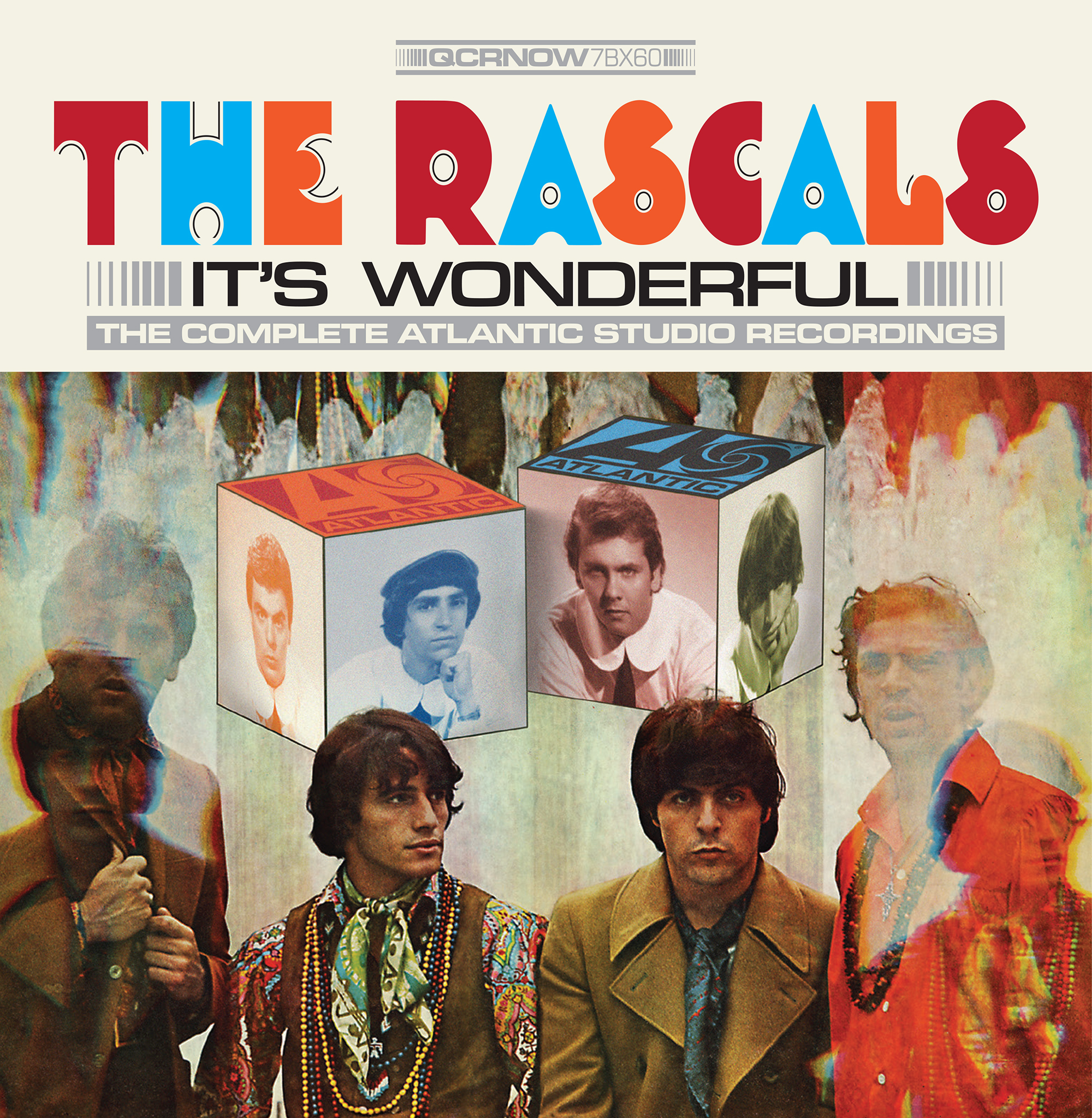
The great rock and soul band, first known as The Young Rascals, and later, simply, The Rascals, delivered some of the great sides of the mid-to-late ’60s with such era-defining singles as “Good Lovin’,” “Groovin’,” “It’s a Beautiful Morning” and “People Got To Be Free.” Now, the group’s entire Atlantic Records output, spanning 1965-1971, is being released on May 2024, on Now Sounds via the U.K.’s Cherry Red Records, as a 7-CD box set, “The Rascals: It’s Wonderful: The Complete Atlantic Studio Recordings”. The 152 remastered songs include 14 previously unreleased tracks. The first four albums are presented in both stereo and mono, along with significant single edits and foreign language versions. The collection includes a 60-page booklet with detailed notes and rare illustrations from The Rascals archives.
“Time Peace: The Rascals Greatest Hits” marked both the culmination of the former “Young” Rascals’ early career and the transition to a new beginning. More than the “best of” it was intended as, it was an effective compilation of the seminal hit singles the band amassed during its chart-topping seminal period, from 1965 throughout 1968, beginning with their first record to capture attention, “I Ain’t Gonna Eat Out My Heart Anymore,” through to 1968’s chart-topper, “A Beautiful Morning” (A.K.A. “It’s a Beautiful Morning”).
Not surprisingly, “Time Peace”, released on June 24th, 1968, topped the U.S. album sales chart and enjoyed an extended run that lasted some 20 weeks. Just as significantly, it documented the trajectory of a group that initially made its name as a white group that could purvey pure R&B. Many didn’t realize until much later that they themselves weren’t a black band. That said, their visual image certainly didn’t lend itself to that impression, given the attempt to exploit the “rascally” persona by dressing in knickers, wide-collared shirts and caps of a schoolboy variety.
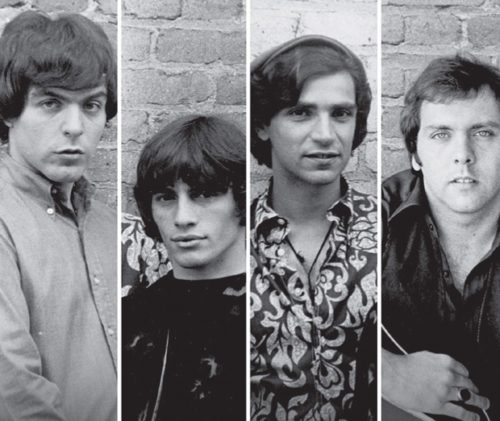
The Rascals were: Dino Danelli, Eddie Brigati, Felix Cavaliere, Gene Cornish Rascals keyboardist Felix Cavaliere, percussionist Eddie Brigati, drummer Dino Danelli and guitarist Gene Cornish evolved and matured rapidly. Original material, mostly by Cavaliere and Brigati, the group’s primary lead vocalists, began to dominate their albums, and they started to incorporate elements of jazz, rock, psychedelia and more. The result was some of the finest popular music of its time.
Nevertheless, The Rascals were clearly more than a novelty. They became an international sensation, appearing on The Ed Sullivan Show and even opening for the Beatles at Shea Stadium. More importantly, they were a potent instrumental outfit. Felix Cavaliere’s trademark organ flourishes helped define their sound, while guitarist Gene Cornish proved an able resource when it came to driving them; the relentless riffing on one particular song on “Time Peace, “Come On Up,” serves as a prime example. As for Dino Danelli, suffice it to say he remains one of the most underrated drummers in the annals of rock ’n’ roll, a powerhouse performer very much in the same vein as Keith Moon.
As time went on, the Rascals began to veer away from the R&B covers that had helped sustain them early on. While several early offerings that were penned by others had a prominent place on “Time Peace” specifically their first big hit, “Good Lovin’,” and the perennial soul standards “Mustang Sally” and “In the Midnight Hour” the album also effectively documents the evolution of the Cavaliere/Eddie Brigati songwriting team. (Brigati, who initially sang lead and took the fore on “I Ain’t Gonna Eat Out My Heart Anymore,” eventually ceded that role to Cavaliere and settled instead for backing vocals and percussion.)
The two made their mark as co-writers, with several of the songs on this collection—“You Better Run” (later a hit for Pat Benatar), “Love Is a Beautiful Thing,” “A Girl Like You,” “How Can I Be Sure,” “It’s Wonderful,” “It’s a Beautiful Morning” and, of course, “Groovin’”.
Those songs also reflected the fact that, at this point, the Rascals could be considered more than a mere a pop band. “Love Is a Beautiful Thing,” “Beautiful Morning” and “A Girl Like You” found them expanding their instrumental arsenal with brass and orchestration. (Listen to the inventive combination of harps and horns that embellish the latter.) They incorporated jazz influences as well, soliciting contributions of such renowned musicians as flutist Hubert Laws to place them on the periphery of a more progressive sound.
On the other hand, the selections credited solely to Cavaliere, “Come Up Up” and “(I’ve Been) Lonely Too Long,” dealt mainly with courtship, love and occasional heartbreak, but managed to do so in a way that was as personal as they were poignant. It was a theme echoed early on with “I Ain’t Gonna Eat Out My Heart Anymore” and later through any number of other songs in this collection, including “You Better Run,” “Love Is a Beautiful Thing” and “How Can I Be Sure.”
So while “Time Peace” could be considered a document detailing the end of an era, it also marked a makeover. The album that preceded it, “Once Upon a Dream“, was an attempt to break from their commercial constraints and offer instead a conceptual offering that Cavaliere wistfully referred to as an attempt at a “Sgt. Pepperish” production. They would continue in that vein long after Time Peace as well, releasing a string of ambitious epochs—”Search and Nearness, See, Peaceful World” and “The Island of Real” well into the early ’70s.
Incredibly, the group’s “People Got To Be Free,” was released as a single in July but wasn’t included on the “Time Peace” album, which had been issued just a week earlier. It became the band’s third song to reach #1. (It was included months later on their 1969 album, “Freedom Suite“.)
From the label’s announcement: In the mid-1960s, the Rascals fused the best of rock and soul and they remain one of the most beloved of acts of that era. The electrifying quartet of Felix Cavaliere, Eddie Brigati, Gene Cornish and Dino Danelli defined the term blue-eyed soul. As the hits mounted up, the group expanded their musical horizons and revealed a powerful songcraft with introspective originals “Groovin’” [one of the group’s three #1 singles] and “How Can I Be Sure,” both future standards.
Although the Rascals are principally remembered for their singles, their albums were also studded with gems, and showcased not just their signature rock and R&B styles but also a progressive exploration of jazz, Eastern modes, psychedelia and other diverse styles. This set presents the full complement of their cornerstone Atlantic recordings, featuring the band’s seven LPs for the label—the first four in both mono and stereo variations—along with assorted non-LP singles, foreign language versions and, for the very first time on a Rascals reissue, 14 previously unreleased tracks.
It’s Wonderful is the definitive compendium of the group’s first five years 1965-1971, charting their growth from New York club band to international superstars. Compiled and suitably remastered by Alec Palao, this major refurbishment of their catalogue leaves no stone unturned. A nearly 10,000-word essay by Richie Unterberger provides an in-depth account of their career, and is supplemented by an extensive session history and copious illustrations from the Rascals Archives. All housed in a deluxe, handsomely appointed box art directed and designed by Steve Stanley.
Stevie Van Zandt heaped a ton of praise on the Rascals when he inducted them into the Rock and Roll Hall of Fame in 1997. If you think he was being hyperbolic, you probably haven’t heard the group, which likely means you weren’t around in the mid- and late 1960s.
“It’s Wonderful” includes a 60-page book with a 10,000 word essay penned by Richie Unterberger, and tons of rare photos from the Rascals Archives.
 The Fat Angel Sings