

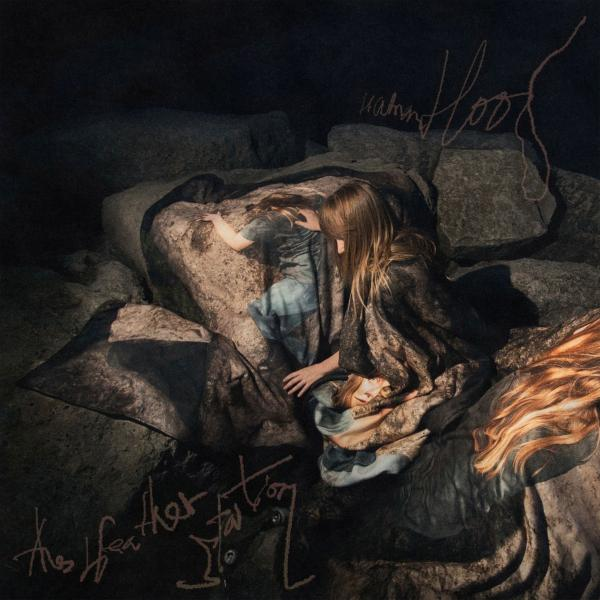
When the Weather Station released their critically acclaimed album “Ignorance” in 2021, Tamara Lindeman, the band’s driving force, became the accidental orator on the ongoing climate crisis. Revisiting “Ignorance’s” infectious palette and embracing improvisation, Tamara Lindeman overcomes pain and uncertainty to reconnect with herself on this her seventh album.
That record spoke of an ever-increasing sense of fear, decay and grief whilst also trying to hold onto the wonderment and beauty in nature. Four years on, the state of the world hasn’t shown much sign of improvement, and the Weather Station’s seventh record, “Humanhood”, shifts its focus from external anxieties to a paralyzing internal strife. In the process of reconnecting with herself, Lindeman fought to keep her head above water, her gaze searching for the sky.
“Ignorance” was a watershed moment for Lindeman, taking a detour from the understated indie-folk that had steered the Canadian outfit’s earlier output. Songs like “Tried To Tell You,” “Parking Lot” and “Loss” boasted anthemic qualities that presented themselves not as polite invitations to dance, but as insistences of joyous movement. The growth in her lyrical narratives were matched with the impressive breadth of the record’s enveloping instrumentation, which required a broader field of musicians. However, just as fans had adapted to the Weather Station’s newfound exuberance, Lindeman promptly revisited the songs she’d penned during “Ignorance’s” conception, seeking closure on its themes with the sparser and delicate follow-up in 2022, “How Is It That I Should Look At The Stars” (2022).
The sonic differences between those companion albums left audiences wondering what direction the Weather Station would explore next. For Lindeman, however, making those first steps didn’t feel possible. It wasn’t that the path was unclear–she simply didn’t have a vessel to make the journey. Before she could make progress with new music, she had to reconnect with all aspects of her being first.
On “Humanhood”. “Your body fooled you,” Lindeman sings on “Body Moves,” a smooth, celestial jazz song that wraps around the listener with a welcome warmth emanating from an infectious piano and sax motif completed with softly brushed drums. A skilled lyricist and earnest performer, when Lindeman presents audiences with her vignettes characterized by a defining feeling. The sincerity coursing through the song, elevated by the dynamic and rich arrangements, are so immediately effective in drawing you further into a world where its imperfections are highlighted instead of hidden.
Over the course of the record, we follow Lindeman as she finds healing in natural surroundings. Water, in particular, provides a crucial lifeline as expressed on the title track: “Maybe if I go down to the water / Maybe I can get back into my body.” In an interview preceding “Humanhood’s” release, Lindeman described the vitality and security she gets from being outdoors, calling the woods “the place [she’s] always felt the safest, the most free, or the most [herself].” “If no one can see or hear me, I feel very free,” she said. “When I write about the natural world, which I do on every record and often every song, it’s returning to the source or connecting back to the deepest thing for me.”
Along with the Weather Station’s core recording band (Ben Whiteley, Kieran Adams, Karen Ng), Lindeman welcomed Sam Amidon, Drew Jurecka and Joseph Shabason to add even more colour and depth to what are some of her most ambitious compositions to date. Elsewhere, Laurel Sprengelmeyer—the Montreal-based artist better known as Little Scream—is credited with providing lyric consultation. The fullness in the studio is felt in the deft turns these songs take, particularly in the closing moments of “Neon Signs” and “Sewing.” splits itself with a blanket of luminous synths which momentarily brings a sense of security before retreating and leaving Lindeman alone with nothing but the pulse of a fragile piano accompaniment.
“Descent.” An improvised piece, it serves as an extended intro for the propulsive stomp of “Neon Signs,” a song in which consumerism and recollections of desire are in conflict in “a world without trust.”
“Descent” is one of three brief instrumental tracks acting as either an extended intro (along with “Passage”) or ambient pieces (“Fleuve” and “Aurora”); “Irreversible Damage” falls into the latter category, with a Radiohead-like inflection and artful composition.
Comparisons to Joni Mitchell have followed Lindeman from the beginning of her musical career, and there’s no denying the similarities in their cadences, especially when she engages the higher register of her vocal. However, “Humanhood“, evokes a far more compelling range of reference points.
Lindeman’s contemplative closing statement “Sewing,” on which she’s uniting the different patterns of her life (made from “pride and shame, beauty and guilt”) to make a blanket. In bringing these contrasting elements together, she appreciates the comfort in seeing a full and fulfilling image of what the future might hold.
 The Fat Angel Sings