

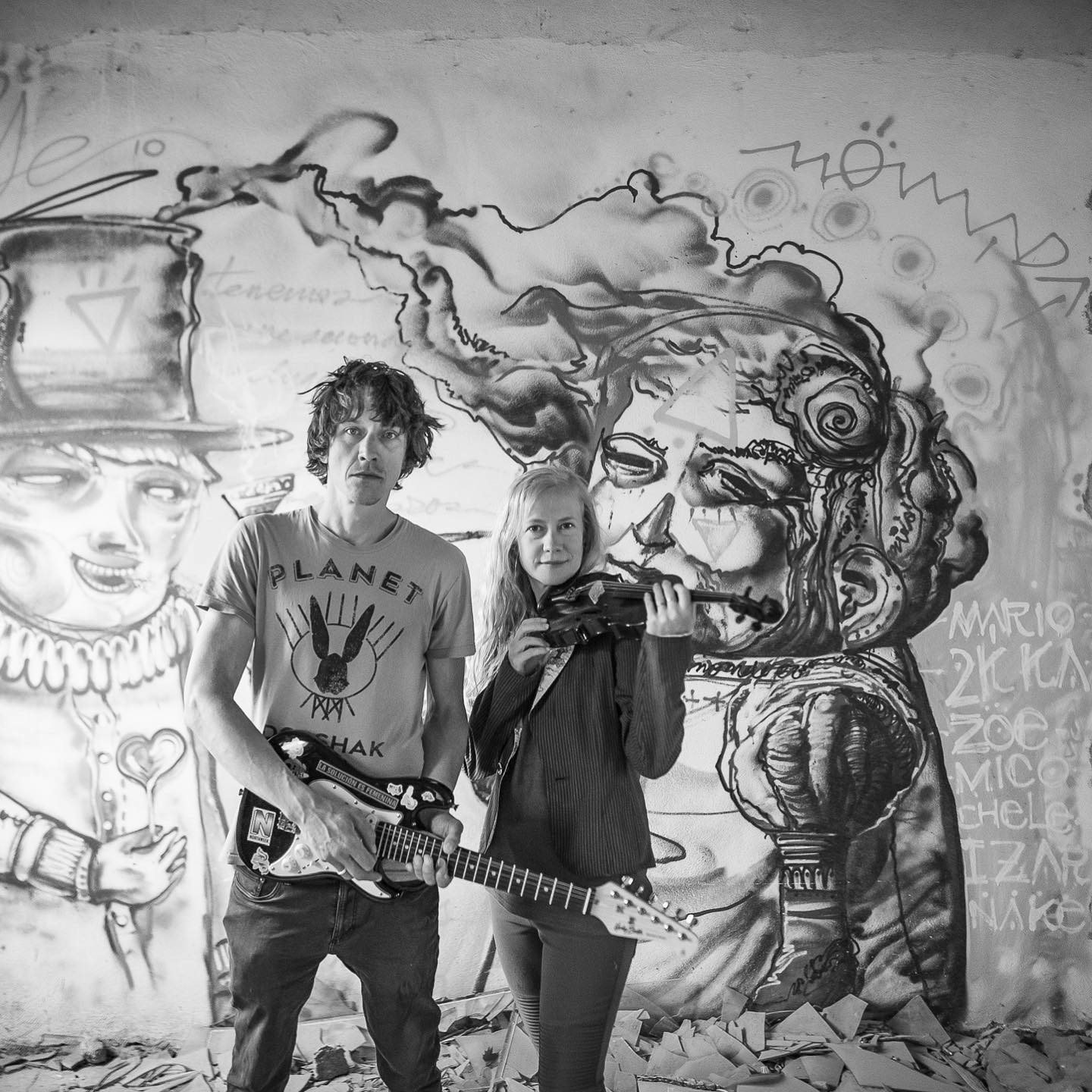
With Welsh traditional music flourishing in experimental arrangements and settings thanks to artists such as Cerys Hafana and Lleuwen, Peiriant’s second album (its title means returning) adds to that thrilling sense of motion. Rose Linn-Pearl’s folk fiddle melodies twist and lock with the post-rock-influenced guitars and drones, played by her bandmate and husband, Dan, conjuring up the sublime, jagged landscapes of their home in the Bannau Brycheiniog of mid-Wales. Mellifluous tracks like “Llethr” (Slope) and “Cân Idris” (Idris’s Song) sit side-by-side with the compelling, twitchy textures of “Gors” (Swamp) and “Carreg” (Stone).
Peiriant (pronounced pie-ree-ant) is a Welsh word for a machine or an engine, a fittingly eerie name for the atmospheric duo of violinist Rose and sound artist Dan Linn-Pearl. A couple who returned to their native Wales in recent years, and co-founded the Nawr concert series in Swansea and Hay-on-Wye (alongside free improvising harpist and Richard Dawson collaborator Rhodri Davies), their second album, “Dychwelyd” (pronounced Duh-ch-wel-id – returning), explores the idea of going back to a source in sound, marrying folk textures and techniques with shimmery, modulated guitars and post-rock drones.
Living in the mountainous Bannau Brycheiniog, through which the rivers Wye and Usk flow, Peiriant make music that is anchored to that landscape, revelling in its drama and delicacy, frills and fissures. Opener “Taflu Dŵr” (Throwing Water) begins with Rose hacking at her strings before her notes build to a cascade, her violin bursts sounding like the sprays of a river careering into the sea.
Then come her folk-evoking fiddle melodies, giving a human dimension to tracks such as “Carreg” (Stone) and “Llethr” (Slope). They scrape and fight in the former against Dan’s subaquatic pulses, conveying a mighty power. In the latter, they soar blissfully above subtler, iridescent electronics, suggesting a kite in gentle flight.
These are not long tracks. Out of eight of them, only the throbbing “Toriad-Agoriad” (Cut-Opening) and the quivering “Gors” (Swamp) are over four minutes long. Nevertheless, all act as portals to places that sound primeval and profound, building towards the blissful finale, “Llwyfan Dir” (Plateau). A moment on top of the world with violin and guitar pedals working together, its summery sheen brings an almost Balearic glisten to the idea of folk music, lighting it up like a beacon.
 The Fat Angel Sings