

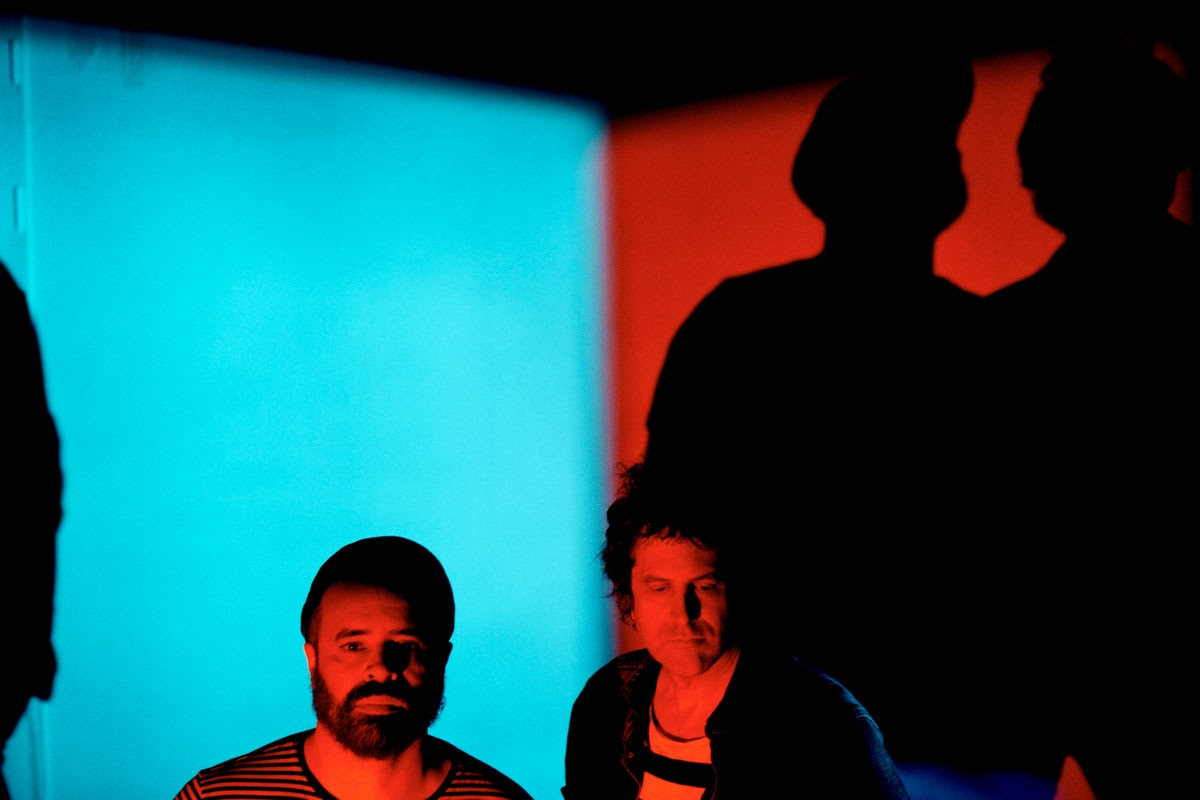
Swervedriver are among the most underrated band’s of their era, which is strange, considering they picked things back up after a decade away in 2008 and have since produced two fantastic records in “I Wasn’t Born to Lose You” and “Future Ruins”. Formed in Oxford in 1989 around core members Adam Franklin and Jimmy Hartridge. Between 1989 and 1998, the band released four studio excellent albums and numerous EPs and singles despite a considerable flux of members, managers, and record labels. By 1993 the band’s lineup had settled with Franklin on vocals/guitar, Hartridge on guitar, Jez Hindmarsh on drums, and Steve George on bass.
Fusing the muscular guitar work of J Mascis and James Williamson with the influence of groups like Sonic Youth and a touch of metal, they have everything right, from the pulsating rhythm section to the dovetailing work of guitarists Adam Franklin and Jimmy Hartridge.
Instead of debuting with a full-length album, Swervedriver released a series of four-track EPs over the span of a year, subscribing to the popular trend in the early ’90s. “If you had 4 songs ready-ish, you would record them there and then and put them all out ASAP. No such thing as ‘saving songs for the album’ back then,” explained Hartridge. Swervedriver’s debut offering, “Son of Mustang Ford“, was released in July 1990.
The group launched the release with an appearance on the John Peel BBC Radio 1 show in July 1990, performing a select B-side from each of their three debut EPs along with the song “Over” (which would not see an official release for 15 years). The release of “Rave Down”, the second EP in the series, followed in November. DJ Mary Anne Hobbs called its title track “a cyclone of wild, swollen riff machinery that sounds like it’s been played with dislocated shoulder joints.
Their third EP, “Sandblasted”, being described as “a head-on collision between guitars raging for chaos.
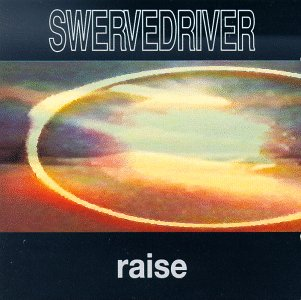
Raise
They are another band who got better when they burned off some of that haze, Swervedriver made a massive leap between their first album, “Raise”, September 1991. It was recorded at The Greenhouse & Falconer Studios and produced by the band, like their prior EPs, and included the title tracks from all three. We hadn’t been together that long when we started work on “Raise”. We’d recorded three EPs with Creation Records already, and then it came to the album. When we’d been looking for a label to get started with, Creation had been literally the last label we’d intended to give a cassette to. We had a bunch of cassettes made up of our demo which we gave to various labels. We had one left over and we thought, ‘What shall we do with this? Creation? They won’t sign us but let’s give one to Mark [Gardener, of Ride]”. And then the story is [Creation founder] Alan McGee was in LA in the back of a car looking for some music to play. He finds this tape given to him by Mark, of this band Swervedriver from Oxford and he puts it in – straight away it sounds great. the actual album was three singles – “Son Of Mustang Ford”, “Rave Down” and “Sandblasted” – and only six new songs. Considering we’d put out three EPs by then, which was 12 songs, in some ways I think it was quite strange that the album came out with only six new songs.
Regarding the group’s overriding fascination with everything automotive, Franklin had said, “the car thing came from twisting around rock ‘n’ roll imagery. Chuck Berry used to sing about cars. T. Rex used to sing about cars, and being in the car is just a good place to hear music.
Swervedriver’s fourth EP, which featured the “Raise” outtake “The Watchmakers Hands” and the track “Scrawl and Scream”, a slowed-down reworking of “Afterglow”
“Rave Down“. It was the first recording we were really happy with and it just has this energy to it that is brilliant.
Using footage from their first leg of touring, A&M representatives Jeff Suhy and Scott Carter produced the video “On the Road with Swervedriver: A Rockumentary”, which also featured interviews and the music videos for “Son of Mustang Ford” and “Sandblasted”, So “Raise” was released, then we go on tour, and… the band falls apart almost immediately. Graham Bonner, our drummer, famously left for a sandwich after a show in Boston never to return.
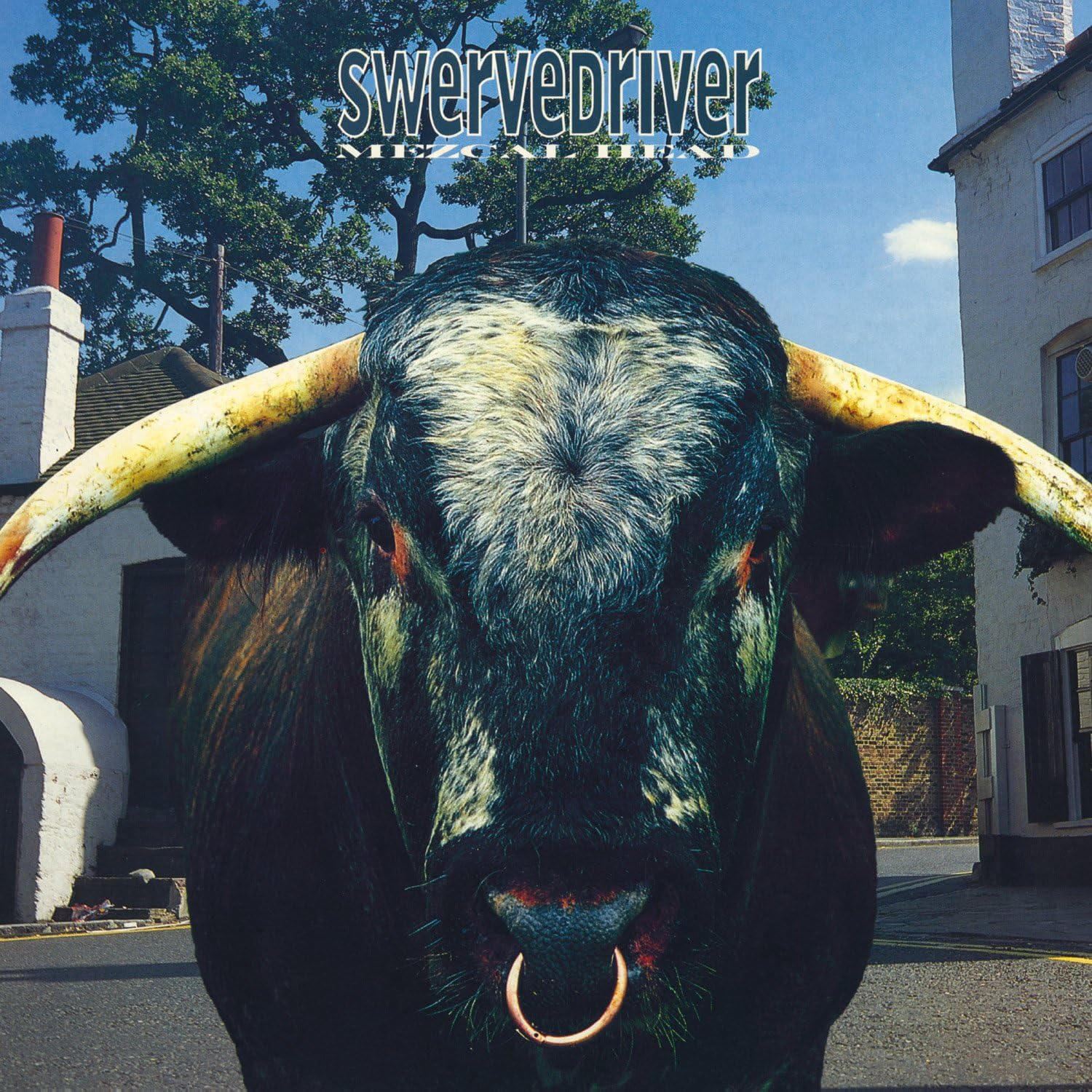
Mezcal Head
Their second, “Mezcal Head”. A big part of that was a new line-up of the band which included a much-improved rhythm section of drummer Jez Hindmarsh and bassist Steve George that could really rip. Ultimately after touring “Raise” infighting within the band led to departure of two members all that remained of the band according to Franklin was, “myself, Jimmy Hartridge and some effects pedals”,
My thoughts on “Mezcal Head” are that I would’ve changed the track-listing slightly. I may have taken “A Change Is Gonna Come” off, possibly, but I appreciate that that song was quite different and it’s quite a strange song for us. But I would probably replace that with “Planes Over The Skyline”, which I think should’ve been on the album.
And “The Hitcher” I think “The Hitcher” is a classic lost Swervedriver song. Those two songs I think would go on the album, But I say that and other people say “Oh but I love that song!” or “You can’t replace that one!” and I think that’s what happens in the end – however flawed an album might be, or how much you think you could improve it, in the end people just want it how it is.
Franklin and Hartridge laid the groundwork for a new album at EMI’s demoing studio near Oxford Street in London, and while recording newly written “Duress” with producer Marc Waterman, he introduced them to Jeremy “Jez” Hindmarsh, ex-drummer of the London band 5:30. Later that night, Hindmarsh approached the duo at The Murray Arms bar in Camden Town and pitched them his services, including use of his 16-track studio equipment. They accepted and Swervedriver had their new drummer. The group got to work on recording their new album first at Playground rehearsal studios in Camden and then Trident 2 studios with Franklin and Hartridge splitting bass duties.
Swervedriver would still need a bassist when the show hit the road, and Franklin would encounter him at another bar in Camden. About meeting Steve George, Franklin recalled, “He actually came up to me and said, ‘You’re the guy from Swervedriver. You need a bass player. I’m your man.
“Mezcal Head”, produced by Alan Moulder and Swervedriver. Franklin and Hartridge credited Moulder for making the album sound “big and clear” and doing “way more for us than we had hoped critically acclaimed. Later reviews praised it “combined the best elements of shoegazing with grunge and even American indie rock. The album’s second single, “Last Train to Satansville”, was released. Critics and fans again were drawn to Hindmarsh’s deeper, harder-hitting drumming and Franklin’s stream-of-consciousness narrative, describing it as “the height of alt-rock badassery … with a monster guitar riff and chunky rhythm” and a “menacing spaghetti western bite.
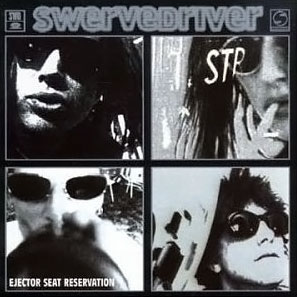
Ejector Seat Reservation
Swervedriver’s third album, “Ejector Seat Reservation”, was recorded primarily at Church Studios and Konk Studios in Crouch End, again produced by the band and Alan Moulder. Aside from themes of fatalism and flight working their way into its composition, “for some reason we were wanting to reverse the notion of being the band with the American references in our songs and so some very British reference points appeared in the lyrics,” I think this album was great – the problem was with the marketing At the time, Britpop was everything, and by this point all the bands were doing songs that started with the acoustic guitar explained Franklin. The band had a dispute with McGee over picking the album’s launching single—they thought “The Other Jesus” was the obvious choice but McGee overrode them, selecting “Last Day on Earth”. These incidents would prove to be just a precursor to the group’s album woes, however. Realizing a vanishing return on their investment, American label A&M cut the band’s funding, telling them the album would not fit into their release schedule for another year and a half.
“Ejector Seat Reservation” didn’t get a fair shot in that it wasn’t released in our biggest marketplace. It didn’t come out in the US, so from that point of view it certainly wasn’t given a fair whack. But I do think there was some great stuff on it. The lyrics on this album were a bit crazy in an interesting way. I remember there were things from dreams being put into the lyrics
Despite its lack of commercial success, critics have considered “Ejector Seat Reservation” to be the band’s highest achievement.
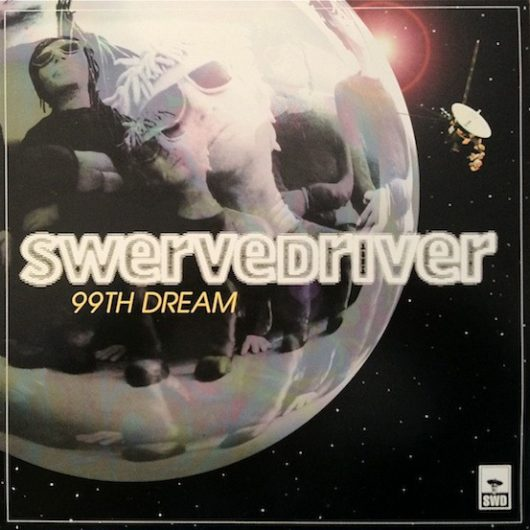
99th Dream
Over the next year, the group would record “99th Dream” their fourth album, February 1998. with Moulder at the helm, this time taking a more simple, laid-back approach than with previous productions. They scaled back from 48-track to 24-track recording, condensing the layering of guitar in the process, and employed more full-ensemble straight live track, partly with the mindset of making it easier to play the guitar lines live. During that time, the band also put out a pair of self-produced boutique label seven-inch singles, including the double split “Why Say Yeah” with indie collaboration act Sophia.
About the album’s progression to a more indie rock style, Franklin said “It wasn’t a conscious decision. [It was] just the way it was going – concise little pop songs, bossa nova beats and such.” He continued, “I’ve always liked the idea that you don’t always know where it’s coming from… [The lyrics are] all about time. It’s all over the place. I didn’t put too much thought into it, which may be good. You’re fuelling more from the subconscious that way.”
Working on the reissue I realised how much was going on at this time, because there’s a lot of really good material. But what I didn’t like about the album personally was the singing. There was something I was trying to do there and I didn’t do it well, and I really can’t stand the vocals. And I think there was a general harshness to the album which has been softened up in this new remaster. The unreleased tracks on CD3 will probably blow a few people away, actually. I think if you’re going to put out unreleased tracks after a long time they ought to be pretty fucking good. And I think these ones are. They’ve got this energy to them and that really struck me.
Hindmarsh mentioned, “There’s a track called ‘She Weaves a Tender Trap.’ That’s like a one-take, all-four-of-us thing, and it has a lot more air in it, a lot more space. In the past, we used to try and fill every single hole. That song sort of defines a change in the way we’re thinking. I think we’re headed that way, to leave space to let the music breathe a little bit.
We already knew we were going to have to do a double vinyl reissue, so it was a question of if we spread the 11 tracks across four sides or if we added a fourth side. I decided to add a fourth side, because the songs on there were all things that appeared on indie 7”s. So you have “Why Say Yeah”, “93 Million Miles From The Sun”, The Director’s Cut Of Your Life. For me, side four is what makes it more of a whole, because I think those songs create more of an overall picture of what was going on with the band around the time. I think this album is flawed, they’re all flawed, but this representation does emphasise things you might have missed first time around.
That year also saw the release of two more works through Swervedriver’s personal label. The EP “Space Travel, Rock ‘n’ Roll”, released on February 1998 as an Australian single, showcased Hindmarsh’s first experimentation with looping. The July 1998 single “Wrong Treats” (“These Times” in Australia) would be the band’s last offering before their ultimate hiatus and featured the instrumental “Homeless Homecoming”, a recording begun during a soundcheck at the Metro Club in Sydney, and a cover of T. Rex’s “Château in Virginia Waters”.
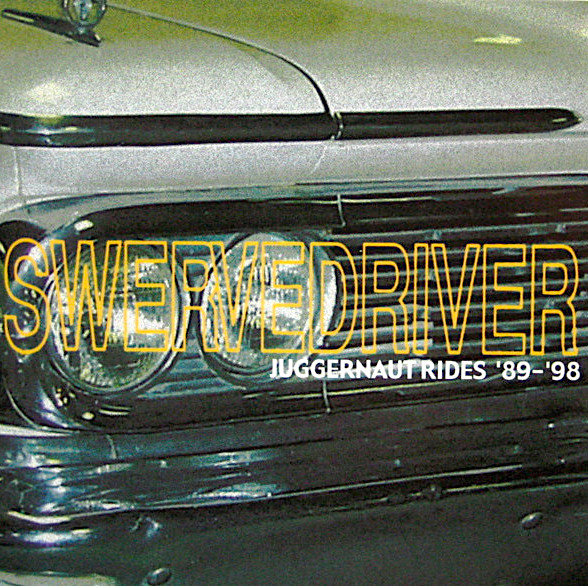
Juggernaut Rides ’89–’98”
Record label issues and waning interest within the group led to their split at the end of 1998. A decade later, Swervedriver reunited In the beginning of 2005, the group convened in a collaboration with Castle Music to decide on songs for a retrospective. “Juggernaut Rides ’89–’98” compiled 33 tracks remastered from the original DATs and toured periodically over the next five years, The two-CD anthology featured four previously unreleased songs, including Shake Appeal’s “Son of Mustang Ford” demo from 1989 and the remainder of Swervedriver’s 1998 recordings, “Just Sometimes” and the orchestral string accompanied “Neon Lights Glow”. Regarding the production effort for “Juggernaut Rides”, Franklin, said “Me and Jimmy sat there [during the remastering] and said, ‘Wow this is pretty great.’ You do forget things about the various tracks,”
Swervedriver kicked off their reunion tour in April 2008 at the Coachella Festival in Indio, California and continued through North America for the next two months. The band then performed a pair of shows in Great Britain at the Scala London and King Tut’s Wah Wah Hut in Glasgow September 2008, respectively. On the heels of the tour’s success, remastered and extended editions of “Raise”, “Mezcal Head”, and “Ejector Seat Reservation” were reissued in the UK by Sony BMG.
Swervedriver appeared on Late Night with Jimmy Fallon on March 2012, performing their debut single “Son of Mustang Ford” and premiering the song “Deep Wound”, Releasing their first new material in fifteen years with the 2013 single “Deep Wound” But it was also better songs and more muscular production courtesy producer Alan Moulder who was very busy in the early ’90s.
The soaring, roaring track “Duel,” arguably the album’s finest moment, is backed with two killer B’s: the majestic “Planes Over the Skyline,” and starry eyed “Year of the Girl,” both of which have Jez going full Keith Moon.
The standalone single “Never Lose That Feeling,” which would be tacked-on the U.S. edition of “Mezcal Head”, was actually the last record the original line-up of the band made. The EP version melts into the dubby “Never Learn,” making for a very worthy 11 minutes of listening.
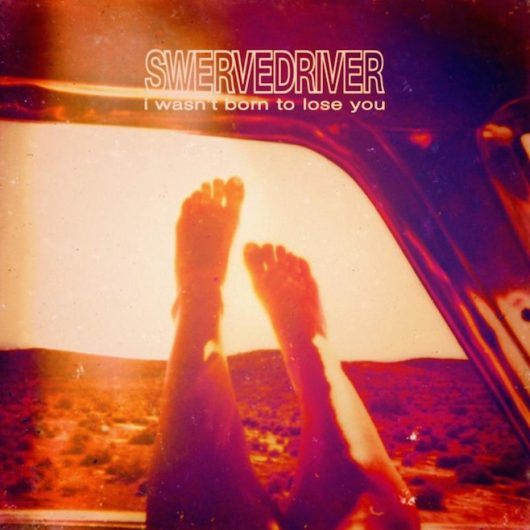
I Wasn’t Born to Lose You
The album, titled “I Wasn’t Born to Lose You”, would be released on March 2015 through the Cobraside record label. The first single off the album, “Setting Sun”, was released on January 2015.
The really interesting thing about the origins of this album is that there’s a recording of a sound check in Arizona in 1998; our sound manager recorded it, and I found the tape. Between us playing a couple of songs, you hear a guitar playing “Lone Star’s” melody, and I thought, that’s quite cool. What is that? So I played it back. I don’t know if it’s me or Jimmy I think it was me. But it was this really good riff that ends up being the main intro riff of “Lone Star”. So that whole tune came out of two seconds of a sound check in Arizona in 1998. And if Dave our soundman hadn’t recorded that and that song, that melody would have floated off into the ether and been lost, or picked up by somebody else. I do quite like the idea of musical archaeology – just finding this tape and this little thing and turning it into something else.
Initially, we just got back together to play shows, and that was really fun. I think that was probably in 2012 or something. It took a while before we actually recorded a new record. But eventually, it got to a point where Jimmy said, ‘Look, we want to do new stuff.’ So we started trying to write songs. I remember sending the band the demo for “Deep Wound”, and I think Steve George, bassist’s one-word response was ‘beautiful,’ and Jimmy’s one-word response was ‘nasty’. It was quite funny because they both happened to reply with just a single word.
Thanks to Rick Beato interviewing Franklin on his popular YouTube channel, as well as the current shoegaze resurrection with the TikTok generation, Swervedriver are earning many new fans. It’s about time, too, as the guitars are of a different class, with Franklin leading the charge. From weaponising open tunings to the scalding speed-freak essence of early cuts such as ‘Son of Mustang Ford’ to more psychedelic, immersive moments like ‘Duress’, in many ways, they are the perfect guitar band, and that is down to the work of Franklin and his sonic confederate Hartridge.
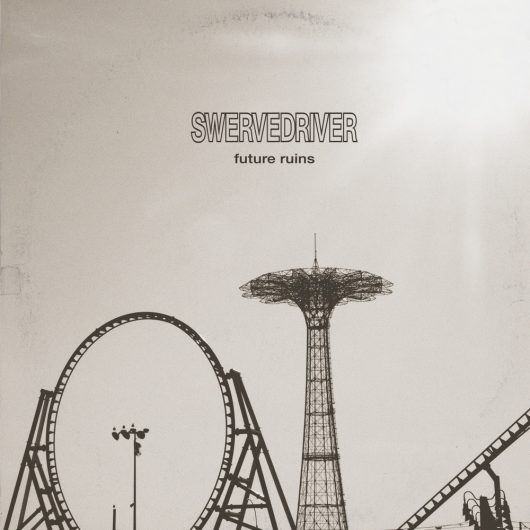
Future Ruins
Franklin comments The standout track is definitely “The Lonely Crowd Fades In The Air.” That title is a misheard Supremes lyric. The original lyric was ‘The lonely cry fades in the air.’ I misheard it as ‘The lonely crowd.’ And I thought, that’s a great lyric, then when I looked it up I realised it actually wasn’t the lyric, and that I could claim that lyric. I think there’s a desire to sort of subvert the language a little bit sometimes. You can have a rock song, and lyrically you can do anything you want with it. And quite often, people don’t even take it in. I mean, even after 30 years, you find out what somebody was singing, and you never knew that’s what they were singing. But I always thought if someone is gonna find out after 30 years what you were singing, they might as well have a pleasant surprise, and find that there’s just something kind of reasonable going on there.
I love “Theeascending“, it’s a beautiful song. “Spiked Flower” was actually a Jimmy riff, and I ended up pretty surprised with the vocal, which I sang late at night – suddenly it was like, ‘oh, holy fuck’, I kind of surprised myself. I think sometimes you hear your own stuff, and when it’s something you’ve recorded and then gone out and toured and played live lots of times, you then have that live version in your head. So you go back, and you hear strange little production things and they can sometimes sound a little out of place.
Not only is Franklin a gifted songwriter, but he’s also an intelligent guitarist who thinks outside of the box and is equally adept at moments of sheer brute force as he is in melodic splendour, toeing the line adroitly. Add a profound handling of effects to the mix, and you have a player who qualified as an all-time great years ago.
There’s something coalescing in terms of a next album. I mean, literally, we have been radio silent for four years. But we did a bit of recording back in October in Oxford, we just haven’t gotten around to finishing it off yet. But there are some songs there, and some other stuff that’s creeping up.
Swervedriver album discography
- Raise (1991)
- Mezcal Head (1993)
- Ejector Seat Reservation (1995)
- 99th Dream (1998)
- I Wasn’t Born to Lose You (2015)
- Future Ruins (2019)
EP’s 12″ Vinyl
Son of Mustang Ford (1990)
Rave Down (1990)
Sandblasted (1991)
Reel to Real (1991)
Never Lose That Feeling (1992)
Last Train to Satansville (1993)
Space Travel, Rock ‘n’ Roll (1998)
 The Fat Angel Sings