


One of the greatest Rock ’n’ Roll Anthem’s of all time and most covered, garage-rock anthems of the 1960s. That was it, nothing more to it. Our boy is so taken by this glorious being whose name is “Gloria” that he’s going to shout her name all night; in fact, he’s gonna shout it every day. You could say he’s smitten.
Written by 18-year-old George Ivan Morrison, better known as Van, “Gloria” has received the Grammy Hall of Fame Award and is included in the Rock and Roll Hall of Fame’s 500 Songs That Shaped Rock and Roll—twice, although neither of the recorded versions cited is Morrison’s original. Perhaps that’s because “Gloria,” credited to Them, the Irish band Morrison fronted, was not a hit in the United States in its original form. It peaked at #93 on singles chart, slightly higher than its flip side, “Baby, Please Don’t Go.” In the U.K., “Gloria” was the B-side and “Baby, Please Don’t Go” what radio folks called at the time the “plug side.” The latter made the top 10; “Gloria” was noticed only by the few who bothered to turn the record over.
It should be noted that the “Gloria” from Van Morrison wasn’t even the first song by that name to make its presence known during the rock era. The tale told in that tune was pretty simple too. She’s Gloria. She’s not Marie. She’s not Sherie. Get her name right: Gloria. It seems this particular Gloria is “not in love with me.” That may change, the singers hope: “Well, maybe she’ll love me, but how am I to know?/And maybe she’ll want me, but how am I to know?” We never find out—as the song ends, Gloria still hasn’t come around.
In any case, the Gloria on the mind of Van Morrison in that summer of 1963, when he penned his song during an engagement in Germany with his group the Monarchs, bore little in common with doo-wop Gloria or disco Gloria. Morrison’s Gloria had one purpose in life: to please him.
It begins, inexplicably, with a description of her height:
“Like to tell you about my baby
You know she comes around
About five feet four
A-from her head to the ground”
She may be fairly short, the singer then explains, but she’s determined:
“You know she comes around here
Just about midnight
She make me feel so good, Lord
She make me feel all right”
The chorus follows, sung—one might say snarled—by the precocious red-headed Morrison, only five-foot-five himself and already so excited that a guitar solo is needed to give him a few seconds to catch his breath. But he’s just starting to get worked up. When he returns from the chorus, our young stud, a teasing organ riff helping him along, goes graphic. You can hear his lust:
“You know she comes around here
At just about midnight
She make me feel so good, Lord
I wanna say she make me feel all right
Comes a-walkin’ down my street
When she comes to my house
She knocks upon my door
And then she comes in my room
Yeah, an’ she make me feel alright”
Another chorus or two, the band builds its slinky, bluesy vamp to a frenzied crescendo, and Gloria and Van are presumably doing whatever.
The name’s six letters just happened to fit the particular rhythm he’d conjured up, sounded especially cool when shouted, and worked well with the three chords he assigned to his tune: E, D and A. (So easy, anyone can play it!) Morrison didn’t perform his new composition regularly until the year after he’d written it, upon his return to his home base of Northern Ireland from his stint in Germany. By that time, he’d decided to leave his then-current band, the Golden Eagles, and quickly hooked up with an already-working group called the Gamblers: Billy Harrison (guitar, vocals), Eric Wrixon (keyboards), Alan Henderson (bass) and Ronnie Milling (drums). Morrison both sang and played the saxophone.
A new, more memorable name was needed, they decided, and so they became Them, taken from a campy 1954 sci-fi film about colossal ants attacking L.A. “Gloria” made its debut when Them performed one of their regular gigs at Belfast’s Maritime Hotel. The song, Morrison once recalled, could last up to 20 minutes onstage, with long improvised sections that found him extending the story of his night time visitor every which way.
Decca Records took notice, and on July 1964, with Pat John McAuley replacing Wrixon on keyboards and session musicians filling in some of the parts, Them recorded “Gloria.”
Them steadily grew their audience not only in Ireland but in England, touring frequently, and soon set their sights on America, where, by mid-1965, the British Invasion was in full swing. Signed to Parrot Records in the U.S., Them sat back and waited for “Gloria”/“Baby, Please Don’t Go” to take off. And waited, and waited…
But Them simply did not make it in the U.S., even while they continued to score in the U.K. (the phenomenal “Here Comes the Night” hit the number #2 spring of ’65). By 1966, Morrison had decided it was time to strike out on his own. having released more than 40 albums and attained the status of rock god. Inducted into the Rock and Roll Hall of Fame in 1993, the famously curmudgeonly Van Morrison became the first living inductee to not attend his own ceremony.
“Gloria,” of course, did not die with Morrison’s split from Them. The song’s ascendance to garage-rock immortality seemingly every local rock ’n’ roll band worth its twang had discovered the tune despite its lack of airplay and sales, and had begun including it in their own sets. Among those was the Shadows of Knight, a band from the Chicago suburb of Mt. Prospect that took the British version of blues favoured by groups like the Rolling Stones, the Yardbirds and the Animals—and Them—and gave it a tough, soulful, Chicago-style toughening up.
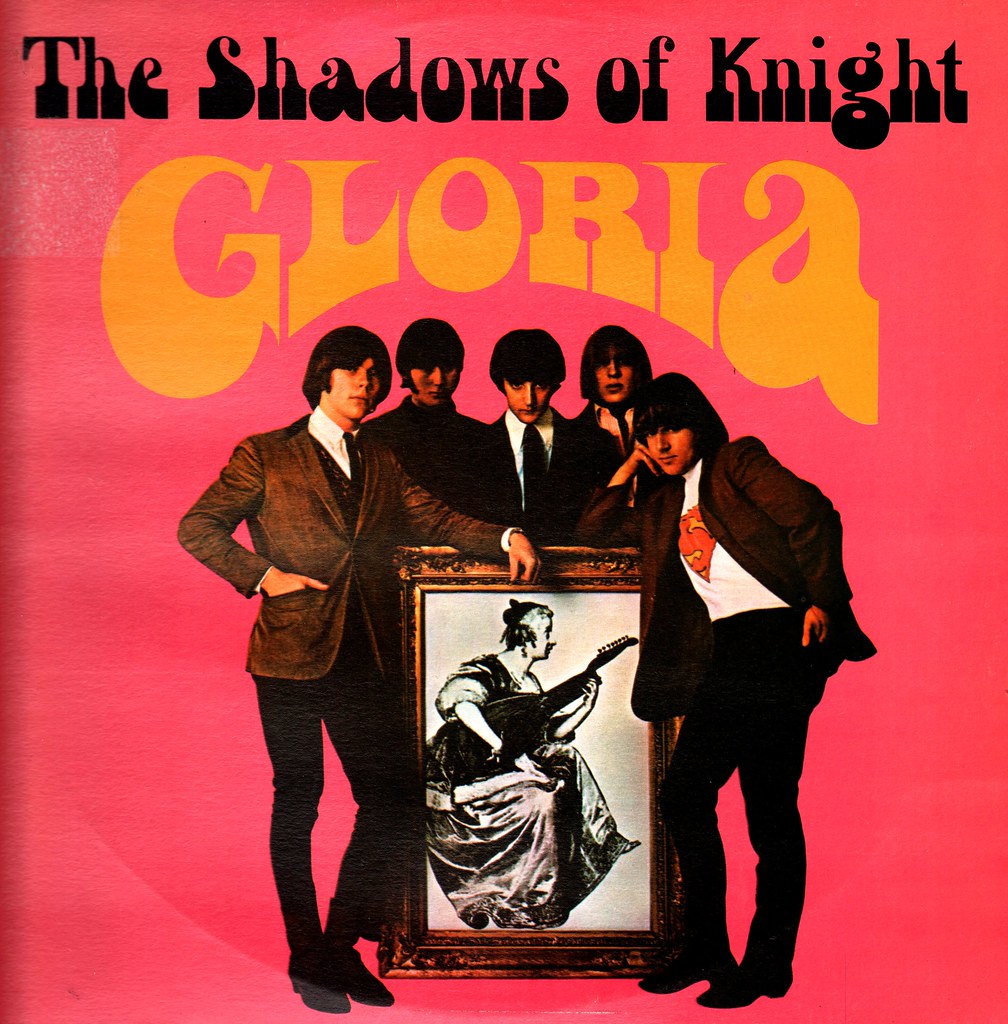
Fronted by 16-year-old Jim Sohns, the Shadows of Knight had formed in 1964 as the Shadows, but when it was pointed out to them that a very popular group existed in Britain by that name, they added the “of Knight” and carried on. Their live performances of “Gloria” went over well with audiences and when they were signed by the local Dunwich label, the group recorded its own take on “Gloria,” close in its approach and arrangement to the Irish original, changing a few words to make it radio-friendly in America (no more “She comes in my room”).
Released in December 1965, “Gloria” was a local hit at first, aired all over Chicago radio. Eventually, it was picked up by other stations around the country and on March 19, 1966, the Shadows of Knight’s “Gloria” entered the singles chart. “Gloria” went into temporary hibernation as the ’60s faded into the more cerebral 1970s. The garage sound in general became dormant as new offshoots of rock came into play. In 1972, rock journalist/record store clerk Lenny Kaye created, for Elektra Records, a two-LP collection of ’60s singles titled “Nuggets: Original Artyfacts from the First Psychedelic Era”, which included the Shadows of Knight’s cover of Bo Diddley’s “Oh Yeah,” their follow up single to “Gloria,” but only a few took notice of the album at first. (Later it would become massively influential and a must have in any collection.) Among the handful that did pay attention to “Nuggets”, however, were other budding musicians, who were growing tired of the excesses of ’70s rock and longing for a return to the simple, more aggressive sounds proffered by bands like the Shadows of Knight, the Standells, the Count Five and the Barbarians.
Among those who got what Kaye was offering was a young woman from New Jersey named Patti Smith, a poet who had begun setting her words to music onstage around New York City—with Lenny Kaye backing her on guitar. Signed by Clive Davis to his Arista Records in 1975, Patti Smith and her eponymous band cut their debut album.
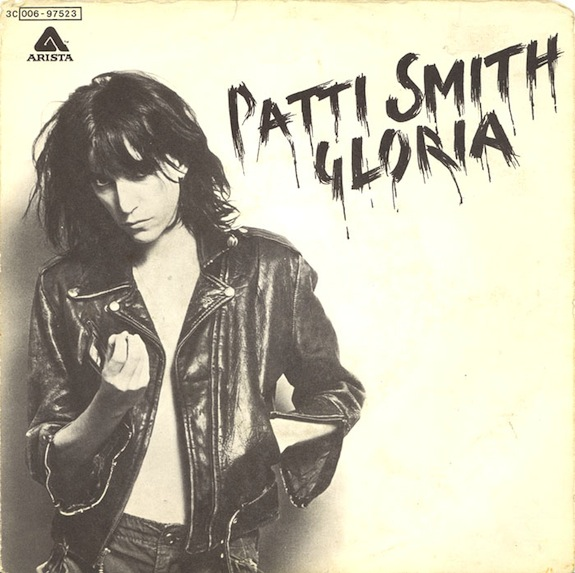
The album, “Horses”, launched with Smith’s own interpretation of the now-10-year-old Van Morrison tune, “Gloria,” which she retitled “Gloria: In Excelsis Deo” and reworked so completely that the familiar “G-L-O-R-I-A” chant doesn’t surface until halfway into its six minutes. Starting with the provocative lyric “Jesus died for somebody’s sins but not mine,” Smith’s slow-building “Gloria” is a tour de force of the emerging punk rock, nothing less than one of the most exhilarating and thought-provoking marriages of rock and poetry ever committed to tape.
“Horses” wasn’t a big hit, in early 1976. Although her concerts sold out and her reputation as an innovator was stellar, Smith wouldn’t enjoy a hit single until “Because the Night” in 1978, which she co-wrote with Bruce Springsteen. But she too, like Van Morrison, managed to survive any disappointing lack of early commercial success: Smith is still recording and live performing today (with Lenny Kaye still accompanying her) and her version of “Gloria” is considered a classic in its own right.
The song has, in fact, long lived a life of its own. Among those who’ve covered it over the decades are The Doors, who performed it between 1968 and ’70 and included it on their 1983 live album “Alive, She Cried”.
AC/DC covered the tune in their early days, U2 grafted it onto the ending of their song “Exit,” and David Bowie sang it on his 1990 Sound and Vision tour. The Jimi Hendrix Experience’s version can be found on a few different compilations and boxed sets, Tom Petty included it on his 2006 Highway Companion tour, and Bruce Springsteen has also been known to perform it at select live shows.
Iggy Pop’s 2011 album “Roadkill Rising” features his take, while Green Day, Bon Jovi, Robert Plant and the Grateful Dead have also bowed to its genius.
“Gloria” began life humbly, as a barely acknowledged vamp by an up-and-coming Irish blues-rocker. More than half a century later it’s recognized as a cornerstone of rock music.
 The Fat Angel Sings