

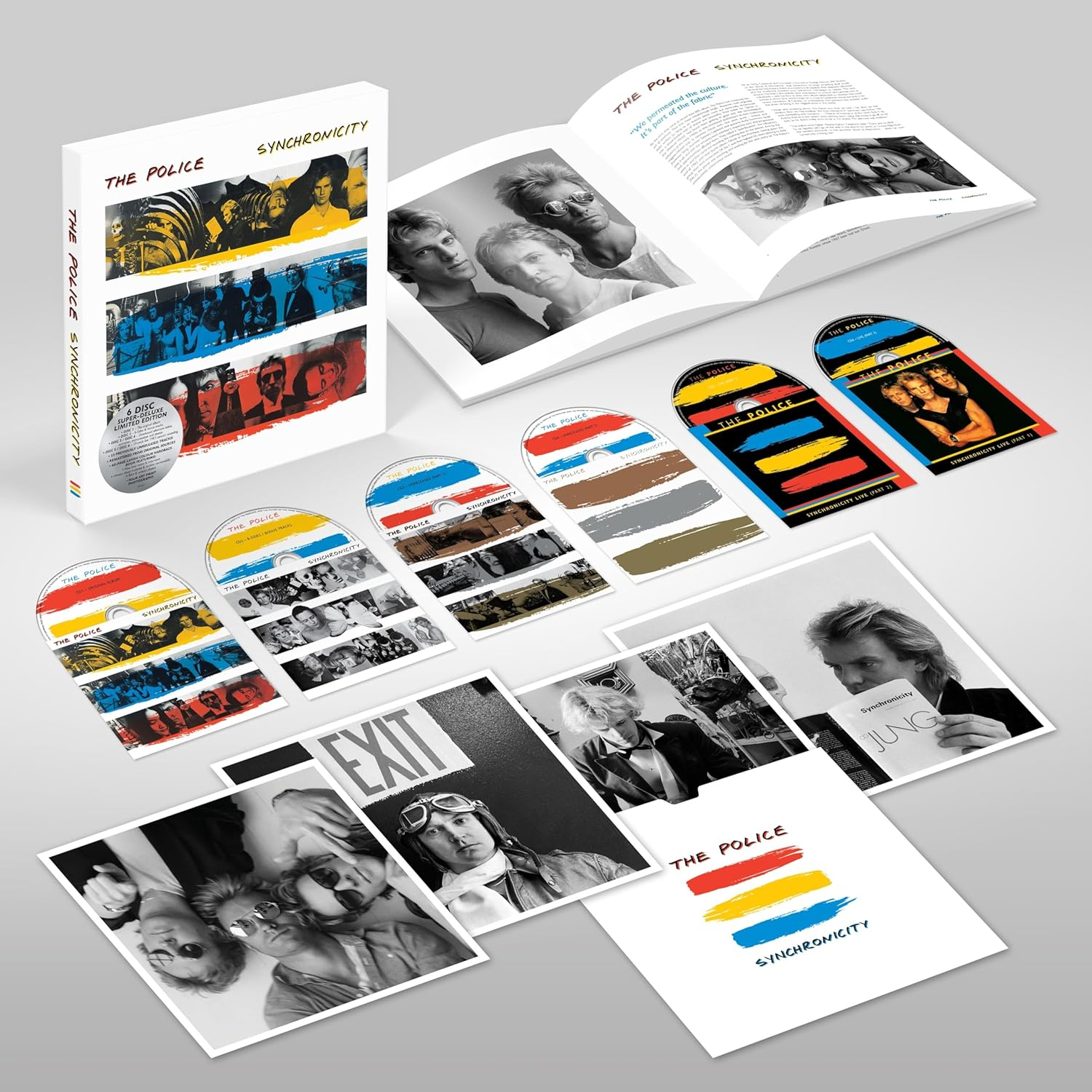
More than 40 years after the release of their final album, The Police offer a massive expansion of their fifth studio effort, 1983’s blockbuster “Synchronicity“.
Released July 26th, the set will be available in multiple formats, each showcasing a wealth of rare studio and live bonus content. The centerpiece of the campaign is a 6 CD limited edition box set featuring B-sides and four discs of unreleased material, including demos, alternate mixes and takes, instrumentals, never-before-heard songs and a live concert from the “Synchronicity” tour. A 4LP box set will offer most of the B-sides and studio material on its bonus discs, and a D2C-exclusive coloured vinyl set will include that set’s first two LPs. A 2CD set will include the remastered album and all B-sides from the bigger CD box, and a limited edition picture disc will offer the original album with an alternate running order.
The set is billed in the official press announcement as being three years in the making, and it would appear it’s worth the wait for hardcore Police fans and completists. The B-sides disc includes every original studio and live non-album track released on the singles “Every Breath You Take,” “King of Pain” and “Synchronicity II,” including a rare alternate slow recording of “Outlandos d’Amour” (1978) favourite “Truth Hits Everybody,” the moody, Andy Summers-sung “Someone to Talk To,” the dreamy, eerie Sting compositions “I Burn for You” and “Once Upon a Daydream,” and even “Every Bomb You Make,” a version of the album’s signature hit rewritten and sung by Sting for the British comedy series Spitting Image. Making their CD debuts are six tracks from the band’s live set at The Omni in Atlanta in the fall of 1983, captured on the video The Synchronicity Concert; the rest of the set was issued on the 1995 package “Live!” Two “derangements” – multi-track reimaginings by drummer Stewart Copeland – will close out the B-sides assortment.
On the two studio discs are a treasure trove for die-hards: at least one, but often more, version of every track on the original album (including B-side “Murder by Numbers,” included on CD copies) in alternate form: Sting’s lo-fi demos, different mixes, alternate studio versions and even instrumentals. If that weren’t enough, there are seven songs and versions that never made the album: an early version of Summers’ “Someone to Talk To” called “Goodbye Tomorrow,” a Copeland demo called “I’m Blind” that later was reworked into a cue from the drummer’s score to Francis Ford Coppola’s Rumble Fish, and even covers of Chuck Berry (“Rock and Roll Music”) and Eddie Cochran (“Three Steps to Heaven”).
A newly-presented live set closes out the box, taken from the group’s September 10th, 1983 set at the Oakland-Alameda County Coliseum in Oakland, CA (the penultimate gig of the first leg of the “Synchronicity” tour). As with other shows on this tour, the trio (as ever, Sting on bass and vocals, Summers on guitar and Copeland on drums) were augmented by backing vocalists Tessa Niles, Dolette MacDonald and Michelle Cobb, performing nearly every song from the album alongside most of their hits from the previous five years. The deluxe package is rounded out with a 62-page booklet featuring new liner notes from Jason Draper and unseen images and memorabilia.
The writing may have been on the wall for The Police when they decamped to AIR Studios in Montserrat for their fifth LP – the same studio they’d recorded penultimate album “Ghost in the Machine” (1981), with the same producer, Hugh Padgham. Tensions never ran low in the band, but felt higher than before, with the group recording parts in separate rooms and sticking mostly to Sting’s song writing and arrangements. (Summers got one track on the album, the demented “Mother,” and Copeland got the quirky “Miss Gradenko.”) Sting, exhausted from a painful divorce and a burgeoning acting career (he’d starred in the British thriller Brimstone and Treacle and featured his first solo recording on the soundtrack alongside several songs by The Police), turned out some of his most intensely psychological song writing, drawing from the writings of Carl Jung and Arther Koestler for some moody but exquisitely catchy tunes – far lighter on the group’s original reggae influences, but still fitting in the trio’s unique post-punk and New Wave sound.
Beyond songs like the sequencer-driven “Synchronicity I,” full-throated rocker “Synchronicity II,” the driving “King of Pain” and contemplative fare like “Wrapped Around Your Finger” and “Tea in the Sahara,” “Synchronicity” featured The Police’s signature tune. “Every Breath You Take” was a deceptive number: lyrics of romantic pain and paranoia masquerading as sincerity under the same soulful chord progression that powered Ben E. King’s “Stand by Me” and a hypnotic guitar lead by Summers. In the summer of ’83, The Police were the biggest they’d ever been thanks to that song, When the dust had settled, “Every Breath You Take” won a Grammy for Song of the Year and earned Sting that year’s Ivor Novello award for British songwriters, eventually becoming recognized by music publisher BMI as the single most-played song in radio history.
“Synchronicity” sold more than 8 million copies in America, was promoted by stylized music videos (including Godley & Creme’s well-known short for “Every Breath”) and gave The Police one last juggernaut tour, including a symbolic sell-out show at Shea Stadium, the same place The Beatles played nearly three decades prior. The trio used that highest of highs to essentially fade away at the height of fame (band tensions aside); they only recorded one more song (a controversial re-do of “Don’t Stand So Close to Me” for a 1986 greatest hits album) and played a handful of gigs that same year for Amnesty International, symbolically passing their instruments to the members of U2 during the final performance. They stayed apart until a massive one-off reunion tour in 2007 and 2008, and Summers and Copeland have documented the band in memoirs, concert tours, retrospectives and documentaries. Sting maintained pop stardom for several decades since, but has made clear that, at 72 (Copeland in 71 and Summers is 81), the trio may never work together again, but maintain friendly terms with each other. That delicate, well-earned relationship informs the creation of this box, and hopefully will do so for additional releases from the band’s archives!
 The Fat Angel Sings