

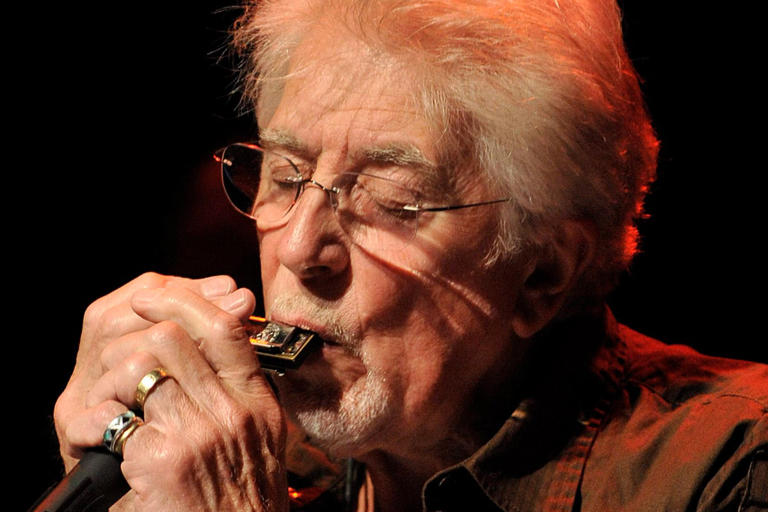
John Mayall, tireless and influential British blues pioneer, dies at 90, John Mayall introduced Eric Clapton, Peter Green, Jack Bruce and Mick Taylor to the world, and has made 60 albums in nearly 60 years, Plenty of British bluesmen have sold more records, but few command as much respect as John Mayall OBE. With a back catalogue of close to 60 albums, and kick-starting the careers of countless stadium-filling galacticos, there’s a solid pub argument that nobody has done so much, for so long, to keep British blues afloat. No wonder they call him the Godfather.
A statement on Mayall’s Instagram page announced his death Tuesday, saying the musician died Monday at his home in California. “Health issues that forced John to end his epic touring career have finally led to peace for one of this world’s greatest road warriors,” the post said
Mayall almost missed the boat. Born near Macclesfield in 1933, he grew up in thrall to his father’s imported collection of blues 78s, and taught himself piano, guitar, harmonica and ukulele during downtime at art school. But National Service knocked him off track, and he returned to 1950s Britain to find a monopoly of trad-jazz bands “all playing the same tunes”.
At last, in 1962, he sensed revolution in the air, and the following year he hit London like a train. Even back then, pushing 30, the bandleader seemed like an elder statesman; a silverback among the cubs of the nascent British scene, whose gravitas, brittle wit and deep knowledge of the genre’s roots made him a big fish at Alexis Korner’s Ealing Club.
“London was booming,” Mayall recalls. “I was just glad the music I’d played since I was a kid was now a viable thing.” With impeccable timing, Mayall launched The Bluesbreakers, and so began an imperious early run of albums that remain set-texts for anyone remotely serious about the blues. This was Mayall’s band (the turnover of hired/fired members backs up his former guitarist Walter Trout’s observation that he was a “benevolent dictator”). But alongside the prolific songwriting, stinging musicianship and tremulous vocals, his genius lay in the nabbing and nurturing of ‘next big things’. In the 60s especially, the talent on the payroll was staggering – Eric Clapton, Peter Green, Jack Bruce, Mick Taylor. And Mayall always let his charges off the leash. “Any person who joins my band,” he noted, “they’re all equal, whatever their age.”
Mayall and Clapton shared a passion for Chicago blues, and the guitarist later remembered that Mayall had “the most incredible collection of records I had ever seen.”
The piano was his main instrument, though he also performed on guitar and harmonica, as well as singing in a distinctive, strained-sounding voice. Aided only by drummer Keef Hartley, Mayall played all the other instruments for his 1967 album, “Blues Alone.”
Mayall was often called the “father of British blues,” but when he moved to London in 1962 his aim was to soak up the nascent blues scene led by Alexis Korner and Cyril Davies. Mick Jagger, Keith Richards and Eric Burdon were among others drawn to the sound.
The Bluesbreakers drew on a fluid community of musicians who drifted in and out of various bands. Mayall’s biggest catch was Clapton, who had quit the Yardbirds and joined the Bluesbreakers in 1965 because he was unhappy with the Yardbirds’ commercial direction.
He is credited with helping develop the English take on urban, Chicago-style rhythm and blues that played an important role in the blues revival of the late 1960s. At various times, the Bluesbreakers included Eric Clapton and Bruce, later of Cream; Mick Fleetwood, John McVie and Peter Green of Fleetwood Mac; Mick Taylor, who played five years with the Rolling Stones; Harvey Mandel and Larry Taylor of Canned Heat; and Jon Mark and John Almond, who went on to form the Mark-Almond Band.
Mayall, now 90, retired from the road in 2021, but continues to make music that pleases the hardcore but make little dent in the mainstream (his last album, 2022’s “The Sun Is Shining Down“, was his 60th). And while it’s unlikely he’ll produce anything to shuffle the pecking-order laid out here, you can bet he’ll go down trying.
“With music you can be any age,” he noted in 2012. “What is the Best John Mayall album of all time?” or “What are the top John Mayall albums?”. John Mayall released a great deal of albums throughout his long and prolific career. John Mayall can easily be considered one of the best blues musicians.
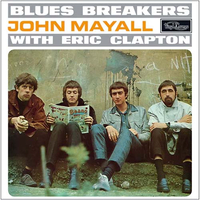
John Mayall And The Bluesbreakers – Blues Breakers With Eric Clapton (Decca, 1966)
The inevitable first purchase, 1966’s so-called Beano album is the high-water mark of the 60s British blues boom, Mayall’s finest hour and Eric Clapton’s precocious launch pad.
From the languid opening swoop of Otis Rush’s All Your Love, through the jet-fuelled Hideaway, to spring-heeled Mayall originals like Key To Love and Little Girl, this is amped-up blues rock that walks a tightrope between reverential and rip-it-up exciting. Nearly 50 years after it hit number six in the UK, there’s a case for saying that nobody involved has ever flown higher.
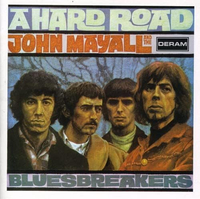
John Mayall And The Bluesbreakers – A Hard Road (Decca, 1967)
Producer Mike Vernon hit the roof when The Bluesbreakers rolled into Decca Studios without Eric Clapton. He needn’t have panicked. The canny Mayall’s new signing to his Bluesbreakers, 20-year-old nonentity Peter Green, was patently up to snuff, whether bleeding soul over his self-penned instrumental The Supernatural, detonating Freddie King’s The Stumble, or dovetailing with Mayall on top-drawer originals like the morose title track.
Green and bassist John McVie would split that same year for Fleetwood Mac, but their legacy is an album that snaps at The Bluesbreakers’ heels.
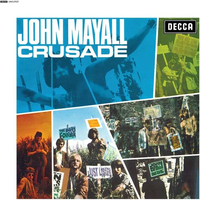
John Mayall And The Bluesbreakers – Crusade (Decca, 1967)
Mayall was outraged by the untrumpeted death of J.B. Lenoir, and Crusade was his attempt to force the blues down the throat of the mainstream (“I hope you’ll join forces with me,” he writes in the sleeve notes).
With Green gone, his eye had settled on a teenage Mick Taylor, who brings equal parts soul and swagger. Crusade took just seven hours to record and mix, which perhaps accounts for its wham-bam brilliance. The band tips its hat on The Death Of J.B. Lenoir, and Taylor arguably pips Clapton’s Hideaway with his jaw-dropping instrumental Snowy Wood.
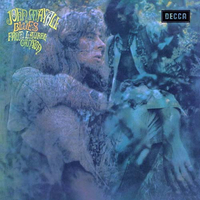
John Mayall – Blues From Laurel Canyon (Decca, 1968)
Mayall had spent the summer of 1968 crashing at Frank Zappa’s dissolute Laurel Canyon home. This loose concept album is his postcard, opening with the roar of an airliner touching down “Vacation”, then lurching through sticky accounts of musos “The Bear” and LA groupies the jazzy “Miss James”.
The rhythm section of drummer Colin Allen and bassist Steve Thompson provide a taut backbone, but the star of the piece is a ridiculously precocious Mick Taylor, whose pugnacious, heart-in-fingers fretwork made his exit for the Stones the following year feel like a step down.
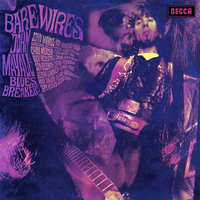
John Mayall’s Bluesbreakers – Bare Wires (Decca, 1968)
Bold moves all round, as Bare Wires binned the Crusade rhythm section, added brass and kicked off with a 23-minute title ‘suite’. Jazzier and lyrically introspective, the album rewarded open-minded listeners with a volley of cuts that still dazzle, from the rug-cutting funk of No Reply (Mick Taylor working the wah-wah pedal with Hendrix-worthy panache) to the parping slow-blues of I’m A Stranger.
It tested the faith of his trad-blues fans, but the consensus was a thumbs-up: Bare Wires gave Mayall his highest UK chart placing (number three) and broke him in the States.
A small but enduring thing. Though Mayall never approached the fame of some of his illustrious alumni, he was still performing in his late 80s, pounding out his version of Chicago blues. The lack of recognition rankled a bit, and he wasn’t shy about saying so.
“I’ve never had a hit record, I never won a Grammy Award, and Rolling Stone has never done a piece about me,” he said in an interview with the Santa Barbara Independent in 2013. “I’m still an underground performer.”
Known for his blues harmonica and keyboard playing, Mayall has had a Grammy nomination, for “Wake Up Call” which featured guest artists Buddy Guy, Mavis Staples, Mick Taylor and Albert Collins. He received a second nomination in 2022 for his album “The Sun Is Shining Down.” He also won official recognition in Britain with the award of an OBE (Officer of the Order of the British Empire) in 2005.
Clapton, interviewed for a BBC documentary on Mayall in 2003, confessed that “to a certain extent I have used his hospitality, used his band and his reputation to launch my own career,” “I think he is a great musician. I just admire and respect his steadfastness,” Clapton added.
Mayall encouraged Clapton to sing and urged Green to develop his song-writing abilities.
Mick Taylor, who succeeded Green as a Bluesbreaker in the late 1960s, valued the wide latitude which Mayall allowed his soloists. “You’d have complete freedom to do whatever you wanted,” Taylor said in a 1979 interview with writer Jas Obrecht. “You could make as many mistakes as you wanted, too.”
 The Fat Angel Sings