

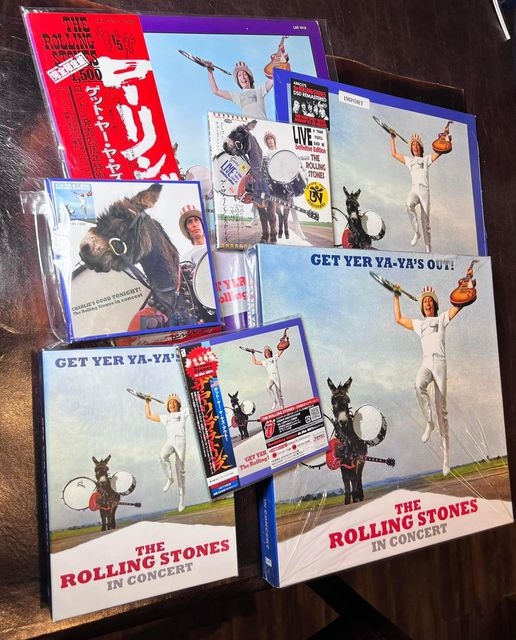
“Get Yer Ya-Ya’s Out!” was the second live album by the Rolling Stones, released on 4th September 1970 on Decca Records in the UK and on London Records in the United States. It was recorded in New York City and Baltimore in November 1969 prior to the release of their studio album “Let It Bleed”. It is the first live album to reach number 1 in the UK. It was reported to have been issued in response to the huge selling bootleg “Live’r Than You’ll Ever Be”.
The Rolling Stones 1969 American Tour’s trek during November into December, with Terry Reid, B.B. King (replaced on some dates by Chuck Berry) and Ike and Tina Turner as supporting acts, played to packed houses.
The tour was the first for guitarist Mick Taylor with the Stones, having replaced Brian Jones shortly before Jones’s death in the July; this was also the first album where Taylor appeared fully and prominently, having only played on two songs on “Let It Bleed“. It was also the last tour to feature just the Stones – the band proper, along with co-founder, road manager and session/touring pianist Ian Stewart – without additional backing musicians.
The performances captured for this release were recorded on 27th November 1969 (one show) and 28th November 1969 (two shows) at New York City’s Madison Square Garden, except for “Love in Vain,” recorded in Baltimore on 26th November 1969. Overdub sessions took place in January 1970 in London’s Olympic Studios. The finished product featured overdubbed lead vocals on all tracks except “Love In Vain” and “Midnight Rambler,” added back-up vocals on three tracks, and overdubbed guitar on two songs (“Little Queenie” and “Stray Cat Blues”). However, this album is widely recognized as one of few actual ‘live’ albums during this era.
“Ya-Ya’s” is manna for guitar freaks, thanks to the fiery interplay between the immortal Keith Richards and inarguably the greatest lead guitarist the Stones ever boasted, Mick Taylor. “Under My Thumb” and “Live with Me” feature wondrously rejiggered riffs, while “Love in Vain”, “Street Fighting Man”, and “Sympathy for the Devil” soar with brilliant solos (two solos in the case of “Sympathy”). Rhythmically, the whole set (aside from a two-song acoustic blues interlude) coagulates into one long, sweaty, irresistible throb.
The title “Get Yer Ya-Ya’s Out!” is taken from Blind Boy Fuller song “Get Your Yas Yas Out”. The lyric in Fuller’s song was “Now you got to leave my house this morning, don’t I’ll throw your yas yas out o’ door”. In the context of Fuller’s original song and its use in other blues music, “yas yas” appears as a folksy euphemism for “ass”. However, Charlie Watts’ T-shirt worn on the album’s front cover shows a picture of a woman’s breasts, suggesting an alternative explanation. Watts said that his wardrobe on the album cover was his usual stage clothing, along with Jagger’s striped hat.
Some of the performances, as well as one of the two photography sessions for the album cover featuring Charlie Watts and a donkey, are depicted in the documentary film Gimme Shelter, and shows Watts and Mick Jagger on a section of the M6 motorway adjacent to Bescot Rail Depot in Walsall, England, posing with a donkey. This is adjacent to where the RAC building now stands. The cover photo, however, was taken in early February 1970 in London, and does not originate from the 1969 session. The photo by David Bailey, featuring Watts with guitars and bass drums hanging from the neck of a donkey, was inspired by a line in Bob Dylan’s song “Visions of Johanna”: “Jewels and binoculars hang from the head of the mule” (though, as mentioned, the animal in the photo is a donkey, not a mule). The band would later say “we originally wanted an elephant but settled for a donkey”.
Jagger commissioned the back cover, featuring song titles and credits with photographs of the group in performance, from British artist Steve Thomas, who said he produced the design in 48 hours.
Rock critic Lester Bangs said, “I have no doubt that it’s the best rock concert ever put on record.”
This was also the band’s final release under the Decca record label and not under its own label Rolling Stones Records.
 The Fat Angel Sings