


“Epoch” begins with a dilemma. why the avant-Americana quartet DeYarmond Edison is worth remembering, this box set would have to start with the recordings they made closer to the end of their mayfly lifespan. But to tell the whole story, it would have to start with Mount Vernon, whose songs, as the accompanying book gently concedes, may grate on the adult sensibilities. That they appear at the beginning anyway shows just how hard “Epoch” comes down on the side of storytelling.
It’s a work of music journalism as much as a portfolio of songs, excavating how Justin Vernon, Joe Westerlund, and brothers Brad and Phil Cook grew up together in Wisconsin, rampantly evolved in North Carolina, and split off asymmetrically, with three of them earning modest acclaim as the band Megafaun as Bon Iver.
The box is divided into six chronological parts, beginning with “All of Us Free”, an LP that captures DeYarmond Edison taking shape in the late 1990s and early ’00s. The second LP, “Silent Signs”, reproduces their second album, which they recorded just before leaving Eau Claire. “That Was Then” consists of four CDs documenting the performances, these discs form the messy, brilliant heart of the box and the band. The LP “Epoch, Etc”. is the sound of them breaking apart under the stress, and “Hazeltons” is Vernon breaking out on his own. The set concludes with the LP “Where We Belong”, with an A-side of recrimination and a B-side of reconciliation.
DeYarmond Edison lasted only a year in Raleigh, but this is where they pushed their trusty roots rock to its limits and beyond—in public. Their sound took as its provenance all the Black and Southern and mountain music recorded by Alan Lomax, the electronic webs and tape delays of Steve Reich, the drone-country collage of Richard Buckner, the pastoral graces of Bill Frisell, the free energies of jazz, the cellular structure of procedural music, and the microtones of bowed cymbals, all of it spinning the chrysalis from which Bon Iver would emerge.
Vernon, a guitarist and singer, and Westerlund, a drummer, started playing together in middle school, but “Epoch” picks up in 1998, when they fused with bassist Brad Cook and pianist Phil Cook as Mount Vernon. Singer Sara Jensen is appealing on “We Can Look Up,” but Vernon is still figuring out whether he wants to be Adam Duritz or Lead Belly.
Vernon’s writing turned inward, his meanings shrouded in melancholy weather reports from real places that already lay half in childhood dreams. By 2004, when they released their debut album as DeYarmond Edison, Vernon was ripening into his husky voice. On the first LP here, you can hear their expanding horizons in a trumpeting electronic bauble from one of Vernon’s solo projects and “The Orient,” a mystic mountain of organ chords that ends disc 1.
The second disc reproduces “Silent Signs”, the album DeYarmond Edison made before leaving Eau Claire at the peak of their local fame. Now Dan was off to college, and Joe tagged back in. “Lift,” 97 seconds of gorgeously suspended gongs, horns, and soft feedback, tunes the listener’s antenna to the experimentation stirring in the sturdy songs to come. On the title track, the horns hang in graceful swags, the harmonica an almost strident drone. Vernon attenuates simple chord progressions into shards and curls, his songs unrolling in many pensive stages. Other highlights include the surprisingly good Tom Waits impression “Time to Know,” the salty-sweet Stevie Nicks homage “Dead Anchor,” and the whispering banjo-and-vibraphone mirage “Ragstock.”
The young Vernon is portrayed as being driven by jealous rivalry with area bands like Amateur Love, which was gaining steam in Eau Claire. Even worse, the Cook brothers were members. Vernon made them choose. The compromise, which probably made sense in their mid-twenties, was that they would go all in on DeYarmond Edison, but it would be a collaborative vessel for their new interests, and they would relocate to Raleigh, a city they knew as an alt-country hotbed in the ’90s, with a Southern halo thanks to “Wagon Wheel.”
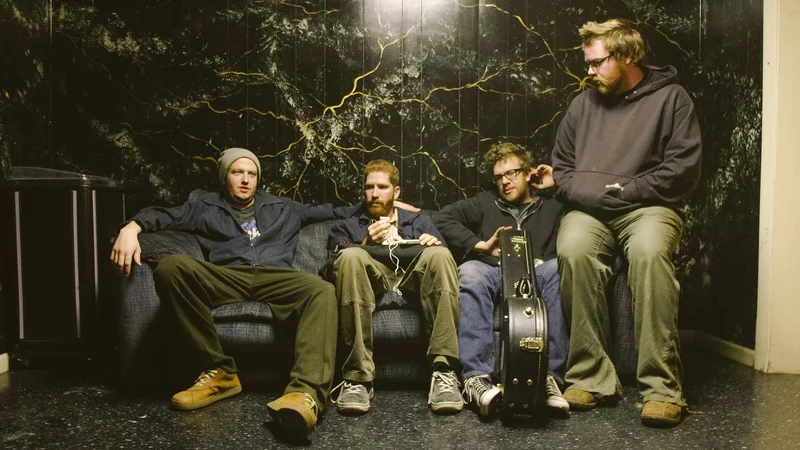
Vernon tasked his bandmates with singing leads instead of their customary harmonies. Westerlund brought in jazz tunes and experimental practices from Bennington. Brad Cook gave a crash course in 20th-century electronic composition. And Phil Cook led a deep dive into early, unamplified American music: Delta blues, spirituals, string and jug bands.
Filling the second two CDs of “That Was Then”, the concert mixes songs from their records with restrained versions of their discoveries at Bickett. It delivers an ideal version of “Silent Signs,” stretched and spectral like Sam Amidon, and the beautiful “Red Shoes,” which has the cloudy mixture of doubt and regret that marks Vernon’s best songs, and the darkly spun charmer “Song for a Lover (of Long Ago),” where the enigmatic repetition of the word “ring” is both a matured take on the circular prosody of “Bones” and a holographic step toward Bon Iver.
Lost in the studio, DeYarmond Edison dissolved mid-session, leaving 1,000 copies of a reissued “Silent Signs” to rot in a barn in Durham. Vernon returned to Wisconsin to make “For Emma, Forever Ago”, and the others went on without him as Megafaun. “We were like three framers and a contractor,” as Phil Cook put it. “Then the contractor left. And then we just built a bunch of fucking houses.”
Still, the final DeYarmond Edison recordings, collected on the “Epoch, Etc”. disc, were some of their best, with new versions that balanced graceful song writing and experimental taste. ard of local gospel music, Westerlund a well-circulated drummer and solo artist.
 The Fat Angel Sings