

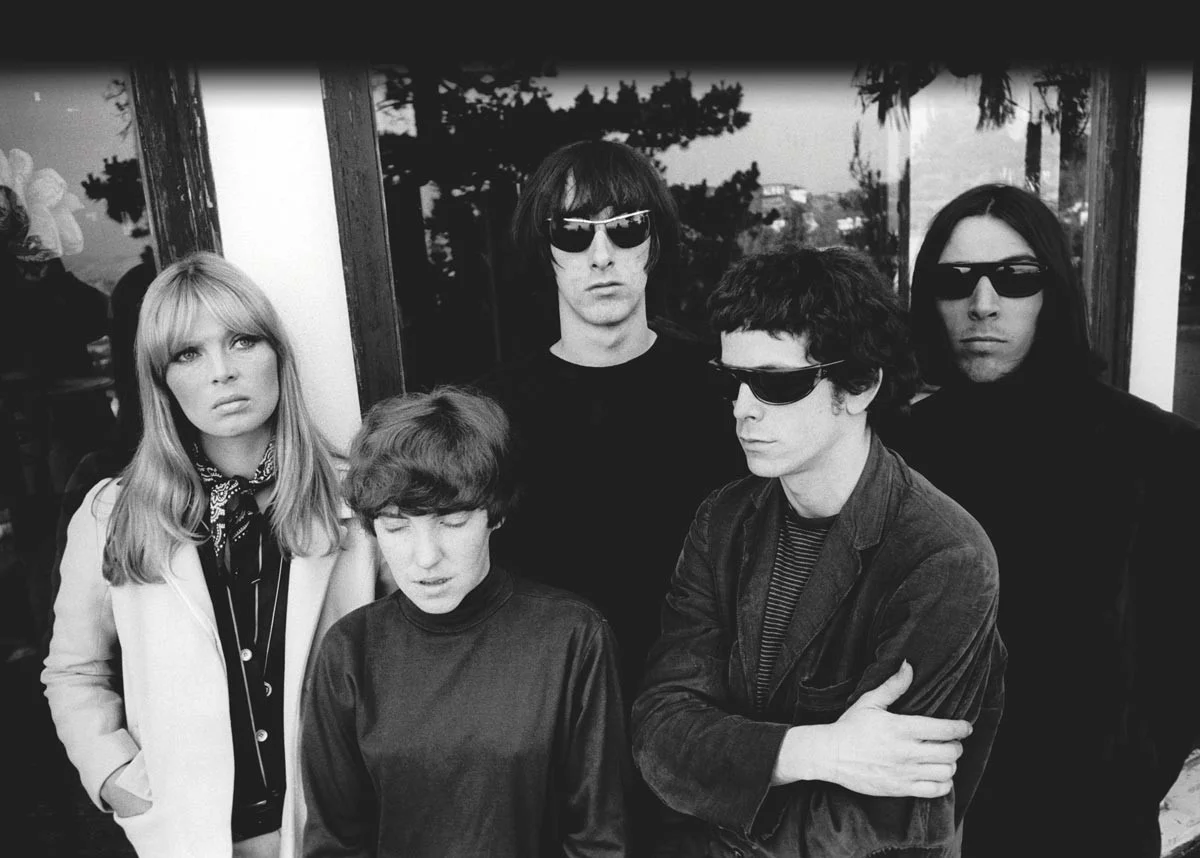
The Velvet Underground began as a collaboration between frustrated songwriter Lou Reed and the classically trained John Cale. Cale had worked with experimental composers John Cage and LaMonte Young, and Reed’s interest in alternative guitar tunings and drone notes provided common ground. The pair recruited guitarist Sterling Morrison and drummer Moe Tucker and The Velvet Underground was formed.
The band were introduced to artist Andy Warhol, who negotiated a recording contract and showcased them in his multimedia road shows, which combined his films with the band’s music. He also introduced the band to German vocalist Nico, who sang three songs on their debut record.
The Velvet Underground became famous for their influence – despite a lack of commercial success during their tenure, they’re now critically revered. Brian Eno is often quoted as saying – “the first Velvet Underground album only sold 10,000 copies, but everyone who heard it formed a band.”
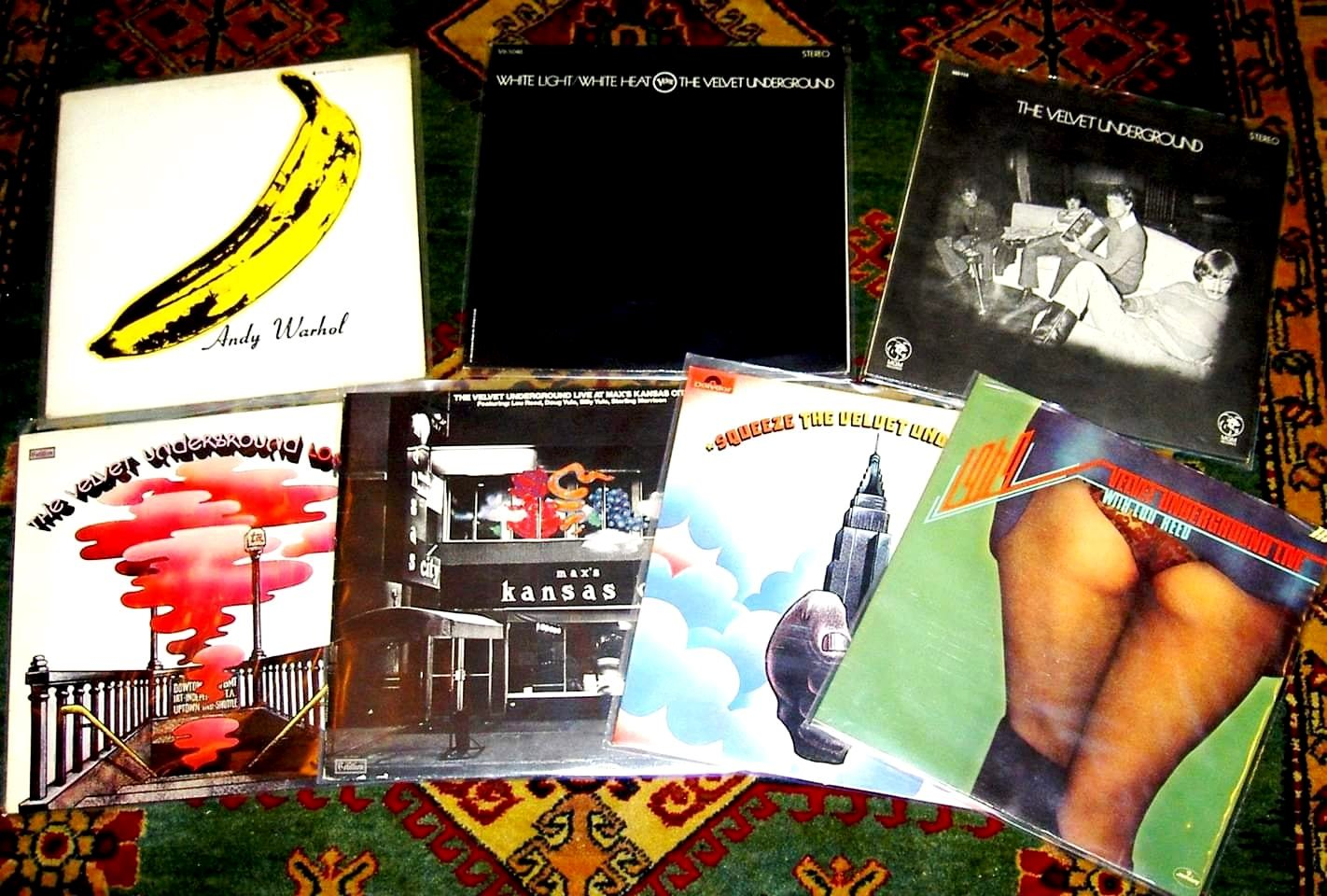
The band gradually lost key members – John Cale left after their second record, forced out of the band by Reed, who wanted to make the band more accessible. When Lou Reed left perhaps the foundational band of underground, artsy, experimental guitar music, he moved back into his parents house on Long Island and took a gig as a typist at his father’s office. In 1970, affter creative power struggles, romantic drama, and four eccentric albums (each now thoroughly canonized), Reed had failed to break his little project into the mainstream. Reed and Morrison both left after 1970’s “Loaded”, leaving replacement bassist Doug Yule in charge for their final record.
The Velvet Underground only made five studio albums, although a couple of 1980s compilations “Another View” and “VU” mopped up outtakes, including a scrapped fourth album.

SQUEEZE 1973
Lou Reed left the Velvet Underground in 1970, followed by Sterling Morrison. This left Doug Yule as the band’s focal point. Yule had contributed heavily to “Loaded”, but Reed wrote all the songs. It’s tough to expect Doug Yule to measure up to creative giants Lou Reed or John Cale – “Squeeze” is a likeable album but it’s clearly lightweight compared to the band’s earlier work. It has pleasant songs like ‘Friends’, later covered by Luna, and inspired the name of Glenn Tilbrook and Chris Difford’s new wave band.
Vaguely pointing to bands like The Beatles (as heard extremely clearly on the McCartney-esque ”Crash” or The Beach Boys (the inspiration behind “Caroline” isn’t exactly subtle), and pushing absolutely no sonic or formal boundaries, the record is offensively forgettable. Not a single hook stands out among this collection of uninspired blues and folk instrumentals. Had “Squeeze” not plastered the name “The Velvet Underground” on its album art (the lesser of the Velvet’s two phallic covers by a mile), it’d almost assuredly be lost to time. We wouldn’t have lost out on much.
Closer “Louise” is the most sonically engaging of the set, even if it does fall short of its Beatles aspirations,.
“Squeeze” is essentially a Velvet Underground album in name alone. Reed and Sterling had officially left the band, leaving Yule — who replaced Cale following his unceremonious firing two albums prior — as the new band leader. He wrote and recorded the entirety of the project nearly alone; not even Tucker, who continued to tour with Yule, makes an appearance. Functionally, the album is a Yule solo project that utilizes his old band’s name because Steve Sesnick, the band’s manager at the time, thought he might be able to squeeze (ha!) a few more dollars out of The Velvet Underground brand.

LOADED (1970)
If “Squeeze” sounded like a copy of a copy of a copy of rock ‘n’ roll, “Loaded” sounds like a masterful reinterpretation of the genre’s original blueprint. Ten songs and 40 minutes in length, the collection is perhaps Reed and company’s most immediate, easily enjoyable set of tunes. Unlike the avant garde nature of albums like “White Light/White Heat”, all-time classic songs like “Sweet Jane” or “Rock & Roll” are perfect Velvet Underground tracks not because of their progressive experimentation, but because of their flawless construction. It’s a record that proves that, if they had wanted to, The Velvet Underground could have been doing straight rock music all along.
Every Velvet Underground (or Spacemen 3 fans, for that matter) should listen to “I Found a Reason” in all of its slow, dreamy glory.
Atlantic Records demanded an album loaded with hits – an odd request for an avant harde band. But “Loaded” is a valiant attempt at a more accessible and radio-friendly Velvet Underground record. “Loaded” starts with three of Lou Reed’s most accessible and memorable songs; the sunshine pop of ‘Who Loves the Sun’, the indelibly simple riff of ‘Sweet Jane’ , and ‘Rock & Roll’. The rest of the album is surprisingly bland – it lacks the experimentation of The Velvet Underground’s previous releases. With Mo Tucker on maternity leave, Doug Yule is highly involved – as well as playing bass, he sings lead vocals on four tracks and plays drums, keyboards, and guitar.
“Loaded” just might be The Velvet Underground’s best rock record, and had any other band released it, it would undoubtedly be in competition for the top spot. “Who Loves the Sun” is a heartbroken pop-rock tune in a uniquely classical sense, “Lonesome Cowboy Bill” is a ballroom bop, and the immaculate “Oh! Sweet Nuthin’” is the ideal of an epic, rockin’ closer.

WHITE LIGHT/WHITE HEAT (1968)
“White Light/White Heat” is often characterized as a sonic battle, and it’s not hard to hear why. The product of two warring creative forces (Cale with his unrestrained lust for musical revolution and Reed with his aspiration for pop perfection), it’s The Velvet Underground at their noisiest, most abrasive, and least conventional. This fruitful conflict comes through most obviously on the cacophonous beast that is “Sister Ray,” but even the album’s most tuneful ditties have an edge sharp enough to scratch a diamond, like on the eponymous opener, which sounds like if a bluesy, pub-ready rocker was blasted with enough saturation to warrant a warning label.
“The Gift,” with its extremely literary spoken word and stereo trickery, was never going to be a radio hit — but gosh darn it if it isn’t one of the most enthralling eight minutes the original Velvets ever put together.
The Velvet Underground’s second album is their noisiest and most extreme. John Cale stated that “White Light/White Heat” was “consciously anti-beauty”. It’s a six track record with punchy garage-rockers like ‘I Heard Her Call My Name’ and the title track, and two longer experimental pieces. John Cale takes the lead vocal on ‘The Gift’, reciting a Lou Reed short story over feedback – it’s distinctive but doesn’t hold up to repeated listens well. The focal point is ‘Sister Ray’, which dominates the second side – a 17 minute tale of debauchery. “White Light/White Heat” is the band’s most out there album, but it’s not always enjoyable listening.
“Sister Ray” is damn near a literal translation of Reed and Cale battling it out through competitive jamming. But what a swan song it was for the band’s most celebrated lineup, and it stands today as their most unapologetic and aggressive statement.
“White Light/White Heat” is likely The Velvet Underground at their peak. It certainly is the band at their most unbound and distorted. Cale’s had successfully upped his sonic fuckery and Reed was penning some of the most transgressive tales of his career. Tracks like “Lady Godiva’s Operation” — hummable yet dirty and touching on taboo subject matter — showcase the magic that spawned from the two artist fighting for creative control. By all accounts, it was a hellish and dramatic recording process, but the results speak for themself.

THE VELVET UNDERGROUND (1969)
If the band’s most abrasive material featured on “White Light/White Heat”, The Velvet Underground’s third album features their mellowest work. With John Cale forced out of the band, “The Velvet Underground” is more conventional than before – Doug Yule’s sweeter voice is used on the opening ‘Candy Says’.
With Cale out of the band and his resistance to anything remotely commercial-friendly, Reed quickly took the band in the opposite direction. The juxtaposition of the final song from “White Light/White Heat” (“Sister Ray”) and the opener of The Velvet Underground (“Candy Says”) is akin to that between a car crash and a cup of hot cocoa. The rest of the album follows suit, keeping the volume lower and the timbres cleaner. It’s the band’s most successful (creatively, at least, if not financially) attempt at crafting artful pop.
There are some vestiges of experimentation on ‘The Murder Mystery’, the most ambitious track on “The Velvet Underground“, helps add nuance to the prevailing narrative of Reed as the populist and Cale as the sonic terrorist. The track reads like the younger, sweeter sister of “The Gift,” complete with overlapping vocals and an extended runtime with a raga rhythm and all four band members contributing vocals, but the heart of the record are Reed’s mellow and confessional ballads like ‘Pale Blue Eyes’ and ‘Jesus’.
The set contains some of Reed’s most moving, plainly beautiful songs — it truly is a wonder none of them managed to introduce the band to the masses. Stripped of Cale’s abrasion, the album’s 10 tracks are able to showcase Reed’s songwriting prowess clearly and without the pesky obscuration of unappealing sounds. They’re intimate and softly presented, and yet retain Reed’s subversive lyricism. If “White Light/White Heat” is The Velvet Underground record for the Cale-loyal, “The Velvet Underground” is the pick for the Reed-heads.

THE VELVET UNDERGROUND & NICO (1967)
The Velvet Underground’s debut, “The Velvet Underground & Nico”, was largely recorded in the spring of 1966 – it’s amazing, given how groundbreaking and influential it was when it was finally released in 1967. The band tackled taboo subjects like drug dealing and S&M, and brought ideas from the avant-garde onto a rock album. It still sounds fresh and daring, especially key tracks like ‘Venus In Furs’ and ‘Heroin’. Despite the band’s avant-garde credentials, they still have great melodies like the gentle opener ‘Sunday Morning’ and the gentle folk-rock of ‘Femme Fatale’. The final tracks, ‘The Black Angel’s Death Song’ and ‘European Son’, are more impenetrable, only recommended for adventurous listeners. Andy Warhol provided the famous cover – early editions of the LP offered a peelable banana.
Bank-rolled and managed by Andy Warhol, The Velvet Underground’s debut is the sound of something new. Rough around the edges with a solid-gold center, “The Velvet Underground & Nico” tops “best albums of all time” lists for a reason the songs are simply incredible. Tabling talk of influence and innovation, Reed, Cale, Tucker, Morrison, and Nico put together a set of timeless rock songs that sound just as engaging today as they did to the few that heard them in ’67. From the understated majesty of “Sunday Morning” or “Femme Fatal” to the unbridled creativity of “Venus in Furs” or “All Tomorrow’s Parties,” the genius of “The Velvet Underground & Nico“ is so vast it almost seems accidental and inimitable.
If any song on a record as heralded as “The Velvet Underground & Nico” could be underrated, it’d be the wonderfully weird, string-scratching “Black Angel’s Death Song.”
Though the band (and Warhol, for that matter) were assuredly doing everything they could to become the next great artistic phenomenon, “The Velvet Underground & Nico” was too revolutionary to be embraced by general audiences. Be it the proto-punk energy of “I’m Waiting for the Man” or the stark vulnerability of “Heroin,” even at their most restrained, the band was too innovative, too disruptive to break into Top 40.
The Velvet Underound only lasted a handful of years, only releasing five albums in total, but they left a mark on rock music matched only by fellow behemoths like The Beatles. Despite their brief existence, the band’s sound twisted and morphed with each subsequent release, resulting in a wildly varied, incredibly impressive discography. With such variety in style and consistency in quality, only a fool would attempt to draft a ‘definitive ranking of every Velvet Underground record.’
History has been kind to The Velvet Underground, and for good reason: the music of Reed, John Cale, Maureen Tucker, Sterling Morrison, Doug Yule, and sometimes Nico oozes with enough sheer creativity and artistry to fuel artists for countless more half-centuries.
 The Fat Angel Sings