

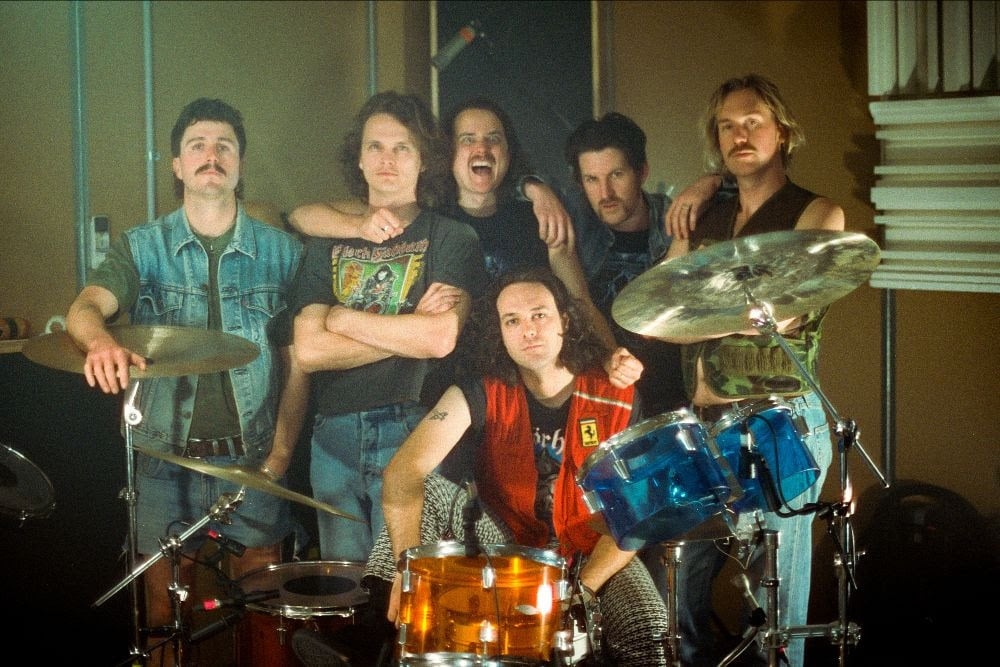
King Gizzard & the Lizard Wizard are taking what counts for them as a break. After two European tours, a series of residencies in US cities and a sprinkle of Australian shows in between, King Gizzard have slowed down just long enough to release their second new album of the year, the fully electronic “The Silver Cord” (out October 27th).
On the cusp of releasing their 25th album a little over a decade since their first, 2012’s “12 Bar Bruise”, King Gizzard have travelled a long, zig-zagging path from their garage punk origins. With the attention to detail as King Gizzard & the Lizard Wizard do on synth-heavy new album “The Silver Cord“. Its seven tracks may seem like the polar opposite of predecessor “PetroDragonic Apocalypse“, but the attentive listener will notice that these two albums have a lot more in common than you might think. “The Silver Cord” is the yang to “PetroDragonic Apocalypse’s” yin, in more ways than one.
The album has two versions – a short one clocking in at 28 minutes, and extended one exactly one hour longer. Neither version is the definitive one, with each version having their own strengths, weaknesses and WTF-moments. The version is the second shortest King Gizzard & the Lizard Wizard studio album to date, beating 2013’s “Eyes Like the Sky” by a mere ten seconds. Opening trio “Theia, The Silver Cord” and “Set” marked the first glimpse of what to expect, coming out as a triple single earlier this month by means of a music video best watched on shrooms. There’s a distinct absence of ‘traditional’ instruments on the entire album, with the band opting solely for synthesised sounds (you name it, they definitely used it). The last time King Gizzard went for this approach was on the summery “Butterfly 3000” in 2021, and even though Theia may bear reminiscence to that sun-kissed album, these comparisons don’t last much longer.
Title track “The Silver Cord” is perhaps the most absurd the band have ever sounded, with warped vocals, haunting melodies and intense lyrics making for an unsettling experience. Its finale restores some sanity into proceedings by way of beautiful synth patterns and ethereal vocals, before “Set” throws all that out of the window in favour of some swaggering beats, rapping from Ambrose Kenny-Smith and a repeated chant of, “slay the mighty Set”. For those unaware, “Set” was the Egyptian god of war and chaos. War and chaos are also pretty good descriptors for this song, destroying the ethereal worlds tracks one and two created without hesitation.
The album’s opening trio painted a relatively positive picture sonically, but the sonic serenity pretty much ends with “Set”. “Chang’e” – the weakest of a strong bunch – is a sudden shift in tone, bridging the gap between “Set’s” playfulness and the intensity still to come. Just like its counterparts across the album, “Chang’e” has a knack for combining warm synth tones with unhinged melodic passages and ethereal vocals. For those curious, Chinese mythology refers to Chang’e as “the woman in the moon”. Interestingly, “PetroDragonic Apocalypse” track “Witchcraft” (also track four…) refers to a similar blood moon goddess. Coincidence? Not at all, but you’d have to keep reading to find out why. “The Silver Cord’s” strongest moments come during the final three songs, which fused together are an absolute monstrous experience. “Gilgamesh” sounds like a bad trip, with heavily altered vocals and another rapped verse from Kenny-Smith. The beats are raw, the synths are warped and the interplay between Mackenzie and Kenny–Smith is infectiously good. “Swan Song” enters much darker territory, both sonically and lyrically. If “Gilgamesh” was a bad trip, then “Swan Song” is the comedown from hell.
There are even moments where Mackenzie veers into throat singing, hauntingly so. It all makes way for “Extinction“, King Gizzard & the Lizard Wizard’s most unhinged album closer to date, a culmination of two entire albums worth of experimentation, lore and hidden connections. Its ending pushes the band into new sonic territory: hardstyle, but not quite in the classic sense of the genre. It’s fast, it’s in your face and and beat-driven to the point of no return. The synths which snake around drummer Michael Cavanagh’s drums are relentless, ensuring “The Silver Cord” goes out on a (for some listeners, literal) high. Think of it as ending on a peak, or being on a trip which you never want to end.
And now for the extended version. Let’s start with the elephant in the room: constant references to previous album “PetroDragonic Apocalypse”. By way of callbacks on each song to its corresponding soundtrack counterpart on PDA, “The Silver Cord” serves the purpose of a mirror, reflecting back elements of a previous album yet in a warped fashion. Yin and yang, basically. “Theia’s” extended cut spawns twenty minutes, although they fly by pretty quickly by way of sprawling melodies, programmed beats and both a call-back to the previous album as well as a call-forward to the next song: we hear Mackenzie sing both “Motor Spirit” repeatedly, as well as recite the “I’m just a vessel” verse from title track “The Silver Cord“. This song’s own extended version centres on acid-laced synth passages (and an oh so subtle melodic callback to PDA’s “Supercell”), also presenting us with the first hints of drum and bass to grace the record. There’s a sense of fleeting urgency to “The Silver Cord’s” extended version, which the groove-based “Set” builds on in and amongst utterings of the word “converge” laced in a near-robotic level of vocoder. Instrumentally, it continues to play on that one quirky melody, with an extra rapped verse from Ambrose Kenny-Smith adding to the fun.
“Chang’e” – which was the weakest track on the short version – is elevated to completely new heights as its extended version borrows both melodies and entire verses from “PetroDragonic Apocalypse” counterpart “Witchcraft”. This metal song’s solo is transposed to synths on “Chang’e“, flirting with upbeat percussion and layered melodies as Mackenzie sings of “red and deep burnt blues” and snakes, which slither “just out of sight”. “Gilgamesh’s” extended version takes the dark undertones of its short version and builds on them in such a way that they mark the perfect precursor for what “Swan Song” and “Extinction” will unleash later. As “Gilgamesh’s” extended version unpacks layer after layer of bubbling synths and obscure noises, we hear the band chant “Gila! Gila!” in what is by far the most obvious callback on the entire album.
It sets the scene perfectly for the Jungle-lite “Swan Song“, which takes no prisoners from the word go and manages to paint a morbid picture led by some of Mackenzie’s gnarliest and prettiest vocals on the record. Things kick up another notch just over halfway into the song, when a heavily roboticized voice makes a bold proclamation over some very subtle, pulsing synths: “The eye dilates, the air gyrates / A gate in the sky, a portal to die, A shriek from space, a mangled yell / Dragon descends, welcome to hell”. This makes way for an in your face instrumental passage, before this same verse returns amidst sonic hellfire. If you think it sounds like the end of the world, then that’s because it is. “Swan Song” is the album’s thematic and sonic breaking point, an apocalypse of sorts where the asteroids are Cavanaugh’s brute force drums, and the flames are synthesizers. In Kenny-Smith’s words, “this plane nosedives straight into hell”. Jungle is massive, and so is “Swan Song”.
“Extinction” is the aftermath of this chaos, although that’s not to say the intensity lets up one bit. Mackenzie’s gnarliness on “Swan Song” has been replaced with ethereal vocal passages, including lyrical references to PDA’s “Flamethrower” with “Extinction” centring on one key lyric throughout: “I can see everything, I can be in the music”. It’s an all encompassing line which King Gizzard fans will surely unpack in more ways than one. As the song prepares for its climax, you can sense that the intertwining synth tones and bubbling undergrowth of bass-y rhythms have one more punch yet to pack. King Gizzard attempting to make classic European hardstyle within the foundations of “The Silver Cord’s” sonic universe. The last four minutes of the album slowly build up in intensity, climaxing on what almost feels like a second apocalypse, one spearheaded by warped synths, a hi-BPM tempo and the constant recurrence of the song’s focal melody. It’s one hell of an ending, to one hell of an album.
 The Fat Angel Sings