

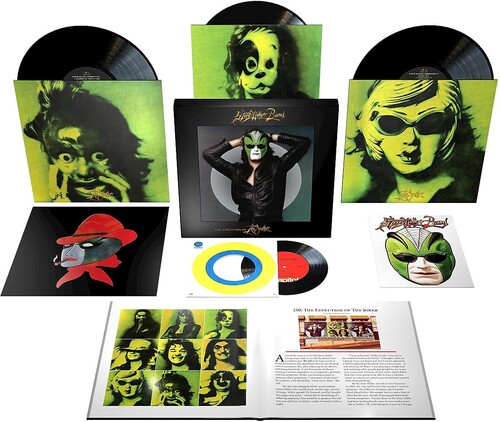
Steve Miller is honoring the 50th anniversary of his chart-topping, Platinum eighth studio album, 1973’s “The Joker”, with a new set chronicling the artistic journey that led to its creation. “J50: The Evolution of The Joker” showcases Miller’s process as he expands and reimagines his craft, ultimately finding a strikingly original new sound that brought him to a wider audience than ever before and set the stage for even greater successes to come. It arrives September 15th, 2023, via Sailor/Capitol/UMe on 2-CDs or 3–LPs + 7”.
“J50” dives deep into the creative process of writing and assembling “The Joker” and amplifies its enduring magic by chronologically placing the original album tracks alongside 27 previously unreleased recordings from Miller’s personal archive – including songwriting demo tapes made by Miller on his TEAC 4-track in hotel rooms on the road and at live performances, plus studio outtakes and rehearsals – as well as six audio commentary tracks from Miller and exclusive liner notes from both Miller and journalist Anthony DeCurtis. The vinyl version includes a reproduction of a vintage “The Joker” iron-on and a limited-edition lithograph.
Hear some of the previously unreleased recordings below. The Gangster of Love had already had several successful albums but hadn’t sniffed a hit single when this was released in October 1973. It topped the chart on January 12th.
“J50: The Evolution of The Joker” is highlighted by “The Joker Suite,” an extended piece showcasing the musical path to the album’s hit title track, “The Joker,” with the previously unreleased “Lidi” and “Travelin’.
Miller shared how “Sugar Babe” evolved, with a series of three audio clips. “[The song] turned into a powerful electric riff in the studio, but in this first recording it’s just a small seed of an idea,” says Miller. “Eventually it got defined on the stage and in the studio and that’s what you hear.”
“The Joker” was originally released worldwide in October 1973 and quickly became a hit in the United States crossing over from FM underground radio to the AM pop radio of the day. Shortly thereafter, the song went to No#1, first in the USA and the rest of the world followed.
This mainstream breakthrough success was certainly fuelled by dramatic shifts in both the line-up and Miller’s own approach to songcraft. “J50” kicks off with acoustic live renditions of “Children of the Future,” “Brave New World” and “Space Cowboy,” recorded while on the road in 1972. Miller had long nurtured his still-growing audience with constant touring, routinely visiting hundreds of cities each year. Backed by Dickie Thompson on keyboards, Gerald Johnson on bass, and John King on drums, the lineup marked the Steve Miller Band’s first iteration as a quartet. Fuelled in part by Thompson’s B3 organ and electric Hohner clavinet, the band developed a distinctive new sound, blending Miller’s signature psychedelic blues with a focused songcraft that expertly merged his many inspirations and influences into something wholly original and all his own.
Their lengthy sets were highlighted by covers of R&B gems like Young Jessie’s “Mary Lou” and The Clovers’ “Your Cash Ain’t Nothin’ But Trash,” both of which would be featured on “The Joker”.
Energized by his band’s nightly workouts, Miller spent his late-night hours recording on a TEAC 4-track tape machine in hotel rooms across the nation, working on new songs largely on 12-string guitar. In July 1973, the band hit Capitol Records’ Studio B in Los Angeles and quickly got to work, recording, mixing, and mastering the album in just 17 days with Miller producing.
When you go into the studio, be ready to do the whole performance the first time you do it, because that’s going to be the best time you do it,” Miller says. “The whole thing is to capture the first performance. That’s a lot of what “The Joker’s” about. It was all first takes, and first takes are always better than perfect takes.
Like if you take ‘The Joker.’ ‘Some people call me the Space Cowboy.’ What the hell was that? Then it continues and it gets your attention again: the slide guitar, the chorus, the harmony, the wolf whistle. It all adds up. All of these things are just elements of writing. You learn those elements, and you’re always playing with them.”
Miller’s new songs, from the album-opening “Sugar Babe” and longtime live favorite “Shu Ba Da Du Ma Ma Ma Ma,” to the easygoing blues shuffle, “The Lovin’ Cup” (extended by a driving, live acoustic version of Robert Johnson’s “Come On In My Kitchen,” with foot-stomping percussive accompaniment) and the devastating, slow-burn “Evil,” the latter recorded on stage at Boston, MA’s Aquarius Theater. “Something To Believe In” closes “The Joker” on a warm, reassuring romantic pop lullaby. “Like clear water in a mountain stream,” he sings, “l will come to you in your dreams/Like pictures reflected in a mountain lake/I will be with you when you wake.”
Released as a single in October 1973, “The Joker” proved, in Miller’s words, “a real, no kidding, non-stop hit.” With its title track seemingly everywhere (as well as its indelible masked album cover by famed photographer Norman Seeff), The Joker album positioned Miller for the next, vitally important stage of his career.
 The Fat Angel Sings