

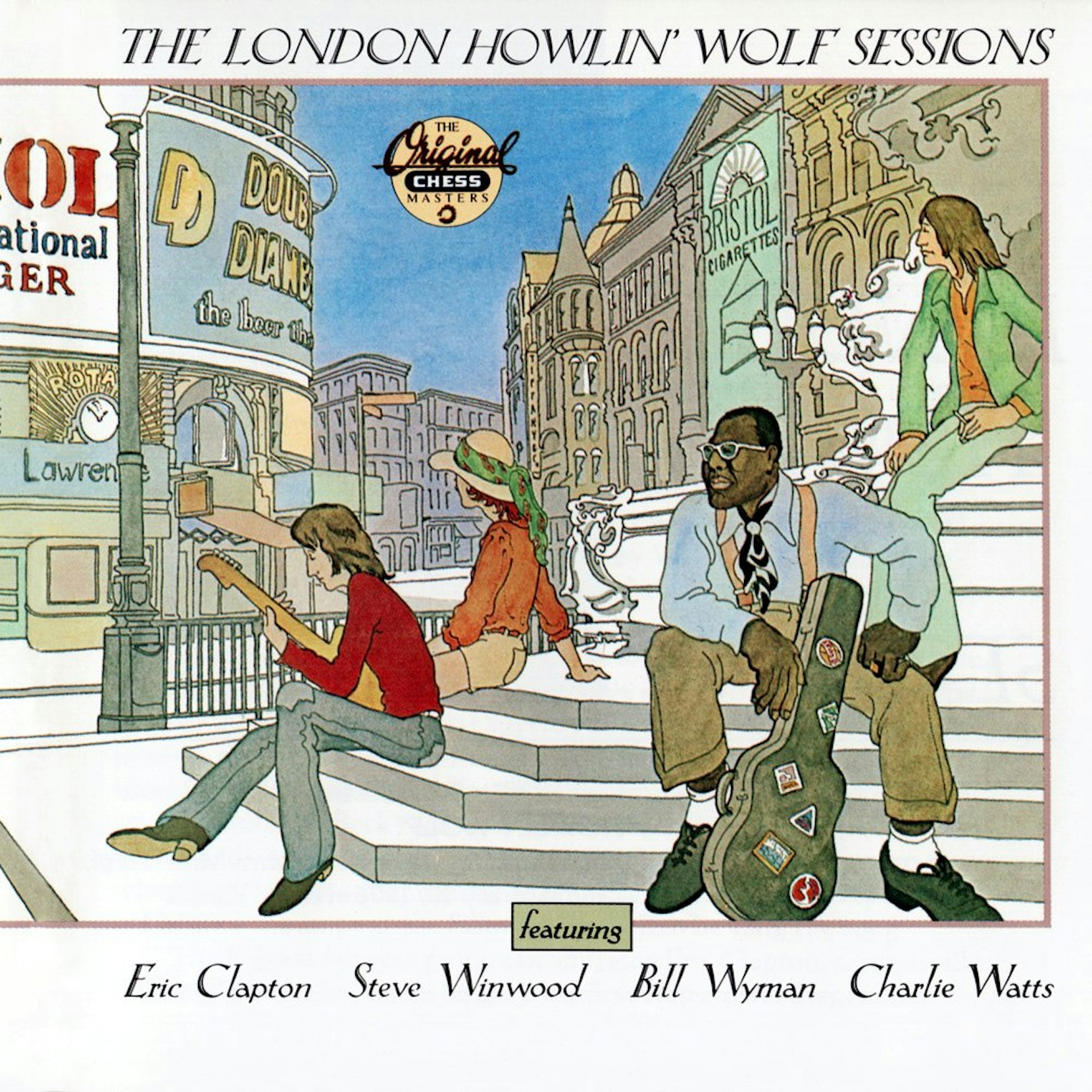
Sometime around 1969, record producer Norman Dayron—fresh from producing the multi-generational “Fathers & Sons” album by Muddy Waters and his younger disciples—ran into Eric Clapton, who may have been backstage at an Al Kooper/Mike Bloomfield show, or perhaps it was a Blind Faith concert. No one seems to remember for sure. In either event, Dayron seized the opportunity to ask Clapton if he’d like to record an album with master bluesman Howlin’ Wolf.
Dayron was a staff producer at Chess Records, and that the offer was indeed legit, arrangements were made by Chess Records. Howlin’ Wolf—born Chester Burnett on June 10th, 1910, in White Station, Miss. would come to London. Clapton was over-the-moon excited, yet agreed under one condition: that Howlin’ Wolf’s longtime guitarist, Hubert Sumlin, be involved as well. There was some initial balking at Chess regarding the expense of flying two players from Chicago O’Hare to Heathrow.
Howlin’ Wolf was another Chess Records mainstay, releasing numerous singles and “best of” LPs on the label. This 1971 album consists of recordings Howlin’ Wolf made with the popular British blues musicians of the time, all of whom had been inspired by the early days of Chess Records. Eric Clapton, Steve Winwood, Bill Wyman and Charlie Watts all feature prominently on the album, and are credited on the LP’s cover.
From May 2nd-10th, 1970, at London’s Olympic Studios home of sessions for the Beatles, Rolling Stones, Jimi Hendrix and David Bowie, among others—the house was rockin’ with Howlin’ Wolf and British rock royalty. Clapton was enlisted to play lead guitar on each of the 20-some songs, some being alternate takes) with Sumlin on rhythm guitar. Thankfully, Clapton yielded to Sumlin in establishing the songs’ grooves, although Sumlin’s rhythm work dominates “Do the Do.” And on “The Red Rooster,” Clapton nods not only to Sumlin, who played on Wolf’s 1961 original, but also to Keith Richards and Mick Taylor’s guitar moods.
The highlight of the LP is the “false start” rehearsal track for “Little Red Rooster,” which is essentially a peek into the artists’ studio session. The song starts, then stops, and then listeners get a peek into the ensuing conversation between Howlin’ Wolf and his British collaborators. It’s not 100 percent intelligible, but it breathes a new sense of life into an already vibrant work.
The Rolling Stones’ rhythm section was enlisted: Bill Wyman, bass; and Charlie Watts, drums, with Klaus Voormann on bass for one song (five if one counts the bonus tracks that saw the light of day on the 2003 expanded reissue), and Ringo Starr on drums on one track from the original album (plus three reissue bonus tracks). When Voormann laid down the song-defining bass riff on “I Ain’t Superstitious,” Wyman played the cowbell. And yet another Rolling Stone (albeit not an official band member), Ian Stewart, played piano on “Rockin’ Daddy.”
British keyboard legend Steve Winwood (Traffic, Blind Faith) overdubbed piano and organ on five tracks while on tour in the U.S. At certain points, it’s impossible to distinguish between Clapton and Sumlin (apart from Clapton playing most of the solos) and between Winwood and first-generation Chicago blues pianist Leake. John Simon, a popular producer in the late ’60s (Leonard Cohen, The Band, Blood, Sweat & Tears, Janis Joplin) takes a turn on piano on ‘Who’s Been Talkin’.”
As for the Wolf, he could do no wrong. The year 1970 found him in excellent voice, spirits and energy, able to moan, growl, snarl, roar and bellow as he’d done since his earliest Sun Studio sessions in 1951. Were there London Sessions songs on which he excelled more than others? Absolutely. “Worried About My Baby,” on which Wolf played his own harmonica, comes to mind. (There are two additional outtake versions of “Worried About My Baby” on the expanded reissue, the most intriguing of which features Wolf, Clapton and Wyman, with no drummer.)
And the groove of Willie Dixon’s “Wang Dang Doodle” and, on the expanded reissue, “Killing Floor,” come to mind. The Wolf saved some of his best howlin’ for the Willie Dixon-penned classic, which closes the original LP, released in August 1971
 The Fat Angel Sings