

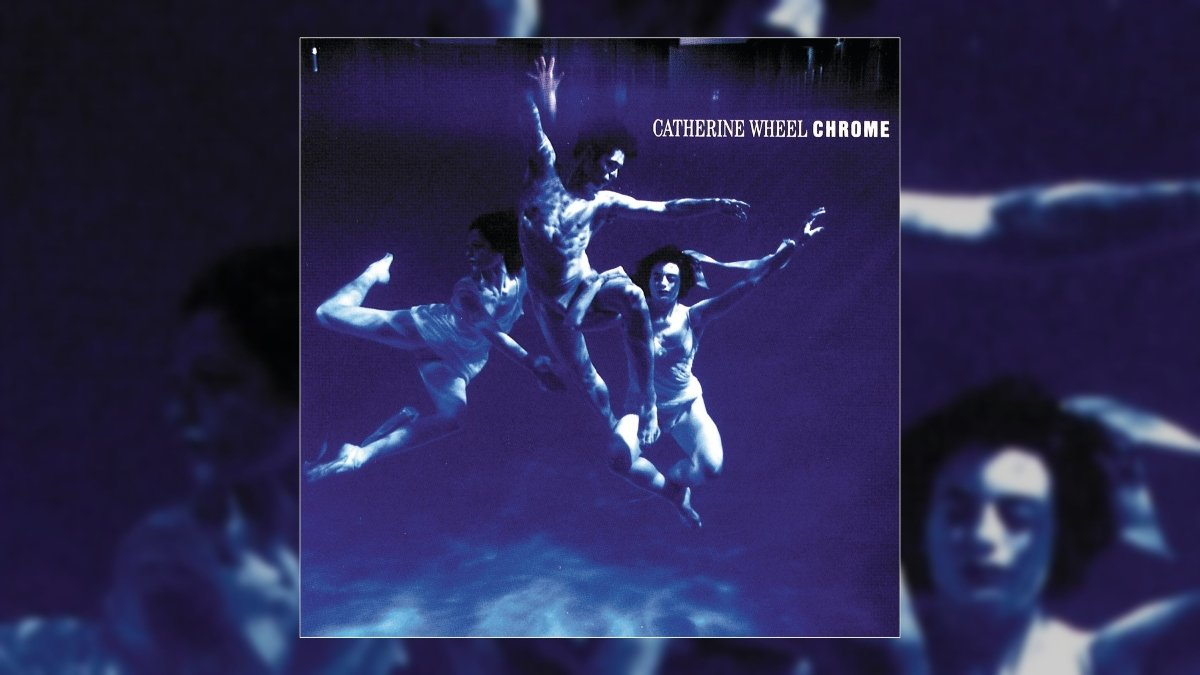
Their 1992 debut “Ferment” offers many beautifully fuzzy moments, a commendable, textural entry into the crowding shoegaze canon. But where “Ferment” cocoons the listener in mellifluous mysteries, their 1993 sophomore effort “Chrome” sheds the debut’s abstract trappings. It barrels past any hypnagogic vagueness, with crystalline focus, into a bigger sound that’s more visceral and immediate. With “Chrome“, Catherine Wheel showed the world they didn’t quite fit that shoegaze label they were so quickly filed under.
Vocalist/guitarist Rob Dickinson, guitarist Brian Futter, bassist Dave Hawes and percussionist Neil Sims formed Catherine Wheel in seaside town Great Yarmouth, on the east coast of England, for one simple reason—to make music. Laser-focused on their craft and devoid of rock star ego or ambition, Catherine Wheel were refreshingly authentic. They had no interest in manufacturing a look or sound to become more commercially viable.
“It was all about the noise…the sweet cacophony that we could create without having to have the usual paraphernalia of a rock band, which none of us liked,” Dickinson recalled during a 2008 interview. Bassist Dave Hawes explained, “The main thing I remember when going to record “Chrome” was that we didn’t just want to make “Ferment” 2. And through continually touring between “Ferment” and going into record “Chrome” we had evolved into a harder sounding band. It just seemed a natural process and so “Chrome” turned into a harder sounding album and I think Gil Norton was the perfect producer for us at that point of time. Steering clear of artifice and employing a more direct approach to production (versus “Ferment”), the band pulled in ex Pixies producer Gil Norton, studio mastermind behind many 4AD bands, including the Pixies, Throwing Muses/Belly, and Pale Saints. Despite this change, “Chrome” still drips with the balmy atmosphere of “Ferment” testament at least partly to the ongoing influence of Tim Friese-Greene, producer of “Ferment” (and electric organist on “Chrome”).
Spurred by the success of their debut, Catherine Wheel grew more confident in their rich, guitar-driven sound and booked recording time at London’s infamous Britannia Row Studios where Joy Division had recorded “Closer” Built by Pink Floyd, the storied space undoubtedly fuelled the band’s determination to make a record that stood out.
“Chrome” takes off with an adrenaline-lifting, soul-baring jolt of reality. In album opener, “Kill Rhythm,” Rob declares, “Shout—the secret’s out.” Continuing the sentiment, “I Confess” follows. And it begins to seem this album is all about facing those skeletons in the closet.
But “Crank,” the album’s powerful first single, reminds us that reality is subjective and we can’t help but create shelter in our minds—“I build my canopy of steel / It fulfills my sense of real / A chrome protection.”
Feeling much fuller and epic than its under-four-minute runtime, “Crank” represents the kind of radio-friendly crescendoing rock perfection that few bands actually attain. Intense, emotional and memorable, “Crank” is the song that baits, as any single should. The track “Ursa Major Space Station” was named after a guitar effects pedal, while “Fripp” was named after King Crimson guitarist Robert Fripp.
Slower tracks like “Fripp” and jangly dreampop moments (“Strange Fruit” and “Show Me Mary”) reveal the breadth of Catherine Wheel’s songwriting abilities. “The Nude” The crushing yet seductive single sends my heart soaring before letting it sink. I’ve rode this comedown so many times, I assure you it’s worth it.
Few rock records sound like this; there are only a few songs on Teenage Fan Club’s “Bandwagonesque” and Sugar’s “Copper Blue” that resemble “Chrome’s” gentle, blushing form of aggression, which generates songs as harsh and menacing as the title track and songs as celestial and full of dread as “Fripp.” Where many shoegaze bands would resign themselves to 2-3 monochromatic notes, Dickinson’s vocal melodies are dynamic, vivid, and exhibit an astral quality; they burn, shimmer, and glow against these songs. “Chrome” bears many of the hallmarks of early 1990s rock, I’d argue it’s a quintessential rock album that holds its own, independent of time. Some bands focus on the formula of commercial success. Others pay mind to their craft. For the fortunate few who know Catherine Wheel, we’d tell you it’s the latter that lasts. The album cover photo was shot in an indoor swimming pool by Storm Thorgerson of the Hipgnosis design company. In 1999, the cover of this album appeared as the cover of the Hipgnosis/Thorgerson retrospective book “Eye of the Storm”:
Melody Maker described “Chrome” as “a tighter, more robust affair” than “Ferment” and “perhaps the ultimate Catherine Wheel album”. NME called it “a triumph”. Happy 30th Anniversary to Catherine Wheel’s second studio album “Chrome”, originally released July 20th, 1993.
This re-issue faithfully replicates the original 1993 Fontana UK release and is pressed onto high quality 180g vinyl. Re-issue Released18/08/2023
Thanks to Albumnism:
 The Fat Angel Sings