

Courtney Barnett announced the release of instrumental album “End Of The Day”. The 17 songs were originally part of the score to the documentary about Barnett titled “Anonymous Club”. The album will be released via Barnett’s own label Milk! Records & Mom+Pop Records. It will be the final release on Milk! ahead of the label closing after more than 70 releases and more than a decade.
“End Of The Day” is described as a “meditative, slow-burning record, prioritizing atmosphere, tone and texture over traditional song structures and melodic hooks. It’s a fearless and stunning turn for an artist who built her formidable reputation through profound lyricism and riff-based fireworks”.
As a taste of the album to come, Barnett releasesed the first three tracks of the album. “Start Somewhere”, “Life Balance” and “First Slow” alongside a visual accompaniment directed by film-maker Claire Marie Vogel.
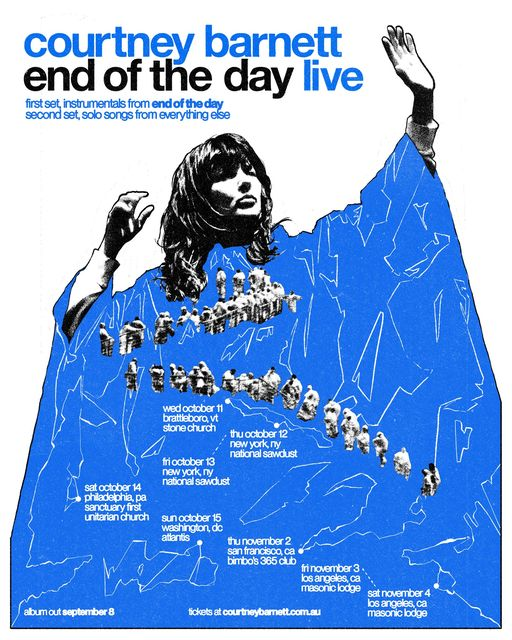
Barnett announced a series of “End Of The Day” concerts. The short tour will consist of intimate shows split in two sets. The first set will see Barnett and collaborator Stella Mozgawa perform instrumental songs and improvisations from the soundtrack, the second will see Barnett performing songs and singing from her back-catalogue.
In May of 2021, Courtney Barnett and collaborator/producer Stella Mozgawa had just handed in the final masters for Barnett’s third album “Things Take Time, Take Time” when they met up with filmmaker Danny Cohen in a Melbourne studio. Barnett had been experimenting with new gear, making meditative long-form pieces for an audience of one. Mozgawa had just bought an Oberheim OB6 which became the centre-piece of her setup, feeding sounds through a tape echo. And for his part, Cohen had a near-finished documentary, “Anonymous Club”, a candid portrayal of the travails and hard-fought personal triumphs of Barnett’s ascent to international indie rock adulation. Now, he just needed a score.
As Cohen played the final edit of his film that day, Barnett and Mozgawa improvised with one guiding principle—nothing too maudlin, obvious, or instructive, nothing to tell the future audience how they should be feeling about Barnett’s life onscreen. “Anonymous Club” offers up a plethora of Barnett’s music, documenting her charged live sets and her start-and-stop-and-search songwriting process. The pieces she and Mozgawa made that day, though, float around the edges of the finished scenes, coloring the proceedings much like the grain of Cohen’s 16mm film. Really, one could watch “Anonymous Club” and never know that Barnett had made extra music for it.
A year passed and Barnett found she liked listening to what they had made in Melbourne, putting it on and existing within its reflective gaze. Might this be more than the instrumental music of a film? She began sorting through the panoply of little instrumentals like amoebic puzzle pieces, figuring out how she might adjust them ever so slightly until they fit together into a complete picture.
 The Fat Angel Sings