

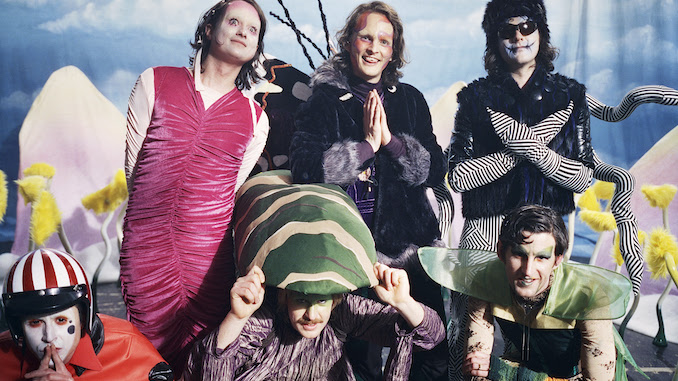
Australian psych-rockers King Gizzard & The Lizard Wizard have never shied away from the quirky and adventurous. Following the release of their 18th studio album “Butterfly 3000”, King Gizz took a literal approach to the album’s visuals, such as the trippy, Hayao Miyazaki-inspired video for “Interior People.” The band shares the visual for “Catching Smoke,” which forgoes animation in favour of the band’s literal transformation into happy, eyebrow-less butterflies.
The video begins in a dim performance space with singer and lead guitarist Stu Mackenzie embraced in a cocoon costume. After a moment of darkness, the band emerges in brilliantly cheesy butterfly costumes, accompanied by dancers. Mackenzie explains that “’Catching Smoke’ is about chasing the feeling that’s impossible to catch.
You’ll never get your hands on it, but you’re gonna try anyway … ”
In a statement, director Danny Cohen explains his approach:
Here’s a clip that might feel like the past, or the future, maybe both, the present? It’s set wherever you want it to be, whenever too, in a time that’s everyone’s. It’s a story of a fleeting fleet, straying the course to inhabit their inner instinctual insect, I think. Or maybe it’s precisely what it is, Sgt. Pepper’s Bug’s Life Matrix Band but more fun.
This is the most considered album we’ve ever made. With lots of elements in different time signatures, it’d be very easy for something like this to just sound like a mess, like free jazz. It takes a lot longer to finesse everything, until every part feels deliberate. As one would expect on a King Gizzard & The Lizard Wizard album, thorny knots of prog surface occasionally – the immersive hopscotch tangle of ‘Black Hot Soup’, for example – but the dominant mode is brilliantly focused and accessible. From the pulsing, utopian electro-pop of ‘Yours’ and the pitch-bent visions of ‘Dreams’, to the ecstatic, uplifting loops of ‘Catching Smoke’ and the assured fusion of synthetic and acoustic elements on ‘Interior People’ (one of the greatest Gizzard anthems yet), “Butterfly 3000” displays a confidence at odds with its experimental methods, and a succinctness that pays dividends.
 The Fat Angel Sings